

Understand LTCG tax rate India 2026 (12.5%). Check exemption ₹1.25 lakh, property & mutual fund rules, examples and tax saving tips.
Based on Budget 2024 & Income Tax Act, 1961
Quick Answer: The current LTCG tax rate in India (FY 2025–26) is 12.5% on equity, equity mutual funds, property, and gold. The first ₹1.25 lakh of equity LTCG per year is fully exempt from tax.
If you made a profit from selling stocks, mutual funds, or property — you might be paying more tax than you actually need to. That's not unusual. Every year, thousands of Indian investors either overpay because they don't know the rules, or miss legitimate exemptions that could save them lakhs.
LTCG tax rate is one of the most searched topics in personal finance right now — and for good reason. The Union Budget 2024 changed the rate, changed the exemption limit, and removed indexation on property. If you haven't caught up with these changes, this guide is for you.
We'll cover what LTCG is, the latest LTCG tax rate in 2026, how it applies to shares, mutual funds, and property, how to calculate it step by step, and legal ways to reduce your tax — all in plain language.
When you sell a capital asset — like shares, mutual funds, property, or gold — at a profit, that profit is called a Capital Gain. The Income Tax Department classifies this gain as either short-term or long-term depending on how long you held the asset before selling.
If you held the asset long enough (the exact period depends on the asset type), the gain is called a Long Term Capital Gain (LTCG). This matters because LTCG is taxed at a lower rate than short-term gains.
Rohan bought 100 shares of a company in January 2022 for ₹10,000. He sold them in February 2024 for ₹18,000. He held them for more than 12 months, so his ₹8,000 profit is a Long Term Capital Gain.
Had he sold after only 6 months, the same ₹8,000 would have been a Short Term Capital Gain — taxed at a higher rate of 20%.
Listed equity shares (NSE / BSE)
Equity mutual funds and equity-oriented hybrid funds
Residential and commercial property, land
Physical gold, Gold ETFs, Sovereign Gold Bonds
Unlisted shares, REITs, INVITs
Debt mutual funds and bonds (treated differently — explained below)
The LTCG tax rate changed in July 2024 when the government presented the Union Budget. Here's how the rate has evolved:
Period | LTCG Tax Rate | Exemption Limit |
|---|---|---|
Before FY 2018–19 | 0% | Fully tax-free |
FY 2018–19 to 2023–24 | 10% | ₹1 lakh/year |
FY 2024–25 onwards ✦ | 12.5% | ₹1.25 lakh/year |
According to the Income Tax Department, the revised LTCG tax rate of 12.5% applies to equity shares, equity mutual funds, property, and gold — effective from July 23, 2024. As a partial offset, the annual exemption limit for equity LTCG was also raised from ₹1 lakh to ₹1.25 lakh.
⚠️ Important Note — Budget 2024: The government removed the indexation benefit for most property sales from July 23, 2024 onwards. Properties purchased before that date have a one-time choice between the old 20% rate with indexation and the new 12.5% without — whichever gives lower tax. Consult a CA to evaluate which is better for your property.
Priya invested ₹2,00,000 in an equity mutual fund in April 2022. By May 2024, her investment grew to ₹3,50,000 — a gain of ₹1,50,000.
Total LTCG:             ₹1,50,000
Less: Annual exemption: ₹1,25,000
Taxable LTCG:           ₹25,000
LTCG tax @ 12.5%:       ₹3,125
Without knowing the ₹1.25 lakh exemption, Priya might have assumed she owed tax on the full ₹1.5 lakh — which would have been ₹18,750. This knowledge alone saved her ₹15,625.
Here's a complete reference table for all major asset types. Save or bookmark this for quick reference.
Asset Type | Holding Period for LTCG | LTCG Tax Rate | Key Note |
|---|---|---|---|
Listed Equity Shares | More than 12 months | 12.5% | ₹1.25 lakh/year exempt. No indexation. |
Equity Mutual Funds | More than 12 months | 12.5% | ₹1.25 lakh/year exempt. No indexation. |
Residential Property | More than 24 months | 12.5% | No indexation (post Jul 2024). Sec 54 exemption applies. |
Commercial Property / Land | More than 24 months | 12.5% | No indexation. Sec 54F exemption applies. |
Physical Gold | More than 24 months | 12.5% | No indexation from FY 2024–25. |
Sovereign Gold Bonds (SGB) | 12 months (8 yrs till maturity) | 0% at maturity | Fully exempt if held till maturity. 12.5% if sold early. |
Debt Mutual Funds (post Apr 2023) | Any period | Slab rate | No LTCG benefit. Taxed as regular income. |
Unlisted Shares | More than 24 months | 12.5% | No indexation. |
REITs / INVITs | More than 12 months | 12.5% | Treated similar to listed equity. |
Surcharge and 4% Health & Education Cess applicable on the base LTCG tax rate. For equity LTCG, surcharge is capped at 15%. Source: incometax.gov.in, Finance Bill 2024.
For most retail investors in India, this is the most relevant category. Whether you invest in direct stocks via a demat account or through SIP in a mutual fund, the rules are the same: hold for more than 12 months and your profit qualifies as LTCG.
The LTCG tax on shares is currently 12.5% above the ₹1.25 lakh annual exemption. Securities Transaction Tax (STT) must have been paid — which happens automatically when you trade on BSE or NSE. For SIP investments, note that each monthly installment has its own 12-month holding period clock.
For the LTCG tax on property, the holding period is 24 months (2 years). Sell before that, and the gain is short-term and taxed at your income slab rate.
Post Budget 2024, the LTCG tax rate on property is 12.5% without indexation for properties bought after July 23, 2024. The big silver lining: you can claim complete exemption under Section 54 if you reinvest the gains into another house within the specified time.
Physical gold held for more than 24 months now attracts the same 12.5% LTCG rate without indexation. The smartest way to invest in gold tax-efficiently remains Sovereign Gold Bonds — zero capital gains tax if held till the 8-year maturity. As per the Reserve Bank of India, SGBs are the most tax-efficient gold investment vehicle currently available to Indian retail investors.
LTCG = Sale Price − Cost of Acquisition − Improvement Costs − Transfer Expenses

Taxable LTCG = LTCG − ₹1.25 lakh exemption (for equity only)

Tax Payable = Taxable LTCG × 12.5%
Note your sale price — the actual amount received on selling the asset
Note your purchase price — what you originally paid to acquire the asset
Add any improvement costs — e.g., renovation costs for property
Add transfer expenses — brokerage, legal fees, stamp duty on sale
Subtract all the above from the sale price — this is your LTCG
Apply the exemption — deduct ₹1.25 lakh if it's an equity gain
Multiply by 12.5% — this is your tax liability
Amit bought 500 shares at ₹200 each (March 2022) and sold at ₹380 each (May 2024). Brokerage: ₹500.
Sale price:          ₹1,90,000
Purchase cost:       ₹1,00,000
Brokerage:           ₹500
LTCG:                ₹89,500
Less: Exemption:     ₹1,25,000
Taxable LTCG:        ₹0 (below exemption limit)
Tax Payable:         ₹0 ✓
Amit pays zero LTCG tax because his total gain is under the ₹1.25 lakh exemption limit.
Kavitha bought a flat in Pune for ₹40 lakh in 2016 and sold it in 2025 for ₹90 lakh. Legal and brokerage fees on sale: ₹1 lakh.
Sale price:          ₹90,00,000
Purchase cost:       ₹40,00,000
Transfer expenses:   ₹1,00,000
LTCG:                ₹49,00,000
Tax @ 12.5%:         ₹6,12,500
However, if Kavitha reinvests ₹49 lakh in a new house under Section 54, her tax liability becomes ₹0. See the exemptions section below.
➡️ To quickly calculate your exact tax, use our long term tax calculator — free, instant, updated for FY 2025–26.
The Income Tax Act, 1961 provides several legal routes to reduce or eliminate your LTCG tax. These are not loopholes — they're government-designed incentives for long-term investment and housing.
Your first ₹1.25 lakh of long-term equity gains in a financial year is completely tax-free. This resets every April 1. Savvy investors plan their redemptions to spread gains across two financial years and effectively use this exemption twice.
If you sell a residential house property and make an LTCG, you can claim full exemption by reinvesting the gains in another residential property — 1 year before or 2 years after the sale (3 years if constructing). Key conditions:
The new property must be located in India
You cannot sell the new property within 3 years of buying it
Exemption capped at ₹10 crore from FY 2023–24 onwards
If you reinvest less than the full gain, partial exemption applies
Section 54F is broader — it applies when you sell any long-term capital asset other than a house (gold, unlisted shares, commercial property) and invest the entire net sale proceeds (not just gains) into a residential property.
You must not own more than one house at the time of sale (besides the new one)
Timeline: 1 year before or 2 years after sale
Proportional exemption if only part of sale proceeds are reinvested
Haven't found a property yet but want to preserve your Section 54/54F benefit? Deposit your gains in a Capital Gains Account at a designated bank before your ITR filing deadline. You can invest from this account when you find a suitable property.
Long-term capital losses can be set off against LTCG from other assets. Any unused loss can be carried forward for 8 years. Strategically booking losses in a falling market — while maintaining your investment exposure through a different fund — is a legitimate tax-reduction strategy.
💡 Smart Tip: Review your portfolio every March. If any investment is sitting at a loss, consider booking that loss before March 31. You can reinvest in a similar (not identical) fund to maintain market exposure while creating a tax-saving loss on paper.
Selling even one day before completing 12 months (equity) or 24 months (property) converts your LTCG to STCG, raising your tax rate from 12.5% to 20%. Always double-check your purchase date.
The exemption is not automatic — you must declare it in your ITR. Many first-time investors pay tax on 100% of their equity LTCG, missing out on the tax-free threshold entirely.
Many property sellers still assume they can apply indexation. Post-July 23, 2024, indexation is removed for most new property sales. Assuming the old 20% + indexation rule still applies can lead to seriously wrong tax estimates.
The deadline to reinvest in a new property for Section 54 exemption is time-bound. Missing it by even a day means losing the full exemption — which could be lakhs of rupees.
Capital gains must be reported in ITR-2 or ITR-3. Filing ITR-1 when you have capital gains can result in a defective return notice from the Income Tax Department.
In SIP investments, each monthly installment has its own 12-month clock. When you redeem a lump sum, some units may be long-term and others short-term — splitting the gain incorrectly leads to over or underpaying tax.
The LTCG tax rate in India for FY 2025–26 is 12.5% on equity shares, equity mutual funds, property, gold, and most other capital assets. This rate was updated after the Union Budget 2024 (effective July 23, 2024). A 4% Health & Education Cess is levied on top. For equity, the first ₹1.25 lakh of LTCG per financial year is tax-free. Source: incometax.gov.in and Finance Bill 2024.
The LTCG tax rate was 10% from FY 2018–19 to FY 2023–24. After the Union Budget 2024, it was increased to 12.5%, effective from July 23, 2024. So from FY 2024–25 onwards — including all transactions in 2025 and 2026 — the applicable rate is 12.5%. The exemption limit was simultaneously raised from ₹1 lakh to ₹1.25 lakh as partial relief.
For equity shares and equity mutual funds, up to ₹1.25 lakh of Long Term Capital Gains per financial year is completely tax-free. This exemption resets on April 1 each year. For property, gold, and other non-equity assets, there is no flat annual exemption — but reinvestment-based exemptions (Section 54, 54F) are available.
Legal ways to reduce LTCG tax include:
Keep equity gains within ₹1.25 lakh per year for zero tax
Use tax loss harvesting — sell losing investments to offset gains
Reinvest property gains under Section 54 or 54F to claim full exemption
Hold Sovereign Gold Bonds till 8-year maturity — capital gains are fully tax-free
Carry forward LTCG losses for up to 8 years to offset future gains
For immovable property (residential house, commercial property, or land), the holding period to qualify for Long Term Capital Gains is more than 24 months (2 years) from the date of acquisition. Selling within 24 months results in a Short Term Capital Gain, taxed at your income tax slab rate.
Budget 2024 removed indexation for most property sales. For properties purchased before July 23, 2024, sellers can choose between 20% with indexation (old regime) or 12.5% without indexation (new regime) — whichever gives lower tax. Properties bought after July 23, 2024 are taxed at 12.5% without indexation only.
Yes. For SIP investments in equity mutual funds, each monthly installment is treated as a separate purchase with its own 12-month holding period. When you redeem, units held for more than 12 months are taxed as LTCG at 12.5% (above ₹1.25 lakh exemption), while units held for less than 12 months are taxed as STCG at 20%.
Understanding the LTCG tax rate is not just about compliance — it's about making smarter financial decisions. The difference between a well-informed investor and an uninformed one can easily be lakhs of rupees over an investing lifetime.
Here's a quick summary of everything covered in this guide:
✅ The LTCG tax rate in 2026 is 12.5% — changed from 10% after Budget 2024
✅ The annual equity exemption is ₹1.25 lakh per financial year
✅ Equity and equity mutual funds qualify as long-term after 12 months
✅ Property and gold qualify as long-term after 24 months
✅ Indexation removed for most property sales post-July 23, 2024
✅ Section 54 and 54F offer full exemption on property gains via reinvestment
✅ Tax loss harvesting and LTCG loss carryforward (8 years) are powerful legal strategies
✅ Always file ITR-2 or ITR-3 when you have capital gains — not ITR-1
The rules are set by the Income Tax Department and updated each year through the Union Budget. Always verify the latest applicable rules at incometax.gov.in or consult a qualified CA for advice specific to your situation.
➡️ Ready to calculate your exact LTCG tax? Use our free long term tax calculator — no signup, instant results, updated for FY 2025–26.
Disclaimer: This article is for educational and informational purposes only. It does not constitute professional tax, legal, or financial advice. Tax rules are subject to change. Please consult a qualified Chartered Accountant before making any financial decisions. All information is based on Budget 2024 updates and the Income Tax Act, 1961 as of April 2026.
Sources: Income Tax Department of India · Union Budget 2024–25 Finance Bill · CBDT Circular on Capital Gains · SEBI · Reserve Bank of India

How to save LTCG tax legally in India: 8 strategies covering Section 54, 54EC, 54F, CGAS, HUF and loss set-off with real ₹ math.
Jun 30, 2026
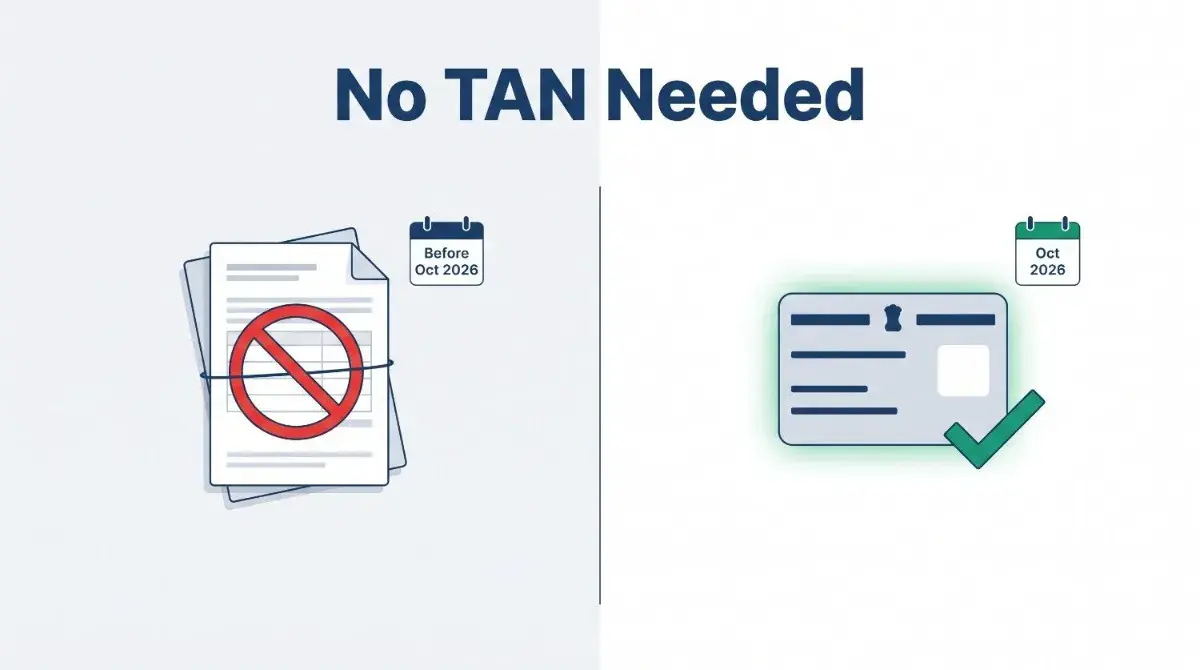
No TAN for NRI property purchase applies only from 1 October 2026, and only to resident individual and HUF buyers. Get the rates, forms, and dates you need.
Jul 25, 2026

Did you lose the SGB premature redemption tax exemption? Here's exactly who's affected, how much tax applies now, and how to check your own bonds.
Jul 24, 2026