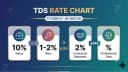
Free Section 194T TDS calculator India. Check TDS on partner salary, bonus, commission & interest. Covers ₹20,000 threshold & 10% rate. Instant result.
Section 194T is a Tax Deduction at Source (TDS) provision introduced by the Finance Act, 2024, requiring partnership firms and LLPs to deduct 10% TDS on specified payments to partners—including salary, remuneration, commission, bonus, and interest—when the aggregate exceeds ₹20,000 in a financial year. Effective from 1 April 2025, it marks the first time partner remuneration entered India's TDS framework.
If you run a partnership firm or an LLP, here's the change that will quietly affect your month-end routine: Section 194T now requires TDS on certain payments to partners. Not profits—payments like remuneration, salary, commission, bonus, and interest.
The headline rule is straightforward:
You must deduct TDS at 10% on covered payments to a partner once the total for that partner crosses ₹20,000 in the financial year.
The challenge isn't understanding the rule—it's implementing it correctly without disrupting partner cash flow, reconciling with Section 40(b) allowability, and meeting tight quarterly filing deadlines.
For years, partner remuneration and partner interest existed in a peculiar "TDS-free zone." Partners would report income in their own tax returns and pay tax through advance instalments or self-assessment. The government has now shifted this income into the mandatory withholding tax framework—meaning your firm becomes responsible for collecting and depositing tax upfront, not the partner later.
Think of it this way: Section 194T doesn't create a new tax. It redirects when tax is collected and who bears the compliance burden.
From hands-on experience with firms transitioning to this rule, this single change forces tightening in three critical areas:
The legal foundation comes from Finance Act, 2024, Clause 62, formally implemented via CBDT Notification No. 22/2025 (dated 27 March 2025), which updated Forms 26Q and 27Q to accommodate Section 194T reporting.
Section 194T applies universally to:
Here's the critical point: Many small firm owners assume, "Our turnover is below ₹1 crore, so TDS won't apply." That logic doesn't hold. Section 194T has zero turnover or audit thresholds. Even a modest three-partner consulting firm paying ₹30,000 annually to each partner must comply.
For authoritative guidance on firm classification, consult the Income Tax Department's Official Website.
Section 194T specifically targets payments to a partner that amount to:
The law uses the phrase "in the nature of," which means substance trumps labeling. If a payment functions like remuneration or interest, calling it a "special allowance" or "discretionary payout" won't work in an audit.
These remain outside Section 194T:
Practical Distinction: If a payment is recurring, contractual, or contingent on the partnership's operations, it's likely covered. If it's a one-time return of what the partner invested, it typically isn't.
Verify your planned remuneration against allowable limits using the Section 40(b) Partner Remuneration Calculator—this prevents later Section 40(b) disallowances that complicate TDS reconciliation.
| Partner's PAN Status | TDS Rate | Notes |
|---|---|---|
| Valid PAN provided | 10% | Standard rate |
| PAN not provided | 20% | Section 206AA penalty rate |
| Non-resident partner | 10% + surcharge + cess | Treaty implications may apply |
Before deducting, verify partner PANs early using the PAN Card Validator to avoid defaulting to the punitive 20% rate.
This threshold is not per individual payment and not per head.
Key Rule: Once a partner's combined covered payments (salary + commission + bonus + interest) exceed ₹20,000 in the financial year, TDS applies on the entire amount, not just the excess.
Example Timeline:
If your accounting team mistakenly deducts TDS only on the "₹3,000 excess over ₹20,000," the return will flag as incorrect in a TDS audit.
Use the Section 194T TDS Threshold Calculator to track cumulative payments in real-time and avoid this common trap.
Section 194T follows the "earlier of" rule:
TDS Must Be Deducted at the Earlier of:
This dual trigger means a journal entry alone is sufficient to trigger TDS—no cash needs to change hands.
Real-World Implication: Many firms finalize partner remuneration calculations in May or June, then post backdated journal entries "as of 31 March." The critical date for TDS timing isn't the backdate—it's when the entry is actually posted/credited in the ledger. If you post the March entry in June, your TDS obligation (and interest exposure) extends to June.
This is why firms that plan payouts early and post entries promptly avoid late-deduction interest under Section 201(1A).
Most firms overthink this. Here's the practical workflow:
Track throughout the year:
Deposit the TDS by the 7th of the following month (or 30th April for March deductions).
Scenario: An LLP credits the following to one working partner during FY 2025–26:
| Payment Component | Amount |
|---|---|
| Monthly Salary (₹10,000 × 12) | ₹1,20,000 |
| Commission | ₹30,000 |
| Interest on Capital (quarterly) | ₹25,000 |
| Year-end Bonus | ₹10,000 |
| Total Covered | ₹1,85,000 |
Threshold Check: ₹1,85,000 > ₹20,000 ✅ TDS applies
TDS Calculation:
The ₹18,500 TDS reflects in the partner's Form 26AS/AIS on the tax portal, and the partner claims it as a credit when filing their ITR.
To model your expected tax liability and compare it against TDS deducted, use the Old vs New Tax Regime Calculator.
This question surfaces constantly in partner forums, and the answer reveals a long-standing gap in the law:
Section 192 (TDS on Salaries)
Section 194A (TDS on Interest)
Section 194T (New Bridge)
Deposit using Challan ITNS 281.
| Quarter | Period | Form 26Q Due |
|---|---|---|
| Q1 | April – June 2025 | 31 July 2025 |
| Q2 | July – September 2025 | 31 October 2025 |
| Q3 | October – December 2025 | 31 January 2026 |
| Q4 | January – March 2026 | 31 May 2026 |
(Non-resident partner payments use Form 27Q with the same due dates.)
Issue Form 16A to each partner within 15 days of the quarterly Form 26Q due date.
Practical Note: If a partner later says "my TDS isn't in my Form 26AS," it's usually because the return was filed late or contains errors. A timely, accurate 26Q filing ensures TDS appears immediately on the tax portal.
TDS defaults create a cascade of financial and legal consequences:
| Violation | Penalty / Interest | Legal Basis |
|---|---|---|
| Failure to deduct TDS | Interest @ 1% per month (until deducted) | Section 201(1A) |
| Failure to deposit after deduction | Interest @ 1.5% per month (until deposited) | Section 201(1A) |
| Late TDS return filing | ₹200 per day until filed (capped) | Section 234E |
| Non-deduction of TDS | Penalty up to 100% of TDS amount | Section 271C |
| Wilful non-deposit | Prosecution: up to 7 years imprisonment | Section 276B |
| Expense disallowance | 30% of uncovered payment disallowed as firm's business expense | Section 40(a)(ia) |
The Most Painful: The Section 40(a)(ia) disallowance hits firms hardest. If you pay ₹5 lakhs in partner remuneration without deducting TDS, the Income Tax Department adds back ₹1.5 lakhs to your taxable income—multiplying your tax liability beyond just interest and penalties.
Wrong Approach: Firm pays ₹25,000 total and deducts TDS on only ₹5,000 (the difference).
Why It Fails: The law requires TDS on the full ₹25,000 once the threshold is crossed, not just the surplus.
Correct Approach:
Wrong Approach: "We credited ₹50,000 to the partner's capital account but didn't deduct TDS since no cash moved."
Why It Fails: Section 194T triggers on credit—a journal entry is sufficient. No cash movement needed.
Correct Approach: Deduct TDS at the moment the credit entry is posted, even if cash follows later or not at all.
Wrong Assumption: "Our turnover is ₹80 lakhs and we're not under Section 44AB audit, so Section 194T doesn't apply."
Why It Fails: Section 194T has zero turnover or audit thresholds. All firms must comply.
Correct Approach: Check partner payment totals, not firm turnover.
Wrong Approach: Track salary separately (₹15,000/month) and think it's below threshold. Forget to add commission (₹5,000/month), bonus (₹2,000), and interest (₹3,000).
Why It Fails: The law aggregates all covered heads. Total = ₹25,000, crossing the threshold.
Correct Approach: Use the Section 194T TDS Threshold Calculator to track all heads together automatically.
Wrong Approach: Books close in July; partners' March remuneration entry posted then.
Why It Fails: March TDS must be deposited by 30th April. Late posting triggers interest liability from the May 7 deadline onward.
Correct Approach: Finalize partner payouts before 30 April to ensure deposits are timely.
Wrong Approach: Deed reads: "Partners shall receive remuneration as mutually agreed."
Why It Fails: No specificity invites disputes with tax authorities on allowability under Section 40(b) and raises questions about TDS quantum.
Correct Approach: Update the deed with precise remuneration terms, limits, and conditions. Verify against Section 40(b) Partner Remuneration Calculator to ensure planned payouts stay within allowable limits.
A partner accustomed to receiving ₹2 lakhs annually now receives ₹1.8 lakhs (after 10% TDS of ₹20,000). This requires:
If a partner's overall tax liability is below 10% (e.g., total income falls in the nil or 5% slab), the TDS deducted exceeds their final liability. They must:
Use the Old vs New Tax Regime Calculator to model expected tax liability vs. TDS deducted, and plan accordingly.
Here's a scenario that creates headaches:
Resolution: File a revised Form 26Q for Q4 to correct the over-deduction. The excess TDS can be:
This is why calculating allowable remuneration before finalizing payments is critical. Use the Section 40(b) Partner Remuneration Calculator upfront to avoid post-closing corrections.
Q: What is the exact threshold for Section 194T TDS?
A: ₹20,000 per partner per financial year, aggregated across all covered payment types (salary, commission, bonus, interest). Once crossed, TDS applies on the entire amount, not just the excess. Use the Section 194T TDS Threshold Calculator to track in real-time.
Q: What is the TDS rate under Section 194T?
A: 10% for partners with a valid PAN. 20% if PAN is not available (Section 206AA). For non-residents, add applicable surcharge and cess. Verify PAN status early using the PAN Card Validator.
Q: From which date is Section 194T effective?
A: 1 April 2025, applicable from FY 2025–26 (AY 2026–27) onwards. No TDS obligation for payments made before 31 March 2025.
Q: Does Section 194T apply to LLPs?
A: Yes. The definition of "firm" includes both traditional partnership firms and LLPs.
Q: Is profit share exempt from Section 194T?
A: Yes. Pure profit distributions remain exempt under Section 10(2A). Section 194T applies only to remuneration, commission, bonus, and interest—not profit share.
Q: Does a book-entry credit (without cash) trigger TDS?
A: Yes. TDS is triggered at the earlier of credit or payment. A journal entry crediting the partner's account is sufficient.
Q: Who is responsible for TDS deduction and deposit?
A: The partnership firm or LLP making the payment is the deductor and is fully liable for timely deduction and deposit.
Q: Can a partner claim a refund if TDS exceeds final tax liability?
A: Yes. File the ITR and claim TDS credit. The refund is issued if TDS exceeds final liability. Check Form 26AS/AIS to confirm TDS appears correctly.
Q: Do firms not liable for audit need to comply?
A: Yes. Section 194T has no audit threshold. Compliance is mandatory for all firms if partner payments exceed ₹20,000.
Q: What forms are required for Section 194T compliance?
A: Form 26Q (resident partners), Form 27Q (non-residents), Form 16A (TDS certificate), and Challan ITNS 281 (deposit).
Built on official standards and verified by certified professionals
Last Updated: 9 April 2026
Toolisky Team
Specialized in financial tools, calculation precision, and policy compliance.
Content Accuracy & Standards Reviewer
Calculations verified against official guidelines and industry regulations.
This Section 194T TDS Calculator India — Partner Payments is built on official guidelines and verifiable sources:
Primary source used for validating logic and accuracy standards.
This tool is for informational and educational purposes only.All calculations on this platform are for informational and educational purposes only. While we strive for 100% accuracy based on official regulations, users should consult with certified professionals for legal or financial decisions.
Key Limitations:
Always consult a qualified professional before making critical decisions based on these results.
All calculations are performed locally in your browser. No data is sent to servers or stored. Your information remains completely private.
Specialists dedicated to making tools and calculators accessible for everyone
Founder & Developer
Tax Planner & Calculation Advisor
Legal Advisor & Senior Content Writer
Content Writer
Toolisky is an independent platform created to help users with complex calculations and insights. For official filing or legal decisions, users should always consult a certified professional in the relevant field.