Checkpost Tax: Rates, Payment & Rules 2026
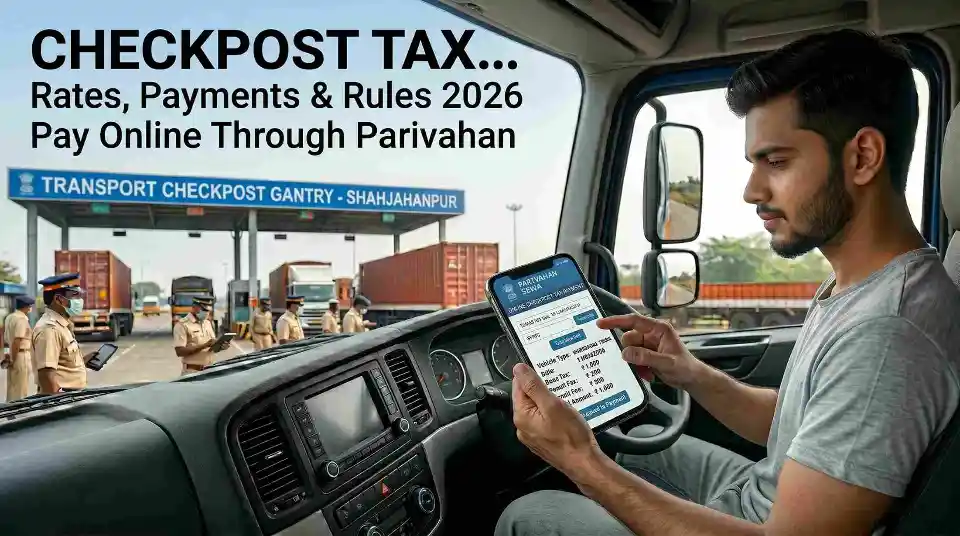
Learn how to pay checkpost tax online through Parivahan. Check rates, calculation methods, permit rules, receipts, FAQs, and official payment steps.
Checkpost tax means the road tax a state government collects from an out-of-state vehicle before it can legally ply within that state, paid online through the Parivahan checkpost portal at vahan.parivahan.gov.in/checkpost. The exact amount depends on your vehicle's weight or seating capacity, the destination state, and your permit type.
What Is Checkpost Tax?
Checkpost tax is the road tax a state charges on any vehicle from another state before it's allowed to operate inside that state's borders. It used to mean queuing at a physical barrier on the highway. Now it mostly means logging into a portal from your phone.
Suresh runs a small parcel delivery business out of Indore. His truck got stopped near the Rajasthan border last month, and the officer told him he owed checkpost tax before the vehicle could continue. He'd never heard the term before that day (most transporters learn it the hard way).
The official system is the Parivahan checkpost tax portal, run by the Ministry of Road Transport and Highways. You'll also see it called vahan checkpost tax or parivahan sewa checkpost tax. Same system, different phrasing.
The Official Rule and Rate Table
As per Section 88(9) of the Motor Vehicles Act, 1988, a vehicle entering another state under a tourist permit owes special road tax there, on top of any road tax due under its own Motor Vehicles Taxation Act. Goods carriers, temporary permits, and stage carriages follow the same logic, with each state's act setting the slab by Gross Vehicle Weight (GVW) or Registered Laden Weight (RLW).
Here is Rajasthan's slab structure for goods vehicles on a 30-day permit, notified under F6(252)Pari/Tax/HQ/05/4G dated 9 March 2007 (transport.rajasthan.gov.in). [VERIFY: confirm current slabs and notification numbers for your destination state at that state's transport site or vahan.parivahan.gov.in/checkpost before paying, since states revise figures independently.]
Vehicle Weight (GVW/RLW) | Road Tax Rate | Special Road Tax Rate |
|---|---|---|
Up to 7,000 kg | ₹110 per 1,000 kg, or part thereof, for 30 days | ₹90 per 1,000 kg of load capacity up to 5,000 kg |
Above 7,000 kg | ₹50 per extra 1,000 kg, or part thereof | ₹70 per extra 1,000 kg above 5,000 kg |
Tourist permit car, up to 6 seats | ₹10 per seat for 7 days | ₹100 per day |
Temporarily registered car or Omni Bus, ≤10 seats | Flat ₹200 per vehicle | Not applicable |
Notice the phrase "or part thereof." That clause is where most people lose money: round up, never down.
How to Calculate and Pay Checkpost Tax Yourself
Identify your vehicle category and destination state. Goods carriers, contract carriages, stage carriages, and temporarily registered vehicles each sit on a different row of the rate table.
Pull your GVW or seating capacity from your RC book. The portal calculates tax on this figure, not your vehicle's market value or fuel type.
Go directly to vahan.parivahan.gov.in/checkpost. Skip any third-party app or look-alike domain; only the official site talks straight to the VAHAN database.
Select your destination state and enter your vehicle number. Your registration details should auto-fill from VAHAN within seconds.
Check the auto-calculated road tax and special road tax against the table for that state. A mismatch almost always means a wrong weight entry, not a system error.
Pay via net banking, UPI, or card, then download the receipt right away. Some enforcement teams at the border still ask for a printed copy.
Skip the manual math: run your registration number through our Vehicle Number Format Checker before you open the payment page, to confirm it matches the format VAHAN expects. One wrong character resets the whole transaction.
Worked Examples
Example 1: Suresh's truck, the common case. Suresh's truck has a GVW of 6,000 kg and a load carrying capacity of 4,000 kg. He's entering Rajasthan on a 30-day temporary permit, so both figures fall inside the "up to 7,000 kg" band.
Road tax: 6,000 kg ÷ 1,000 × ₹110 = ₹660 Special road tax: 4,000 kg ÷ 1,000 × ₹90 = ₹360 Total checkpost tax: ₹660 + ₹360 = ₹1,020 for the full 30-day permit window.
Example 2: Farida's truck, the edge case. Farida runs a slightly bigger transport operation out of Surat. Her truck's GVW is 8,500 kg, with a load capacity of 6,000 kg. Both numbers cross Rajasthan's 7,000 kg and 5,000 kg thresholds, so the second slab kicks in.
Road tax: (₹110 × 7) + (₹50 × 2, since the excess 1,500 kg rounds up to a full 2,000 kg) = ₹770 + ₹100 = ₹870 Special road tax: (₹90 × 5) + (₹70 × 1, for the excess 1,000 kg) = ₹450 + ₹70 = ₹520 Total checkpost tax: ₹870 + ₹520 = ₹1,390 for the same 30-day window.
That "part thereof" rule is the part everyone forgets. Farida's excess weight was only 1,500 kg, but the portal still billed her for a full extra 2,000 kg slab. The same rounding logic applies on the special road tax side too, so it pays to calculate both halves separately before you trust the on-screen total.
Who Does This Apply To?
It applies if:
Your vehicle is registered in one state but operating commercially in another, on a temporary or reciprocal permit
You're driving a goods carrier, tourist bus, taxi, or contract carriage across a state border for work
Your vehicle, or even just its chassis, is passing through a state temporarily, even without unloading there
It doesn't apply if:
Your vehicle holds a valid National Permit under Section 88 of the Motor Vehicles Act and the destination state has a reciprocal exemption in place
You're driving your own private car through another state purely for personal travel, with no commercial permit attached
Misconception: Most people assume the mParivahan mobile app lets them pay checkpost tax directly, since it already handles RC, driving licence, and challan services. ✓ Reality: Checkpost is a separate web-based service listed under Parivahan Sewa's "Other Services" menu. You need vahan.parivahan.gov.in/checkpost, not the app.
Checkpost Tax vs Road Tax vs Entry Tax: What's the Difference?
Term | What It Actually Means | Who Pays It | Still Exists Today? |
|---|---|---|---|
Checkpost tax | Road tax collected through the checkpost tax online payment system when an out-of-state vehicle operates in a new state | Out-of-state commercial vehicle owners | Yes |
State road tax | Tax for using a vehicle within its own home state | All registered vehicle owners | Yes |
Special Road Tax (SRT) | Extra levy on commercial or contract carriage vehicles for plying rights elsewhere | Bus, taxi, and goods transport operators | Yes |
Entry tax | Old state-level tax on goods entering for sale or use | Traders and transporters of goods | No, mostly folded into GST since July 2017 |
What this table means for most transport operators: if your vehicle is registered outside the state you're entering, checkpost tax is almost always the one you owe, not entry tax, which barely exists anymore post-GST. Mixing up the two is the single biggest reason people show up at the wrong payment window entirely.
Common Mistakes and What to Do Right Now
Paying through a look-alike app instead of vahan.parivahan.gov.in/checkpost. You risk getting no valid receipt, and the money may never reach the state treasury.
Entering the wrong GVW or load capacity. Farida's example above shows how a gap of just 1,500 kg can still cost a full extra 2,000 kg slab.
Assuming your 30-day permit receipt still covers you after it lapses mid-route. It doesn't. A fresh payment cycle starts the moment day 31 begins.
Paying via UPI? Double-check your VPA with our UPI ID Format Checker first; a typo is the top reason payments show "failed" after money leaves your account.
What to do right now: pull your RC book, note your GVW and load capacity, then go to vahan.parivahan.gov.in/checkpost and check today's figure before you drive.
Related Tools and Resources
Vehicle Number Format Checker : confirms your registration number matches the standard VAHAN format before you submit it anywhere online.
UPI ID Format Checker : catches a malformed UPI ID before a checkpost or any other government payment fails.
PAN Card Validator : useful when your transport business's PAN needs to match other registration documents.
Browse our full library of free calculators : income tax, salary, and MSME tools beyond vehicle compliance.
Frequently Asked Questions
What is checkpost tax in India? Checkpost tax is the road tax a state charges an out-of-state vehicle before it can legally operate within its borders. It's collected online through the Parivahan checkpost portal, and the figure depends on your vehicle's weight or seating capacity, your permit type, and the state you're entering.
How do I pay checkpost tax online? Visit vahan.parivahan.gov.in/checkpost, select your destination state, and enter your vehicle number. The system pulls your registration details from VAHAN, calculates the road tax and special road tax due, then redirects you to a payment gateway. Download the receipt once payment clears.
Can I pay checkpost tax through the mParivahan app? Not directly. The mParivahan app mainly handles RC, driving licence, and challan services. Checkpost tax payment lives on a separate web portal under Parivahan Sewa's "Other Services" menu, at vahan.parivahan.gov.in/checkpost. Third-party apps claiming otherwise usually just link back to that same site.
What if my truck's temporary permit expires while it's still inside the state? Your 30-day checkpost tax payment stops covering you the moment that window closes. You'll need a fresh payment cycle for the next period, even mid-delivery. Plan your renewal a few days before expiry to avoid a roadside dispute.
Why do some search results show "checkpost tax 183" or "checkpost tax 185"? Those numbers usually come from page IDs on unofficial sites, not from any government notification or tax code. The official Parivahan system has no numbered codes for vehicle owners. Stick to vahan.parivahan.gov.in/checkpost, and treat any "search by number" site with caution.
Is checkpost tax the same as entry tax or GST? No. Entry tax was a state levy on goods entering for sale, mostly folded into GST since July 2017. Checkpost tax is a road tax on the vehicle itself, charged by the destination state under its own Motor Vehicles Taxation Act. Different law, different purpose.
Official Sources and References
Motor Vehicles Act, 1988, Section 88(9), tourist permit special road tax provision : morth.nic.in
Notification F6(252)Pari/Tax/HQ/05/4G, dated 9 March 2007, road and special road tax slabs for other-state vehicles : transport.rajasthan.gov.in
Online Checkpost Tax Payment of Vehicles, national e-service listing : parivahan.gov.in
Reviewed by Toolisky Editorial Team | Last Updated: July 2026
Disclaimer: This article is for general educational purposes only and does not constitute tax, legal, or financial advice. Rates and notification numbers vary by state and change periodically. Verify current figures at your destination state's transport portal or vahan.parivahan.gov.in/checkpost before paying.