
Calculate professional tax on salary using real state-wise 2026 slabs, two worked ₹ examples, Section 16(iii) new-regime rules, penalties, and due dates.
To calculate professional tax on salary, match your gross monthly pay to your state's slab and apply the fixed rupee amount that slab sets. It's not a percentage of your pay. Most states cap it at ₹2,500 a year, and nine states don't charge it at all.
Professional tax (PT) is a state-level tax on income you earn from a job, trade, or profession. It comes from Article 276 of the Constitution, which gives states this power. It has nothing to do with income tax, which is a central government tax. PT goes straight to your state government instead.
If you're salaried, the deduction shows up under Section 16(iii) of the Income Tax Act, 1961. Once the newer Act takes over, this becomes Section 19 of the Income-tax Act, 2025. Whatever PT you pay in a year gets deducted from your gross salary before your income tax is worked out. But here's the catch most people miss: this only works if you file under the old regime, which we'll get into further down.
This article covers PT rules for FY 2025-26 (filed under the 1961 Act) and the position from Tax Year 2026-27 onward (under the 2025 Act). Wherever the two differ, we've said so clearly.
Applies to | Does NOT apply to |
|---|---|
Salaried employees in PT-levying states | Employees in Delhi, UP, Haryana, Rajasthan, Punjab, Uttarakhand, Himachal Pradesh, Arunachal Pradesh, Jammu & Kashmir |
Self-employed professionals (CAs, doctors, lawyers, consultants) | Agricultural income earners in most states |
Freelancers earning above the state threshold | Senior citizens above 65, in most states |
Business owners, traders, partners of firms | Persons with 40%+ permanent disability |
HUFs running a business | Parents or guardians of children with permanent disability, in some states |
A quick note: exemptions vary from state to state. Maharashtra exempts women earning up to ₹25,000 a month. Tamil Nadu and Madhya Pradesh go further and exempt women in certain slabs entirely. Don't assume your friend's state rule applies to you too. Check your own state's notification first.
This is where most articles just describe the formula and stop. We're giving you the actual rupee figures for the states where most salaried readers work.
Maharashtra (State Tax on Professions, Trades, Callings and Employments Act, 1975)
Up to ₹7,500/month: Nil
₹7,501–₹10,000/month: ₹175/month
Above ₹10,000/month: ₹200/month, and ₹300 in February. That adds up to ₹2,500/year
Women earning up to ₹25,000/month: exempt
Karnataka (Karnataka Tax on Professions, Trades, Callings and Employments Act, 1976, amended in 2025)
Up to ₹25,000/month: Nil (raised from ₹15,000, effective 1 April 2025)
Above ₹25,000/month: ₹200/month, ₹300 in February. Total ₹2,500/year
Tamil Nadu, charged half-yearly rather than monthly
Income up to ₹21,000 in a half-year: Nil
Income above ₹21,000 rises through several bands up to a half-yearly maximum of ₹1,250
Deducted from the August salary (for April–September) and the January salary (for October–March)
[VERIFY: exact intermediate slab figures. Different official-looking sources currently quote different numbers for the mid-range bands, likely due to local body variations across Greater Chennai Corporation versus other municipalities. Confirm with your specific municipal corporation before running payroll on this state.]
West Bengal (West Bengal State Tax on Professions, Trades, Callings and Employments Act, 1979) uses one of the most detailed slab structures in the country, starting from fairly low income levels and rising to the ₹2,500 annual cap. [VERIFY: exact ₹ breakpoints against the official portal before publishing, since this draft could not independently confirm the full table in this session.]
Andhra Pradesh / Telangana
Up to ₹15,000/month: Nil
₹15,001–₹20,000/month: ₹150/month
Above ₹20,000/month: ₹200/month
Madhya Pradesh: ₹208/month for 11 months, and ₹212 in the 12th month, depending on the income band.
States that don't levy PT at all: Delhi, Uttar Pradesh, Rajasthan, Haryana, Punjab, Uttarakhand, Himachal Pradesh, Arunachal Pradesh, and Jammu & Kashmir.
Suresh works in Pune, Maharashtra, and earns a gross monthly salary of ₹28,000.
Step 1: Check the state. Maharashtra levies PT.
Step 2: Match the slab. His salary falls above ₹10,000/month.
Step 3: Apply the rate. That's ₹200/month for 11 months, and ₹300 in February.
Monthly PT for 11 months: ₹200 × 11 = ₹2,200
February PT: ₹300
Annual PT paid: ₹2,200 + ₹300 = ₹2,500
That full ₹2,500 gets deducted from Suresh's gross salary under Section 16(iii), but only if he files under the old regime.
Priya changed jobs mid-year. From April to September, she worked in Bengaluru, Karnataka, earning ₹22,000 a month, which sits below Karnataka's ₹25,000 exemption threshold, so she paid ₹0 PT there. From October, she moved to a Mumbai, Maharashtra office on ₹32,000 a month.
April–September (Karnataka, below threshold): ₹0 × 6 = ₹0
October–January (Maharashtra, above ₹10,000): ₹200 × 4 = ₹800
February (Maharashtra): ₹300
March (Maharashtra): ₹200
Total PT for the year: ₹0 + ₹800 + ₹300 + ₹200 = ₹1,300
Priya's Form 16 should show ₹1,300, not the full ₹2,500. That's because PT is worked out state by state, for the actual months she spent there, not assumed for the whole year in one place. This is exactly the kind of mid-year job-switch situation most guides never bother to work through.
Short answer: no. This one gets argued about a lot online, so let's settle it properly.
Section 115BAC, the section behind the new tax regime, blocks most deductions under Section 16, keeping only the standard deduction under Section 16(ia). That knocks out both Section 16(ii), the entertainment allowance, and Section 16(iii), the professional tax deduction. Several independent breakdowns of the exact statutory clause confirm this exclusion by name, so it isn't a grey area once you check the actual list rather than a summary article.
In practice: under the old regime, your full PT paid during the year reduces your taxable salary rupee for rupee, with no separate cap on the deduction (the ₹2,500 cap only limits what the state can charge you). Under the new regime, the default since FY 2023-24, you lose this deduction completely. Your employer still deducts PT either way. It simply stops lowering your tax bill.
For someone in the 30% tax slab, that ₹2,500 deduction is worth roughly ₹750 in tax saved under the old regime. It's a small number, but it's worth knowing before you assume lower new-regime rates always win. Run your real numbers through the Old vs New Tax Regime Calculator instead of guessing.
Your Form 16 shows the wrong PT amount. Cross-check your monthly salary slips against your state's slab for each month you worked there. If your employer got it wrong, raise it with payroll before you file your return. A mismatch between Form 16 and your salary slips is a common reason returns get flagged for scrutiny.
PT was deducted for a state you never worked in. This happens often with remote employees whose payroll is registered in a different state. Ask payroll which state's PTRC, or Professional Tax Registration Certificate, applies to your role. PT follows the employer's registered office, not where you physically sit, so this may actually be correct even if it feels off.
You changed jobs and PT wasn't updated for your new state. Payroll teams sometimes forget to re-map PT when someone transfers between offices in different states. Flag it in the same financial year it happens. Fixing it after your Form 16 is already issued means an amended TDS return, which just takes longer.
Penalties differ by state, but the pattern stays the same everywhere: employers carry the legal risk, not employees.
Maharashtra: Late registration draws a fine of ₹5 a day. Non-payment or a delayed return brings a 10% penalty on the tax due, plus 1.25% interest every month.
Karnataka: 1.25% monthly interest on unpaid tax. Returns are due by the 20th of the following month.
West Bengal: 1% interest a month, and a penalty of up to 50% of the amount owed.
General rule across states: since PT is deducted at source, the compliance risk sits with the employer. As an employee, your only real worry is a mismatch on your own return if the deducted amount was never paid over.
Match your gross monthly salary to your state's slab, apply the fixed rupee rate, and remember: it's fully deductible only under the old regime. Check your latest payslip against the table above, it takes two minutes. For the exact tax effect of your PT deduction, try the Salary Tax Calculator, and confirm anything official with your state's commercial tax department.
Written by Anita Patil, Tax Planner & Calculation Advisor | Last Updated: July 2026 Reviewed by Toolisky Editorial Team
For educational purposes only. Verify all figures at official sources before acting. Toolisky is not affiliated with any government body. Consult a qualified CA or legal professional before making compliance decisions. See toolisky.com/accuracy-and-limitations.
No. Each state government sets its own professional tax rules under Article 276 of the Constitution, so slabs and exemptions differ widely. The one thing every state shares is the ₹2,500-a-year ceiling. Nine major states, including Delhi and UP, don't charge it at all.
It's worked out on your gross monthly salary, meaning basic pay plus DA, HRA, and other allowances, before any deductions like PF or TDS are taken out. A common mistake is calculating it on basic pay alone, which puts you in the wrong slab entirely.
No, and this is a genuine misconception worth clearing up. Section 115BAC excludes Section 16(iii) deductions, so professional tax is deductible only under the old regime. Under the new regime, PT is still deducted from your pay, but it no longer lowers your taxable income.
Each state's PT gets calculated only for the months you actually worked there, using that state's own slab. Your Form 16 should show one combined figure. Double-check it doesn't wrongly show a full year's PT for a state you left halfway through.
Yes. Self-employed professionals need to register directly with their state's commercial tax department and pay PT themselves, usually as a flat annual amount, since there's no employer around to deduct it monthly. Registration is typically required within 30 days of starting the practice.
Delhi, Uttar Pradesh, Rajasthan, Haryana, Punjab, Uttarakhand, Himachal Pradesh, Arunachal Pradesh, and Jammu & Kashmir currently don't levy it. If your employer's registered office sits in one of these, you pay zero PT no matter your salary.
Because ₹200 times 12 months only adds up to ₹2,400, which falls ₹100 short of the ₹2,500 constitutional cap. States running a flat ₹200-a-month structure usually bump one month, most often February, by ₹100 to close that gap exactly.
Yes, technically, though it's slow. You'd file a refund claim with the state's commercial tax department within roughly a year of the deduction, with salary slips as proof. It's much quicker to catch the mistake early and get your employer to stop it going forward.
Yes. Pull out your old Form 16s or salary slips and match them against whichever state slab applied at that time, since slabs do change. Karnataka's exemption threshold, for instance, moved from ₹15,000 to ₹25,000 in April 2025. If you spot a genuine overpayment, raise it with your employer's payroll team.
In most states, yes. If a bonus or arrear gets paid as a lump sum, it's added to that month's gross salary for slab purposes, which can temporarily push you into a higher PT bracket for just that month. Some states allow the arrear to be spread proportionately across the months it actually belongs to instead, so check your specific state's rule with payroll.
No TAN for NRI property purchase applies only from 1 October 2026, and only to resident individual and HUF buyers. Get the rates, forms, and dates you need.
Jul 25, 2026

Did you lose the SGB premature redemption tax exemption? Here's exactly who's affected, how much tax applies now, and how to check your own bonds.
Jul 24, 2026
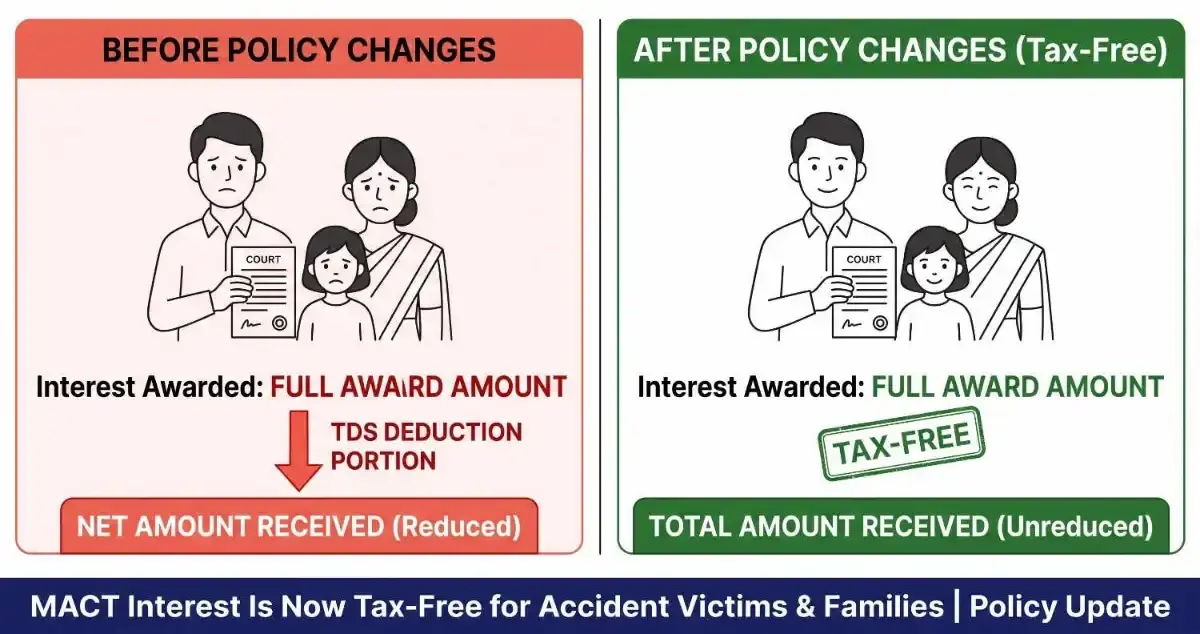
MACT interest income TDS exemption 2026 explained: who qualifies, old vs new Act rules, the FD interest trap, refund steps, and how to report it in your ITR.
Jul 24, 2026