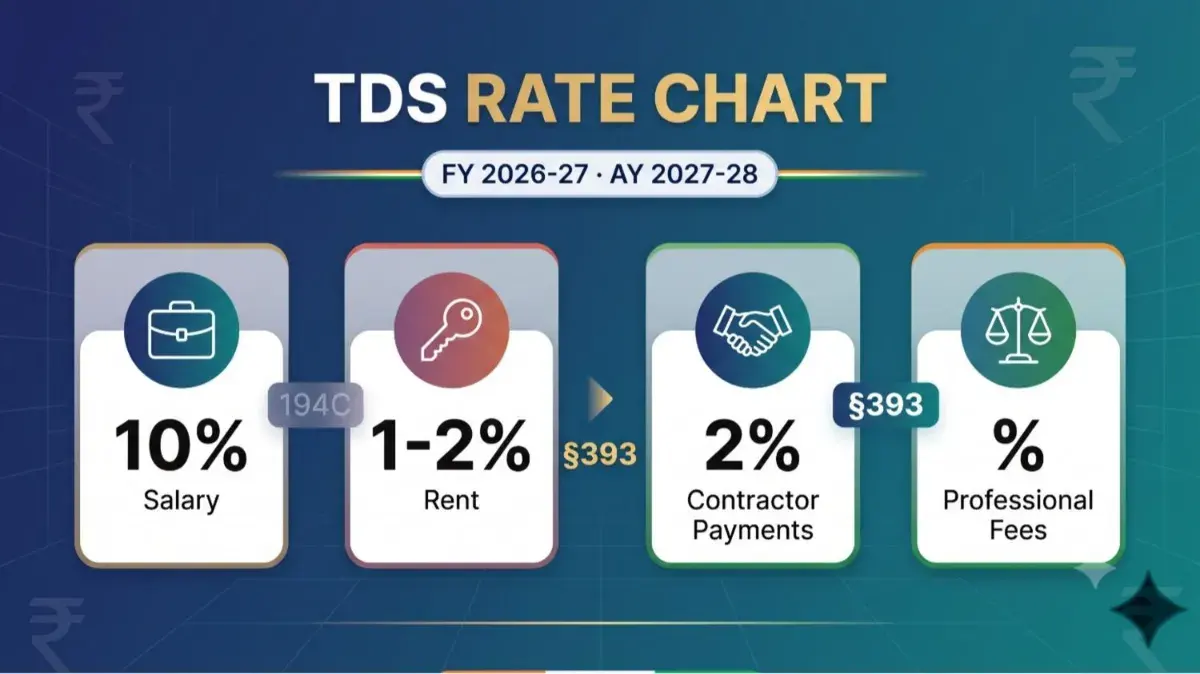

TDS rate chart FY 2026-27: All Section 393 rates, old-vs-new section mapping, 3 rate changes, payment due dates & worked ₹ examples. Updated July 2026.
From 1 April 2026, every TDS return must use a 4-digit payment code — not old section names like 194C or 194J. File a Q1 FY 2026-27 return with an old section name and CPC rejects it. This TDS Rate Chart for FY 2026-27 covers every Section 393 rate, the complete old-to-new section mapping, what genuinely changed this year (it's less than most guides claim), and every quarterly deadline.
Tax Deducted at Source (TDS) is the system where the payer — not the recipient — cuts a percentage of tax before releasing payment and deposits it directly with the government. The recipient then claims this as a tax credit when filing their Income Tax Return (ITR).
The Income Tax Act, 2025 replaced the 1961 Act from 1 April 2026. The rates and thresholds themselves are, for the most part, unchanged — this is a renumbering and consolidation exercise, not a rewrite of who owes what. So why does the renumbering matter? Because the old Act scattered TDS across 30+ individual sections (192, 193, 194A, 194C, 194J...), and the new Act collapses all of it into three consolidated sections:
Section 392 — Salary TDS. Replaces old Sections 192 and 192A.
Section 393 — All other TDS, for resident and non-resident payees alike. Absorbs old Sections 193, 194, 194A through 194T, 195, and 196A through 196D into sub-tables.
Section 394 — Tax Collected at Source (TCS). Replaces the entire 206C family.
Inside each section, every payment type gets a 4-digit numeric payment code. Quote that code — not a section name — in returns, challans, and TDS certificates for any transaction where payment or credit falls on or after 1 April 2026. Quote an old section name instead, and the return can fail validation at the CPC. The Income Tax Department's own transition guidance is direct about this: deductors filing for transactions on or after 1 April 2026 must quote the relevant Section 393 (or 394, for TCS) table item, and quoting old section numbers such as 194C, 194J, or 194H "may result in system-level validation errors."
A note on how the codes below were checked: CBDT has not published one single, final, consolidated code list as of this writing. The codes in this chart are drawn from what's live on the income tax portal's challan dropdown, updated TDS software, and cross-checked practitioner sources as of June 2026. The high-volume codes — contractor payments, professional and technical fees, partner payments, rent, e-commerce, property purchase — are corroborated across multiple independent sources and are reliable. A handful of lower-volume codes are still settling, and we've flagged those individually. Cross-check anything you're unsure of against the official TDS rates page or your TDS software's live dropdown before you file.
One more terminology shift worth flagging: "Financial Year" and "Assessment Year" are gone. The new Act uses a single term — Tax Year. So Tax Year 2026-27 = what used to be called FY 2026-27 / AY 2027-28. For a full breakdown of what else changed between the two Acts, read our Income Tax Act 2025 vs 1961 guide.
TDS Applies To | TDS Does Not Apply To |
|---|---|
All companies and firms making specified payments | Payments below the applicable threshold limit |
Government deductors (all payment types) | Pure profit share distributed to partners (only salary/commission/bonus/interest are covered under old 194T / new Code 1067) |
Employers deducting salary TDS — every category | Recipients who submit a valid Form 121 (replaces old Form 15G/15H) where their total income is below the taxable threshold |
E-commerce operators making seller payments | Non-taxable amounts specifically exempt under the Act |
Partnership firms and LLPs paying partners remuneration or interest exceeding ₹20,000 | Individuals/HUFs below the turnover threshold, for most sections (exceptions below) |
Conditional case: Individuals and HUFs must deduct TDS on contractor and professional fee payments once their turnover in the preceding year crosses ₹1 crore for a business or ₹50 lakh for a profession — this is the "specified person" threshold. Below that, most sections don't apply to individuals/HUFs, though a few — old 194-IB (rent), 194M, 194S — carry their own rules regardless of turnover. If you're unsure whether your business crosses the audit threshold, use the Section 44AB Tax Audit Applicability Checker.
All rates below apply to Tax Year 2026-27 (1 April 2026 onwards) under the Income Tax Act, 2025. Use these payment codes — not old section names — in Forms 138, 140, and 144.
Code | Old Section | Nature of Payment | New Section | Rate | Threshold |
|---|---|---|---|---|---|
1001 | 192 | Salary — State Govt. employees | 392 | Applicable slab rate | — |
1002 | 192 | Salary — Non-govt. employees | 392 | Applicable slab rate | — |
1003 | 192 | Salary — Union Govt. employees | 392 | Applicable slab rate | — |
1004 | 192A | EPF accumulated balance withdrawal | 392(7) | 10% | ₹50,000 |
The exact split of codes 1001–1003 across employee categories is the one part of the salary table we could not independently triple-confirm across sources — the ₹50,000 EPF code (1004) and the general "Section 392 covers salary" structure are solid. Confirm the specific per-category code against your payroll software or the TRACES dropdown before filing.
Salary TDS rate = the income tax slab applicable to that employee after all qualifying deductions and exemptions. There is no flat rate.
Code | Old Section | Nature of Payment | New Section | Rate | Threshold |
|---|---|---|---|---|---|
1005 | 194D | Insurance commission (Individual) | 393(1) Sl.1(i) | 2% | ₹20,000 |
1005* | 194D | Insurance commission (Others) | 393(1) Sl.1(i) | 10% | ₹20,000 |
1006 | 194H | Commission / Brokerage — others | 393(1) Sl.1(ii) | 2% | ₹20,000 |
1008 | 194-I(a) | Rent — machinery / equipment / plant | 393(1) Sl.2(ii).D(a) | 2% | ₹50,000/month |
1009 | 194-I(b) | Rent — land / building / furniture | 393(1) Sl.2(ii).D(b) | 10% | ₹50,000/month |
Pending confirmation | 194-IB | Rent by individual/HUF (not audit-liable) | 393(1) Sl.2(i) | 2% (cut from 5% on 1 Oct 2024 — not new this year) | ₹50,000/month |
1011 | 194-IC | JDA consideration (not in kind) | 393(1) Sl.3(ii) | 10% | — |
1012 | 194-IA | Purchase of immovable property | 393(1) Sl.3(iii) | 1% | ₹50 lakh |
1013 | 194K | Mutual fund unit income | 393(1) Sl.4(i) | 10% | ₹10,000 |
1019 | 193 | Interest on securities | 393(1) Sl.5(i) | 10% | ₹10,000 |
1020 | 194A | FD/bank interest — senior citizens (60+) | 393(1) Sl.5(ii).D(a) | 10% | ₹1,00,000 |
1021 | 194A | FD/bank interest — others | 393(1) Sl.5(ii).D(b) | 10% | ₹50,000 |
1022 | 194A | Interest from other sources (co-op, post office) | 393(1) Sl.5(iii) | 10% | ₹10,000 |
1023 | 194C | Contractor payment — Individual/HUF payer | 393(1) Sl.6(i).D(a) | 1% | ₹30,000 single; ₹1,00,000 aggregate |
1024 | 194C | Contractor payment — Others (companies, firms) | 393(1) Sl.6(i).D(b) | 2% | ₹30,000 single; ₹1,00,000 aggregate |
1026 | 194J(a) | Technical services / call centre fees | 393(1) Sl.6(iii).D(a) | 2% | ₹50,000 |
1027 | 194J(b) | Professional fees (CA, legal, medical, etc.) | 393(1) Sl.6(iii).D(b) | 10% | ₹50,000 |
1028 | 194J(b) | Director fees / sitting fees | 393(1) Sl.6(iii).D(b) | 10% | No threshold |
1029 | 194 | Dividends (including preference shares) | 393(1) Sl.7 | 10% | ₹10,000 |
1030 | 194DA | Life insurance maturity / survival benefit | 393(1) Sl.8(i) | 2% (cut from 5% on 1 Oct 2024 — not new this year) | ₹1,00,000 |
1031 | 194Q | Purchase of goods | 393(1) Sl.8(ii) | 0.1% | >₹50 lakh per seller |
1033 | 194R | Business perquisites / benefits-in-kind | 393(1) Sl.8(iv) | 10% | ₹20,000 |
1035 | 194O | E-commerce seller payments | 393(1) Sl.8(v) | 0.1% (cut from 1% on 1 Oct 2024 — not new this year) | ₹5 lakh (Ind/HUF) |
1037 | 194S | Virtual digital asset (VDA) consideration | 393(1) Sl.8(vi) | 1% | ₹10,000 |
Code 1005 is listed against both insurance-commission rows above because that's how the payment-code lists we cross-checked present it — with the individual/company distinction apparently captured elsewhere in the return (similar to how PAN-based deductee typing works for other codes), rather than through two separate codes the way contractor payments (1023/1024) work. This is the one rate row we'd genuinely like you to confirm against the live TRACES dropdown before relying on it, since it breaks the pattern used everywhere else in this table.
No-PAN Rule — Section 397(2) (old 206AA): If the recipient doesn't furnish a valid PAN, deduct at the higher of the applicable rate or 20%. Exception: for goods purchase (Code 1031) and e-commerce (Code 1035), the no-PAN rate is 5% — not 20%.
Code | Old Section | Nature of Payment | New Section | Rate |
|---|---|---|---|---|
1039 | 194E | Non-resident sportsman/entertainer | 393(2) Sl.1 | 20% |
1044 | 194LB | Interest from Infrastructure Debt Fund | 393(2) Sl.5 | 5% |
1055 | 196D | FII income from securities | 393(2) Sl.15 | 20% |
1057 | 195 | Any other foreign payment (including technical services) | 393(2) Sl.17 | Average rate / 20% (DTAA applies) |
Always verify the applicable Double Tax Avoidance Agreement (DTAA) rate before applying the domestic rate on foreign payments — the lower rate applies, subject to a valid Tax Residency Certificate and Form 10F.
Code | Old Section | Nature of Payment | New Section | Rate | Threshold |
|---|---|---|---|---|---|
1058 | 194B | Lottery / crossword / gambling winnings | 393(3) Sl.1 | 30% | ₹10,000 per transaction |
1060 | 194BA | Online game winnings | 393(3) Sl.2 | 30% | No threshold |
1062 | 194BB | Horse race winnings | 393(3) Sl.3 | 30% | ₹10,000 per transaction |
1064 | 194N | Cash withdrawal — co-operative society | 393(3) Sl.5.D(a) | 2% | ₹3 crore |
1065 | 194N | Cash withdrawal — individual/company | 393(3) Sl.5.D(b) | 2% | ₹1 crore |
1067 | 194T | Partner salary, commission, bonus, interest | 393(3) Sl.7 | 10% | ₹20,000 annual |
Tax Collected at Source (TCS) shifts from the 206C label to Section 394 under the new Act.
Code | Old Section | Nature of Collection | New Section | Rate |
|---|---|---|---|---|
1068 | 206C-A | Sale of alcoholic liquor for human consumption | 394(1) Sl.1 | 2% ↑ (was 1%) |
1069 | 206C-I | Sale of tendu leaves | 394(1) Sl.2 | 2% |
1073 | 206C-E | Sale of scrap | 394(1) Sl.4 | 2% ↑ (was 1%) |
1075 | 206C-L | Sale of motor vehicle exceeding ₹10 lakh | 394(1) Sl.6.D(a) | 1% |
1076–1085 | 206C-M | Luxury goods >₹10 lakh (watches, art, yachts, sunglasses, shoes, bags, home theatre, polo horses) | 394(1) Sl.6.D(b) | 1% |
1086 | 206C-T | LRS remittance for education/medical (>₹10 lakh) | 394(1) Sl.7.D(a) | 2% |
1087 | 206C-Q | LRS remittance for other purposes (>₹10 lakh) | 394(1) Sl.7.D(b) | 20% |
1088 | 206C-O | Overseas tour package ≤₹10 lakh | 394(1) Sl.8.D(a) | 2% |
TCS payment codes were checked less exhaustively than the TDS side of this chart — the two rate changes (scrap and liquor, both to 2%) are well corroborated, but the individual code numbers above should be treated as indicative pending final CBDT confirmation.
Most guides to this transition list three TDS rate cuts alongside the two TCS increases. That's not quite right, and it's worth getting straight before you rely on this TDS Rate Chart for compliance decisions.
Only two rates are genuinely new for Tax Year 2026-27 — both via the Finance Act 2026, effective 1 April 2026:
What Changed | Rate Before | Rate Now (FY 2026-27) | Payment Code |
|---|---|---|---|
TCS on sale of scrap (old 206C-E) | 1% | 2% | 1073 |
TCS on sale of alcoholic liquor (old 206C-A) | 1% | 2% | 1068 |
The other three rate cuts you'll see mentioned almost everywhere — rent by individuals/HUF (old 194-IB), life insurance maturity payouts (old 194DA), and e-commerce seller payments (old 194O) — did happen, but not this year. All three dropped on 1 October 2024, under the Finance (No. 2) Act, 2024, eighteen months before the Income Tax Act, 2025 even took effect. They simply carry forward unchanged into Tax Year 2026-27:
Rate (unchanged since Oct 2024) | Was | Now | Actually Changed |
|---|---|---|---|
Rent by individual/HUF not liable to audit (old 194-IB) | 5% | 2% | 1 October 2024 |
Life insurance maturity/survival benefit (old 194DA) | 5% | 2% | 1 October 2024 |
E-commerce seller payments (old 194O) | 1% | 0.1% | 1 October 2024 |
Why the mix-up? These three rates are appearing under a new section number (393) for the first time this year, so it's easy to mistake the renumbering for a rate change. It isn't — the Income Tax Act, 2025 is, by design, a structural and renumbering exercise. Practitioner sources are consistent on this point: the new framework brings "no substantial changes in the underlying TDS provisions, except for renumbering and structural consolidation."
What didn't change at all: contractor TDS (1%/2%), professional fees (2%/10%), rent on land/building (10%), FD interest (10%), dividends (10%), VDA (1%), and property purchase (1%).
Section 194T on partner payments is in its second year — effective 1 April 2025, also via the Finance (No. 2) Act, 2024, so it isn't a 2026-vintage provision either. Many partnership firms still haven't set up TDS deduction for partners. That's now a compliance priority regardless of which Act is technically in force.
Before you apply this TDS Rate Chart to a real payment, walk through the arithmetic below — it's where most deduction errors actually happen.
Priya is a freelance CA hired by a private company to conduct a financial audit. Invoice: ₹75,000 in May 2026.
Audit and CA services fall under professional services (Code 1027), not technical services (Code 1026) — the distinction matters because the rates are 10% and 2% respectively, and using the wrong one is an under-deduction error that triggers a demand notice later.
Step 1: Check threshold. ₹75,000 > ₹50,000. TDS applies.
Step 2: Apply rate. TDS = ₹75,000 × 10% = ₹7,500
Step 3: Net payment. ₹75,000 − ₹7,500 = ₹67,500 paid to Priya
Step 4: Deposit by 7 June 2026 (7th of month following deduction).
Step 5: Report Code 1027 in Form 140, Q1 return due 31 July 2026.
If Priya's PAN is not on file, TDS = ₹75,000 × 20% = ₹15,000 under Section 397(2).
Ramesh's LLP credits the following to him during Tax Year 2026-27: salary ₹80,000 + commission ₹35,000 + interest on capital ₹15,000 + year-end bonus ₹10,000. PAN is on file.
Step 1: Aggregate all covered payment heads. ₹80,000 + ₹35,000 + ₹15,000 + ₹10,000 = ₹1,40,000 total
Step 2: Check threshold. ₹1,40,000 > ₹20,000. TDS applies under Code 1067 / Section 393(3) Sl.7.
Step 3: Apply rate. TDS = ₹1,40,000 × 10% = ₹14,000
Step 4: Net credit. Ramesh's capital account receives ₹1,40,000 − ₹14,000 = ₹1,26,000
Step 5: ₹14,000 TDS reflects in Ramesh's Form 168 (Annual Tax Statement) on the tax portal. He claims it as credit in his ITR filing.
The critical trap: TDS triggers on credit to a partner's account — no cash movement is needed. A journal entry is sufficient. Use the Section 194T TDS Calculator to track all payment heads together and avoid crossing the threshold by accident.
Anil buys a flat for ₹65 lakh from a resident seller in June 2026. Stamp duty value is also ₹65 lakh.
Step 1: Check threshold. ₹65 lakh > ₹50 lakh. TDS applies under Code 1012 / Section 393(1) Sl.3(iii).
Step 2: Apply rate. TDS = ₹65,00,000 × 1% = ₹65,000 (deducted on the full consideration, not just the amount above ₹50 lakh)
Step 3: Net payment to seller. ₹65,00,000 − ₹65,000 = ₹64,35,000
Step 4: Deposit within 30 days of the end of the month of deduction, using Form 141 (Schedule B).
Step 5: Issue Form 16B-equivalent certificate to the seller.
If the seller doesn't provide PAN, the rate rises to 20%, not 5% — the lower no-PAN rate under Section 397(2) applies only to goods purchase and e-commerce codes, not property.
Month of Deduction | Deposit By |
|---|---|
April 2026 | 7 May 2026 |
May 2026 | 7 June 2026 |
June 2026 | 7 July 2026 |
July 2026 | 7 August 2026 |
August 2026 | 7 September 2026 |
September 2026 | 7 October 2026 |
October 2026 | 7 November 2026 |
November 2026 | 7 December 2026 |
December 2026 | 7 January 2027 |
January 2027 | 7 February 2027 |
February 2027 | 7 March 2027 |
March 2027 | 30 April 2027 (special extended date) |
Government deductors using book entry (Treasury Challan): deposit on the same day of deduction, except March, which is due 7 April 2027.
Quarter | Period | Form (Salary) | Form (Non-Salary Resident) | Due Date |
|---|---|---|---|---|
Q1 | Apr–Jun 2026 | Form 138 | Form 140 | 31 July 2026 |
Q2 | Jul–Sep 2026 | Form 138 | Form 140 | 31 October 2026 |
Q3 | Oct–Dec 2026 | Form 138 | Form 140 | 31 January 2027 |
Q4 | Jan–Mar 2027 | Form 138 | Form 140 | 31 May 2027 |
New form names: Form 138 replaces Form 24Q (salary TDS). Form 140 replaces Form 26Q (non-salary resident). Form 144 replaces Form 27Q (non-resident). Form 143 replaces Form 27EQ (TCS). Form 141 consolidates old Forms 26QB, 26QC, 26QD, and 26QE (property/rent/VDA challan-cum-statement) — confirmed directly on the e-filing portal.
Submit old form names for Tax Year 2026-27 transactions and CPC will reject the return.
Issue Form 130 (replaces Form 16) to salaried employees by 15 June 2027. Issue Form 131 (replaces Form 16A) within 15 days of the quarterly return due date.
Form 121 (replaces Form 15G/15H) declarations must be submitted to the deductor quarterly by the 7th of the month following each quarter.
Problem 1: Your TDS return was filed using old section names (e.g. "194C" instead of Code 1023)
CPC flags the return as defective or rejects it. File a correction statement immediately — replace every old section reference with the applicable 4-digit payment code. Practitioner guidance circulating as of June 2026 indicates that a challan already deposited under the wrong code can typically be used in a correction return without raising a fresh challan, since the challan itself isn't locked to a specific deductee code — only the deductee row needs updating. Treat this as general practice rather than a guaranteed outcome in every case, and confirm with TRACES support if the correction doesn't go through cleanly.
Problem 2: TDS deducted under the wrong code (e.g. Code 1004 instead of Code 1023)
File a correction statement via TRACES. Delete the incorrect deductee row and re-add it with the correct code. A challan with the wrong code at the deductor level can often be reassigned — but if the challan carries the wrong section at deductee level, a correction is mandatory to reflect accurate credits in the payee's Form 168.
Problem 3: You missed the quarterly return filing deadline
Late filing attracts ₹200 per day under Section 427 (the new number for old Section 234E). This fee runs from the day after the due date to the day you actually file, and cannot exceed the total TDS deducted for that quarter. Pay the late fee using Challan ITNS 281 first — TRACES won't accept the return until the fee is cleared. If the return stays unfiled for more than a year past the deadline, a separate penalty of ₹10,000 to ₹1,00,000 under Section 461 (the new number for old Section 271H) may also apply.
Default | Consequence | New Act Section |
|---|---|---|
Failed to deduct TDS at all | Interest @ 1% per month, from due-deduction date to actual deduction date | Section 398 |
Deducted but not deposited to govt. | Interest @ 1.5% per month, from deduction date to deposit date | Section 398(3) |
Late quarterly return filing | ₹200 per day; capped at TDS amount for the quarter | Section 427 |
Return not filed for over 1 year after due date | ₹10,000 to ₹1,00,000 penalty | Section 461 |
No PAN furnished by recipient | Deduct at 20% (or 5% for Codes 1031 and 1035) | Section 397(2) |
Wilful non-deposit of deducted TDS | Prosecution: 3 months to 7 years imprisonment | Old Section 276B — new section number not independently confirmed; verify before citing |
Business expense disallowance for non-deduction | 30% of payment disallowed as deductible expense | Section 35(b) |
The disallowance rule hits hardest in practice. Pay ₹10 lakh in professional fees without deducting TDS and ₹3 lakh gets added back to your firm's taxable income — that's an extra ₹90,000 to ₹1,20,000 in tax, on top of the 1.5% monthly interest and penalties.
1. What is the new section number for contractor payments (old 194C) under the Income Tax Act 2025?
Old Section 194C is now Section 393(1) Table Sl. No. 6(i) of the Income Tax Act, 2025. Use payment Code 1023 if the contractor is an individual or HUF, and Code 1024 for companies and other entities. The rate stays unchanged at 1% (individual/HUF) and 2% (others). Threshold: ₹30,000 per single payment or ₹1,00,000 in aggregate during the year, whichever is triggered first.
2. Has the TDS rate on FD interest changed for FY 2026-27?
No. TDS on FD and bank interest stays at 10% under Section 393(1) Sl.5(ii). The thresholds — ₹1,00,000 for senior citizens (Code 1020), ₹50,000 for others (Code 1021) — were set in an earlier Budget and carry forward unchanged into Tax Year 2026-27. To model how TDS fits into your total FD tax liability, try the Interest Income Tax Calculator. For a full guide including 80TTB vs 80TTA deductions and Form 121 submission, see Tax on FD Interest India 2025.
3. Do I still submit Form 15G or 15H to avoid TDS on interest?
No. Under the Income Tax Act, 2025, Form 15G and Form 15H are replaced by Form 121. The same eligibility logic applies — individuals (Form 121 equivalent to 15G) and senior citizens (Form 121 equivalent to 15H) whose total income is below the taxable threshold can submit Form 121 to the deductor to prevent TDS deduction. Submit it before interest is credited, not after.
4. What exactly is Section 393 in the new Income Tax Act?
Section 393 is the single consolidated TDS section for all non-salary payments in the Income Tax Act, 2025. Old sections 193, 194, 194A through 194T, 195, and 196A through 196D have all been absorbed into sub-tables within Section 393, organised into three broad divisions: 393(1) for resident non-salary TDS, 393(2) for non-resident and foreign payments, and 393(3) for winnings, cash withdrawals, and partner remuneration. No standalone "194" sections exist for transactions dated 1 April 2026 onwards.
5. I'm an Amazon seller in India. What is my TDS rate for FY 2026-27?
E-commerce operators (Amazon, Flipkart, etc.) deduct TDS at 0.1% on payments to sellers under Code 1035 / Section 393(1) Sl.8(v). Note that this rate dropped from 1% to 0.1% back on 1 October 2024, not as part of this year's transition — it simply carries forward. The threshold for individual and HUF sellers is ₹5 lakh per year; for other sellers, TDS applies from the first rupee. If your PAN isn't registered with the platform, deduction rises to 5%.
6. My company bought goods worth ₹70 lakh from one supplier. Is TDS needed?
Only if your company's turnover in the previous financial year exceeded ₹10 crore. If yes, deduct TDS at 0.1% on the amount exceeding ₹50 lakh under Code 1031 / Section 393(1) Sl.8(ii). Calculation: (₹70 lakh − ₹50 lakh) × 0.1% = ₹2,000. If the supplier doesn't furnish PAN, the rate on this section rises to 5% — not the standard 20% that applies elsewhere.
7. The tenant is an individual paying ₹55,000 a month in rent. Do they need to deduct TDS?
Yes, once an individual landlord's rent exceeds ₹50,000 per month. The old 194-IB provision is now under Section 393(1) Sl.2(i) of the new Act. The rate itself was cut from 5% to 2% back on 1 October 2024 — it isn't a change tied to this year's transition, just a rate that continues unchanged. The specific payment code for this sub-section wasn't formally confirmed across our sources as of this writing — verify the exact code from the current TRACES portal before filing. For the full tax picture including deductions a landlord can claim, read Rental Income Tax in India 2025-26.
8. I missed the TDS return deadline. What's the exact calculation of my late fee?
The late fee under Section 427 is ₹200 per day for each day after the due date until you actually file. Example: Q1 due date was 31 July 2026. You file on 17 November 2026 — that's 109 days of delay. Fee = 109 × ₹200 = ₹21,800. But if your total TDS deducted for Q1 was ₹15,000, the late fee is capped at ₹15,000, not ₹21,800. Pay the capped amount via ITNS 281 before filing.
9. Can I still write "194J" in TDS returns for payments made in May 2026?
No. Any payment or credit made on or after 1 April 2026 must be reported using the new numeric payment codes. "194J" is a 1961 Act reference. Payments made on or before 31 March 2026 still use old form references and old section names, even if you deposit the tax after 1 April — the Act that applies depends on when the payment or credit was made, not when the tax was deposited.
10. What is Form 168 and how does it relate to Form 26AS?
Form 168 is the Annual Tax Statement under the Income Tax Act, 2025, replacing Form 26AS. It consolidates all TDS credits, advance tax paid, self-assessment tax, and other financial transactions linked to your PAN. You access it the same way — through incometax.gov.in under the e-filing portal.
11. Is my partnership firm required to deduct TDS on partner salary in FY 2026-27?
Yes. Section 194T (now Code 1067 under Section 393(3) Sl.7) requires TDS at 10% on salary, remuneration, commission, bonus, and interest paid to partners, once the total across all these heads exceeds ₹20,000 in a year. This applies to every firm and LLP — no turnover or audit threshold applies. Section 194T has actually been in force since 1 April 2025 (inserted by the Finance (No. 2) Act, 2024), so FY 2026-27 is its second year, not its first. TDS must be deducted at the time of credit, even if no cash is paid immediately.
12. Do senior citizens automatically get a higher TDS threshold on interest?
Yes. Banks automatically apply the ₹1,00,000 threshold (Code 1020) for account holders aged 60 and above, versus ₹50,000 for others (Code 1021). No separate application is needed — the bank uses age records already on file. If a senior citizen's total income still falls below the taxable limit, they can submit Form 121 (replaces Form 15H) to the bank to prevent any TDS deduction altogether.
13. Do small transporters still get a TDS exemption under the new Act?
Yes, and this one trips up a lot of businesses because it's easy to assume it quietly disappeared in the transition. A transporter who owns 10 or fewer goods carriages at any point during the year, and who furnishes a valid PAN along with a declaration, is exempt from TDS on payments for plying, hiring, or leasing those goods carriages — the exemption now sits under Section 393(4) of the Income Tax Act, 2025 (previously old Section 194C(6)). The exemption covers only carriages the transporter actually owns, not hired or leased-in vehicles, and it must be re-checked if the transporter crosses 10 carriages partway through the year — TDS then applies from that point forward, not retroactively. Without a valid declaration and PAN, the payer must deduct TDS at the standard contractor rate (1% or 2%), or 20% if PAN is missing entirely.
14. Which TDS rate applies to a foreign consultant, and does the DTAA actually override the Act's rate?
Yes — where India has a Double Tax Avoidance Agreement with the consultant's country of residence, the payer applies whichever is lower: the Act's rate under Section 393(2) Sl.17 (Code 1057), or the DTAA rate. This isn't automatic, though. The consultant needs to furnish a Tax Residency Certificate and Form 10F before the lower DTAA rate can be applied; without those, the payer defaults to the Act's rate (or 20% if higher, subject to Section 397(2) for missing PAN). This is one of the more commonly mishandled areas in practice — payers often apply the DTAA rate on the strength of a claim alone, without the underlying certificate on file, which creates exposure if the deduction is later questioned.
Your immediate action: confirm every TDS return your team files from Q1 FY 2026-27 uses the 4-digit payment code, not the 1961 Act section name. Only two rates are genuinely new this year — TCS on scrap and liquor, both raised to 2% — while the "rent, life insurance, and e-commerce TDS cuts" you'll see credited to this transition everywhere else actually date back to October 2024. Section 194T partner TDS is in its second year, with zero exemptions for firm size. Property purchase TDS stays at 1% on transactions of ₹50 lakh or more — not 10%, a distinction worth double-checking against any other rate chart you're cross-referencing.
Bookmark this TDS Rate Chart FY 2026-27 and check back as CBDT finalises the remaining payment codes; a handful are still settling as of mid-2026. For official challan format notifications, watch incometax.gov.in. For the underlying Act changes, see our Income Tax Act 2025 vs 1961 guide.
Written by Anita Patil, Tax Planner & CA | Last Updated: July 2026 Reviewed by Toolisky Editorial Team Facts verified against the Income Tax Department's e-filing portal, official TDS/TCS rate pages, and cross-checked practitioner sources as of July 2026 — see inline links above.
For educational purposes only. Verify all figures at official sources before acting. Toolisky is not affiliated with any government body. Consult a qualified CA or legal professional before making compliance decisions. See toolisky.com/accuracy-and-limitations.
No TAN for NRI property purchase applies only from 1 October 2026, and only to resident individual and HUF buyers. Get the rates, forms, and dates you need.
Jul 25, 2026

Did you lose the SGB premature redemption tax exemption? Here's exactly who's affected, how much tax applies now, and how to check your own bonds.
Jul 24, 2026
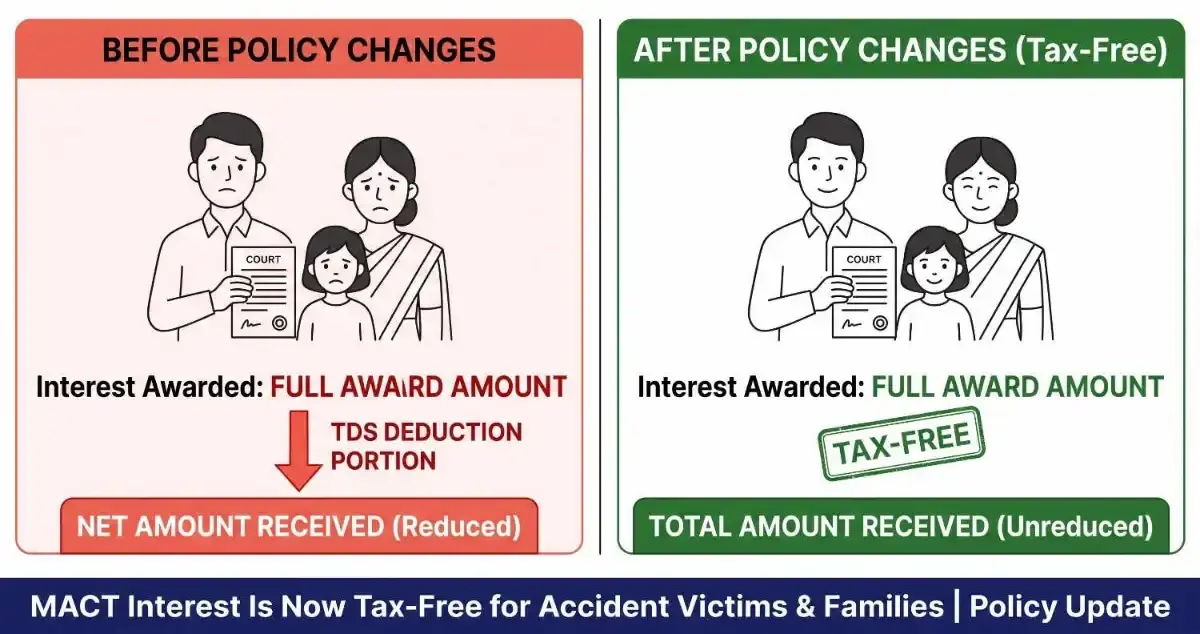
MACT interest income TDS exemption 2026 explained: who qualifies, old vs new Act rules, the FD interest trap, refund steps, and how to report it in your ITR.
Jul 24, 2026