

Crypto tax India 2026 explained: 30% VDA tax, 1% TDS, new 18% GST, penalties, and whether the 1961 or 2025 Income Tax Act governs your crypto filing this year.
If you're filing your ITR this July, your crypto gains are still taxed under the old Income-tax Act, 1961, not the new 2025 Act. Confused about which law actually applies to you right now? You're not the only one. Most guides skip this part, so here's the flat 30% tax, the 1% TDS, the new 18% GST layer, and exactly where each Act starts and stops.
Here's the confusion killer, stated plainly. The Income-tax Act, 2025 came into force on 1 April 2026. But it does not govern the return you're filing this year.
Your crypto trades from FY 2025-26 (1 April 2025 to 31 March 2026) fall under Assessment Year 2026-27, and AY 2026-27 is assessed entirely under the old Income-tax Act, 1961. That means Section 115BBH, Section 194S, and Section 2(47A) are the numbers that matter for the return due this July and August. This is the last filing season under the 1961 Act.
Only crypto transfers happening from 1 April 2026 onward, in what the new Act calls Tax Year 2026-27, fall under the 2025 Act's renumbered sections. You won't file that return until 2027.
So which sections apply, and when?
Period | Governing Act | Assessment terminology | ITR due date |
|---|---|---|---|
FY 2025-26 (up to 31 Mar 2026) | Income-tax Act, 1961 | AY 2026-27 | 31 Jul 2026 (ITR-2), 31 Aug 2026 (ITR-3) |
Tax Year 2026-27 (from 1 Apr 2026) | Income-tax Act, 2025 | Tax Year 2026-27 | Due in 2027 |
This article covers both periods, side by side, so you don't mix up the numbering. You can also check the Income Tax Department's own Act comparison page if you want to see the source text yourself.
A VDA is any crypto token, coin, or NFT that's created through cryptographic means, holds value, and can be transferred electronically. Bitcoin, Ethereum, meme coins, stablecoins, and NFTs all qualify. Indian rupees and foreign currency don't.
Under the 1961 Act, this sits in Section 2(47A). The Finance Act 2025 added sub-clause (d), which names "crypto-asset" explicitly, so there's no room left for an exchange to argue that a specific token falls outside the definition. [VERIFY: the 2025 Act carries this definition into a renumbered clause under Section 2; the exact new clause number wasn't confirmed against the bare Act text during this review, so treat it as pending confirmation rather than settled fact.]
Applies to | Does NOT apply to |
|---|---|
Anyone selling, swapping, or spending crypto or NFTs for a gain | Simply holding crypto without selling |
Traders on Indian exchanges (CoinDCX, WazirX, CoinSwitch) | Indian currency or foreign fiat currency |
Traders on foreign platforms (Binance, KuCoin, Bybit) | Gift cards, vouchers, and loyalty points |
Miners, stakers, and airdrop recipients (taxed on receipt, then again on sale) | N/A |
NRIs holding crypto in Indian or foreign accounts | N/A |
One thing worth flagging: if you only bought crypto this year and never sold, swapped, or spent it, you owe zero VDA tax for FY 2025-26. But if you're an NRI, or a resident holding crypto abroad worth over ₹20 lakh, you may still owe a Schedule FA disclosure even without a single sale.
Here are the actual figures, not vague descriptions of them.
Tax rate: flat 30% on gains, under Section 115BBH of the 1961 Act (applies to FY 2025-26). Add 4% health and education cess on top. Effective minimum rate: 31.2%.
Surcharge: kicks in above ₹50 lakh of total income, at the usual slab-linked rates.
Deduction allowed: only cost of acquisition. Gas fees, exchange commissions, and internet bills don't count, no matter how tempting it is to claim them.
TDS on crypto: 1% on the sale amount under Section 194S, deducted by the buyer or the exchange. The threshold is ₹50,000 a year for specified persons (business turnover above ₹1 crore, or professional receipts above ₹50 lakh) and ₹10,000 a year for everyone else.
Loss set-off: not permitted, not even against a gain from a different crypto asset. Losses can't be carried forward either.
Crypto gifts: anything over ₹50,000 from a non-relative is taxed as income from other sources at your slab rate, under Section 56(2)(x), not at the flat 30%.
GST on crypto trading: since 7 July 2025, exchanges must charge 18% GST on service fees, including trading, withdrawal, and staking charges. This sits on top of the 30% tax and 1% TDS, not instead of them.
Here's what that GST actually costs you. Say your exchange charges a ₹1,000 trading fee. You now pay an extra ₹180 as GST on that fee alone. It won't touch your taxable gain, but it will shrink what actually lands in your account.
This is the side-by-side table most crypto tax guides never bother building.
Provision | Income-tax Act, 1961 (FY 2025-26, AY 2026-27) | Income-tax Act, 2025 (Tax Year 2026-27 onward) |
|---|---|---|
VDA definition | Section 2(47A) | Renumbered clause under Section 2 (exact number pending confirmation) |
30% flat tax on VDA transfer | Section 115BBH | Section 194(1), Table Serial No. 4 |
1% TDS on transfer | Section 194S | Section 393(1), Table Serial No. 8(vi) |
Loss set-off bar | Section 115BBH(2) | Carried into Section 194, no substantive change |
Reporting by exchanges | Not codified | Section 509(1), newly introduced |
Penalty for non-reporting | Not codified | Section 446, newly introduced, ₹200/day plus ₹50,000 |
Terminology | Financial Year / Assessment Year | Tax Year (single concept, no FY/AY split) |
Schedule VDA | ITR-2 / ITR-3 | Continues in the new ITR forms |
The substance hasn't changed at all. What changed is the section numbers, and the extra reporting teeth built around them.
Example 1: the common case (FY 2025-26, old Act numbering)
Suresh, a salaried employee in Pune, bought Ethereum worth ₹80,000 in December 2024. He sold it in October 2025 for ₹1,30,000.
Gain = ₹1,30,000 minus ₹80,000 = ₹50,000
Tax under Section 115BBH = 30% of ₹50,000 = ₹15,000
Cess = 4% of ₹15,000 = ₹600
Total tax = ₹15,600
TDS under Section 194S = 1% of ₹1,30,000 = ₹1,300, already deducted by the exchange
Suresh claims that ₹1,300 as TDS credit and pays the remaining ₹14,300 through advance tax or self-assessment.
Example 2: the edge case most guides skip (mixed gain and loss, same year)
Farida trades often. In FY 2025-26 she sells Dogecoin bought for ₹40,000 at ₹25,000, a ₹15,000 loss. In the same year, she sells an NFT bought for ₹2,00,000 at ₹3,50,000, a ₹1,50,000 gain. Her exchange also charges her a ₹1,200 fee, which now carries 18% GST on top.
The ₹15,000 Dogecoin loss cannot offset the NFT gain. This is the rule almost every new investor gets wrong.
Tax on the NFT gain alone = 30% of ₹1,50,000 = ₹45,000
Cess = 4% of ₹45,000 = ₹1,800
Total tax = ₹46,800, calculated on ₹1,50,000 alone; the ₹15,000 loss simply disappears
TDS under Section 194S = 1% of ₹3,50,000 = ₹3,500
GST on the ₹1,200 exchange fee = 18% of ₹1,200 = ₹216, an extra cost on top of everything above
Would splitting these two trades across separate financial years help Farida? No. The no-set-off rule applies whether the trades happen on the same day or years apart.
Gather every transaction from every exchange, wallet, and P2P trade for FY 2025-26.
Identify each transfer event. Selling, swapping one crypto for another, spending on goods, and gifting all count as transfers. Holding doesn't.
Work out cost of acquisition for each transaction, using the FIFO (first-in, first-out) method for consistency.
Compute profit as sale consideration minus cost of acquisition. Nothing else can be deducted.
Apply the 30% flat tax plus 4% cess, and add surcharge if your total income crosses ₹50 lakh.
On the e-filing portal, pick ITR-2 for capital gains, or ITR-3 if crypto trading is closer to a business for you.
Open Schedule VDA and enter transaction-wise details for every single transfer, not a net summary figure.
Cross-check your total against Form 26AS and your Annual Information Statement (AIS) to catch any TDS mismatch before you submit.
Pay any balance tax through Challan 280, then e-verify the return within 30 days.
You filed the wrong ITR form. Filed ITR-1 while holding VDA income by mistake? File a revised return under Section 139(5) before 31 March 2027, switching to ITR-2 or ITR-3 with Schedule VDA filled in correctly.
Your TDS credit doesn't match Form 26AS. This usually means the exchange quoted your PAN incorrectly, or used the wrong section code. Raise a grievance through TRACES and ask the deductor to file a correction statement.
You never reported past crypto income. The Income Tax Department has already sent over 44,000 notices flagging mismatches for AY 2023-24 and AY 2024-25, uncovering more than ₹888 crore in undisclosed VDA income through exchange data and AIS cross-checks. File an updated return (ITR-U) for the relevant year and pay the extra tax with interest. That's a lot cheaper than waiting for a scrutiny notice to land.
Document | Digital copy accepted? | Where to get it |
|---|---|---|
Exchange transaction statement | Yes | Your exchange's account or reports section |
Form 26AS | Yes | Income Tax e-filing portal |
Annual Information Statement (AIS) | Yes | e-filing portal, under the AIS tab |
Cost of acquisition proof | Yes | Exchange order history or wallet transaction log |
PAN | Yes | UIDAI-linked e-PAN or physical card |
Schedule FA disclosure, if foreign holdings exceed ₹20 lakh | Yes | Compile from your foreign exchange statements |
Not disclosing VDA income counts as under-reporting under Section 270A: a 50% penalty on the tax you should have paid. Deliberate misreporting, like inflating your cost of acquisition, attracts 200%.
Budget 2026 gave the Income Tax Department real teeth against exchanges too. Under Section 446 of the 2025 Act, reporting entities that fail to file the transaction statement required under Section 509(1) face ₹200 per day in penalty, plus ₹50,000 for inaccurate data they don't correct. This targets exchanges rather than individual traders directly, but it means any gap between what you file and what your exchange reports becomes far easier for the department to catch.
If you're holding crypto abroad worth over ₹20 lakh and skip Schedule FA, Black Money Act penalties apply on top of the regular VDA tax, and those run steeper than the usual Section 270A rates.
Failing to deduct TDS on a P2P trade makes the buyer liable for the TDS amount itself, plus 1.5% monthly interest and a matching penalty.
Not in any real sense. The 30% rate, the 1% TDS, and the no-loss-set-off rule all carry forward unchanged. Only the section numbers change: Section 115BBH becomes Section 194(1), Table Serial No. 4, and Section 194S becomes Section 393(1). For FY 2025-26 filing, ignore the new numbers; they don't apply yet.
Yes. Neither Budget 2025 nor Budget 2026 touched the flat rate. It stays at 30% plus 4% cess, whichever Act's numbering you happen to be citing.
ITR-2 if you're treating your gains as capital gains from occasional trading. ITR-3 if your crypto activity looks like a business, with frequent, high-volume trades.
No, and this is the single biggest misconception floating around. You cannot set off a crypto loss against another crypto gain, or against salary, business income, or any other head. Losses also can't be carried forward to next year.
Under Section 270A, non-disclosure attracts a 50% penalty on the unpaid tax. Deliberate misreporting attracts 200%. Over 44,000 notices have already gone out for past mismatches, so don't assume the department won't notice yours.
Not really, but it does hit you twice. Staking rewards and airdrops are taxed as income at your slab rate the moment you receive them. When you later sell that same crypto, any further gain is taxed again at 30% under the VDA rules.
Yes. If your total foreign crypto holdings cross ₹20 lakh, you must disclose them under Schedule FA, separate from your regular VDA reporting. Skip that, and you're looking at Black Money Act exposure, which carries far steeper penalties than a routine VDA miss.
31 July 2026 for ITR-2 filers on the capital gains route, and 31 August 2026 for ITR-3 filers on the business income route, unless the government announces a separate extension.
Not on your trading profit itself. GST at 18%, effective from 7 July 2025, applies only to the service fees your exchange charges, things like trading fees and withdrawal charges, not to the gain you've actually made.
The 1961 Act uses Section 115BBH, Section 194S, and Section 2(47A). The 2025 Act folds these into a tabular structure and adds two brand-new penalty sections, 446 and 509(1), that never existed before. The substance is identical; only the citations and the enforcement layer changed.
File a revised return if you're still within the window, or an updated return (ITR-U) if the original deadline has already passed. With more than 44,000 notices already out for AY 2023-24 and AY 2024-25 mismatches, correcting things voluntarily now beats waiting for a department notice later.
Schedule VDA requires line-by-line reporting for every single transfer: date of acquisition, date of transfer, cost, and sale value. It's not a single net-profit figure. A trader with 200 swaps in a year needs 200 rows, not one tidy summary number.
Pull your complete transaction history from every exchange you've used this year, and reconcile it against Form 26AS before you go anywhere near the ITR form. If you're also reporting equity or property gains alongside your crypto income, run those through Toolisky's Capital Gains Tax Calculator so your entire FY 2025-26 tax picture sits in one place. Received crypto as a gift this year? Check your exact liability with the Gift Tax Calculator for Non-Relatives before assuming it's tax-free.
There's no dedicated crypto tax calculator on Toolisky yet, so for now you'll need to combine the arithmetic above with the steps in this guide. For a deeper dive into what changes once Tax Year 2026-27 actually begins, our VDA tax guide under the new Income Tax Act 2025 walks through Section 194 and Section 393(1) in full, and our Income Tax Act 2025 vs 1961 comparison covers the wider renumbering beyond crypto. For the bare Act text itself, the Income Tax Department's official portal remains the final word.
For educational purposes only. Verify all figures at official sources before acting. Toolisky is not affiliated with any government body. Consult a qualified CA or legal professional before making compliance decisions. See toolisky.com/accuracy-and-limitations.
No TAN for NRI property purchase applies only from 1 October 2026, and only to resident individual and HUF buyers. Get the rates, forms, and dates you need.
Jul 25, 2026

Did you lose the SGB premature redemption tax exemption? Here's exactly who's affected, how much tax applies now, and how to check your own bonds.
Jul 24, 2026
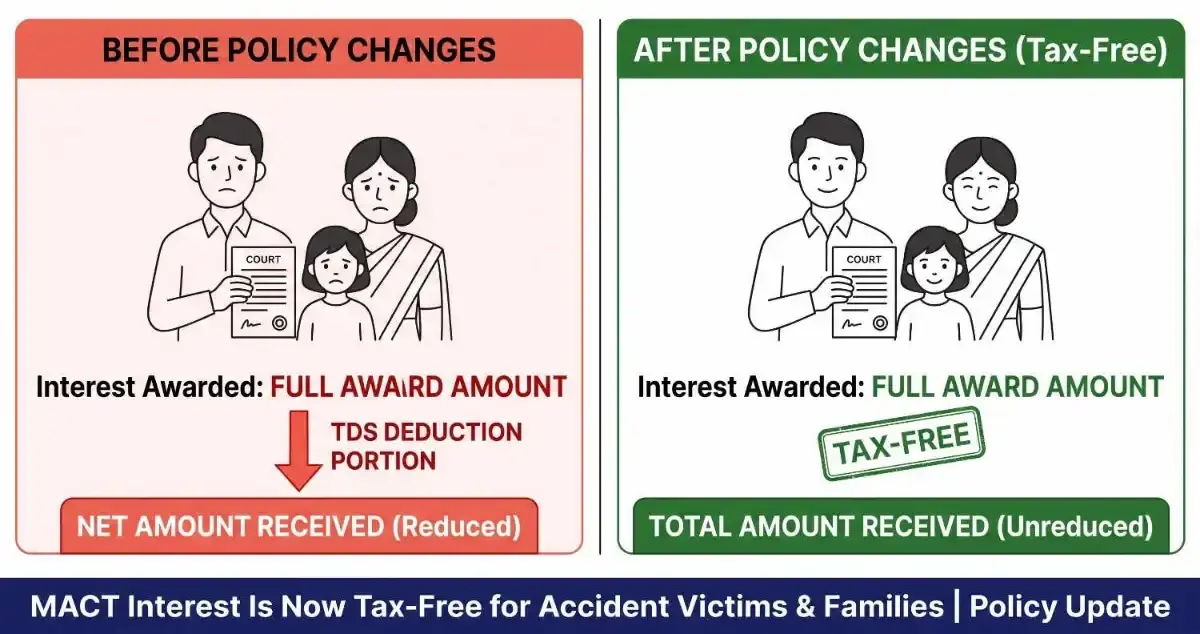
MACT interest income TDS exemption 2026 explained: who qualifies, old vs new Act rules, the FD interest trap, refund steps, and how to report it in your ITR.
Jul 24, 2026