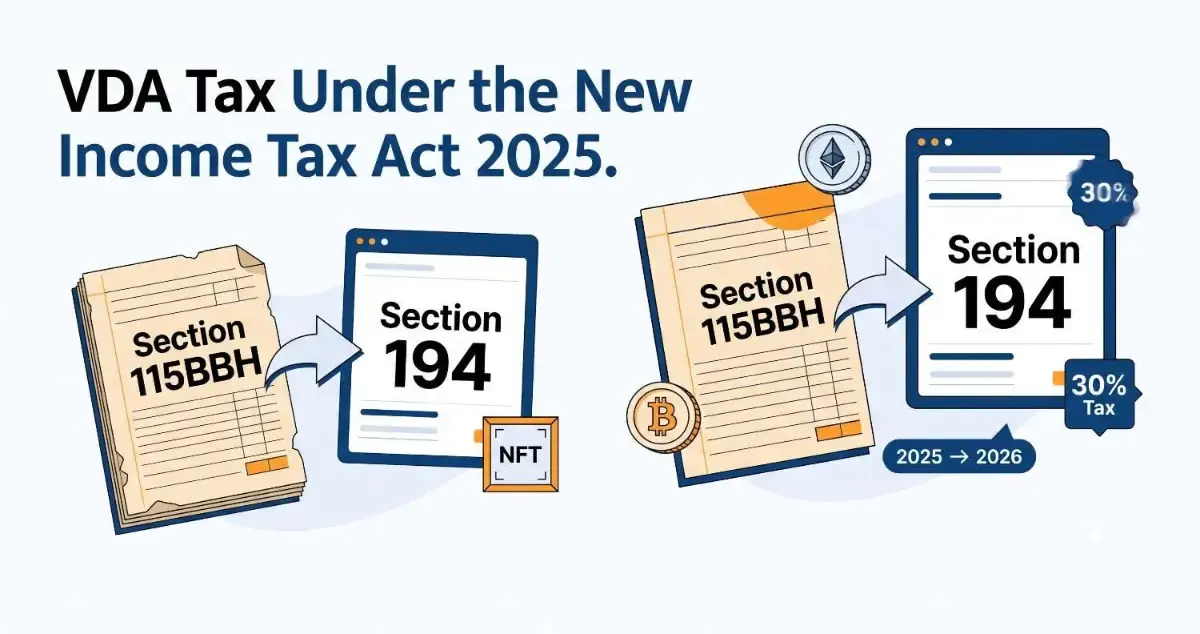

VDA tax under the new Income Tax Act 2025 explained: Section 194, TDS under Section 393, loss rules, GST, penalties, and how to file Schedule VDA in 2026.
Your crypto and NFT profits are still taxed at a flat 30%. Only the section number has changed. Old Section 115BBH is now Section 194 (Table Sl. No. 4) under the Income-tax Act, 2025, from 1 April 2026. The tax rate, the TDS rule, and the loss rules haven't got any easier. If anything, reporting has gotten stricter. Here's what changed, what didn't, and what you owe under VDA tax rules.
A Virtual Digital Asset, or VDA, covers cryptocurrency, NFTs, and any other digital asset the government notifies. VDA tax is the flat 30% charge on profit from transferring one of these assets. It sat under Section 115BBH of the 1961 Act until 31 March 2026, and now sits under Section 194, Table Sl. No. 4, of the 2025 Act from 1 April 2026 onward. Same rate, new label.
TDS runs alongside it. The 1% withheld on every sale, earlier Section 194S, is now Section 393(1), Table Sl. No. 8(vi), sitting inside the same Section 393 TDS rate chart that covers every other TDS rule under the new Act. We checked both mappings against the Income Tax Department's own section text before writing a single figure here.
Most guides skip this part, so let's be precise about it. If you sold crypto or an NFT any time up to 31 March 2026 (that's FY 2025-26, assessed in AY 2026-27), you report it under the old numbering: Section 115BBH and Section 194S. If the transfer happens from 1 April 2026 onward (Tax Year 2026-27, in the new Act's language), you cite Section 194 and Section 393(1) instead.
Filing your AY 2026-27 return in July 2026? You'll still write 115BBH and 194S, even though the new Act is already in force by then. The law that governs a transaction is fixed by the date you transferred the asset, not the date you file your return. This guide covers both windows side by side.
Applies to | Does NOT apply to |
|---|---|
Anyone selling, swapping, or spending crypto (individuals, HUFs, firms, companies) | Indian rupee transactions and RBI-issued CBDCs |
NFT sellers and creators earning royalties on resale | Foreign currency transactions under FEMA |
Crypto received as salary, mining reward, staking income, or airdrop, once you transfer it | Simply holding crypto without selling, swapping, or spending it |
NRIs transferring VDAs held on Indian or foreign platforms | Assets the government hasn't notified as a VDA |
One partial case worth flagging: if you only bought crypto and never sold, swapped, or spent it, you owe zero VDA tax for that year. You may still owe Schedule FA disclosure if you hold it abroad, though. Holding by itself isn't a taxable event.
Here are the real figures, not just descriptions of them.
Tax rate: flat 30%, plus 4% health and education cess. That works out to an effective rate of 31.2% before any surcharge.
Surcharge: applies above ₹50 lakh total income, at the usual slab-linked rates (10% to 25%, capped for this income head), the same structure used for other income.
Deduction allowed: only the cost of acquisition. Transaction fees, internet costs, and mining hardware costs don't count.
TDS: 1% on the sale amount, deducted by the buyer or the exchange, under Section 194S (1961 Act) or Section 393(1), Table Sl. No. 8(vi) (2025 Act). The threshold is commonly reported as ₹50,000 a year for specified persons (business turnover above ₹1 crore, or professional receipts above ₹50 lakh) and ₹10,000 for everyone else, carried forward unchanged from the old provision. A handful of TDS rate charts list this row as having no threshold instead, so if the exact figure matters for your filing, cross-check it against the official TDS chart before you rely on it.
Loss set-off: not allowed against any other income, including gains from a different crypto asset. Losses can't be carried forward either.
Gifts: crypto gifted to a non-relative worth over ₹50,000 is taxed as income from other sources, at your slab rate, not the flat 30%.
Section 206AB removed: the rule that charged non-filers a higher TDS rate stopped applying from 1 April 2025. A non-filing history no longer bumps up your 1% rate.
One correction worth making here, since it's circulating online: some pages claim VDA losses can now be carried forward for eight years under the new Act. That's wrong. The bar on set-off and carry-forward hasn't changed in substance. It just sits under a renumbered section now.
Since 7 July 2025, exchanges have had to charge 18% GST on their service fees: trading, withdrawal, staking, and similar charges. This move followed a government clarification treating crypto platforms as ordinary service providers under GST law, and several exchanges, including Bybit, rolled it out that week. It sits on top of the 30% tax and 1% TDS, not instead of them.
Say your exchange charges a ₹1,000 trading fee. You'll pay an extra ₹180 as GST on that fee alone. It doesn't touch your taxable gain, but it does shrink what lands in your bank account.
Example 1: the common case (FY 2025-26, old Act numbering)
Priya, a salaried employee, bought Ethereum for ₹80,000 in December 2024. She sold it in October 2025 for ₹1,30,000.
Gain = ₹1,30,000 − ₹80,000 = ₹50,000
Tax under Section 115BBH = 30% × ₹50,000 = ₹15,000
Cess = 4% × ₹15,000 = ₹600
Total tax = ₹15,600
TDS under Section 194S = 1% × ₹1,30,000 = ₹1,300, deducted by the exchange at the point of sale
Priya claims that ₹1,300 as TDS credit and pays the remaining ₹14,300 through advance tax or self-assessment.
Example 2: the edge case most guides skip (Tax Year 2026-27, new Act numbering)
Ramesh sells Dogecoin bought for ₹40,000 at ₹25,000, a ₹15,000 loss. In the same year, he sells an NFT bought for ₹2,00,000 at ₹3,50,000, a ₹1,50,000 gain.
Loss on Dogecoin: ₹15,000, but Section 194 doesn't let him set this off against the NFT gain
Tax on the NFT gain alone = 30% × ₹1,50,000 = ₹45,000
Cess = 4% × ₹45,000 = ₹1,800
Total tax = ₹46,800, on the ₹1,50,000 gain alone; the loss doesn't reduce it
TDS under Section 393(1), Sl. No. 8(vi) = 1% × ₹3,50,000 = ₹3,500
Exchange fee, say ₹1,200, attracts 18% GST = ₹216 extra
Would Ramesh be better off splitting the two trades across separate years? No. The no-set-off rule applies whether the trades happen on the same day or in different tax years. That's the part that trips people up almost every time.
There's no separate "crypto tax filing" portal. It sits inside your regular ITR.
Log in to the e-filing portal and pick ITR-2 (capital gains) or ITR-3 (business income).
Open Schedule VDA, available on both forms.
Enter transaction-wise details: date of acquisition, date of transfer, cost of acquisition, and sale amount for each transfer.
The portal auto-computes gains per transaction and totals only the positive entries; losses show as nil, not negative.
Cross-check the total against your TDS statement and your AIS for mismatches. For the AY 2026-27 return you're filing this July, that statement is still Form 26AS. Form 26AS is being renumbered Form 168 under the new Act, but that new number only takes effect for income earned from FY 2026-27 onward, which you'll file next year as AY 2027-28. Don't go looking for Form 168 this filing season; it isn't in use yet.
Pay any balance tax through Challan 280 before you submit, then verify the return.
Wrong ITR form filed. Filed ITR-1 by mistake while holding VDA income? File a revised return under Section 139(8A) before the deadline, switching to ITR-2 or ITR-3 with Schedule VDA filled in properly.
TDS credit mismatch in Form 26AS. This usually means the exchange quoted your PAN wrong, or used the wrong section code. Raise a grievance through TRACES and ask the deductor to file a correction statement.
You missed reporting past crypto income entirely. The department has already sent notices for AY 2023-24 and AY 2024-25 mismatches. File ITR-U for that year and pay the extra tax with interest, rather than wait for a scrutiny notice.
Document | Digital copy accepted? | Where to get it |
|---|---|---|
Exchange transaction statement | Yes | Download from your exchange's account or reports section |
Form 26AS | Yes | Income Tax e-filing portal |
Annual Information Statement (AIS) | Yes | Income Tax e-filing portal, under the AIS tab |
Cost of acquisition proof (purchase invoice or screenshot) | Yes | Exchange order history or wallet transaction log |
PAN | Yes | UIDAI-linked e-PAN or physical card |
Non-disclosure of VDA income counts as under-reporting under Section 270A, which carries a 50% penalty on the tax that should've been paid. Deliberate misreporting, like faking your cost of acquisition, attracts 200%.
Budget 2026 added something genuinely new here. Section 446 now imposes a ₹200-per-day penalty on reporting entities, mainly exchanges, that fail to file the statement required under Section 509(1), plus ₹50,000 for inaccurate data they don't correct. This targets exchanges rather than individual traders, but it means any gap between what you file and what your exchange reports becomes far easier for the department to catch.
If you're an NRI holding crypto on a foreign platform, and its value exceeds ₹20 lakh, you must also disclose it in Schedule FA. Skip that, and Black Money Act penalties, far steeper than the usual Section 270A rates, can apply on top of the VDA tax itself. If you've also delayed advance tax on a large crypto gain, run the numbers through Toolisky's Section 234A, 234B, 234C interest calculator to see the extra interest you owe.
Section 194 (Table Sl. No. 4) replaced Section 115BBH for the 30% charge, effective 1 April 2026. TDS moved from Section 194S to Section 393(1), Table Sl. No. 8(vi). Both carry forward the same substantive rules as before.
Yes. Tax applies on transfer: selling, swapping, or spending. Simply holding an asset, however much its value has risen, creates no taxable event for that year.
No, and this is the single biggest misconception floating around online. Some pages claim an 8-year carry-forward now exists under the new Act. That's false. Section 115BBH(2), and its successor Section 194, both explicitly disallow set-off and carry-forward.
ITR-2 if you're treating it as capital gains from occasional trading; ITR-3 if you're running it as a business, with regular high-frequency trading.
Yes. Both fall under the Section 2(47A) definition of VDA and are taxed identically at 30% flat, with the same 1% TDS and the same no-set-off rule.
No. GST at 18% applies only to the service fees exchanges charge you, like trading fees and withdrawal charges, not to your trading profit itself.
File ITR-U for that year before the updated-return deadline closes, declare the income, and pay the additional tax plus interest. This works out far cheaper than waiting for a Section 270A notice.
The buyer becomes liable for the TDS amount, plus 1% monthly interest and a matching penalty, since P2P deals still fall under Section 393(1) even without an exchange in between.
Yes, under Schedule FA, if the total value crosses ₹20 lakh. This runs separately from your regular VDA income reporting and carries Black Money Act exposure if you skip it.
No. Unlike shares or property, VDA tax makes no distinction based on how long you held the asset. A coin sold after one day or one year is taxed identically at 30% flat.
The standard ITR due date applies: 31 July 2026 for most individual taxpayers who aren't subject to audit, unless the government extends it separately.
File under Section 194 and Section 393(1) for anything transferred after 1 April 2026, and under the old 115BBH and 194S numbering for anything before it. Don't mix the two up. Our Income Tax Act 2025 vs 1961 comparison walks through the wider renumbering if you want the full picture beyond crypto. For the bare-act text itself, the Income Tax Department's portal is the final word.
For educational purposes only. Verify all figures at official sources before acting. Toolisky is not affiliated with any government body. Consult a qualified CA or legal professional before making compliance decisions. See toolisky.com/accuracy-and-limitations.

Digital tokens tax under the new Income Tax Act: 30% VDA rate, old vs new section mapping (115BBH to 194), 1% TDS, NFT rules, and penalties for 2026 filing.
Jul 17, 2026
No TAN for NRI property purchase applies only from 1 October 2026, and only to resident individual and HUF buyers. Get the rates, forms, and dates you need.
Jul 25, 2026

Did you lose the SGB premature redemption tax exemption? Here's exactly who's affected, how much tax applies now, and how to check your own bonds.
Jul 24, 2026