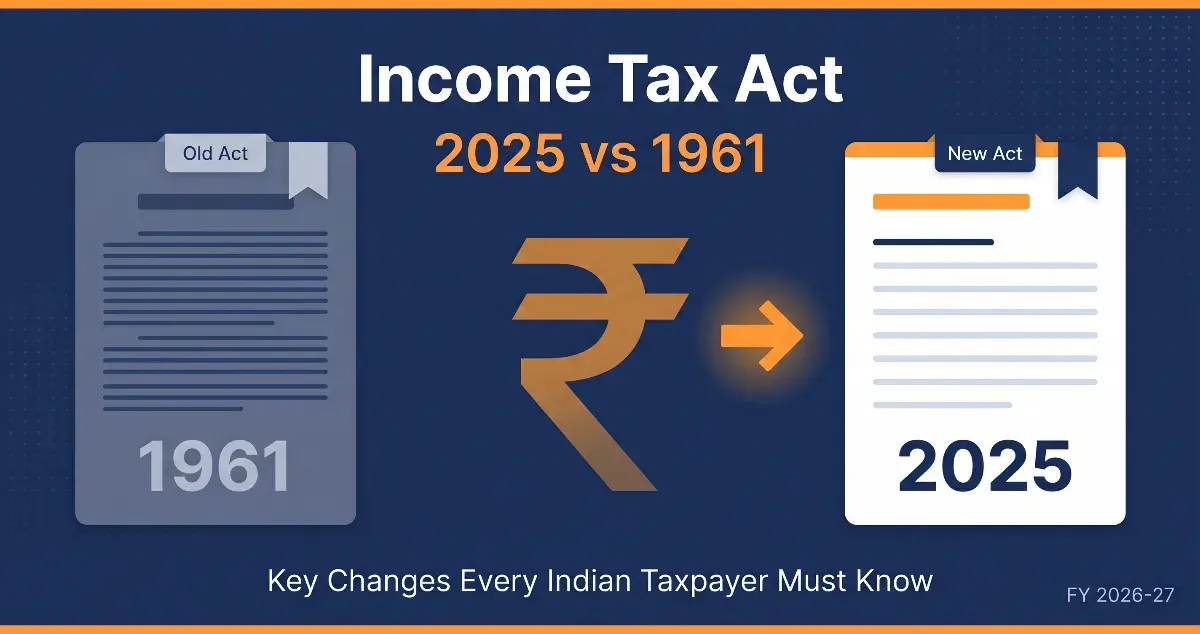

Income Tax Act 2025 vs 1961 — what changed, what didn't, and how it affects your taxes from FY 2026-27. Compare slabs, sections, and key rules.
Quick Answer: The Income Tax Act 2025 replaced the 1961 Act from 1 April 2026. It slims the law from 819 sections to 536, merges "Previous Year" and "Assessment Year" into a single "Tax Year," and consolidates all TDS provisions under one section — but the tax rates, slabs, and deductions you actually pay remain exactly the same.
Which Act applies to your ITR right now?
Filing for FY 2025-26 (ITR due July 31, 2026)? → Use the Income Tax Act, 1961. Old section numbers (80C, 139, 143), Form 16, and Form 26AS all apply as usual.
Filing for FY 2026-27 (Tax Year 2026-27, due July 31, 2027)? → Use the Income Tax Act, 2025. New section numbers (Section 123 instead of 80C), Form 130 instead of Form 16, and Form 168 instead of Form 26AS.
The e-filing portal will support both Acts simultaneously — Tab 1 for old Act, Tab 2 for new Act.
The Income Tax Act, 1961 was a solid piece of legislation for its era. But 65 years and roughly 4,000 amendments later, it had become something of a legal jungle. Over 850 provisos and explanations. Multiple Finance Acts layering exceptions on top of exceptions. Cross-references that sent you from Section 80C to Section 10(14) to a sub-clause in Rule 2BB — all for one simple deduction.
The Income Tax Act, 2025 was formally passed by Parliament on 11 August 2025, received Presidential assent on 21 August 2025, and came into force on 1 April 2026. The stated goal was not to redesign the tax system but to rewrite the container — cleaner, shorter, easier to read. Think of it like migrating a legacy codebase to a modern framework. The business logic is unchanged; the structure is completely rebuilt.
This matters for you practically. If you filed your ITR for FY 2025-26 (AY 2026-27) before 31 March 2026, you used the 1961 Act. From FY 2026-27 (Tax Year 2026-27) onward, the 2025 Act applies.
Feature | Income Tax Act, 1961 | Income Tax Act, 2025 |
|---|---|---|
Total Sections | 819 | 536 |
Schedules | 14 | 16 |
Rules | 511 (with 399 forms) | 333 (with 190 forms) |
Chapters | Not clearly structured | 23 distinct chapters |
Year Terminology | Previous Year + Assessment Year | Tax Year (single concept) |
TDS Sections | Multiple (Sections 192–194T) | Consolidated under Section 393 |
New Tax Regime Section | Section 115BAC | Section 202 |
Section 87A Rebate | Section 87A | Section 156 (Clause 156) |
Effective Date | 1 April 1962 | 1 April 2026 |
Faceless Assessment | Scheme-based authority | Direct statutory basis |
Digital Enforcement | Ad hoc | "Virtual Digital Space" formally defined |
(Source: incometax.gov.in, FAQs on Income Tax Act 2025; as of June 2026)
The single most important thing to internalize: tax policy has not changed. What changed is section numbers, terminology, and document structure. If someone tells you the 2025 Act will raise or lower your taxes, that's incorrect — the Finance Act 2025 slabs carry across without modification.
The "Tax Year" change deserves a closer look because it trips people up. Under the 1961 Act, income earned in FY 2025-26 was assessed and taxed in AY 2026-27. This two-year reference created consistent confusion — ask any first-time filer. The 2025 Act scraps both terms. Now income earned in Tax Year 2026-27 is simply Tax Year 2026-27. One reference. Done.
This is the most-searched piece of information on this topic. Every section number you knew from the 1961 Act has changed. The benefits and limits are identical — only the reference numbers are different. Here are the key mappings every Indian taxpayer needs to know:
Section (1961 Act) | Section (2025 Act) | What It Covers |
|---|---|---|
Section 80C | Section 123 | Deductions — PPF, ELSS, LIC, tuition fees, housing loan principal (limit ₹1.5 lakh) |
Section 80D | Section 124 | Health insurance premium deduction (₹25,000 / ₹50,000 for senior citizens) |
Section 80E | Section 125 | Interest on education loan deduction |
Section 80G | Section 133 | Donations to charitable institutions |
Section 80TTA | Section 140 | Interest on savings account (up to ₹10,000) |
Section 87A | Section 156 | Tax rebate (up to ₹60,000 for income ≤ ₹12 lakh under new regime) |
Section 115BAC | Section 202 | New (default) tax regime for individuals and HUFs |
Section 10 | Schedule II | Income exemptions — HRA, gratuity, leave encashment, provident fund |
Section 139 | Section 263 | Filing of income tax return (due dates) |
Section 143(3) | Section 278 | Scrutiny assessment by assessing officer |
Section 148 | Section 285 | Notice for income escaping assessment (reopening) |
Section 192 | Section 392 | TDS on salary by employer |
Section 194C | Section 393 | TDS on payments to contractors (now consolidated) |
Section 194J | Section 393 | TDS on professional/technical fees (consolidated under 393) |
Section 195 | Section 393 | TDS on payments to non-residents |
Section 270A | Section 295 | Penalty for under-reporting / misreporting of income |
Section 271 | Section 300 | Penalty for concealment of income |
Section 44AB | Section 63 | Tax audit requirement for businesses and professionals |
Form 16 | Form 130 | TDS certificate issued by employer to employee |
Form 26AS | Form 168 | Annual tax statement / consolidated tax credit statement |
Note: For your July 2026 ITR filing (FY 2025-26), use the old 1961 Act section numbers. New section numbers apply from July 2027 filing (Tax Year 2026-27) onwards. Source: incometax.gov.in section mapping utility; CBDT clarifications.
One of the most common points of confusion around the Income Tax Act 2025 is the replacement of "Financial Year" and "Assessment Year" with a single concept: Tax Year.
Under the old 1961 Act framework, every taxpayer had to track two different year references for the same income:
Previous Year (or Financial Year) — the year in which income was earned (e.g., April 2025 to March 2026)
Assessment Year (AY) — the following year in which that income was assessed and taxed (e.g., AY 2026-27)
This created constant confusion, especially for first-time filers who couldn't understand why their "FY 2025-26 income" was being filed in "AY 2026-27."
Under the Income Tax Act 2025, both terms are gone. There is only one reference: Tax Year.
Under 1961 Act | Under 2025 Act | ITR Due Date |
|---|---|---|
FY 2025-26 / AY 2026-27 | Not applicable (1961 Act still governs) | July 31, 2026 |
FY 2026-27 / AY 2027-28 | Tax Year 2026-27 | July 31, 2027 |
FY 2027-28 / AY 2028-29 | Tax Year 2027-28 | July 31, 2028 |
Important: The fiscal year itself has not changed. Tax Year 2026-27 still runs from 1 April 2026 to 31 March 2027 — the April-to-March cycle continues exactly as before. Only the naming convention changed.
Because the slabs are unchanged in substance, here's a clean look at what applies from 1 April 2026:
Taxable Income | Rate |
|---|---|
Up to ₹4 lakh | Nil |
₹4 lakh – ₹8 lakh | 5% |
₹8 lakh – ₹12 lakh | 10% |
₹12 lakh – ₹16 lakh | 15% |
₹16 lakh – ₹20 lakh | 20% |
₹20 lakh – ₹24 lakh | 25% |
Above ₹24 lakh | 30% |
Key points: Standard deduction of ₹75,000 applies for salaried individuals. Section 156 (formerly 87A) rebate of up to ₹60,000 applies for income up to ₹12 lakh — making effective tax zero up to ₹12.75 lakh for salaried taxpayers.
Taxable Income | Rate |
|---|---|
Up to ₹2.5 lakh | Nil |
₹2.5 lakh – ₹5 lakh | 5% |
₹5 lakh – ₹10 lakh | 20% |
Above ₹10 lakh | 30% |
Key points: Standard deduction of ₹50,000. Section 87A rebate of ₹12,500 for income up to ₹5 lakh. Allows 80C (up to ₹1.5 lakh), 80D, HRA, home loan interest, LTA, and 70+ other deductions.
Add 4% Health & Education Cess to the computed tax under either regime.
Surcharge applies on higher incomes: 10% for income ₹50 lakh – ₹1 crore; 15% for ₹1 crore – ₹2 crore; 25% for ₹2 crore – ₹5 crore; 25% for above ₹5 crore (under the new regime; 37% on old regime for >₹5 crore).
(Source: Finance Act 2025 / Union Budget 2025; incometax.gov.in; verify surcharge rates for specific income levels before relying on them)
Priya is a 32-year-old software engineer in Bengaluru earning ₹12 lakh per year.
Gross salary: ₹12,00,000
Less standard deduction: ₹75,000
Taxable income: ₹11,25,000
Tax computation:
Up to ₹4 lakh: ₹0
₹4–8 lakh @ 5%: ₹20,000
₹8–11.25 lakh @ 10%: ₹32,500
Sub-total tax: ₹52,500
Section 156 rebate (taxable income ≤ ₹12 lakh ✓): –₹52,500
Tax payable: ₹0
Priya pays nothing. Zero. This is a genuine outcome of the revised slabs + higher rebate under the 2025 Act — not a loophole.
Arvind is a 40-year-old senior manager earning ₹18 lakh. He has 80C investments of ₹1.5 lakh, pays ₹18,000 as health insurance (80D), and receives HRA of ₹3 lakh (fully exempt given his rent).
New Regime calculation:
Taxable income: ₹18,00,000 – ₹75,000 (std deduction) = ₹17,25,000
Tax: ₹0 + ₹20,000 + ₹40,000 + ₹60,000 + ₹25,000 (₹17.25L – ₹16L = ₹1.25L @ 20%) = ₹1,45,000
Actually: ₹0 + 5%×4L + 10%×4L + 15%×4L + 20%×1.25L = ₹20,000+₹40,000+₹60,000+₹25,000 = ₹1,45,000
Plus 4% cess: ₹5,800
Total: ₹1,50,800
Old Regime calculation:
Gross: ₹18,00,000
Less standard deduction: ₹50,000
Less 80C: ₹1,50,000
Less 80D: ₹18,000
Less HRA exemption: ₹3,00,000
Taxable income: ₹12,82,000
Tax: 5%×₹2.5L + 20%×₹5L + 30%×₹2.82L = ₹12,500 + ₹1,00,000 + ₹84,600 = ₹1,97,100
Plus 4% cess: ₹7,884
Total: ₹2,04,984
Arvind saves ₹54,184 per year under the new regime, despite having ₹4.68 lakh in deductions. This is the regime crossover point in action — once your deduction stack isn't large enough, the new regime wins.
To instantly compare your specific numbers, use the Old vs New Tax Regime Calculator on Toolisky — plug in your income and deductions, and it shows you the better option in seconds.
This works for both the 1961 Act era and under the new 2025 Act — the math hasn't changed, only the section references.
Step 1: Calculate Gross Total Income Add all income heads: salary, house property, business/profession, capital gains, other sources (FD interest, dividends, etc.).
Step 2: Subtract Deductions
New regime: Only standard deduction (₹75,000 for salaried), NPS employer contribution (Section 80CCD(2)), and a small list of others.
Old regime: Standard deduction (₹50,000) plus 80C (₹1.5 lakh), 80D, HRA exemption, home loan interest, LTA, and more.
Step 3: Apply Slab Rates Use the tables in Section 3 above. Tax is calculated progressively — each slab rate applies only to income within that bracket.
Step 4: Apply Rebate
New regime: Income ≤ ₹12 lakh? Rebate up to ₹60,000 (Section 156 / formerly 87A).
Old regime: Income ≤ ₹5 lakh? Rebate up to ₹12,500.
Check if marginal relief applies if your income is just above the rebate threshold. Use the Section 87A Marginal Relief Calculator to handle this quickly — the math is genuinely tricky at the boundary.
Step 5: Add Surcharge and Cess Add applicable surcharge (if income > ₹50 lakh), then add 4% Health & Education Cess on (tax + surcharge).
Use the Salary Tax Calculator India to automate all five steps for your exact CTC and deduction profile.
Salaried employees: Your Form 16 format changes from Tax Year 2026-27 onward — the old Form 16 references 1961 Act section numbers. CBDT will issue updated forms. Your actual tax liability: unchanged.
Freelancers and consultants: TDS certificates and challans will carry new section references (e.g., TDS under Section 393 instead of Section 194J). Make sure your accounting software is updated. Tax rates on professional income: unchanged.
MSME owners: The 2025 Act formally defines "Virtual Digital Space" — covering email servers, cloud storage, social media accounts, and online trading records. This enables the Income Tax Department to conduct digital surveys and enforcement more systematically. Keep business records well-organized digitally. For MSME-specific financial tools, see the MSME Classification Calculator on Toolisky.
NRIs: Residential status rules, which affect what income is taxable in India, sit in Chapter II of the new Act. The substance hasn't changed, but the section numbers have — consult a CA when filing.
Trusts and NGOs registered under 12A/80G: The 2025 Act restructured Chapter XVI provisions. New Form 112 applies for audit reporting. This is one area where the operational changes go beyond just renumbering.
What happens to assessments, appeals, and notices issued under the 1961 Act after 1 April 2026?
This is a common misconception: many people assume the 1961 Act simply disappears on 1 April 2026. It doesn't — not entirely. Section 536 of the new Act contains a "savings clause" that keeps the 1961 Act alive for all proceedings, assessments, and appeals relating to tax years before 1 April 2026.
So if you get a scrutiny notice in July 2026 for FY 2023-24, it will still be governed by the Income Tax Act, 1961. The relevant section numbers in the notice will refer to the old Act. Don't panic when you see "Section 143(3)" — that's not a typo. That assessment proceeds under the 1961 framework.
What to do: Keep a copy of both the old and new Acts (or the section mapping published by incometax.gov.in) for at least 6 years post-2026, since assessments can go back that far.
Common misconception to correct: Several social media posts claimed the 2025 Act introduces a "new tax year" that shifts India to a January–December fiscal year. This is completely false. The Tax Year under the 2025 Act is still 1 April to 31 March — it simply consolidates the old "Previous Year" and "Assessment Year" terminology into one label.
These Toolisky calculators are directly relevant to understanding your tax position under the new framework:
Old vs New Tax Regime Calculator — Compare your exact liability under both regimes side by side.
Salary Tax Calculator India — Full tax computation from gross CTC to take-home.
Section 87A Marginal Relief Calculator — Critical if your income is between ₹12–₹12.75 lakh (new regime) or ₹5–₹5.1 lakh (old regime).
Standard Deduction Tax Impact Calculator — Understand how the ₹75,000 vs ₹50,000 deduction affects your final number.
Capital Gains Tax Calculator — For equity, mutual fund, or property gains; useful as capital gains rules are largely preserved in the 2025 Act.
MSME Classification Calculator — For business owners navigating MSME-specific benefits.
Q: Has the Income Tax Act 2025 changed my tax slab rates? No. The Finance Act 2025 slab rates carry forward unchanged into the Income Tax Act 2025. Under the new (default) regime, income up to ₹12 lakh remains effectively tax-free due to rebates. Under the old regime, rates of 5%, 20%, and 30% continue as before. The 2025 Act is a structural reform, not a rate change.
Q: Which income tax act applies for FY 2025-26 filing? The Income Tax Act, 1961 applies for your July 31, 2026 ITR filing. Old section numbers (80C, 139, 143), Form 16, and Form 26AS all apply as usual. The Income Tax Act 2025 applies only from Tax Year 2026-27 (July 2027 filing) onwards.
Q: Do I need to do anything differently when filing my ITR from FY 2026-27? Your ITR form numbers and some section references in Form 16 will change. CBDT will issue updated forms for Tax Year 2026-27 onward. Your actual calculation — income, deductions, tax — follows the same logic. Most tax filing software will be updated automatically; just ensure you're using a current version.
Q: What is the "Tax Year" concept in the Income Tax Act 2025? Tax Year replaces the dual terminology of "Previous Year" (when income is earned) and "Assessment Year" (when it is taxed). Under the 2025 Act, income earned in Tax Year 2026-27 (1 April 2026 to 31 March 2027) is assessed and taxed in that same reference year. It's simpler — one label instead of two.
Q: What is the new section number for 80C in the Income Tax Act 2025? Section 80C is now Section 123 under the Income Tax Act 2025. The ₹1.5 lakh deduction limit and all eligible investments remain unchanged. Similarly, 80D is now Section 124, and 80E is now Section 125.
Q: Has Form 26AS been renamed under the Income Tax Act 2025? Yes. Form 26AS is renamed Form 168 under the new Act. Form 16 is renamed Form 130. These new form numbers apply from Tax Year 2026-27 onwards. Your July 2026 filing still uses the old form names.
Q: Which tax regime is better for a ₹10 lakh salary? At ₹10 lakh gross, a salaried individual in the new regime has taxable income of ₹9.25 lakh (after ₹75,000 standard deduction) and pays ₹52,500 tax + cess. Under the old regime, you'd need deductions exceeding roughly ₹2.2 lakh to do better. If you have ₹1.5 lakh in 80C investments plus ₹50,000 in HRA or 80D, the old regime may edge ahead. Use Toolisky's Old vs New Regime Calculator for your exact scenario.
Q: I received a tax notice in 2026 for FY 2022-23. Which Act applies? The Income Tax Act, 1961. The Section 536 savings clause in the 2025 Act ensures all proceedings for tax years before 1 April 2026 continue under the 1961 Act. Section references in your notice will follow the old numbering.
Q: Is Section 80C still available after the Income Tax Act 2025? The deduction continues to exist under the new Act, though it sits under restructured chapters and renumbered sections. Under the old tax regime (optional), you can still claim up to ₹1.5 lakh for PPF, ELSS, life insurance, and so on. Under the new (default) tax regime, 80C-type deductions are still disallowed. The regime choice, not the new Act itself, determines whether 80C helps you.
Q: Is the 4% Health & Education Cess still applicable? Yes. The 4% Health & Education Cess on total tax (plus surcharge, if applicable) continues under the Income Tax Act 2025 without any change.
Q: Does the Income Tax Act 2025 affect HUFs and firms differently? For HUFs, slab rates and deduction eligibility are largely unchanged. The new tax regime (Section 202) covers HUFs alongside individuals. Firms and LLPs continue to be taxed at flat rates under separate provisions. If you operate a business through a partnership or LLP, the structural renumbering affects your TDS certificate references but not your tax rate.
Q: What is the standard deduction for salaried employees now? ₹75,000 under the new tax regime and ₹50,000 under the old tax regime. This applies for FY 2026-27 onward under the Income Tax Act 2025, identical to what was in effect for FY 2025-26 under the 1961 Act.
Q: Can I still opt for the old tax regime after 1 April 2026? Yes. The old regime remains available as an opt-in choice under the Income Tax Act 2025. For salaried individuals, the choice can be made each year. For those with business income, switching back from the new regime has restrictions — same rules as before, just renumbered.
Income Tax Act, 2025 — Gazette notification, Ministry of Law and Justice, 21 August 2025 — incometax.gov.in
FAQ: Objective and Scope of the New Act — Income Tax Department, incometax.gov.in (accessed June 2026)
Finance Act, 2025 / Union Budget 2025 — CBDT notification on revised slabs and Section 87A rebate — cbdt.gov.in
Income Tax Rules, 2026 — Ministry of Finance; effective 1 April 2026
Section 87A rebate limits — as per Finance Act 2025; verify current limits at incometax.gov.in before filing
Disclaimer: This article is for educational and informational purposes only. It does not constitute tax, legal, or financial advice. Tax laws are subject to change, and individual circumstances vary. Please consult a qualified Chartered Accountant or tax professional before making any tax-related decisions. The worked examples use simplified assumptions and may not reflect your exact situation.
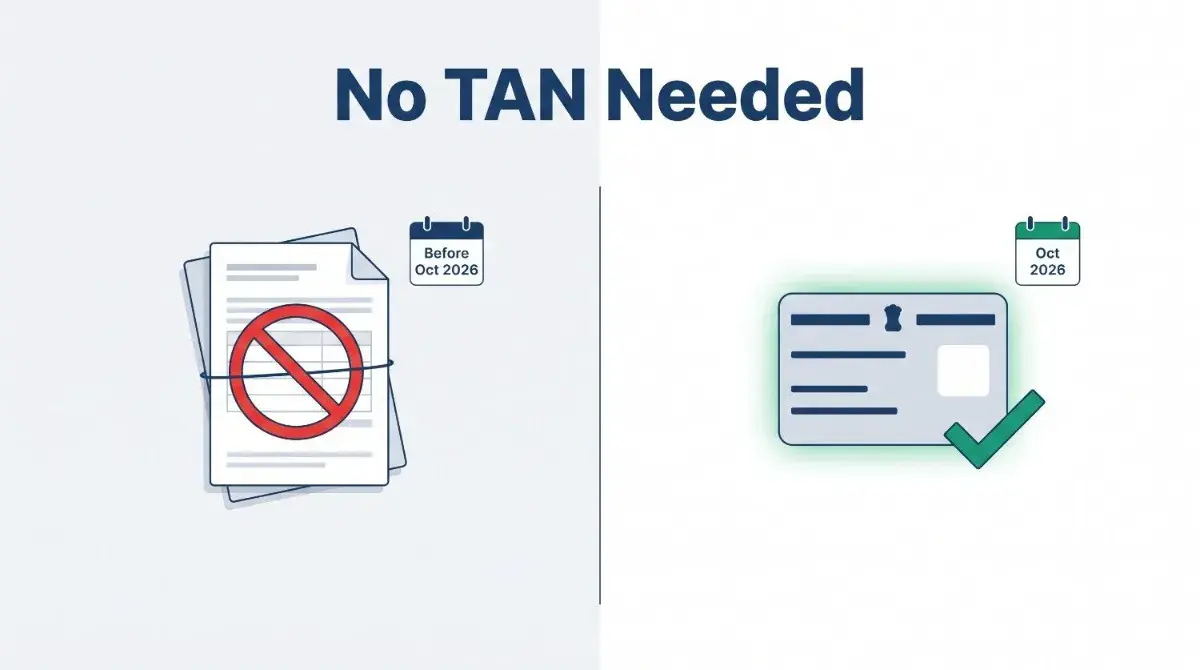
No TAN for NRI property purchase applies only from 1 October 2026, and only to resident individual and HUF buyers. Get the rates, forms, and dates you need.
Jul 25, 2026

Did you lose the SGB premature redemption tax exemption? Here's exactly who's affected, how much tax applies now, and how to check your own bonds.
Jul 24, 2026
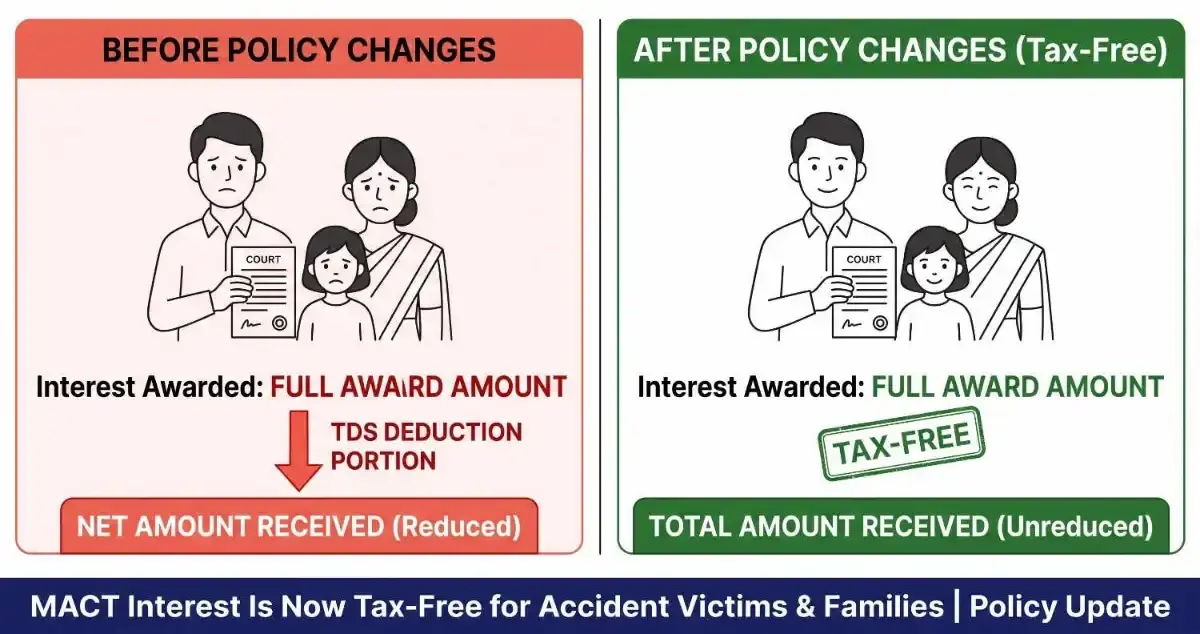
MACT interest income TDS exemption 2026 explained: who qualifies, old vs new Act rules, the FD interest trap, refund steps, and how to report it in your ITR.
Jul 24, 2026