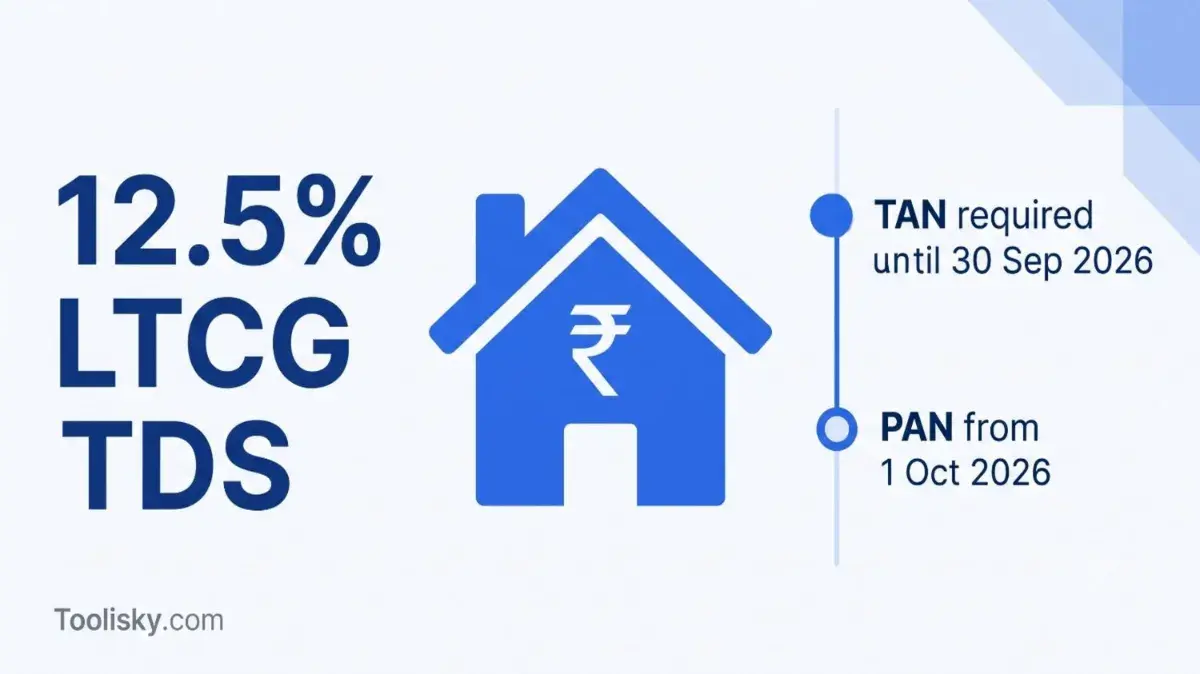

TDS on property purchase from NRI 2026: 12.5% LTCG rate, TAN rules till 30 Sept, DTAA reality, inherited property rules, and two worked ₹ examples inside.
Buying property from an NRI? You'll deduct TDS at 12.5% on long-term gains, or at slab rate on short-term gains, under Section 393(2) of the Income-tax Act, 2025. And here's the part most buyers miss: you deduct this on the full sale price, not just the seller's profit. You'll also still need a TAN for any deal closing before 1 October 2026.
Simply put, it's the tax you, the buyer, must cut from the sale price and deposit with the government before handing over the balance to an NRI seller. You can't pay the full amount and let the seller sort out their taxes later — the law puts that job on you.
This is governed by Section 393(2), Table Serial No. 17 of the Income-tax Act, 2025, effective from 1 April 2026. It's the direct successor to Section 195 of the old 1961 Act — so if you've read older articles talking about "Section 195 TDS," that's the same rule, just renumbered. NRI stands for Non-Resident Indian, and TDS is Tax Deducted at Source.
One quick note on timing: if your deal closed before 1 April 2026, Section 195 of the 1961 Act still applies to it. This guide is written for deals happening now, under the 2025 Act.
Applies to | Does NOT apply to |
|---|---|
Resident buyers purchasing property from an NRI, OCI, or PIO seller | NRI buyers purchasing from a resident seller (that falls under Section 393(1), the usual 1% TDS route) |
Individual, HUF, company, or firm buyers — nobody's exempt | Sales where the seller counts as a resident for that tax year |
Every deal size — there's no ₹50 lakh threshold here | Rent, interest, or salary paid to an NRI (different rows under the same Section 393(2) table) |
Both residential and commercial property | Agricultural land in specified rural areas, which follows separate rules |
One case worth flagging: if a property is jointly owned by one resident and one NRI, you deduct two separate amounts — 1% on the resident's share, and the higher NRI rate on the rest. Don't blend the two into one number.
Nature of gain | Holding period | TDS rate |
|---|---|---|
Long-term capital gain (LTCG) | More than 24 months | 12.5%, without indexation, plus surcharge and 4% cess |
Short-term capital gain (STCG) | 24 months or less | Slab rate — most buyers deduct at 30% since they have no way to check the seller's actual slab, plus surcharge and cess |
Seller hasn't shared a valid PAN | Either | 20% flat, under Section 397(2) |
[Source: incometax.gov.in — Section 393 e-filing help page]
Now, the TAN confusion. TAN is still compulsory for every NRI property purchase until 30 September 2026. Budget 2026 proposed scrapping it through an amendment to Section 397(1)(c), but that relief only starts on 1 October 2026, and only for resident individual and HUF buyers. Companies, LLPs, and partnership firms still need a TAN no matter what the calendar says. [Source: Income Tax Department, Union Budget 2026 coverage]
After that date, eligible buyers can deposit TDS using their own PAN through a challan-cum-statement, working much like Form 141 already does for resident-to-resident deals. What decides the rule isn't when your deal started — it's the actual payment date. Instalments straddling 1 October are judged separately.
Indexation stays off the table too. It was removed for property sales from 23 July 2024 onward, and the new Act keeps that rule. The seller pays 12.5% on the whole gain, no inflation adjustment, no matter how many decades ago they bought the place.
Here's something that trips up a lot of people: a DTAA does not stop India from taxing capital gains on Indian property. Most treaties — USA, UK, Canada, Australia — give India the first right to tax gains on property sitting on Indian soil. The treaty just stops the seller's home country from taxing that same gain all over again. It doesn't touch what you deduct at the point of sale.
UAE: No personal income tax back home, so there's nothing to relieve — but the 12.5% Indian TDS still applies in full.
USA, UK, Canada, Australia: India taxes the gain first. The seller then claims a foreign tax credit at home for what they've already paid here, so the same rupee isn't taxed twice — but your TDS deduction doesn't change.
So does a DTAA let you cut a smaller cheque to the tax department? No. The only thing that lowers your deduction is a Lower or Nil Deduction Certificate (Form 128) issued in the seller's favour.
If your seller wants to work out their DTAA position in more detail, Toolisky's DTAA relief calculator is a good starting point.
Suresh, a bank employee in Pune, buys a 2BHK from his NRI uncle in Toronto for ₹80,00,000. His uncle has owned it since 2011 — long-term. Registration: August 2026.
TDS = ₹80,00,000 × 12.5% = ₹10,00,000
Add 4% cess: ₹10,00,000 × 1.04 = ₹10,40,000
Net to seller = ₹80,00,000 − ₹10,40,000 = ₹69,60,000
Since registration is before 1 October, Suresh needs a TAN, deducts at payment, deposits via Challan ITNS 281, and reports it in Form 144 for that quarter.
Farida, a schoolteacher in Nagpur, buys a plot from an NRI seller in Singapore for ₹40,00,000, paid in two instalments — ₹20,00,000 in September 2026, ₹20,00,000 in November. The seller bought it 16 months earlier — short-term.
September instalment: ₹20,00,000 × 30% = ₹6,00,000 + 4% cess = ₹6,24,000. Before 1 October, so she needs a TAN, reported via Form 144.
November instalment: same math, ₹6,24,000. After 1 October, so as an individual buyer, she deposits this leg using her PAN alone — no fresh TAN filing needed.
Total TDS: ₹12,48,000. Net to seller: ₹27,52,000.
One deal, two compliance tracks, because the payment dates land on either side of the cutover — exactly the scenario most guides never mention.
Here's the formula: TDS = sale consideration (or instalment amount) × applicable rate + cess, plus surcharge where relevant.
Confirm the seller's residential status and PAN.
Check the holding period. Over 24 months means LTCG at 12.5%; 24 months or under means STCG, usually deducted at 30%.
Ask if the seller already holds a Form 128 certificate. If they do, use that certified rate instead of the default one.
Apply surcharge if the sale value, combined with the seller's other Indian income, crosses the surcharge threshold — this depends on the seller's total income, so check with a CA rather than guessing.
Add 4% health and education cess on the tax-plus-surcharge figure.
Deduct at the time of payment or credit, whichever happens first — not at registration.
If you'd rather not run these numbers by hand, this NRI property TDS calculator does the LTCG/STCG split, surcharge, and cess for you and shows the exact net payout. And if you're also handling other non-salary payments to non-residents this year, Toolisky's Section 393 TDS rate chart covers the full picture.
Almost every guide tells buyers to "confirm the seller's residential status" and stops right there. So how do you actually check?
What counts as proof: passport with visa or work-permit stamps, an NRO or NRE bank account (NRIs generally can't hold a regular resident savings account), a Tax Residency Certificate, or FRRO registration where it applies. A foreign address on the sale deed alone isn't enough — ask for one of these.
If the seller lies about their status? Your TDS obligation runs on their real status under Section 6, not on what they told you. Deduct at the resident rate for someone who's actually an NRI, and the department can treat you as an "assessee in default," chasing you for the shortfall plus interest under Section 398 — even though the seller misled you. Get a written declaration and keep the papers; it won't fully protect you, but it helps your case in a dispute.
What if the seller became resident partway through the year? Status runs on full-year day-count tests, not the sale date. Someone who moved back mid-year might already count as a resident, even while still holding an NRO account. When unsure, ask for their own residency computation or bring in a CA before you settle on a rate.
If your NRI seller inherited the property, two rules under Section 49(1) change the picture — and this is where buyers get caught off guard.
Cost of acquisition is whatever the original owner paid, not the market value on the day the NRI inherited it. Property bought before 1 April 2001 can use the fair market value as of that date instead.
Holding period carries over the original owner's time too. So a flat "inherited" eighteen months ago, bought by the parent decades earlier, still counts as long-term.
None of this changes what you deduct — you're still withholding tax on the sale price, not the profit. But it explains why the seller's real tax bill is often far lower than the 12.5% TDS you're taking off the top, and why sellers of inherited property so often apply for a Form 128 certificate before closing. Worth asking if they have.
You deducted 20% because the seller hadn't shared a PAN, and it's arrived since. You can't lower a challan already deposited, but you can file a correction statement through TRACES. The seller claims credit for the extra amount when they file, and future instalments go through at the correct rate.
You assumed the PAN-only rule applied, but your payment date was before 1 October 2026. The payment date decides this, not today's date. Apply for a TAN right away and refile Form 144 correctly. Interest under Section 398 applies for the delay.
The seller's Form 128 certificate hadn't come through by closing time. Deduct at the standard rate — don't assume approval is coming and deduct less. Applications usually go in 30 to 60 days before the sale, and TRACES processing takes 10 to 30 days. If your closing date is tight, ask for proof of when they applied.
Document | Digital copy accepted? | Where to get it |
|---|---|---|
Buyer's PAN | Yes | e-filing portal |
NRI seller's valid PAN | Yes | Provided by the seller; apply via NSDL/Protean if missing |
Sale deed or agreement of sale | Yes | Drafted by your property lawyer |
TAN application acknowledgment (deals before 1 Oct 2026) | Yes | e-filing portal, Form 49B |
Form 128 lower or nil deduction certificate, if applicable | Yes | Seller applies via TRACES under Section 395(1) |
Proof of the seller's NRI status (passport stamps, NRO/NRE account, TRC) | Yes | Collected from the seller before finalising the rate |
Stamp duty valuation certificate | Yes | Sub-registrar's office |
Failed to deduct TDS: interest at 1% per month from the due date until you deduct, under Section 398.
Deducted but didn't deposit it: interest at 1.5% per month, under Section 398(3).
Late Form 144 filing: ₹200 a day, capped at that quarter's TDS amount, under Section 427.
Return unfiled a year past due: ₹10,000 to ₹1,00,000, under Section 461.
No valid PAN from the seller: an automatic jump to 20% TDS instead of 12.5%, under Section 397(2) — it hits the seller's payout hardest, but a buyer who deducts less without a valid PAN on file is still on the hook.
Yes. The PAN-only relief begins only on 1 October 2026. Any payment before that still needs a TAN, deducted at the applicable rate, and reported through quarterly Form 144.
No — this is the most common mix-up on the topic. It becomes optional for one group only: resident individual and HUF buyers, from 1 October 2026. Companies, LLPs, and firms still need a TAN either way.
No. Form 141, which replaced Form 26QB, is only for a resident seller, with a ₹50 lakh threshold. NRI purchases use Form 144, the successor to Form 27Q, with no threshold at all. Mixing the two up is a costly, common mistake.
The rules stay the same. Use the actual NRI owner's PAN, never the PoA holder's, and issue Form 131 in the owner's name. A PoA holder can't redirect TDS compliance onto their own PAN.
No, that stays your job. You remain the deductor under Section 393(2), even when a bank pays the seller directly. Talk to your bank so TDS comes out of the disbursed amount, or arrange it separately from your own funds.
Not automatically. A DTAA mostly protects the seller from being taxed twice at home — it doesn't lower what you deduct at source. Only a Form 128 certificate changes your rate.
Not quite. Net proceeds usually land in the seller's NRO account first. Moving money abroad needs Form 145, and Form 146 from their CA where taxable, and repatriation is generally capped at USD 1 million per financial year.
It could get flagged as defective, since Section 195 isn't live for FY 2026-27 transactions anymore. File a correction statement with the right section reference — usually only the deductee-level entry needs fixing.
Deduct two separate amounts — 1% on the resident's share under Section 393(1), and 12.5% or 30% on the NRI's share under Section 393(2), depending on holding period. Treat these as two transactions, not one blended rate.
No. Unlike the ₹50 lakh floor on resident-to-resident sales, TDS on an NRI seller applies from the first rupee.
Yes, by filing Form 128, which replaced the old Form 13, under Section 395(1) — asking the Assessing Officer for a lower or nil certificate based on their actual expected liability.
Check your payment date against 1 October 2026 before you assume which compliance route applies — the paperwork on TDS on property purchase from NRI deals changes, but the tax rate doesn't. Lock in the seller's PAN and proof of NRI status well before registration, since a missing PAN alone adds 7.5 percentage points to your TDS bill. Run your exact numbers with the NRI property TDS calculator, read up on the TAN rules for NRI property purchase if your deal straddles 1 October, and always cross-check the latest rules on the Income Tax Department's official website.
For educational purposes only. Verify all figures at official sources before acting. Toolisky is not affiliated with any government body. Consult a qualified CA or legal professional before making compliance decisions. See toolisky.com/accuracy-and-limitations.

Border tax payment 2026: pay checkpost tax on Parivahan, fix a pending or failed transaction, verify your receipt, and check state-specific rates.
Aug 31, 2026

8th pay commission arrears will likely arrive as a lump sum once notified, covering January 2026 onward. Here's the real timeline, the math, and the tax rules.
Aug 20, 2026

Section 87A proviso explained: first proviso rebate limits vs the second proviso's capital-gains bar, with FY 2025-26 math and real fixes for demand notices.
Aug 19, 2026