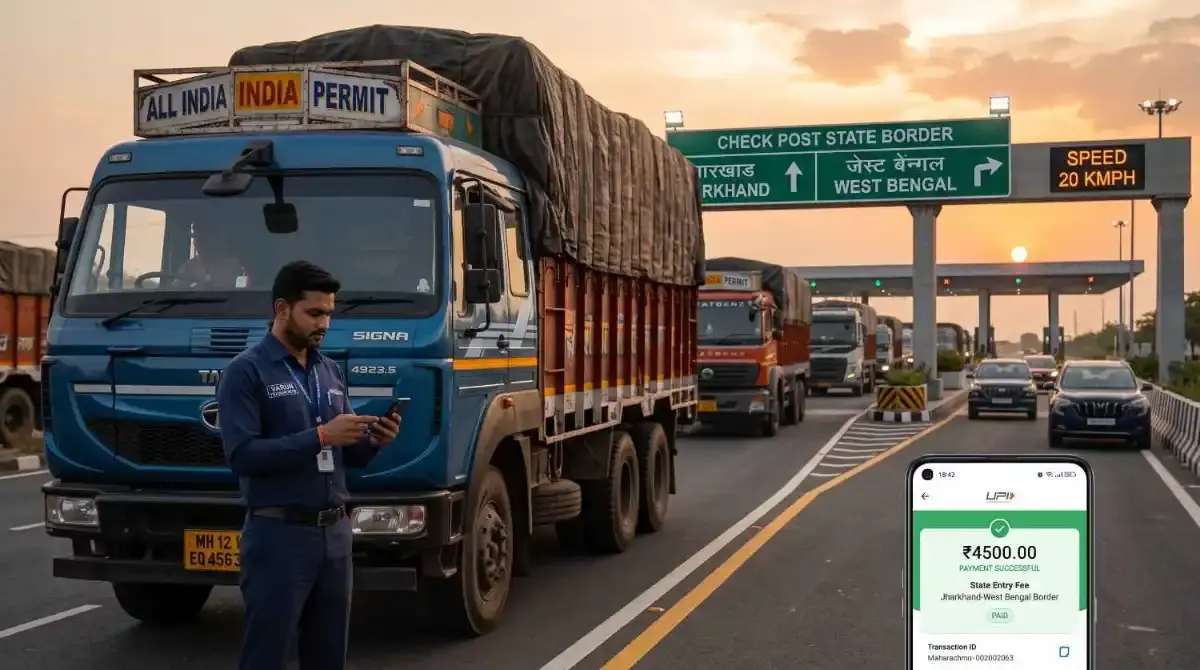

Border tax payment 2026: pay checkpost tax on Parivahan, fix a pending or failed transaction, verify your receipt, and check state-specific rates.
Border tax payment is the road tax a state government collects from an out-of-state commercial vehicle before it can legally operate within that state's borders. You pay it online through the Parivahan checkpost system at vahan.parivahan.gov.in/checkpost, and the amount depends on your vehicle's weight, your permit type, and which state you're entering.
Ramesh drives a goods carrier registered in Madhya Pradesh. Last month, a checkpost officer near the Rajasthan border stopped his truck and asked for proof of border tax payment. He'd genuinely never heard the term before that day. Most transporters learn about it the same way — at the barrier, under time pressure.
Here's the plain version. Border tax, commonly called checkpost tax or special road tax, sits under the Motor Vehicles Act, 1988 (a central law), read together with each state's own Motor Vehicles Taxation Act. Two provisions do most of the work:
Section 66(1) of the Motor Vehicles Act, 1988 says no transport vehicle can be used in a public place without a valid permit.
Section 88(9) lets a State Transport Authority grant tourist permits valid across states, and states use this and their own taxation acts to charge special road tax on out-of-state vehicles operating within their territory.
This is a state road-tax matter, not an income-tax one. You won't find a "border tax" provision in the Income-tax Act, 1961, or in the Income-tax Act, 2025 (effective 1 April 2026) — if you arrived here expecting something about cross-border money transfers or customs duty, this article covers a different subject: vehicles crossing state lines within India.
The official system for paying it is the Parivahan checkpost portal at vahan.parivahan.gov.in/checkpost, run under the Ministry of Road Transport and Highways, currently on its fourth version (Checkpost V4).
Not every interstate vehicle owes border tax, and it's worth being precise about this rather than assuming a blanket rule.
Situation | Border Tax Likely Applies? |
|---|---|
Commercial goods vehicle entering another state on a temporary permit | Yes, in most states |
Contract carriage, taxi, or tourist bus crossing a state border for hire | Yes, under Section 88(9) special road tax |
Vehicle holding a valid National Permit under Section 88, where the destination state has a reciprocal exemption | Often exempt, but not automatically — check the specific state |
Private car crossing a state purely for personal, non-commercial travel | Generally no |
Temporarily registered vehicle or bare chassis passing through a state | Yes, usually at a flat rate |
Vehicle carrying Over Dimensional Cargo (ODC) | Yes, plus a separate ODC-related fee on the same portal |
Two things matter more than anything else here: whether the vehicle is being used commercially, and whether the destination state has a reciprocal agreement with the vehicle's home state. Both vary. A national permit that's fully exempt going into one state can still attract an authorisation fee going into another, so treat "national permit vehicles don't pay border tax" as a starting assumption to verify, not a fixed rule.
Go directly to vahan.parivahan.gov.in/checkpost. Type the URL yourself rather than tapping a link from an SMS or forwarded message.
Open "Online Services" and select the checkpost tax / border tax payment option, then choose "Tax Payment."
Select your visiting (destination) state, then pick the correct service name — typically "VEHICLE TAX COLLECTION (OTHER STATE)" for most states, or "VEHICLE TAX COLLECTION (NCR)" if you're entering the Delhi NCR region specifically.
Enter your vehicle registration number and click "Get Details." Registration details should auto-fill from the VAHAN database.
Fill in the remaining fields: mobile number, source state, permit type, purpose of journey, entering district, and the tax period dates.
Click "Calculate Tax" and check the total against your destination state's published rate table before proceeding.
Pay via net banking, UPI, or card. The portal redirects you to a payment gateway and back.
Download the receipt once payment clears, and use the link on the confirmation page to print your permit where applicable.
A quick practical tip: running your registration number through a vehicle number format checker before you start can catch a mistyped character early — a malformed number is one of the more common reasons a transaction won't go through cleanly on the first attempt.
This is where most complaints actually originate, and the fix depends on which failure you're looking at.
Payment shows "pending." The checkpost system will not let you start a fresh transaction for the same vehicle while an earlier one is still pending — it has to be resolved first. Use the portal's "Check Pending Transaction" option, enter your vehicle number, and review the current status before doing anything else. Pending usually means the bank hasn't confirmed the transaction back to the portal yet, which can take time.
Money was deducted, but the transaction shows as failed. This is a bank-side reconciliation delay more often than a lost payment. Note your bank reference number and wait, since re-attempting immediately can occasionally create a second pending entry against the same vehicle. If the status still shows failed after checking again later, use "Reverify Failed Transactions" on the portal — select your state, enter your vehicle number, and it will pull the transaction details for review.
The payment page goes blank or doesn't respond. Retry after a short wait. If it persists, that's a portal-side or connectivity issue rather than something on your end, and it's worth trying a different browser or network before assuming the tax wasn't paid.
If none of these resolve it within a reasonable window, raise the issue with the destination state's transport department or the relevant helpdesk, quoting your bank reference number and transaction ID rather than just the vehicle number — that's what actually lets someone trace the payment on their side.
Once a payment succeeds, the portal generates a computer-generated tax receipt showing your vehicle number, chassis number, transaction ID, bank reference number, and the tax period covered. Genuine receipts issued through the system also carry an instruction to verify the receipt through the portal itself, and many carry a QR code for the same purpose — don't treat a printed copy alone as sufficient if a checkpost officer questions it; the underlying transaction record on the portal is what settles the question.
For a manual cross-check without logging in, some users are able to verify a vehicle's checkpost payment status by messaging VAHAN, followed by the state code, "CP," and the vehicle number (for example, VAHAN RJ CP RJ14AB1234) to 7738299899. This SMS-based lookup builds on the same VAHAN database the portal uses, though SMS-based services can change without much notice, so if it doesn't respond, fall back to the portal's own receipt or transaction-status pages rather than assuming your payment failed.
Keep both a digital and printed copy of the receipt in the vehicle. Some checkpost enforcement teams still ask for a physical copy even though the record exists online.
There is no single national border-tax rate, and any source claiming otherwise is oversimplifying. Each state notifies its own slabs under its own Motor Vehicles Taxation Act, and these figures change independently of each other on their own schedules.
As a concrete, sourced example, Rajasthan's structure for goods vehicles entering on a 30-day permit is notified under F6(252)Pari/Tax/HQ/5/4G dated 9 March 2007, published by the Rajasthan Transport Department:
Vehicle Weight (GVW/RLW) | Road Tax | Special Road Tax |
|---|---|---|
Up to 7,000 kg | ₹110 per 1,000 kg, or part thereof, for 30 days | ₹90 per 1,000 kg of load capacity up to 5,000 kg |
Above 7,000 kg (extra) | ₹50 per additional 1,000 kg, or part thereof | ₹70 per additional 1,000 kg above 5,000 kg |
Rajasthan also runs separate, differently structured slabs for contract carriages under Section 88(9) tourist permits, for stage carriages on reciprocal agreements, and for temporarily registered vehicles or bare chassis passing through — each with its own notification number.
Other states run their own systems entirely: Gujarat's motor vehicle tax framework, Maharashtra's, and Uttar Pradesh's each set their own slabs, thresholds, and notification numbers, and none of them mirror Rajasthan's figures exactly. If your route runs through Gujarat–Maharashtra, Delhi NCR, or any other specific corridor, treat the rate shown on the Parivahan calculator for that destination state as the number to trust, not a figure carried over from a different state's table. For a broader state-by-state comparison and additional worked rate scenarios, see our detailed checkpost tax rates guide.
The portal calculates the tax automatically once you enter your vehicle's weight and permit details, but knowing the logic helps you catch an error before you pay.
Example 1 — the common case. Ramesh's truck has a GVW of 6,000 kg and a load capacity of 4,000 kg, entering Rajasthan on a 30-day temporary permit. Both figures sit inside the "up to 7,000 kg" band.
Road tax: 6,000 ÷ 1,000 × ₹110 = ₹660
Special road tax: 4,000 ÷ 1,000 × ₹90 = ₹360
Total: ₹1,020 for the 30-day permit window
Example 2 — the edge case. Priya runs a slightly larger operation. Her truck's GVW is 8,500 kg, with a 6,000 kg load capacity — both numbers cross Rajasthan's 7,000 kg and 5,000 kg thresholds.
Road tax: (₹110 × 7) + (₹50 × 2, since the excess 1,500 kg rounds up to a full 2,000 kg) = ₹770 + ₹100 = ₹870
Special road tax: (₹90 × 5) + (₹70 × 1, for the excess 1,000 kg) = ₹450 + ₹70 = ₹520
Total: ₹1,390 for the same 30-day window
The phrase "or part thereof" is where most people lose money. Priya's excess weight was only 1,500 kg, but the slab still bills for a full extra 2,000 kg on both the road tax and special road tax components. Work the two halves out separately before trusting the on-screen total, especially near a threshold.
These four get confused constantly, and mixing them up is the single most common reason people show up at the wrong payment window.
Term | What It Actually Is | Still Applies Today? |
|---|---|---|
Border tax / checkpost tax | Road tax an out-of-state vehicle owes to the destination state, under that state's Motor Vehicles Taxation Act | Yes |
Road tax (home state) | Tax for using a vehicle within the state where it's registered | Yes |
Toll tax | A fee for using a specific road, bridge, or expressway, charged regardless of the vehicle's registration state | Yes, but a separate system entirely (FASTag), unrelated to border tax |
Entry tax | An older state levy on goods entering for sale or use | Mostly folded into GST since 1 July 2017; largely doesn't exist in its old form |
E-Way Bill | A GST compliance document generated on the e-way bill portal for movement of goods above a state-specified value threshold, under Rule 138 of the CGST Rules | Yes, but it tracks the goods and their invoice value, not the vehicle's tax status |
Border tax is a tax on the vehicle. Toll is a fee for the road. Entry tax, where it still existed, taxed the goods. An e-way bill documents a goods movement for GST purposes. A truck can need all four at different points of the same trip, and paying one doesn't substitute for another.
Rates and rules genuinely differ by vehicle type and by state, so a few points worth flagging rather than glossing over:
Goods vehicles are taxed by GVW or RLW slabs, as shown above. Contract carriages and tourist buses are taxed by seating capacity instead, under a completely different notification.
National permit vehicles under Section 88 may be exempt from a destination state's special road tax where a reciprocal arrangement exists, but some states still charge a separate authorisation fee even on exempt vehicles — this is set out in Section 88(14)(b) of the Motor Vehicles Act, 1988.
Delhi NCR movement uses a distinct service option on the portal ("VEHICLE TAX COLLECTION (NCR)") rather than the general other-state option, reflecting the NCR's separate tax-coordination arrangement among Delhi, Haryana, and UP.
Temporarily registered vehicles or bare chassis passing through a state without unloading still attract a flat per-vehicle or per-chassis charge in most states, even for a brief transit.
Rates change when states revise their Motor Vehicles Taxation Act notifications, which typically happens around state budget announcements. A rate correct today can be outdated within a year, so always confirm the current figure on the destination state's own transport portal or the Parivahan checkpost calculator before paying, rather than relying on a rate table from an old bookmark or a search result.
Is border tax the same as toll tax? No. Toll tax is charged for using a specific road, bridge, or expressway, collected through FASTag regardless of where the vehicle is registered. Border tax is charged specifically because a vehicle is registered outside the state it's entering. You can owe one without owing the other.
Is border tax the same as entry tax? No. Entry tax was a state levy on goods entering for sale or use, and it was largely subsumed into GST from 1 July 2017. Border tax is a tax on the vehicle itself under the Motor Vehicles Act framework, unrelated to the value or nature of the goods being carried.
Is checkpost tax still applicable after GST? Yes. GST replaced entry tax on goods movement, but it didn't affect a state's power to tax vehicles under Entry 57 of the State List of the Constitution. Border tax is a vehicle tax, not a goods tax, so it sits outside GST's scope entirely.
How do I pay border tax online in India? Visit vahan.parivahan.gov.in/checkpost, select your destination state and the correct service (Other State or NCR), enter your vehicle number, and let the system pull your registration details. It calculates the tax due, redirects you to a payment gateway, and lets you download a receipt once payment clears.
What if my border tax payment shows pending? Use the portal's "Check Pending Transaction" option before initiating a new payment for the same vehicle — the system blocks a fresh transaction until the earlier one resolves. Most pending statuses clear once the bank confirms the transaction back to the portal.
What if the payment failed but money was deducted from my account? Don't pay again immediately. Note your bank reference number, wait for the status to update, and use "Reverify Failed Transactions" on the portal if it's still showing as failed after some time. If it remains unresolved, contact the destination state's transport helpdesk with your bank reference and transaction ID.
What if I missed paying before crossing the border? Border tax is meant to be paid before the vehicle operates in the new state. If you're stopped without having paid, you can typically complete the payment on the spot through the portal on a mobile device, but you may still face a compounding fee, and in stricter enforcement, the vehicle can be detained until the tax is settled.
Are national permit vehicles exempt from border tax? Sometimes, not automatically. Exemption depends on whether the destination state has a reciprocal arrangement with the vehicle's home state. Some states still levy a separate authorisation fee on national-permit vehicles even where the special road tax itself is waived, so check the specific state rather than assuming a blanket exemption.
How do I verify my border tax receipt is genuine? Cross-check the transaction ID and bank reference number on your receipt against the portal's own record, or scan the QR code where the receipt includes one, rather than relying on a printed copy alone if it's questioned at a checkpost.
Does the mParivahan app let me pay border tax? Not directly. mParivahan mainly handles RC lookup, driving licence, and challan services. Border tax payment runs on the separate checkpost web portal, and any third-party app claiming to offer it usually just redirects back to that same site.
Are border tax rates the same across every state? No. Each state sets its own slabs under its own Motor Vehicles Taxation Act. A rate table for Rajasthan won't match Gujarat's, Maharashtra's, or Uttar Pradesh's, so always check the destination state specifically before paying.
What happens if I don't pay border tax at all? Operating a vehicle in contravention of the permit conditions in Section 66(1) can attract prosecution under Section 192A of the Motor Vehicles Act, 1988, which carries a fine of up to ₹10,000 and imprisonment of up to six months for a first offence. Individual states may also levy their own interest or penalty under their Motor Vehicles Taxation Act for unpaid tax, and these figures differ by state, so check the applicable state law for the exact amount.
Parivahan Checkpost Tax Payment Portal — vahan.parivahan.gov.in/checkpost
Rajasthan Transport Department — Tax on Vehicles of Other States, including notification F6(252)Pari/Tax/HQ/5/4G dated 9 March 2007 — transport.rajasthan.gov.in
The Motor Vehicles Act, 1988, Sections 66, 88, 88(9), 88(14), and 192A
Madhav WadwaleReviewed by Anita Patil, CA (ICAI)
This article explains how the Parivahan checkpost system generally works, based on publicly available portal information and state transport department notifications. Toolisky is an independent publisher and is not affiliated with the Ministry of Road Transport and Highways, Parivahan, or any state transport department. Rates, portal terminology, and procedures can change; always confirm current figures and steps on vahan.parivahan.gov.in/checkpost or your destination state's transport portal before paying. Consult a qualified professional for compliance decisions specific to your fleet or business. See toolisky.com/accuracy-and-limitations.
Section 87A proviso explained: first proviso rebate limits vs the second proviso's capital-gains bar, with FY 2025-26 math and real fixes for demand notices.
Aug 19, 2026
Section 87A rebate on lottery income is not allowed under Section 115BB, even below ₹12 lakh. See exact FY 2025-26 tax math, rules, and TDS rate details.
Aug 12, 2026
Section 87A rebate does not cover STCG under 111A or LTCG under 112A for AY 2026-27. Real numbers, two worked examples, and what to do about demand notices.
Aug 11, 2026