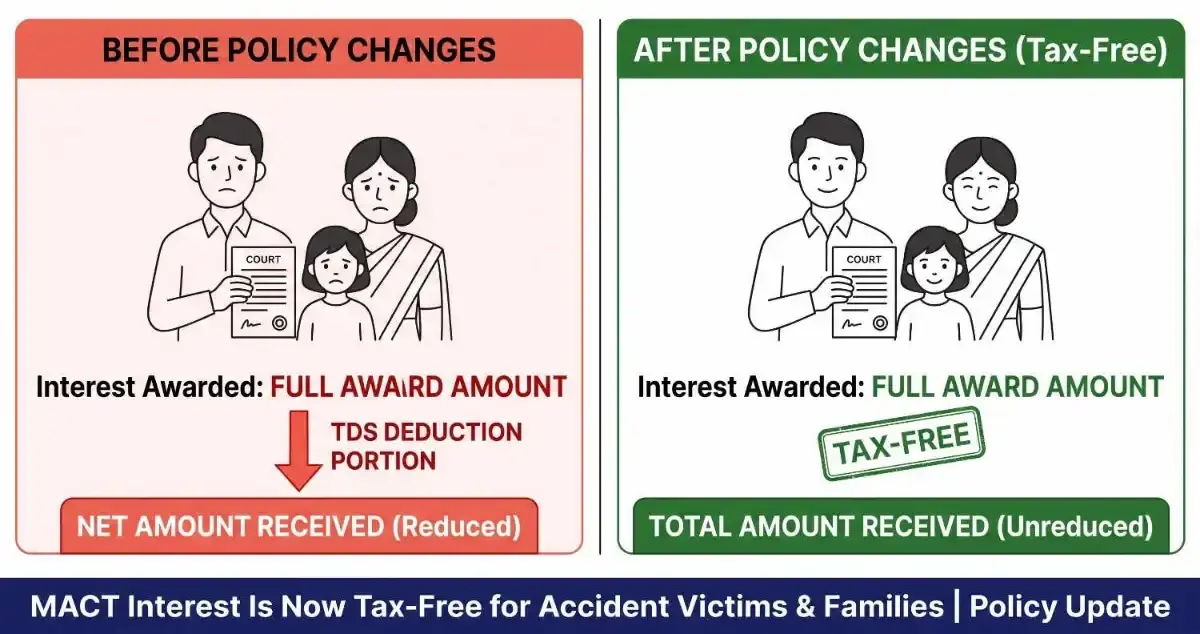

MACT interest income TDS exemption 2026 explained: who qualifies, old vs new Act rules, the FD interest trap, refund steps, and how to report it in your ITR.
Interest awarded by a Motor Accident Claims Tribunal to an individual or their legal heir is now fully exempt from income tax, with no TDS at all, from 1 April 2026 onward. Before that date, the interest was taxable and TDS applied above ₹50,000 a year. This guide walks you through both positions, the one exception nobody talks about, and how to file it.
What Is the MACT Interest Income TDS Exemption?
Who Does This Exemption Apply To?
MACT Interest Rules Before and After April 2026
Worked Examples
How to Report MACT Interest in Your ITR
What If Something Goes Wrong?
Documents Needed for a TDS Refund on Old Deductions
Penalties
FAQ
This topic spans two laws. Interest awarded up to 31 March 2026 (FY 2025-26, AY 2026-27) falls under the Income-tax Act, 1961. Interest awarded from 1 April 2026 onward (Tax Year 2026-27) falls under the Income-tax Act, 2025, which replaced the 1961 Act on that date.
Budget 2026 inserted a fresh exemption into the new Act covering any interest awarded under the Motor Vehicles Act, 1988 to an individual or their legal heir. Section 393(4) [Table Sl. No. 7] of the Income-tax Act, 2025 is the matching TDS provision — it removes the TDS obligation entirely on this interest when paid to an individual. [Source: incometaxindia.gov.in, CBDT Budget 2026 FAQ]
Before this amendment, the interest was already taxable as "Income from Other Sources." What changed is that it's now fully exempt for individuals and legal heirs specifically. A Motor Accident Claims Tribunal (MACT) is a quasi-judicial body set up under Section 165 of the Motor Vehicles Act, 1988 to decide compensation claims arising from road accidents.
Applies to | Does NOT apply to |
|---|---|
An individual accident victim | A company, firm, LLP, or trust that is the claimant |
The legal heir of a deceased victim | A Hindu Undivided Family (HUF), as the CBDT FAQ specifies "individual" and "legal heir" only |
Interest directly awarded by the MACT under Section 171, MV Act 1988 | Interest earned later on a bank fixed deposit made from the compensation |
Awards made or interest accrued on or after 1 April 2026 | Interest awarded before 1 April 2026 (taxed under the 1961 Act rules) |
A note on the transition: if your award was passed before 1 April 2026 but the insurer pays it after, the rule that applies depends on when the interest is credited, not when the award was passed.
Before 1 April 2026 (Income-tax Act, 1961): Interest on MACT compensation was fully taxable, added under "Income from Other Sources." TDS under Section 194A(3)(ix) and (ixa) was skipped only if the aggregate interest in a financial year stayed within ₹50,000. Cross that threshold, and TDS applied at 10% on the entire amount, not just the excess.
From 1 April 2026 (Income-tax Act, 2025), for individuals and legal heirs only: The interest is completely exempt — no monetary ceiling, a full carve-out. No TDS is deducted at all, on any amount. Non-individual claimants (companies, HUFs, trusts) see no change: tax and TDS above ₹50,000 continue exactly as before. [Source: incometaxindia.gov.in, CBDT Budget 2026 FAQ]
The exception almost nobody covers — bank FD interest: Once your compensation and interest are deposited into a bank fixed deposit (common when a minor is involved, or the Tribunal orders funds locked in for safekeeping), that money legally stops being "interest awarded by the Tribunal." A recent court ruling confirmed that interest generated on such an FD is ordinary "Income from Other Sources," fully subject to standard bank TDS rules under Section 393(1) — the Budget 2026 exemption does not reach it. [Source: incometaxindia.gov.in via the mapping utility for Section 393(1); court ruling reported by taxheal.com, July 2026]
Why does this matter to you? Because two people can receive the same ₹5 lakh MACT award and end up with completely different tax outcomes purely based on where that money physically sits afterward.
Example 1 — Common case: Suresh, individual claimant, award after April 2026
Suresh is awarded ₹3,20,000 as interest by the MACT in October 2026, credited directly to his savings account.
Interest awarded: ₹3,20,000. Is Suresh an individual? Yes. Is the award dated on/after 1 April 2026? Yes.
TDS deducted: ₹0. Tax payable on this interest: ₹0. Suresh receives the full ₹3,20,000.
Compare the same award made in February 2026, under the old rules: since ₹3,20,000 exceeds ₹50,000, TDS at 10% would apply to the whole amount — ₹32,000 deducted, ₹2,88,000 paid out — and the ₹3,20,000 would still be fully taxable at Suresh's slab rate when he files.
Example 2 — Edge case: Priya, legal heir, minor's compensation parked in an FD
Priya's late husband's MACT award of ₹8,00,000 is credited in June 2026. Since their son is a minor, the Tribunal orders ₹6,00,000 of it deposited in a fixed deposit until he turns 18.
The directly-paid interest portion: exempt, ₹0 tax, ₹0 TDS.
The ₹6,00,000 FD then earns ₹21,000 in bank interest during FY 2026-27. This is not "interest awarded by the Tribunal" — it's ordinary bank interest, taxed under normal rules.
₹21,000 sits below the ₹50,000 TDS threshold under Section 393(1), so the bank deducts nothing. But it's still fully taxable and must be reported under "Income from Other Sources."
Two different tax treatments from the same court order — the gap most articles on this topic skip entirely.
Confirm your award date. If the interest was credited on or after 1 April 2026, it's exempt income for you as an individual or legal heir.
Report it under Schedule EI (Exempt Income) in your ITR. Even fully exempt income needs disclosure — skipping this can trigger a mismatch notice even when you owe nothing.
Check Form 26AS / Form 168 on incometax.gov.in to confirm no TDS was wrongly deducted on your MACT interest.
If a bank FD was created from the award, report that separate FD interest under "Income from Other Sources," and claim any TDS credit shown against it.
Pick your ITR form based on your other income — salaried individuals with only this exemption typically stay on ITR-1 or ITR-2; capital gains, business income, or foreign assets push you to a higher-numbered form.
The insurer deducted TDS on your post-April-2026 award by mistake. This happens when payers haven't updated their systems. Ask the insurer for a TDS correction statement removing the wrong deduction; if they refuse or delay, you can still claim the deducted amount back as a refund when you file your ITR, since the underlying income is exempt.
Your award straddles the transition — part paid before, part after 1 April 2026. Treat each tranche separately based on its actual payment or credit date. Don't assume the whole award follows whichever date is more favourable; the tax department will look at each credit entry individually.
You already paid tax on MACT interest deducted in an earlier year (pre-April 2026) and think you're owed a refund now. You're not, automatically — the exemption is prospective from 1 April 2026, not retrospective. If TDS was wrongly deducted in an earlier year despite you being under the ₹50,000 threshold, that's a separate refund claim through a revised or belated return for that specific year, not this year's exemption.
MACT award copy — from the Tribunal registry; a certified copy is usually required, physical only in most district Tribunals.
TDS certificate (Form 16A / new Form 131) — from the insurer or bank that deducted TDS; digital copy accepted.
Form 26AS or Form 168 — downloaded from the e-filing portal, digital copy accepted.
Bank statement showing the credit — digital copy accepted.
PAN and Aadhaar — digital copy accepted for e-filing.
If an insurer or bank wrongly deducts TDS on exempt MACT interest and refuses to correct it, that's a compliance failure on the deductor's side, not the claimant's — you remain entitled to claim the credit back via your ITR regardless. On the deductor side, failure to correct an erroneous deduction, or continued TDS non-compliance more broadly, can attract interest and penalty under the TDS-default provisions of the governing Act — old Sections 201/271C under the 1961 Act, or their corresponding provisions under the Income-tax Act, 2025 . For late filing of a return altogether, standard Section 234F late fees apply — up to ₹5,000 if your total income exceeds ₹5 lakh.
Yes, but only for interest credited or paid on or after 1 April 2026, and only to an individual claimant or the legal heir of a deceased victim. Interest to companies, firms, or HUFs remains taxable, with TDS above ₹50,000 a year as before.
No. It's prospective, not retrospective. Interest credited before 1 April 2026 stays under the Income-tax Act, 1961, where it was taxable and TDS applied only above ₹50,000.
No, and this trips up a lot of claimants. Once compensation sits in a bank FD, the interest that FD generates is ordinary bank interest — not interest "awarded by the Tribunal" — and stays fully taxable under Section 393(1), with TDS above ₹50,000 (₹1,00,000 for senior citizens).
Yes. The CBDT's Budget 2026 FAQ specifically names "an individual or his legal heir," so a legal heir receiving the award is covered on the same terms as the original claimant.
No. The official FAQ language covers only "individual" and "legal heir" — an HUF falls under neither, so the older, taxable treatment with the ₹50,000 TDS threshold continues.
Ask for a correction statement first. If that doesn't resolve it before your filing deadline, claim the wrongly-deducted TDS back as a refund, since the underlying interest is legally exempt regardless of what was deducted.
Under Schedule EI (Exempt Income). Even fully exempt income needs disclosure — skipping it can trigger a scrutiny notice on the mismatch alone, even when zero tax is actually due.
No. Unlike the old ₹50,000 TDS-only threshold, the Budget 2026 exemption has no ceiling for individuals and legal heirs — the full amount is exempt and TDS-free, whether it's ₹50,000 or ₹50 lakh.
Only if that deduction was wrongly made under the rules then in force — say, TDS taken despite your total interest staying under ₹50,000. That's a separate refund claim tied to that year's return, not this year's exemption.
Only the interest. The principal compensation was already treated as non-taxable under settled principles, separate from this Budget 2026 change.
It depends on when the interest is actually credited to you, not when the case was filed. If payment lands on or after 1 April 2026 and you're an individual or legal heir, the exemption applies regardless of how long the case has run.
Check the date your insurer actually credited or is scheduled to credit your MACT interest — that single date decides which rules apply to you. If any of it lands in a bank FD, track that FD's interest separately in your books, since it does not carry the same exemption. Use Toolisky's Interest Income Tax Calculator to work out the tax on any FD interest that isn't covered by this exemption, and check which ITR form to file before you sit down to submit your return. For the official CBDT FAQ text, see incometaxindia.gov.in.
For educational purposes only. Verify all figures at official sources before acting. Toolisky is not affiliated with any government body. Consult a qualified CA or legal professional before making compliance decisions. See toolisky.com/accuracy-and-limitations.
No TAN for NRI property purchase applies only from 1 October 2026, and only to resident individual and HUF buyers. Get the rates, forms, and dates you need.
Jul 25, 2026

Did you lose the SGB premature redemption tax exemption? Here's exactly who's affected, how much tax applies now, and how to check your own bonds.
Jul 24, 2026

TCS on overseas tour package 2026 is now a flat 2% with no minimum threshold, effective 1 April 2026 under Budget 2026 and the new Section 506 mapping rule.
Jul 23, 2026