

Section 87A proviso explained: first proviso rebate limits vs the second proviso's capital-gains bar, with FY 2025-26 math and real fixes for demand notices.
Section 87A has two provisos, and people mix them up constantly. The first proviso sets your rebate limit — up to ₹60,000 if your income is under ₹12,00,000 in the new regime. The second proviso, added by the Finance Act, 2025, stops that rebate from touching tax on capital gains, effective FY 2025-26 (AY 2026-27).
Section 87A sits in Chapter VIII (Rebates and Reliefs) of the Income-tax Act, 1961. If you're filing for FY 2025-26, that's Assessment Year 2026-27 — the last assessment year the 1961 Act will ever cover. So every section number and rate in this article follows the 1961 Act, not the newer one. If you want the full picture of how India is moving between the two Acts, our guide on the tax year under the Income-tax Act, 2025 walks through exactly which Act governs which filing year.
Here's the twist, though. Under the Income-tax Act, 2025, which takes over for income earned from 1 April 2026 onward, Section 87A gets renamed Section 156. The rebate itself works the same way. Only the number changes. If you come across a document dated after April 2026 talking about Section 156, that's this exact rebate under a new label.
At its core, the Section 87A rebate cuts your tax bill directly — not your taxable income. It applies after your tax on total income is worked out, but before health and education cess gets added. Miss that ordering, and your own manual math won't match what the portal shows.
Category | Eligible? | Rebate Ceiling (FY 2025-26) |
|---|---|---|
Resident individual, old regime | Yes | ₹12,500 (income up to ₹5,00,000) |
Resident individual, new regime (Section 115BAC(1A)) | Yes | ₹60,000 (income up to ₹12,00,000) |
Non-resident individuals (NRIs) | No | Not applicable |
HUFs, partnership firms, companies, AOPs | No | Not applicable |
Senior citizens, resident (age 60-79) | Yes | Same rules as above |
Super senior citizens (80+) | Yes, though basic exemption already covers most cases | Same slab logic applies |
Only individuals qualify — not HUFs, not firms, not trusts. Age doesn't change the rebate ceiling. It only shifts your exemption limit elsewhere in the calculation. This table covers the broad strokes; if you want the complete rundown of every excluded category, including AOP members, RNORs, and income from lottery or crypto, our post on who is not eligible for the Section 87A rebate goes through all ten of them with sourced references.
This is where most guides get sloppy, so let's take it apart cleanly.
The base rule predates both provisos. If you're on the old regime and your total income stays under ₹5,00,000, you get a rebate equal to 100% of your tax, or ₹12,500, whichever is lower.
The first proviso was inserted by the Finance Act, 2023, effective 1 April 2024, and later revised upward by the Finance Act, 2025 (effective 1 April 2026, applicable from AY 2026-27). It applies only if you're on the new regime under Section 115BAC(1A):
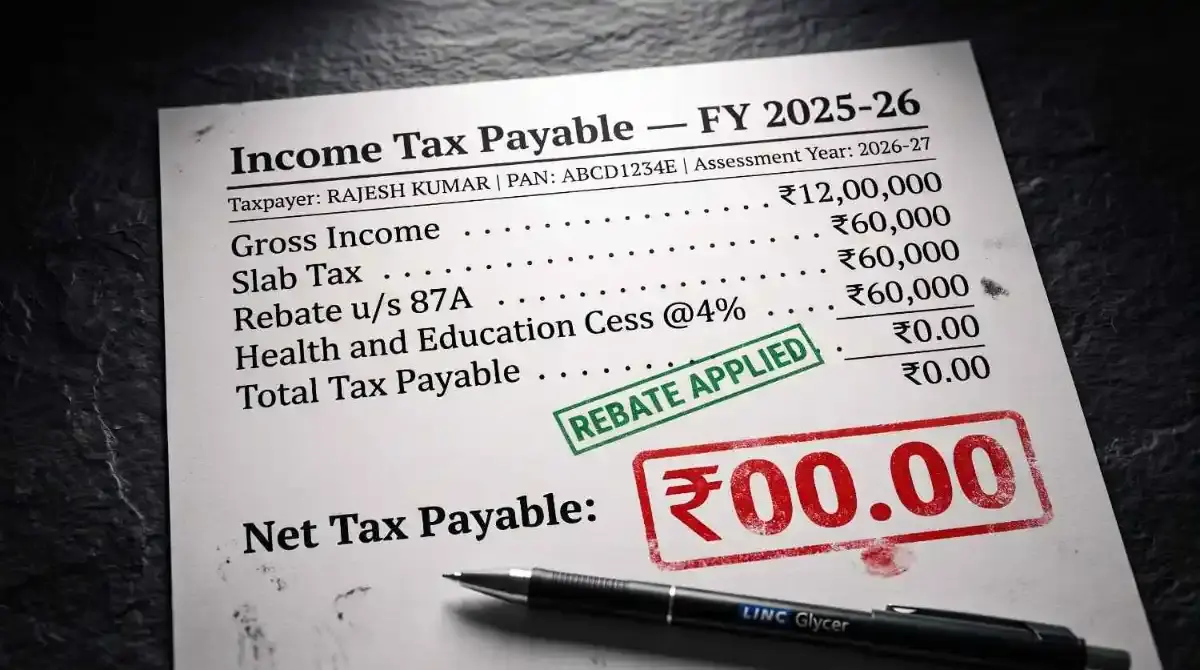
Total income up to ₹12,00,000 (raised from ₹7,00,000): rebate equals 100% of tax or ₹60,000 (raised from ₹25,000), whichever is lower.
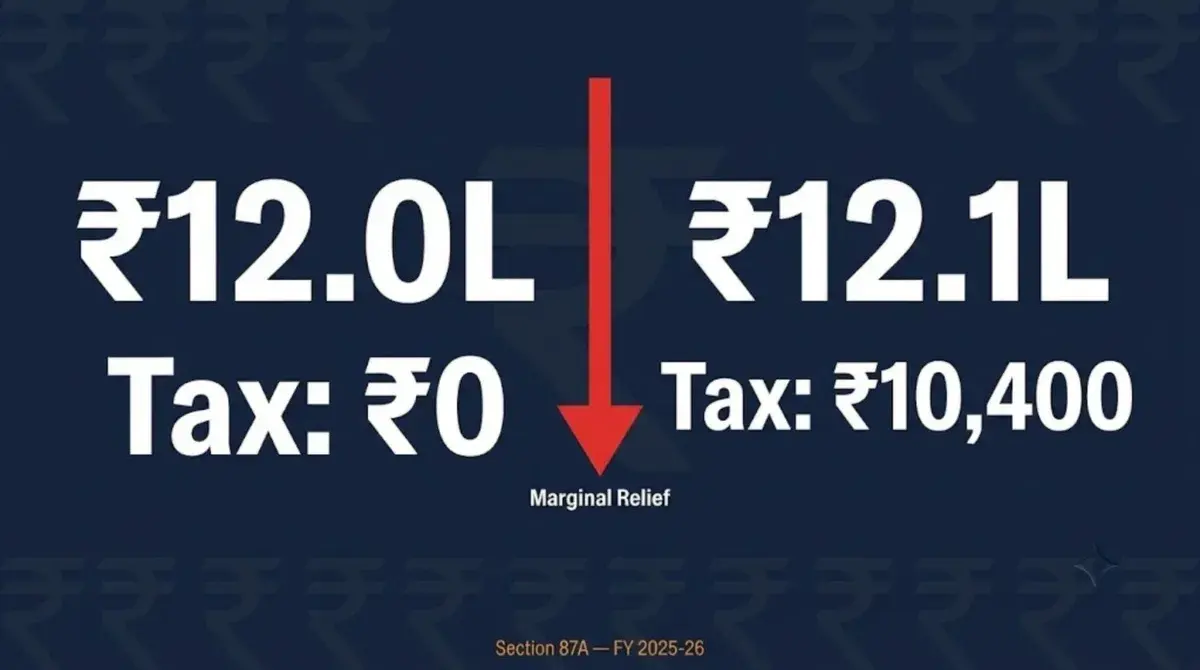
Total income above ₹12,00,000, where tax payable exceeds the amount your income crosses that line by: you get marginal relief instead, which limits your extra tax to exactly your extra income.
The second proviso is the sharper, newer rule. Also inserted by the Finance Act, 2025, and effective the same date, it puts a ceiling on whatever the first proviso would otherwise give you. That ceiling is the tax payable on your slab-rate income alone, computed at new-regime rates. Nothing more.
In plain words: the rebate — including marginal relief — can only wipe out tax on your regular, slab-taxed income. Tax on short-term capital gains under Section 111A, long-term capital gains under Section 112A, lottery winnings under Section 115BB, or any other special-rate income stays completely outside its reach. It doesn't matter how low your total income is.
This closes a fight that dragged through most of FY 2024-25. Before this amendment, the tax department's e-filing utility blocked the Section 87A rebate against STCG income outright, taxpayers pushed back through the courts, and the position stayed genuinely unsettled for a while. From FY 2025-26 onward, the law itself settles it in plain text, no interpretation needed. Our separate deep dive on Section 87A rebate and capital gains walks through this dispute year by year, including how the courts and the CBDT eventually landed on the current position — worth reading if you're dealing with an old notice.
One more detail worth knowing: Section 112A carries its own separate bar on rebate against LTCG tax, written directly into sub-section 112A(6), independent of this second proviso, and it applies no matter which regime you've picked. LTCG has effectively always sat outside the rebate's reach. STCG's exclusion under the new regime is the newer part, arriving only with FY 2025-26. Our capital-gains guide linked above also covers the old-regime position on this point in more depth than we have room for here.
Under the Income-tax Act, 2025, this whole framework gets carried forward with new section numbers: Section 87A becomes Section 156, Section 111A becomes Section 196, and Section 112A becomes Section 198, with the same exclusions intact. Only the labels change.
Example 1: Ramesh, salaried, common case (new regime, FY 2025-26)
Ramesh's slab income after standard deduction comes to ₹9,00,000. He also booked ₹1,50,000 in short-term capital gains under Section 111A from selling listed shares. His total income: ₹10,50,000.
Tax on slab income (₹9,00,000):
₹0 to ₹4L: nil
₹4L to ₹8L (₹4,00,000 at 5%): ₹20,000
₹8L to ₹9L (₹1,00,000 at 10%): ₹10,000
Slab tax total: ₹30,000
Tax on STCG: ₹1,50,000 at 20% = ₹30,000
Total tax before rebate: ₹60,000
First proviso check: total income of ₹10,50,000 is under ₹12,00,000, so the provisional rebate is 100% of tax or ₹60,000, whichever is lower. That works out to ₹60,000.
Second proviso cap: the rebate can't exceed tax on slab income, and that figure is only ₹30,000.
Actual rebate: ₹30,000. Final tax before cess: ₹30,000. Add 4% cess, and Ramesh owes ₹31,200.
His STCG tax stays fully payable. Only the slab-income tax gets wiped out. If you're in a similar spot, the STCG Calculator for Section 111A works out the capital-gains portion of your tax in a few seconds.
Example 2: Farida, freelancer, edge case (new regime, LTCG-heavy)
Farida's slab income after deductions is ₹5,80,000. She also has long-term capital gains under Section 112A worth ₹6,00,000, after applying the ₹1,25,000 exemption. Her total income: ₹11,80,000 — still under the ₹12,00,000 mark.
Tax on slab income (₹5,80,000):
₹0 to ₹4L: nil
₹4L to ₹5.8L (₹1,80,000 at 5%): ₹9,000
Slab tax total: ₹9,000
Tax on LTCG: ₹6,00,000 at 12.5% = ₹75,000
Total tax before rebate: ₹84,000
First proviso check: since total income is under ₹12,00,000, the provisional rebate is 100% of tax or ₹60,000, whichever is lower — ₹60,000.
Second proviso and Section 112A's own separate bar: the rebate is capped to slab tax alone, which is only ₹9,000.
Actual rebate: ₹9,000. Final tax before cess: ₹75,000. With cess, Farida owes ₹78,000.
She assumed staying under ₹12 lakh meant zero tax. It doesn't, not when most of that income is LTCG. This is exactly the edge case that trips people up. The LTCG Calculator for Section 112A can run this exemption-and-rate math for your own numbers, and the Capital Gains Tax Calculator is useful if your gains are spread across several assets.
Confirm you're a resident individual. NRIs, HUFs, and companies don't qualify at all.
Add up your total income across every head — salary, capital gains, interest, rent, everything.
Work out tax on your slab-rate income separately, using the rates for your chosen regime.
Work out tax on any special-rate income separately: STCG at 20%, LTCG above ₹1,25,000 at 12.5%, and so on.
Add both figures together for your total tax before rebate.
Apply the first proviso. If total income falls within ₹12,00,000 (new regime) or ₹5,00,000 (old regime), work out your provisional rebate or marginal relief.
Apply the second proviso. Cap that number at your slab-tax figure from step 3.
Subtract the final rebate, then add 4% cess. That's your payable tax.
If manual math isn't your thing, the Section 87A Rebate Calculator handles steps 3, 6, 7, and 8 in one go for both regimes. For the marginal relief zone specifically — income just above ₹12,00,000 — the Section 87A Marginal Relief Calculator breaks the calculation down slab by slab.
The portal auto-applies a rebate that doesn't match your own calculation. Don't trust the auto-fill blindly. Open Schedule SI (Special Income) in your ITR and check whether special-rate income got netted against the rebate by mistake. If it has, fix the figures before you submit — the CPC will catch it eventually anyway, and it's cleaner to correct it upfront.
You've received a demand notice disallowing a rebate you claimed against STCG in an earlier year. For AY 2024-25 and AY 2025-26 returns, the second proviso didn't exist yet. Tribunal orders from the ITAT Ahmedabad and Indore benches allowed such claims in specific cases during that window. You can file a rectification under Section 154 citing the relevant order, or respond to the demand referencing CBDT Circular No. 13/2025, dated 19 September 2025, which waived interest under Section 220(2) on exactly this kind of rectification demand, provided it was paid by 31 December 2025. That deadline has since passed, so check the current interest position before assuming the waiver still applies. Our capital gains rebate guide has the full year-by-year breakdown of this dispute if you need the background for a written submission.
You claimed the full ₹60,000 rebate for FY 2025-26 against your total tax, including capital gains, and now realise the second proviso caps it lower. File a revised return before the applicable deadline and pay the shortfall voluntarily. Waiting for a notice only adds interest under Sections 234B and 234C on top of what you already owe. If you're unsure how close your income sits to the ₹12,00,000 line, the Tax Cliff Calculator shows exactly how far you are from the rebate threshold and the marginal relief zone.
Keep your Form 16 handy for the salary breakup, along with broker contract notes or capital gains statements for STCG and LTCG figures. Pull your AIS and TIS from the e-filing portal too, and build a simple working sheet that separates slab-rate income from special-rate income before you file. That split is exactly what the second proviso hinges on, so getting it right upfront saves you a headache later.
Getting this calculation wrong has real teeth. Under Section 270A, under-reporting tax because of an incorrect rebate claim draws a penalty of 50% of the tax on the under-reported amount, and that can rise to 200% if the assessing officer treats it as deliberate misreporting rather than an honest slip. Separately, Sections 234B and 234C charge interest at 1% per month on any advance-tax shortfall tied to the error. There's no standalone penalty attached to the rebate rule itself. It's the tax gap it creates that costs you.
The first proviso sets your rebate ceiling — up to ₹60,000 for new-regime taxpayers earning under ₹12,00,000, with marginal relief kicking in above that. The second proviso, added later by the Finance Act, 2025, then caps that same rebate so it only ever offsets tax on slab-rate income, never on capital gains or other special-rate income.
Not against the STCG tax itself, not from FY 2025-26 onward under the new regime. The second proviso rules it out expressly. For earlier years — AY 2024-25 and AY 2025-26 — several tribunal orders allowed such claims, since no statutory bar existed at that point. Our Section 87A and capital gains guide has the full timeline, year by year.
LTCG under Section 112A has carried its own built-in exclusion since 2018, via sub-section 112A(6), entirely separate from Section 87A. STCG under Section 111A only picked up an explicit bar starting FY 2025-26, through the second proviso. Before that, it was a matter of interpretation and courtroom argument, not settled statute.
It means your rebate math takes two steps, not one. First, you check whether you qualify based on total income. Second, even if you do, the rupee amount you actually save is limited to whatever tax falls on your regular, slab-taxed income. Nothing from capital gains gets forgiven, no matter how the first step turns out.
Yes. Under the Income-tax Act, 2025, the provision previously numbered 87A becomes Section 156, per the Income Tax Department's own 1961-versus-2025 mapping utility. Section 111A and Section 112A get renumbered too, to Section 196 and Section 198 respectively. This applies to income earned from Tax Year 2026-27 onward, not to your current FY 2025-26 filing, which still runs on the old numbering.
In The Chamber of Tax Consultants v. Director General of Income Tax (Systems), decided 24 January 2025, the Bombay High Court ruled that a software restriction in the e-filing utility couldn't override a taxpayer's statutory right to claim the rebate. It's worth being precise here: the court didn't rule that STCG income itself qualifies for the rebate on merits. It left that question to be decided case by case, and criticised the department for blocking the option through the utility rather than through law.
If the assessment year is still open for a revised return or rectification, yes. File a revised return with the corrected computation, or submit a rectification application under Section 154 if your return has already been processed. Once that window closes, your options narrow considerably.
Yes, it does. Marginal relief is simply a form of the first-proviso deduction, so the second proviso's ceiling applies to it exactly the same way. If your marginal relief figure would otherwise eat into capital-gains tax, it gets trimmed back to your slab-tax amount. Our separate piece on marginal relief under Section 87A has a full worked table for the ₹12,00,000 to ₹12,75,000 band if you want to see this at every income point.
No. Age changes your basic exemption elsewhere in the computation, but the rebate ceiling itself — ₹12,500 under the old regime, ₹60,000 under the new one — stays the same across age groups, as long as you're a resident individual.
Split your total tax into two buckets before applying any rebate at all: tax on slab-rate income, and tax on special-rate income. Only the first bucket is eligible for the rebate. Run your slab income through the Section 87A Rebate Calculator and your gains through the STCG Calculator for Section 111A separately, then add the two results together for your real final number.
The second proviso's text amends only the first proviso, which applies specifically to new-regime taxpayers. In practice, the old regime's own rebate is understood to exclude STCG and LTCG income the same way, chiefly because Section 112A's bar on LTCG applies regardless of regime. The mechanism for STCG under the old regime is less explicit in the statute itself, so if this affects you directly, it's worth a quick confirmation with a CA before you file — our capital gains guide covers this year-by-year for anyone who wants the fuller picture.
Check first whether it falls within CBDT Circular No. 13/2025's interest-waiver window, which covered demands paid by 31 December 2025. Outside that window, standard interest under Section 220(2) applies from the original due date, so it pays to settle the demand quickly rather than let it sit.
No, not at any income level. The rebate is restricted to resident individuals under the Act, and the Income Tax Department's own guidance confirms non-residents are excluded outright, capital gains or not. If you're an NRI trying to work out your India tax liability, the NRI Tax Calculator is built for exactly that situation.
The first proviso tells you whether you qualify and roughly how much rebate you're looking at. The second proviso then decides how much of that rebate actually lands on your final tax bill once capital gains enter the picture. Skip that second check, and you'll either overestimate your refund or, worse, underpay and end up staring at a demand notice. Run your slab income and special-rate income separately every single time, check both provisos before you file, and you won't be caught off guard.
Written by Viraj Mathpati, Legal & ITR Compliance Writer
For educational purposes only. Verify all figures at official sources before acting. Toolisky is not affiliated with any government body. Consult a qualified CA or legal professional before making compliance decisions. See toolisky.com/accuracy-and-limitations.
Section 87A, Income-tax Act, 1961 (Chapter VIII, Rebates and Reliefs): incometaxindia.gov.in/w/section-87a-26
Income-tax Act, 2025 vis-à-vis Income-tax Act, 1961 mapping utility (for the Section 87A → Section 156 renumbering): incometaxindia.gov.in, utility to check provisions of the two Acts side by side
CBDT Circular No. 13/2025, dated 19 September 2025, on waiver of interest under Section 220(2)
ITAT Ahmedabad order, Jayshreeben Jayantibhai Palsana v. ITO, ITA No. 1014/Ahd/2025, dated 12 August 2025
ITAT Indore order, Kanhaiya Lal Panchal v. CIT (NFAC), January 2026
Bombay High Court, The Chamber of Tax Consultants v. Director General of Income Tax (Systems), PIL (L) No. 32465 of 2024, order dated 24 January 2025
Related reading on Toolisky: Section 87A Rebate on Capital Gains: Full Guide for AY 2026-27 · Who Is NOT Eligible for Section 87A Rebate? · Marginal Relief Under Section 87A, Explained Properly · Tax Year Under the Income Tax Act, 2025
Tools you may find useful: Section 87A Rebate Calculator · Section 87A Marginal Relief Calculator · STCG Calculator, Section 111A · LTCG Calculator, Section 112A · Capital Gains Tax Calculator · Tax Cliff Calculator · NRI Tax Calculator
Section 87A rebate does not cover STCG under 111A or LTCG under 112A for AY 2026-27. Real numbers, two worked examples, and what to do about demand notices.
Aug 11, 2026
Section 87A of the Income Tax Act, 1961 explained for FY 2025-26: Rs 60,000 rebate, marginal relief, capital gains rules, and how to claim it in your ITR.
Aug 8, 2026
Tax on 12.1 lakh income in FY 2025-26 is ₹10,400 with Section 87A marginal relief, not ₹61,500 or the wrong ₹25,000 some sites show. Full slab math and table.
Aug 7, 2026