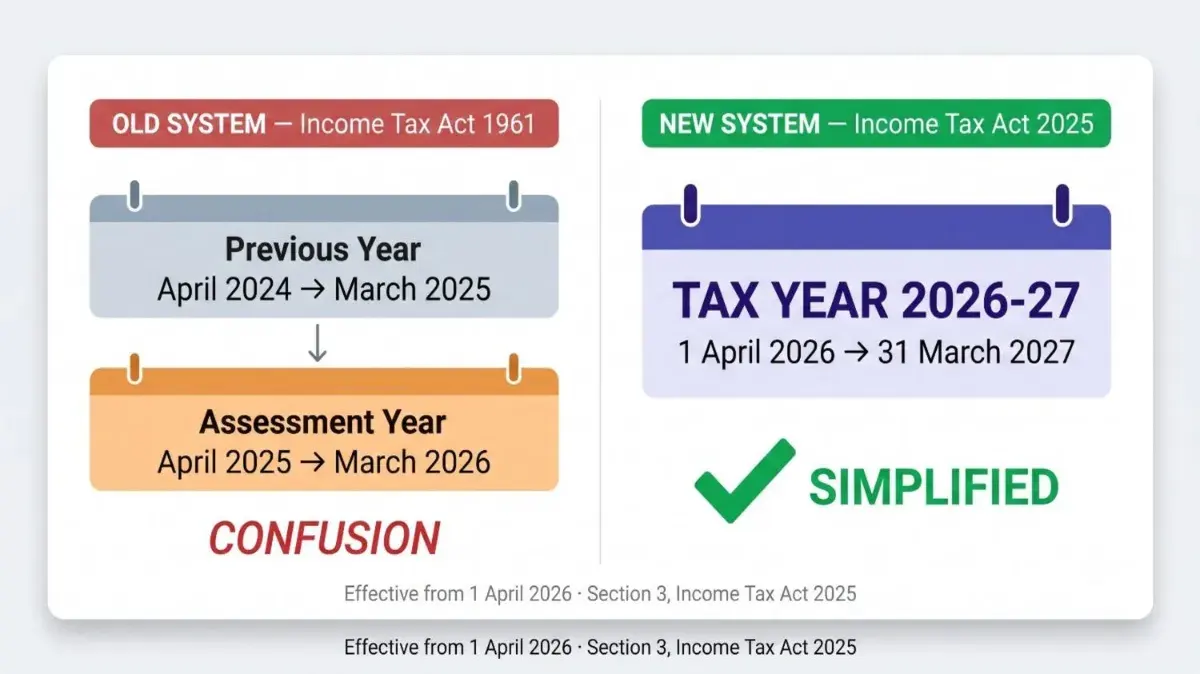

Under Section 3 of the Income Tax Act, 2025, a tax year is a 12-month period running from 1 April to 31 March. It replaces both "Previous Year" and "Assessment Year" from 1 April 2026 onward. You earn the income and get assessed under the same year label now, not a different one the year after.
Here's the plain-language version: under Section 3 of the Income Tax Act, 2025, a "tax year" is the 12-month period starting 1 April and ending 31 March. For a business or profession set up mid-year, the tax year starts on the day it actually begins, and still ends on the next 31 March. (Source: incometaxindia.gov.in)
Assessment Year and Previous Year are gone as fresh concepts from tax year 2026-27 onward. For over sixty years, Indian taxpayers earned money in one year and got taxed under a different year's name. It never quite made sense, did it?
The Income Tax Act, 2025 fixes that. One year, one label, for both earning and taxing.
This is the part most guides get muddled, so let's be precise about it.
Income earned up to 31 March 2026 (FY 2025-26) falls under the Income-tax Act, 1961. You'll file this as Assessment Year 2026-27, not tax year.
Income earned from 1 April 2026 onward falls under the Income-tax Act, 2025, per Section 3, and gets the Tax Year 2026-27 label.
If you're filing your return in July or August 2026, you're almost certainly reporting FY 2025-26 income. That's AY 2026-27 under the old Act. The actual tax year 2026-27 return, for income earned from April 2026, isn't due until 2027. (Source: incometax.gov.in)
Governing law for this article: both Acts, covered side by side, since the topic spans the transition. Section numbers below are checked against the Income Tax Department's transition FAQs and the Act text on incometaxindia.gov.in.
Applies to | Does NOT apply to |
|---|---|
Anyone earning income from 1 April 2026 onward — salary, freelance, business, capital gains, rent | Anyone filing for FY 2025-26 income in the current AY 2026-27 season |
New businesses or freelance income that started after 1 April 2026 | Old notices, pending assessments, or reassessments tied to years before FY 2026-27 |
Employers and payroll teams updating TDS certificates and returns | Taxpayers only checking their slabs or rates — those haven't moved |
One partial case worth a note: say you had a salaried job until March 2026 and started freelancing in May 2026. You'll file two separate returns eventually — one using AY 2026-27 for the salary income, another using tax year 2026-27 language once the new-Act forms open up for the freelance income. They don't blend into one filing.
Term | Defined under | Meaning | Still used? |
|---|---|---|---|
Financial Year (FY) | Common usage, 1 April–31 March | The year income is actually earned | Yes, informally, under both systems |
Previous Year (PY) | Section 3, Income-tax Act, 1961 | Legal name for FY under the old Act | Only for years before 1 April 2026 |
Assessment Year (AY) | Section 2(9), Income-tax Act, 1961 | The year after PY, when tax is assessed and return filed | Only up to AY 2026-27, the last one |
Tax Year | Section 3, Income-tax Act, 2025 | One label for earning and taxing the same year | From Tax Year 2026-27 onward |
Subsequent Tax Year | Section 3, Income-tax Act, 2025 | The tax year right after the current one, used where the law needs to reference a following period | From Tax Year 2027-28 onward |
No year gets skipped or double-counted here. FY 2024-25 is AY 2025-26 (old Act). FY 2025-26 is AY 2026-27 (old Act, the final one). FY 2026-27 is tax year 2026-27 (new Act, the first one). FY 2027-28 becomes tax year 2027-28. Clean handover, no gap in between.
Standard tax year: 1 April 2026 to 31 March 2027, for anyone with continuing income sources.
Newly set-up business or profession: the tax year runs from the actual start date to 31 March 2027, so it can be shorter than 12 months. (Source: incometaxindia.gov.in)
Newly arising income source: the same rule applies — the clock starts the day that source begins.
Transition bridge, Section 536(3): any tax year reference for a period before 1 April 2026 gets read back as the matching "previous year" under the 1961 Act. This is the exact clause stopping a missing or double-counted year. (Source: incometax.gov.in)
Pending matters, Section 536(2)(c): any assessment or notice tied to a year before 1 April 2026 stays fully under the 1961 Act's old numbering, no matter when it actually reaches you.
What changed vs what didn't: ITR terminology, Form 16 (now Form 130), Form 26AS (now Form 168), and CBDT notices all shift to tax year language. Your slab rates, the April–March window itself, deductions, and the July 31 filing rhythm for salaried filers stay exactly where they were.
Does any of this mean you owe more tax? No, not a rupee more. Nothing about your liability changes here — only what the year gets called.
Example 1 — Suresh, a salaried employee (the common case, roughly 70% of filers)
Suresh earned ₹9,00,000 in FY 2025-26 (1 April 2025 to 31 March 2026) and is filing his ITR in July 2026.
Income earned: FY 2025-26, before 1 April 2026, so the 1961 Act governs it.
Filing label on his ITR-1: Assessment Year 2026-27.
Due date: 31 July 2026 for non-audit, salaried filers.
Tax year terminology: doesn't apply to this return at all.
Quick check: FY 2025-26 runs April 2025 to March 2026, which is 12 months. Assessment happens the year after, so it's AY 2026-27. There's no "Tax Year 2025-26" — that label simply never existed.
Example 2 — Rahul, a freelancer who starts mid-year (the edge case most guides skip)
Rahul lands his first client on 1 November 2026, well after the new Act kicks in.
Business start date: 1 November 2026, after 1 April 2026, so the 2025 Act, Section 3(2) governs it.
Tax year for this income source: 1 November 2026 to 31 March 2027.
Arithmetic: November, December, January, February, March — that's 5 months, not a full 12.
Label on his first return: Tax Year 2026-27, filed sometime in 2027 once the forms are notified.
Had Rahul started on 1 August 2026 instead, his shortened tax year would run August through March, 8 months. Same rule, just a different start date.
Quick reference for a few other taxpayer types:
Taxpayer | Income earned when | Act and label |
|---|---|---|
Sneha, startup founder registering 1 Aug 2026 | 1 Aug 2026–31 Mar 2027 | 2025 Act, Tax Year 2026-27 (8-month first year) |
Vikram, NRI with India-source salary from April 2026 | Tax Year 2026-27 | 2025 Act, Tax Year 2026-27 |
Mrs Joshi, senior citizen submitting the new Form 15G/15H equivalent after April 2026 | Ongoing FD interest | 2025 Act; form references tax year, not AY |
You don't need a calculator here, just one date check.
Income earned before 1 April 2026? Use Previous Year or Assessment Year language — you're under the 1961 Act.
Income earned on or after 1 April 2026? Use tax year language — you're under the 2025 Act.
Starting a business or income source mid-year? That source's tax year runs from its actual start date to 31 March, following rule 2.
Still unsure? Look at the label printed on the document in front of you. "AY 20XX-YY" means old-Act language. "Tax Year 20XX-YY" means new-Act language. The two never describe the same income. For the fuller side-by-side breakdown, our tax year vs assessment year guide walks through the complete timeline.
1. Your CA or filing software still shows "AY 2027-28" instead of "Tax Year 2026-27." Both might point to the same underlying period, but only one is technically correct under the new Act. Ask which CBDT-notified terminology your software version actually uses — some transitional builds lag behind. Cross-check it against the e-filing portal's own labelling before you submit anything.
2. You get a notice quoting an old-Act section number for FY 2025-26 income, dated after April 2026. This is expected, not a mistake. Section 536(2)(c) keeps every proceeding tied to a pre-cutover year under the old numbering, however late it lands in your inbox. Confirm the year first, then match the section number before you reply.
3. Your accounting or payroll software has no "Tax Year" field yet. Plenty of mid-sized platforms roll this out in phases. Meanwhile, log every transaction by its real date and let your CA map it to the correct tax year manually. Don't let your bookkeeping wait around for a software update.
Getting the year label wrong in casual conversation costs you nothing. But getting it wrong on an actual return, a notice reply, or a declaration form can misalign your filing with what the department expects.
Late filing fee (1961 Act, applies to AY 2026-27 returns): Section 234F — up to ₹5,000 if total income exceeds ₹5 lakh, capped at ₹1,000 if income is ₹5 lakh or below, nil if income is below the basic exemption limit. (Source: incometax.gov.in)
Defective return (1961 Act): Section 139(9), for returns tied to AY 2026-27 or earlier.
2025 Act equivalents:
The transition gives no amnesty on past penalties. Old-Act fees stand exactly as they were, whichever Act governs your current filing.
For a full walkthrough of the interest that stacks alongside these late fees, see our Section 234A, 234B, 234C interest guide.
It's the 12-month period from 1 April to 31 March, defined under Section 3 of the 2025 Act. It replaces both "Previous Year" and "Assessment Year," applying from tax year 2026-27 onward, not to income earned before 1 April 2026.
Yes, the period itself is identical — 1 April to 31 March. The difference is legal, not calendar-based. "Financial Year" is informal usage, while "Tax Year" is the formal Section 3 term now used across the 2025 Act's provisions and forms.
Yes, for one last cycle. FY 2025-26 income is still governed by the 1961 Act and gets assessed in AY 2026-27, the very last assessment year the system will use. Tax year fully takes over from 2026-27 income onward.
No. This is purely a terminology and structural change. Slab rates, deductions, and exemptions under the new Act line up with what applied under the 1961 Act for the equivalent period — only the year's name and some section numbers moved.
It applies to income earned from 1 April 2026 onward. If you're filing in 2026 for FY 2025-26 income, you're still using AY 2026-27 — tax year language doesn't touch that return at all.
It's the transition bridge clause. Any "tax year" reference for a period before 1 April 2026 reads back as the matching "previous year" under the 1961 Act, so no income year is missed or taxed twice during the handover.
Under Section 3(2), its first tax year runs from the actual date of setup, or the date the income source begins, up to the following 31 March. That means it can run shorter than 12 months, exactly like the old "previous year for a newly set up business" rule.
If you picked the correct year in the actual ITR dropdown but mentioned the "wrong" word somewhere casual, there's usually no real impact. If you selected the wrong year in the dropdown itself, file a revised return citing the correct year before the deadline.
No. Your existing PAN, TAN, and the faceless assessment and appellate framework all continue without interruption under the Income Tax Act, 2025.
Tax Year 2026-27, covering income earned from 1 April 2026 to 31 March 2027. It's the first period assessed entirely under the new Act's Section 3 framework, with returns due only in 2027.
The old PY-AY pair meant every provision had to spell out which of two years it meant, adding drafting complexity across decades of amendments. Most major economies already run on one year concept, and the 2025 Act brings India in line with that.
Check one date before anything else: was the income earned before or after 1 April 2026? That single check settles whether you're in Assessment Year or tax year territory, and it decides every form label from here on. If you're filing for FY 2025-26 income right now, our Salary Tax Calculator can confirm your exact AY 2026-27 liability in under a minute. For the department's own transition FAQs, visit incometax.gov.in.
For educational purposes only. Verify all figures at official sources before acting. Toolisky is not affiliated with any government body. Consult a qualified CA or legal professional before making compliance decisions. See toolisky.com/accuracy-and-limitations.
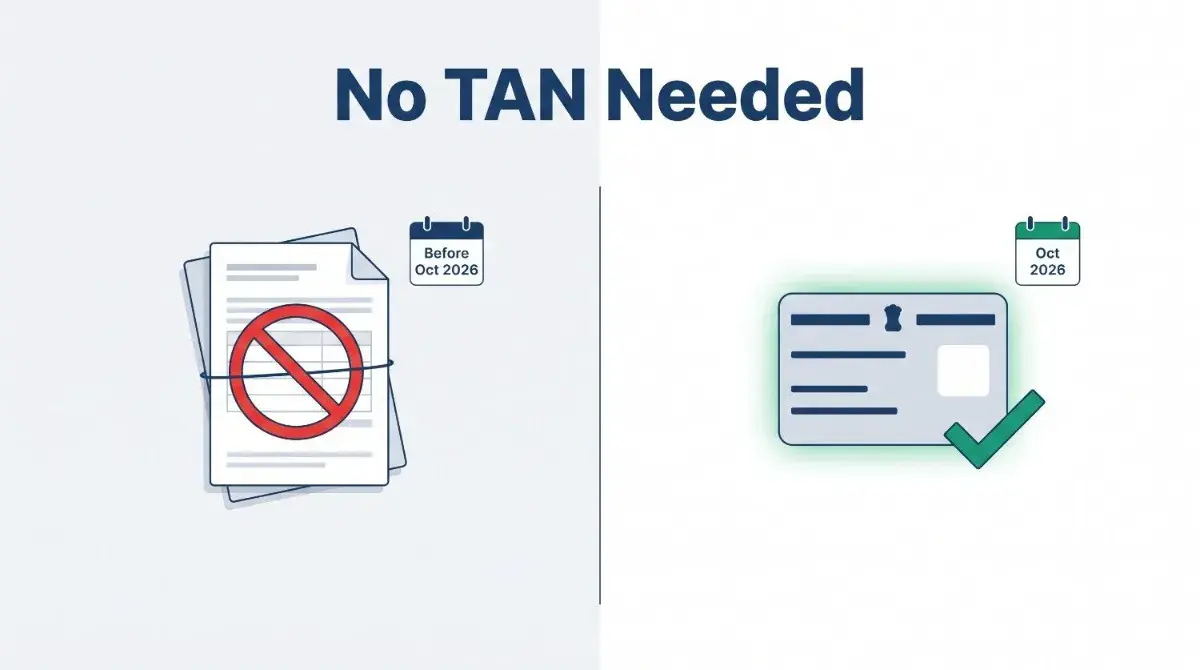
No TAN for NRI property purchase applies only from 1 October 2026, and only to resident individual and HUF buyers. Get the rates, forms, and dates you need.
Jul 25, 2026

Did you lose the SGB premature redemption tax exemption? Here's exactly who's affected, how much tax applies now, and how to check your own bonds.
Jul 24, 2026
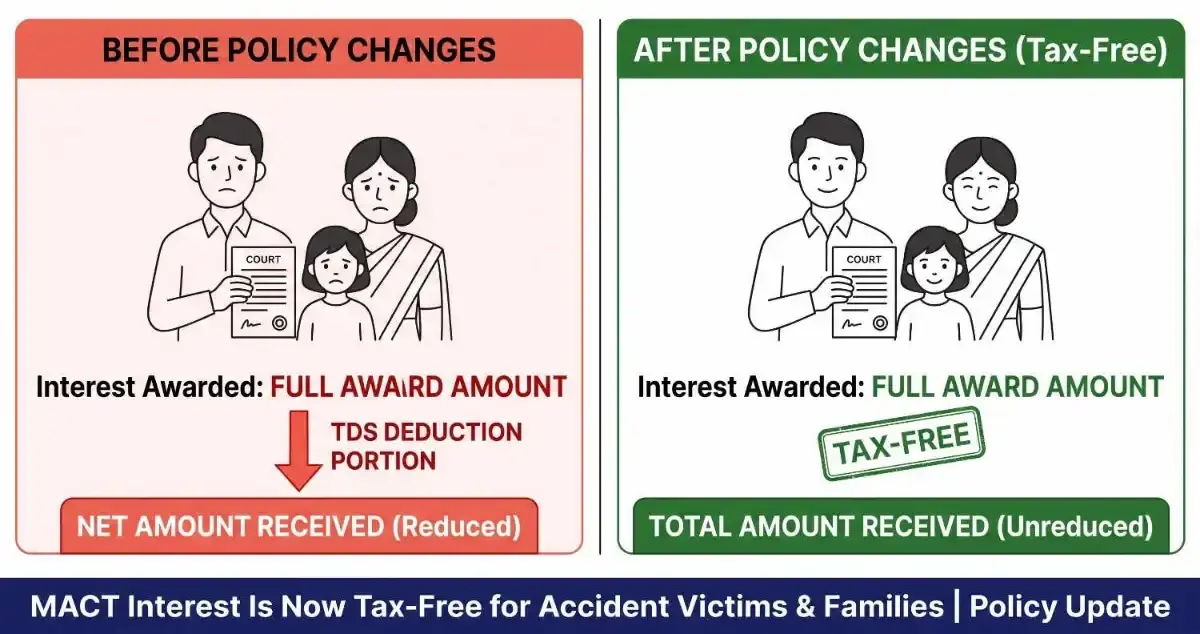
MACT interest income TDS exemption 2026 explained: who qualifies, old vs new Act rules, the FD interest trap, refund steps, and how to report it in your ITR.
Jul 24, 2026