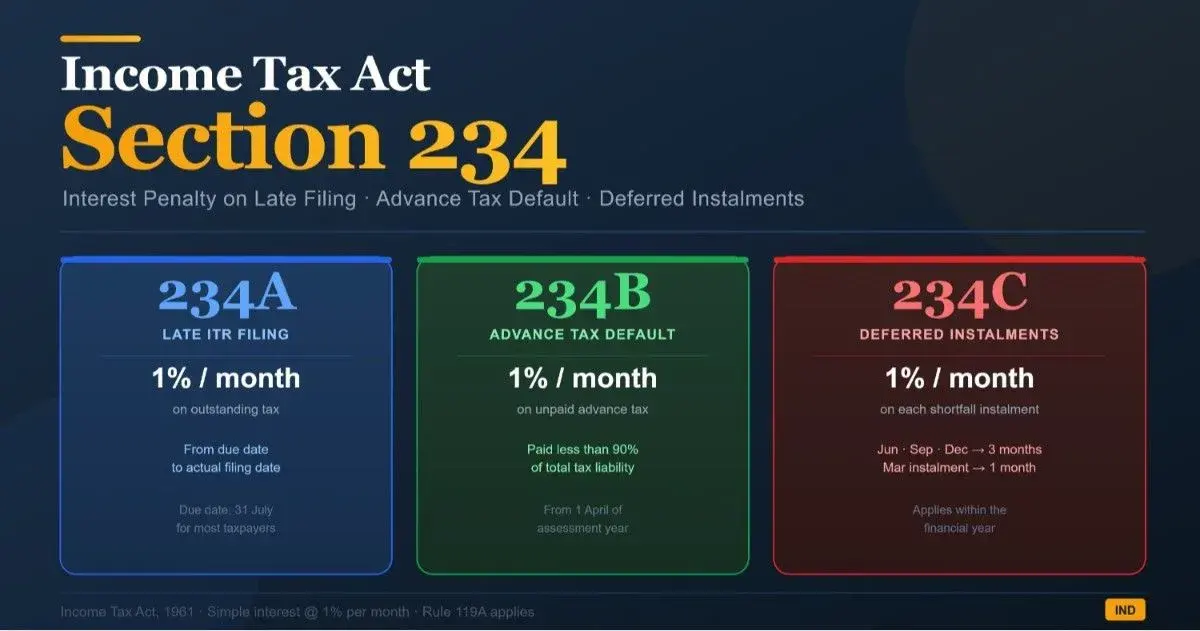

Learn how interest under Section 234A, 234B & 234C of Income Tax Act is calculated on late ITR filing, advance tax default & deferred instalments with examples.
Miss your ITR due date or skip an advance tax instalment and the department adds 1% interest per month, automatically. No notice, no discretion, no negotiation. Section 234A charges you for filing late. Section 234B charges you for not paying 90% of your tax as advance tax. Section 234C charges you for missing a quarterly instalment. All three can land on the same tax liability in the same year, and most people only find out when the e-filing portal quietly adds a few thousand rupees to their tax due.
Sections 234A, 234B, and 234C of the Income-tax Act, 1961 levy simple interest on three separate defaults: late filing of your return, failure to pay advance tax, and short-payment of a quarterly advance tax instalment. None of this needs an assessing officer to step in. The interest is self-computed, and the e-filing portal works it out automatically the moment you file. There's no flat fee here — the number grows with every month of delay and every rupee left unpaid.
For income earned during FY 2025-26 (assessed in AY 2026-27), the 1961 Act still governs. From 1 April 2026 onwards, the Income-tax Act, 2025 takes over and renumbers these as Sections 423, 424, and 425. The renumbering is mostly cosmetic for FY 2025-26 filers, though — as you'll see further down, the 2025 Act actually loosens one rule for instalment timing that didn't exist before. If you want the fuller picture of what changed and what didn't between the two Acts, we've laid it out section by section here.
If you'd rather skip the manual math entirely, our Section 234A 234B 234C Interest Calculator applies Rule 119A automatically and breaks the result down by section.
Applies to | Does not apply to |
|---|---|
Individuals with net tax payable above ₹10,000 after TDS | Individuals whose entire tax is covered by TDS, with nil net payable |
Freelancers, self-employed individuals, business owners | Resident senior citizens (60+) with no business or professional income — exempt from 234B and 234C only |
Salaried employees with side income (FD interest, rent, capital gains, F&O) pushing net payable above ₹10,000 | Taxpayers whose total tax liability for the year is below ₹10,000 |
Companies and firms | Persons under Section 44AD/44ADA presumptive taxation — exempt from quarterly instalments under 234C; they only need to pay 100% by 15 March |
There's a grey zone worth flagging: a salaried employee whose employer deducts full TDS, but who also earns ₹80,000 in FD interest during the year. TDS on FD is usually 10%. If the marginal tax on that interest — say 30% — leaves more than ₹10,000 net payable after the 10% already deducted, advance tax kicks in. Skip it, and 234B and 234C both apply. If you're a freelancer juggling 44ADA and advance tax, this scenario is covered in more depth here.
Applicable law for AY 2026-27: Section 234A, Income-tax Act, 1961 (Section 423, Income-tax Act, 2025, for Tax Year 2026-27 onward).
Rate: 1% per month or part of a month, simple interest. Period: From the day after the ITR due date until you actually file. If you never file at all, interest keeps running until the date of best-judgment assessment under Section 144. Base amount: Total assessed tax, minus advance tax paid, TDS/TCS credit, and any relief under Sections 89, 90, 90A, 91, or MAT/AMT credit under 115JAA/115JD.
Taxpayer category | Due date |
|---|---|
Non-audit individuals, HUFs, and firms | 31 July 2026 |
Businesses/professions requiring audit | 31 October 2026 |
Transfer pricing cases | 30 November 2026 |
One thing people get wrong constantly: if your net tax payable is already nil when you file — because TDS and advance tax covered everything — there's no 234A interest, even if you file in December. The interest sits on unpaid tax, not on the act of being late. (You'd still owe the flat Section 234F late-filing fee, but that's a separate matter from interest.)
Formula: Interest u/s 234A = Net tax payable × 1% × Number of months delayed (any part of a month counts as a full month)
Applicable law for AY 2026-27: Section 234B, Income-tax Act, 1961 (Section 424, Income-tax Act, 2025, for Tax Year 2026-27 onward).
Trigger: You paid less than 90% of your total assessed tax as advance tax by 31 March 2026 — or nothing at all. Rate: 1% per month or part of a month, simple interest. Period: From 1 April 2026 until the date the tax is actually paid. Base amount: Assessed tax minus advance tax paid (TDS counts as advance tax for this calculation). Threshold: Advance tax only becomes compulsory once net tax payable crosses ₹10,000 after TDS. At ₹9,800, you're in the clear — no advance tax required, no 234B.
Formula: Interest u/s 234B = (Assessed tax − Advance tax paid) × 1% × Number of months from 1 April to the date of payment
Applicable law for AY 2026-27: Section 234C, Income-tax Act, 1961 (Section 425, Income-tax Act, 2025, for Tax Year 2026-27 onward).
Trigger: You paid the correct total advance tax for the year, but missed the quarterly percentage deadlines along the way. Rate: 1% per month, simple interest.
Instalment | Due date | Minimum cumulative advance tax required | Interest period if short |
|---|---|---|---|
1st | 15 June 2025 | ≥ 15% of assessed tax | 3 months |
2nd | 15 September 2025 | ≥ 45% of assessed tax | 3 months |
3rd | 15 December 2025 | ≥ 75% of assessed tax | 3 months |
4th | 15 March 2026 | 100% of assessed tax | 1 month |
Presumptive taxpayers under Section 44AD/44ADA get one instalment instead of four: 100% by 15 March 2026. Fall short, and you pay 1% for one month on the shortfall.
Formula (per instalment): Interest u/s 234C = Shortfall for that instalment × 1% × Interest period (3 or 1 month) Shortfall = (Required cumulative % × Assessed tax) − Advance tax actually paid by that date
One change worth flagging if you're also tracking the FY 2026-27 transition: the 2025 Act introduces a small tolerance band that didn't exist under the old Section 234C. For the first two instalments, no interest applies if you've paid at least 12% by 15 June and 36% by 15 September — slightly looser than the 15%/45% thresholds above. That relief only kicks in for Tax Year 2026-27 onward under the new Act; for AY 2026-27 filings (FY 2025-26 income) under the 1961 Act, the 15%/45%/75%/100% schedule in the table above is what actually governs.
This is the part almost every online calculator — and a fair number of CA blogs — quietly skip. Rule 119A of the Income Tax Rules, 1962 does two things:
Round the tax base to the nearest ₹100 before applying interest. ₹84,270 → last two digits are 70 → round up → ₹84,300. ₹84,230 → last two digits are 30 → round down → ₹84,200.
Any part of a month counts as a full month. A delay of 2 months and 1 day gets billed as 3 months.
Why does this matter so much? Because if you calculate interest on the raw ₹84,270 instead of the rounded ₹84,300, your number won't match what shows up on the department's Section 143(1) intimation. That mismatch looks like your mistake — but the department's figure is the correct one. Any calculator that skips Rule 119A is going to hand you a wrong answer with total confidence.
Our 234A/234B/234C Interest Calculator bakes Rule 119A in by default, so the number you get matches what the portal will eventually show.
Priya is a salaried employee in Pune. Here's her FY 2025-26 picture:
Total income tax liability (tax + surcharge + cess): ₹68,000
TDS deducted by employer: ₹52,000
TDS on FD interest: ₹1,600 (₹16,000 FD interest at 10% TDS)
Advance tax paid: ₹0
Net tax payable: ₹68,000 − ₹52,000 − ₹1,600 = ₹14,400
ITR due date: 31 July 2026
Actual filing date: 3 December 2026
Rule 119A check on ₹14,400: last two digits are 00, already a multiple of ₹100, so the base stays ₹14,400.
Section 234B: Priya paid ₹0 advance tax. 90% of ₹14,400 is ₹12,960 — she paid none of it, so the full ₹14,400 is short. Period: 1 April 2026 to 3 December 2026 is 8 months 3 days, which rounds up to 9 months. Interest = ₹14,400 × 1% × 9 = ₹1,296
Section 234A: Net tax payable on the filing date is still ₹14,400. Period: 1 August 2026 (day after due date) to 3 December 2026 is 4 months 3 days, rounding to 5 months. Interest = ₹14,400 × 1% × 5 = ₹720
Note that 234B runs from 1 April until the ITR due date (31 July); from 1 August, 234A takes over. They don't stack on the same amount for the same days.
Total interest for Priya: ₹1,296 (234B) + ₹720 (234A) = ₹2,016
Ramesh is a Delhi-based UX designer filing under Section 44ADA. His FY 2025-26:
Total tax liability (income tax + cess, old regime): ₹1,20,000
TDS deducted under Section 194J: ₹8,000
Net advance tax liability: ₹1,20,000 − ₹8,000 = ₹1,12,000
Advance tax paid by 15 March 2026: ₹80,000 (short of the full amount)
ITR filed: 20 September 2026 (after the 31 July 2026 due date)
Self-assessment tax paid on filing: ₹32,000
As a 44ADA taxpayer, Ramesh has only one instalment deadline — 100% by 15 March. ₹1,12,000 is already a round number, so no rounding adjustment is needed. Shortfall = ₹1,12,000 − ₹80,000 = ₹32,000.
Section 234C (single-instalment rule): Required by 15 March was ₹1,12,000; he paid ₹80,000. Shortfall ₹32,000, interest period 1 month. Interest = ₹32,000 × 1% × 1 = ₹320
Section 234B: He paid ₹80,000 against a 90% threshold of ₹1,00,800 — short by ₹32,000. Period: 1 April to 31 July 2026 (234B stops at the ITR due date) = 4 months. Interest = ₹32,000 × 1% × 4 = ₹1,280
Section 234A: Net outstanding on 20 September 2026 was ₹32,000. Period: 1 August to 20 September is 1 month 20 days, rounding to 2 months. Interest = ₹32,000 × 1% × 2 = ₹640
Total interest for Ramesh: ₹320 (234C) + ₹1,280 (234B) + ₹640 (234A) = ₹2,240
Had Ramesh paid the full ₹1,12,000 by 15 March and filed by 31 July, none of this would apply. If you're filing under 44ADA and want to check your own numbers before they reach the portal, our freelancer income tax guide walks through the advance tax math in more detail, and the ITR-1 vs ITR-4 guide is useful if you're unsure which form even applies to your income type.
234A, 234B, and 234C can all land in the same assessment year, but they cover different stretches of time and different defaults:
234C applies during the financial year itself — the June, September, December, and March deadlines — and is purely about quarterly shortfalls.
234B runs from 1 April until the ITR due date or actual payment, whichever comes first, if advance tax fell short of 90% by year-end.
234A picks up from the day after the ITR due date and runs until you actually file, but only if there's still outstanding tax at that point.
234A and 234B never overlap on the same rupees for the same days — 234B stops the moment 234A's clock starts.
Resident senior citizens aged 60 or above are exempt from advance tax — and therefore from 234B and 234C — but only if they have no income chargeable under "Profits and Gains of Business or Profession" (PGBP).
What counts as PGBP? Running a proprietorship, a professional practice, drawing remuneration as a partner in a firm, freelance income outside 44ADA, or any business with regular commercial activity. Rental income doesn't count. Neither does dividend income or capital gains.
So a 65-year-old retired doctor living on pension, FD interest, and house rent is fully exempt — no PGBP income, no advance tax obligation, no 234B or 234C. The same doctor consulting as a radiologist for ₹6 lakh a year, though, now has PGBP income, and both sections apply in full.
Section 234A is the exception here — it applies to every taxpayer regardless of age. Senior citizens get no relief from late-filing interest.
Section 234C(1) carves out a specific exception. If you earn capital gains (equity, property, mutual funds), lottery winnings, racehorse income, or income from a business that started mid-year, and you genuinely couldn't have estimated it at an earlier instalment date — you won't face 234C interest on that portion, as long as you pay the tax on it by the very next instalment, or by 31 March if no instalment remains.
Example — Farida (equity capital gains in Q3): Her total assessed tax is ₹90,000. She paid ₹13,500 (15%) by 15 June and ₹40,500 (45%) by 15 September. In November 2025, she sold mutual fund units and booked ₹2,00,000 in long-term capital gains, generating ₹25,000 in additional tax. She pays ₹67,500 (75% of ₹90,000, including that ₹25,000) by 15 December 2025. Because she settled the capital gains tax by the very next instalment, she owes no 234C interest on the June or September quarters for that shortfall.
Budget 2021 extended this same exception to dividend income. If you're tracking your LTCG exposure separately, our LTCG tax rate guide covers the current 12.5% rate and the ₹1.25 lakh exemption in detail.
Section | Formula |
|---|---|
234A | (Assessed tax − Advance tax − TDS − reliefs) × 1% × Months late |
234B | (Assessed tax − Advance tax paid) × 1% × Months from 1 April to payment |
234C | Shortfall per quarter × 1% × 3 months (or 1 month for the last instalment) |
Apply Rule 119A every time: round the tax base to the nearest ₹100, and treat any part of a month as a full month. Or skip the manual work entirely and run the numbers through the Section 234A 234B 234C Interest Calculator — it applies Rule 119A automatically and shows you the interest owed under each section separately.
The timing of payment decides which section it reduces. Self-assessment tax paid before the ITR due date lowers your 234A base. Tax paid after the due date reduces 234B for that earlier period instead — not 234A. So if you paid ₹20,000 on 5 August 2026 (after the 31 July due date), that payment doesn't touch your 234A interest at all; it only reduces 234B interest for the 1 April to 31 July window. Pull up your Challan 280 receipt, check the date, and confirm which section it actually affects before assuming there's an error.
Filing an updated return (ITR-U) under Section 139(8A) — available up to 48 months from the end of the relevant year under Section 263(6) of the 2025 Act — triggers fresh 234A interest on the additional income you're declaring. That interest period runs from the day after the original due date to the date of the updated return, calculated on the additional tax. This sits separately from the 25%/50% additional tax under Section 140B — both apply at once. Don't assume the additional tax under 140B is the only cost of filing an ITR-U.
CBDT has given the Principal Chief Commissioner (Pr. CCIT) and Chief Commissioner (CCIT) the power to reduce or waive this interest, but only when all three conditions are met together: genuine financial hardship from the payment, a default caused by circumstances genuinely outside your control (not ignorance of the law or a CA's mistake), and full cooperation throughout assessment. You'll need to submit a written application with supporting evidence to your jurisdictional CCIT. Routine delays, portal glitches, or general financial inconvenience won't qualify.
Section | Trigger | Rate | Period | 2025 Act equivalent |
|---|---|---|---|---|
234A | ITR filed late with outstanding tax | 1% per month | Day after due date to filing date | Section 423 |
234B | Advance tax < 90% of assessed tax | 1% per month | 1 April of AY to payment date | Section 424 |
234C | Quarterly instalment short-paid | 1% per month | 3 months (first three) or 1 month (4th) | Section 425 |
234F (fee, not interest) | ITR filed after due date | ₹1,000 (income ≤ ₹5 lakh); ₹5,000 (others) | One-time | Section 428 |
234F is a flat fee, not interest — and the two can stack if you file late with tax still outstanding.
What is Section 234A interest and when does it start? It's 1% per month on outstanding tax when your ITR goes in after the due date. For AY 2026-27, non-audit individuals have until 31 July 2026, so interest starts running from 1 August. If TDS and advance tax already cover your full liability, 234A simply doesn't apply, even if you file on 31 December.
Can I avoid 234A interest by paying all tax before the due date even if I file late? Yes. 234A only charges interest on outstanding tax. If your net payable is zero on the due date because you've cleared full self-assessment tax by 31 July, filing after that date doesn't trigger 234A. You'll still owe the ₹1,000/₹5,000 Section 234F late-filing fee, but that's separate.
What is the 90% rule under Section 234B? You need to have paid at least 90% of your total tax liability as advance tax by 31 March. Fall short, and 234B interest starts from 1 April of the assessment year. TDS counts toward this 90% test.
Does Section 234C apply if I pay all my advance tax but miss the quarterly dates? Yes — 234C is about timing, not the year-end total. Pay 100% by 31 March but nothing by 15 September when 45% was due, and that September shortfall still costs you 3 months of interest at 1%.
What does Rule 119A do to my interest calculation? It rounds the tax base to the nearest ₹100 (₹84,270 → ₹84,300; ₹84,230 → ₹84,200) and treats any part of a month as a full month. That's why a rough back-of-envelope calculation often comes out different from what the portal and the Section 143(1) intimation show.
I'm a freelancer under 44ADA. Do I pay advance tax in four instalments? No — just one, 100% by 15 March. Miss it or pay short, and you owe 234C interest at 1% for one month on the shortfall. If your total advance tax still falls under 90% of assessed tax, 234B applies too, from 1 April.
I booked equity capital gains in January 2026. Do I owe 234C for the June and September quarters? Not on the capital gains portion. Section 234C(1) exempts shortfalls from capital gains, lottery winnings, or income from a business started mid-year, provided you pay tax on that income by the very next instalment, or by 31 March if none remains. Pay the capital gains tax by 15 March 2026 and there's no 234C interest on that slice for the earlier quarters.
What if I filed the wrong ITR form and need to file a revised return late? A revised return filed after the due date doesn't trigger fresh 234A interest if the original return was filed on time. 234A only bites if the original or belated return itself was late. But if the revised return adds new income and tax, and the revised return is itself filed after the due date, 234A applies to that additional outstanding tax.
Can Section 234B and 234C interest be waived if I had a genuine reason? The interest itself is automatic — no assessing officer can waive it. Only the Principal Chief Commissioner or Chief Commissioner can reduce or waive it, and only when genuine financial hardship, circumstances beyond your control, and full cooperation with the department are all present together. Ignorance of the law or a CA's error doesn't qualify.
Is 234A the same as the 234F late filing fee? No. 234A is interest on unpaid tax at 1% per month. 234F is a flat fee — ₹1,000 if income is ₹5 lakh or below, ₹5,000 otherwise — charged simply for filing late, regardless of whether tax is owed. Both can apply together on a belated return.
Does switching from old to new tax regime mid-year affect 234B or 234C liability? Indirectly, yes. If you paid advance tax estimating under the old regime but switch to the new regime at filing, your assessed tax changes. If the new regime works out cheaper and you'd already paid 90%+ under your old-regime estimate, you might end up with no 234B/234C exposure at all. But if either estimate was simply too low, it's the actual assessed tax under whichever regime you finally choose that determines the shortfall — not the regime you used when making the advance tax payments.
What is the minimum advance tax threshold? Below what amount do all three sections not apply? Under Section 208, advance tax only becomes mandatory once your estimated tax liability after TDS hits ₹10,000 or more. Stay below that, and you owe no advance tax — so 234B and 234C don't apply. 234A can still apply separately if you file late with any tax outstanding, however small.
Pull up your AIS or Form 26AS on the e-filing portal and check your advance tax payment history quarter by quarter. (Note: Form 26AS has been renamed Form 168 under the 2025 Act — here's what that rename actually changes for your FY 2025-26 filing.) If any quarter looks short, or the 31 July 2026 due date has already passed, run the numbers through the Section 234A 234B 234C Interest Calculator before you file — it applies Rule 119A and shows you exactly what the department will charge. Then file your AY 2026-27 ITR on the e-filing portal at incometax.gov.in.
Written by Anita Patil, Tax Planner & Calculation Advisor | Last Updated: June 2026
Reviewed by Toolisky Editorial Team
For educational purposes only. Verify all figures at official sources before acting. Toolisky is not affiliated with any government body. Consult a qualified CA or legal professional before making compliance decisions. See toolisky.com/accuracy-and-limitations.

Section 234A, 234B, 234C interest calculator: exact formulas, Rule 119A rounding, new Income Tax Act 2025 section numbers, waivers, and worked ₹ examples.
Jul 2, 2026
No TAN for NRI property purchase applies only from 1 October 2026, and only to resident individual and HUF buyers. Get the rates, forms, and dates you need.
Jul 25, 2026

Did you lose the SGB premature redemption tax exemption? Here's exactly who's affected, how much tax applies now, and how to check your own bonds.
Jul 24, 2026