

Form 26AS has been renamed Form 168 under the Income Tax Act 2025. Here's exactly when that applies, and what FY 2025-26 ITR filers should use right now.
Why this is trending in June 2026: Searches for "Form 168 income tax" and "Form 26AS renamed" have spiked this month as taxpayers started filing FY 2025-26 returns and encountered confusing news coverage about the Income-tax Act, 2025. This article explains the exact timeline so you don't waste time looking for a form that doesn't apply to your current return.
Direct answer: Form 26AS has officially been renumbered Form 168 under the Income-tax Rules, 2026, but this new number applies only from FY 2026-27 onward. For your current FY 2025-26 ITR (AY 2026-27), you still pull up Form 26AS by its old name on the income tax portal. Nothing about its content or TDS data has changed.
If you've filed an Indian income tax return any time in the last decade, you've already used Form 26AS, even if you didn't know it by name. It's the tax department's running ledger against your PAN — every rupee of tax deducted at source (TDS) by your employer, bank, or client, every rupee of tax collected at source (TCS), every advance tax instalment you paid, and a growing list of high-value transactions reported to the department by third parties.
Think of it as a bank passbook, except instead of tracking your money, it tracks every tax credit the government already knows you're owed. Before the Annual Information Statement (AIS) was introduced a few years ago, Form 26AS used to carry far more data. Today, Form 26AS itself is narrower — mostly TDS, TCS, and tax payment entries — while AIS carries the broader picture: dividend income, mutual fund transactions, foreign remittances, GST turnover, and property deals.
Here's why this matters every single filing season: if the TDS your employer deducted from your salary doesn't show up correctly in your Form 26AS, the income tax department's system won't recognise that credit when you file your return. You could end up paying tax twice on income that was already taxed at source, or worse, get a mismatch notice that delays your refund by months.
This is the part causing confusion in June 2026, and it's worth getting precise about dates.
The Income-tax Act, 2025 received presidential assent in August 2025 and came into force on 1st April 2026, replacing the Income-tax Act, 1961, which had governed direct taxes in India for over six decades. Alongside the new Act, the CBDT notified the Income-tax Rules, 2026, which renumber a large set of commonly used compliance forms as part of a broader simplification exercise — not just Form 26AS.
Old Form (Income-tax Act, 1961) | New Form (Income-tax Rules, 2026) | What It Covers |
|---|---|---|
Form 26AS | Form 168 | TDS, TCS, advance tax, PAN-linked tax credits |
Form 16 | Form 130 | Annual TDS certificate from employer |
Form 15G / Form 15H | Form 121 (merged) | Declarations for no-TDS on interest income |
Forms 3CA, 3CB, 3CD | Form 26 (consolidated) | Tax audit reports |
[VERIFY: Confirm the exact appendix/rule number for this table against the final notified Income-tax Rules, 2026 on incometaxindia.gov.in before publishing, since some provisions were still in draft/consultation stage as of early 2026.]
Here's the timing catch that most articles glide over: the new form numbers apply only to Tax Year 2026-27 onward — that is, income earned from 1st April 2026. The return you are filing right now, for FY 2025-26 (Assessment Year 2026-27), assesses income earned before that date, so it continues to run under the old Income-tax Act, 1961 framework. Practically, that means your employer's TDS certificate is still called Form 16, and your tax credit statement is still called Form 26AS on the e-filing portal, TRACES, and your net banking tax-statement page. Form 168 terminology only kicks in when you file your AY 2027-28 return, sometime in 2027.
Tax professionals have flagged this transition gap publicly. CBDT has been asked to issue clearer transitional guidance so taxpayers don't get confused mid-filing-season, and an Income Tax Forms Navigator tool has been referenced as one way the department plans to bridge old and new form references during the changeover period.
Example 1: Salaried employee with a TDS mismatch
Suppose Priya earns a salary of ₹9,60,000 a year and her employer deducts TDS of ₹62,000 across the financial year, depositing it in four instalments. When Priya checks her Form 26AS in June 2026 before filing her FY 2025-26 return, she finds only ₹46,500 reflected — the employer's Q4 TDS return (covering January to March deductions) hadn't been processed yet. If Priya files her ITR claiming the full ₹62,000 credit without waiting for this to update, her return could throw a TDS mismatch, since the department's system only matches what's actually reflected, not what she believes was deducted. The fix: she waits a week, rechecks Form 26AS once her employer's TDS return is processed, confirms the full ₹62,000 appears, and only then files.
Example 2: Freelancer with TDS deducted by multiple clients
Rohan, a freelance graphic designer, invoices three clients during FY 2025-26: Client A pays him ₹4,20,000 and deducts ₹42,000 TDS under Section 194J (10% on professional fees). Client B pays ₹1,80,000 and deducts ₹18,000. Client C pays ₹95,000 but, being a smaller firm, deducts nothing since the payment is below the ₹30,000-per-transaction threshold for that financial year was already crossed earlier, so the obligation existed but the client missed it. When Rohan checks his Form 26AS, he sees ₹60,000 in TDS credit (from Clients A and B) against total receipts of ₹6,95,000. He still owes self-assessment tax on the income from Client C, since no TDS credit exists for that amount — it doesn't mean that income is tax-free, only that nobody withheld tax on his behalf.
Log in to the income tax e-filing portal at incometax.gov.in using your PAN as user ID.
Go to e-File → Income Tax Returns → View Form 26AS, which redirects you to the TRACES portal.
Select the relevant Assessment Year — for FY 2025-26 income, choose AY 2026-27.
Choose the format (PDF, HTML, or Text) and download. The PDF is usually password-protected with your date of birth in DDMMYYYY format.
Cross-check every TDS/TCS entry against your salary slips, Form 16, bank interest certificates, and any invoices where a client withheld tax.
If anything is missing or incorrect, contact the deductor (employer, bank, or client) and ask them to file or correct their TDS return — you cannot edit Form 26AS yourself.
Re-check after a week or two if a deductor confirms they've filed a correction, since updates aren't instant.
You can also access the same data through your AIS dashboard on the e-filing portal, or through net banking on most authorised banks, without going through TRACES separately.
Every taxpayer with a PAN who has any TDS, TCS, or advance tax activity needs to check Form 26AS before filing — this isn't optional for salaried employees, freelancers, landlords with rental TDS, or small business owners with deductions on professional fees, contractor payments, or rent.
Common misconception: Many taxpayers assume that if their income is below the basic exemption limit, they don't need to check Form 26AS at all. That's only half right — if TDS was deducted on, say, fixed deposit interest even though your total income is below the taxable threshold, you still need Form 26AS to claim that TDS back as a refund through your ITR. Skipping the check means leaving your own money with the government.
Edge case worth flagging: NRIs and taxpayers who changed employers mid-year sometimes see Form 26AS entries split across two TAN numbers (the deductor's Tax Deduction Account Number) for the same financial year. If you switched jobs in, say, October 2025, your Form 26AS for FY 2025-26 will show TDS from both your old and new employer separately — make sure you're adding both, not just the most recent one, when you reconcile against your combined Form 16s.
Practical next step competitor articles often skip: before you finalise your ITR, don't just eyeball Form 26AS — actually total the TDS column yourself and tally it against the TDS figure your tax-prep tool or CA has pre-filled. A single transposed digit in a five-digit TDS entry is one of the most common reasons salaried taxpayers get a defective return notice under Section 139(9).
To get your exact tax liability after accounting for whatever TDS shows up in your Form 26AS, use our Salary Tax Calculator — it helps you see whether the TDS already deducted covers your full liability or whether you owe additional self-assessment tax.
Feature | Form 26AS (current name, FY 2025-26) | Form 168 (applies from FY 2026-27) | AIS |
|---|---|---|---|
Governing law | Income-tax Act, 1961 | Income-tax Act, 2025 | Both, via Section 285BB / successor provision |
Content scope | TDS, TCS, advance/self-assessment tax | Same content, new form number | Broader — adds dividends, mutual funds, property, foreign remittances, GST turnover |
Applicable for | AY 2026-27 return (filed in 2026) | AY 2027-28 return (filed in 2027) onward | Every AY, runs alongside both |
Where to access | e-filing portal, TRACES, net banking | Same access points, renamed | e-filing portal AIS dashboard |
Editable by taxpayer | No — raise correction with deductor | No — same process | No — same process |
Is Form 26AS really gone now? No. Form 26AS still exists under that exact name for any return covering income earned before 1st April 2026. The renumbering to Form 168 only takes effect for Tax Year 2026-27, which you'll file in 2027. For your FY 2025-26 return due in 2026, keep using Form 26AS as before.
Do I need to do anything differently to download my Form 26AS this year? No. The download process through the e-filing portal, TRACES, or your bank's net banking tax-statement section is unchanged. You'll still see it labelled "Form 26AS" for AY 2026-27.
Why did the government rename these forms at all? The renaming is part of a wider exercise under the Income-tax Act, 2025 to renumber and consolidate compliance forms — for example, merging Form 15G and 15H into a single form, and combining the three tax audit forms into one. Officials describe it as administrative restructuring, not a change to what the forms actually report.
Will my CA or tax software need to update anything because of Form 168? Not for your FY 2025-26 filing. Tax software and CAs only need to adapt once Form 168 references become mandatory for FY 2026-27 income, filed from 2027 onward. [VERIFY: confirm with current ITR utility release notes closer to the FY 2026-27 filing season, since CBDT may issue further transitional clarifications.]
What's the difference between Form 26AS and AIS? Form 26AS is narrower — mainly your TDS, TCS, and tax payment ledger. AIS is the fuller picture, additionally covering dividend income, mutual fund and share transactions, foreign remittances, and high-value purchases reported by banks and registrars. Always check both before filing, since AIS can flag income Form 26AS won't show.
What happens if there's a mismatch between my Form 26AS and the TDS I'm claiming? Your return may be processed with the lower, already-reflected TDS amount, which can mean a smaller refund than expected or a tax demand for the difference. Contact the deductor to file a correction statement, then recheck Form 26AS after a couple of weeks before submitting your return.
Can I still find Form 26AS if I search for "Form 168" on the income tax portal? For AY 2026-27 filings, portal navigation still uses the "Form 26AS" label. Some recent news coverage uses "Form 168" interchangeably to explain the upcoming change, which is part of why this is confusing taxpayers right now — but the live portal hasn't switched the FY 2025-26 view over yet.
Income-tax Act, 2025 and Income-tax Rules, 2026 — incometaxindia.gov.in
Income tax e-filing portal, Form 26AS access and AY selection — income-tax.gov.in
CBDT notifications on revised ITR forms and due dates for AY 2026-27 — cbdt.gov.in / pib.gov.in
[VERIFY: Add direct CBDT notification number/date for the Form 168 renumbering once the final (non-draft) notification is published, and link it here in place of the general portal reference.]
Salary Tax Calculator India — check your total tax liability against the TDS already reflected in your Form 26AS.
Old vs New Tax Regime Calculator — see which regime gives you a lower final tax bill for FY 2025-26.
Interest Income Tax Calculator India — match TDS on FD/savings interest shown in Form 26AS against actual tax due.
Dividend Income Tax Calculator India — reconcile dividend TDS entries that now also show up in AIS.
Capital Gains Tax Calculator India — cross-check share/mutual fund transactions flagged in your AIS against your actual capital gains tax.
To make sure nothing in your Form 26AS slips through unverified before you hit submit, run your numbers through our Old vs New Tax Regime Calculator once you've confirmed every TDS entry matches.
No TAN for NRI property purchase applies only from 1 October 2026, and only to resident individual and HUF buyers. Get the rates, forms, and dates you need.
Jul 25, 2026

Did you lose the SGB premature redemption tax exemption? Here's exactly who's affected, how much tax applies now, and how to check your own bonds.
Jul 24, 2026
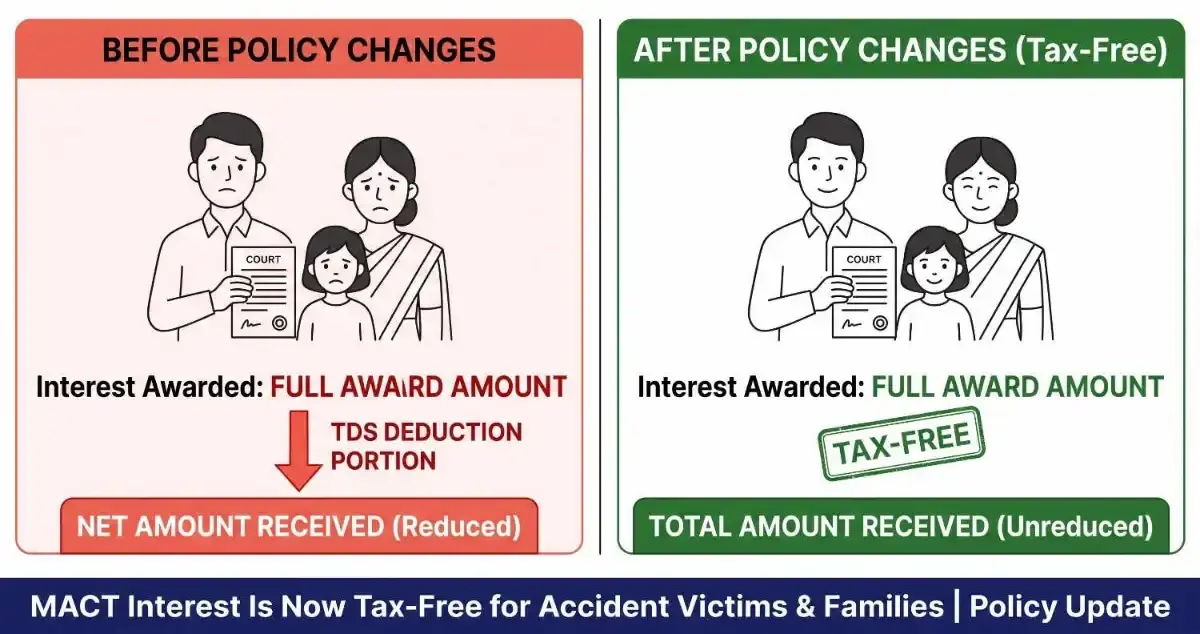
MACT interest income TDS exemption 2026 explained: who qualifies, old vs new Act rules, the FD interest trap, refund steps, and how to report it in your ITR.
Jul 24, 2026