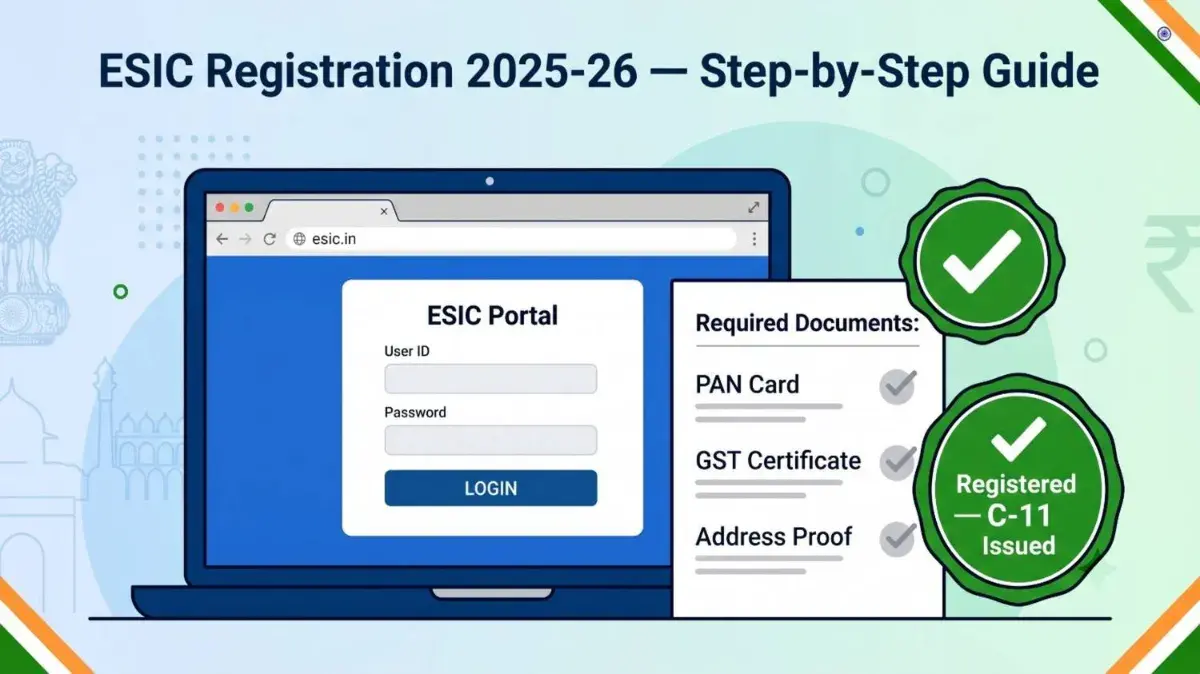

ESIC registration process 2025-26: the complete step-by-step online guide covering documents, fees, portal steps, deadlines, and employer penalties in India.
If your factory or establishment has 10 or more employees (20 in a few states), you must complete the ESIC registration process within 15 days of crossing that number. It's done entirely online at esic.gov.in with no government fee, and skipping it means back-dated contributions plus interest, not just a warning notice.
ESIC registration means enrolling your factory or establishment under the Employees' State Insurance Act, 1948 so your eligible employees get medical care, sickness pay, maternity benefit, and disability cover. This isn't an income-tax matter, so there's no old-Act-versus-new-Act confusion here — the ESI Act, 1948 runs the whole show, untouched by the Income-tax Act transition.
ESIC stands for Employees' State Insurance Corporation, the autonomous body under the Ministry of Labour and Employment that runs this scheme. Once you register, your establishment gets a 17-digit code for life, and that number follows every filing you'll ever do with ESIC.
Applies to | Does NOT apply to |
|---|---|
Non-seasonal factories using power, with 10+ workers in a manufacturing process | Seasonal factories not using power (different, narrower rules apply here) |
Shops, hotels, restaurants, cinemas, road transport, and newspapers with 10+ employees (20 in a handful of states) | Agricultural work and domestic workers employed in private homes |
Private schools, colleges, and medical institutions once they cross the threshold | Establishments still below their state's employee threshold |
Any establishment where even one employee earns ₹21,000/month or less (₹25,000 for a person with disability) | Establishments where every single employee earns above the wage ceiling |
Here's the part people miss: one employee under ₹21,000 is enough to trigger applicability, even if the rest of your staff earn well above it. And once you're in, you're in — registration doesn't switch off just because headcount later dips.
A quick word on state thresholds. Maharashtra is widely quoted as a 20-employee state, but that's outdated — a state notification (No. ESIC 2015/C.R.150/RAKAVI-2) brought shops, hotels, and similar establishments there down to 10 employees, effective 1 October 2020. Chandigarh, Odisha, Tamil Nadu, and Telangana show up as 20 in some guides and 10 in others. [VERIFY: current threshold for these four states — confirm with your Regional ESIC office or the ESIC coverage page]
These are the numbers that drive the whole ESIC registration process — some fixed since 2019, others changed only months ago.
Contribution rate: Employer pays 3.25%, employee pays 0.75%, for a combined 4% of gross wages. This has been fixed since 1 July 2019 and hasn't changed for FY 2025-26 or FY 2026-27. [Source: esic.gov.in/contribution]
Wage ceiling: ₹21,000/month gross for regular employees; ₹25,000/month for persons with disabilities.
Daily wage exemption: Anyone earning ₹176 or less a day skips the 0.75% employee share — though the employer still pays their 3.25%.
Registration deadline: Within 15 days of the establishment becoming eligible.
Monthly contribution deadline: By the 15th of the following month, under Regulation 31 of the ESI (General) Regulations, 1950. (This used to be 21 days, but the rule was amended in 2017 to 15 days — don't trust older articles still quoting 21.)
Half-yearly return: April-September period is due 11 November; October-March period is due 11 May.
Registration fee: Zero. You only pay if you hire a consultant to handle it for you.
The Labour Code change nobody explains well. The Code on Social Security, 2020 took effect on 21 November 2025, and ESIC's December 2025 circulars changed how "wages" gets calculated. If an employee's allowances — HRA, conveyance, and so on — add up to more than half their total pay, the extra amount now counts back as wages for ESI purposes. In plain terms, basic pay plus dearness allowance needs to be at least 50% of gross pay. If your payroll was built with a low basic to keep people under the ₹21,000 ceiling, some of those employees may now land back inside ESI coverage. [Source: ESIC circulars, December 2025]
SPREE 2025 and the Amnesty Scheme. ESIC's one-time, penalty-free registration window, SPREE 2025, ran from 1 July to 31 December 2025 and has now closed. Still open is the separate Amnesty Scheme, 2025, which lets employers settle old disputes over coverage, damages, and interest without full litigation, running until 30 September 2026. [Source: pib.gov.in, June 2025]
Example 1 — a 12-person retail shop in Pune
Suresh runs an electronics shop with 12 staff. Six earn ₹18,000/month gross, six earn ₹24,000. The shop crosses ESIC applicability the day the 10th person joins, regardless of salary, so Suresh has 15 days to register. Only the six employees under ₹21,000 get covered.
Monthly contribution per covered employee: ₹18,000 × 4% = ₹720 (₹585 employer, ₹135 employee). For all six: ₹4,320 a month, split as ₹3,510 employer and ₹810 deducted from wages.
Example 2 — a Bengaluru startup at exactly the ceiling
Priya works at a 15-person startup. Her CTC is built as ₹10,000 basic + ₹11,500 HRA and special allowance, totalling ₹21,500 — just above the ceiling, so on paper, no ESI deduction.
Here's the catch: her allowances (₹11,500) exceed half of her ₹21,500 gross. Fifty percent of ₹21,500 is ₹10,750, so ₹750 gets added back as wages under the new Labour Code rule. In her case the number barely moves — but if her basic had been lower, say ₹8,000 with ₹13,500 in allowances, the add-back would pull her effective wage down toward the ceiling and could bring her back into coverage entirely. Any employer with basic pay under 50% of gross should recheck every payslip. [VERIFY: exact add-back computation your regional ESIC office applies — implementation guidance is still settling state by state]
Go to esic.gov.in and click "Employer Login." First-timers click "Sign Up" instead.
Fill in the basics — company name, employer name, state, PAN, mobile number, and email. Confirm with the OTP sent to you.
Check your inbox. ESIC emails your username and password within minutes.
Log in and open Form-1, the Employer Registration Form. Enter establishment details: nature of business, date started, employee count, bank account, and PAN/TAN.
Upload your documents (full list below) and submit Form-1.
Pay the advance contribution. The portal shows "Pay Initial Contribution." Choose "Online," note the challan number, and pay by net banking, UPI, or card — this covers six months upfront.
Get your Registration Letter, Form C-11. This arrives with your permanent 17-digit ESIC number — your proof of registration, and what you'll use to download your ESIC registration certificate later. Officer verification can take 7-15 working days, even if the C-11 itself often arrives faster.
Register every employee separately. Your employer code doesn't cover staff automatically. Go to the employee registration section and file Form-6 for each eligible employee with their Aadhaar number and bank details — this new-employee step happens right after employer registration, and most guides barely mention it.
Issue Pehchan cards. Employees complete a biometric check (photo, signature, fingerprints) and get a Temporary Identity Card, followed by the permanent Pehchan card by post.
Payment went through but no C-11 arrived. Check "Payment History" in your employer login first. If your bank confirms the debit but ESIC's system shows nothing after 3-4 working days, raise a grievance through the portal's grievance module with your challan number and transaction ID. Don't pay again — reversing a duplicate payment takes longer than waiting out the grievance.
Form-1 got rejected or stuck in verification. This usually comes down to a mismatch between your PAN or GST details and what you entered, or an incomplete address proof. Check the "Application Status" tab for the exact rejection remark, fix that field, and resubmit — no need to start over.
You ended up with two establishment codes. This happens more than you'd think for a private limited company incorporated after 23 February 2020, since ESIC sometimes auto-registers such companies through MCA data before the employer applies manually. Write to your Regional Office with both codes and ask for consolidation — ignoring one code just lets penalties pile up on it quietly.
Document | Digital copy accepted? | Where to get it |
|---|---|---|
PAN card of the establishment | Yes | Income Tax e-filing portal |
Certificate of Incorporation, Partnership deed, or Shops & Establishment licence | Yes | MCA portal or local registrar |
GST registration certificate | Yes | GST portal |
Memorandum and Articles of Association (for companies) | Yes | MCA portal |
Cancelled cheque or bank account proof | Yes | Your bank |
List of employees with wage details | Yes | Internal payroll records |
Address proof of the establishment | Yes | Electricity bill or rent agreement |
Nothing here needs a physical visit — every document goes through the portal as an upload.
Non-payment of contribution (Section 85): Up to 3 years imprisonment and a fine up to ₹10,000. If the employer deducted the 0.75% employee share but never deposited it, the minimum jumps to 1 year with a mandatory ₹10,000 fine — courts have held they can't go lower once this is proven.
Damages for delayed payment (Section 85-B): Up to 100% of the arrears, usually graded — roughly 5% for a short delay, rising to 25% past six months.
Interest on late payment (Section 39(5)(a)): 12% per year, from the day after the due date.
Repeat offences (Section 85-A): Up to 2 years and ₹5,000 for a second violation.
Late half-yearly return: A separate offence under Section 85, even if every monthly payment was on time.
Mostly, yes — a few states set it at 20. Even professionals get confused here: Maharashtra's threshold shows up as both 10 (per a 2020 state notification) and 20 (in older guides). Confirm your state's current notification with your Regional ESIC office before assuming either figure.
Voluntary registration for smaller establishments opened up during SPREE 2025, which closed on 31 December 2025. Outside a scheme like that, sub-threshold establishments generally don't need to register, though some regional offices accept voluntary applications on request.
Your establishment code is active, but no employee has coverage or a Pehchan card until you file Form-6 for each one. This is the single most common gap employers leave open — treat employee registration as its own task, not something automatic.
You still have to register — there's no expiry on the obligation. ESIC can demand contributions retrospectively from the date you first crossed the threshold, plus 12% annual interest on the backdated amount. Sort it out sooner rather than later; the bill only grows.
Contract workers placed at your site count toward your employee threshold, and if they earn under ₹21,000, they need ESIC cover too — with liability shifting to you, the principal employer, if the contractor doesn't comply. Pure gig or platform workers without a direct employer-employee relationship still sit outside ESIC for now, though the Code on Social Security, 2020 opens the door to future coverage. [VERIFY: gig-worker ESIC rollout timeline — check labour.gov.in for state-level updates]
Two separate schemes, different rules. ESIC applies at 10 (or 20) employees, with a ₹21,000 gross wage ceiling and a 4% combined contribution. EPF applies uniformly at 20 employees nationwide, with a ₹15,000 basic-wage ceiling and 12% + 12% contribution. An employee can be covered under both at once — it isn't either-or.
The C-11 letter often shows up within a day or two of your advance contribution clearing. Separately, officer verification of your details can take 7-15 working days, and employee-level Pehchan card issuance with biometric capture adds another 30 days on top. Keep these three timelines apart — they don't run together.
No. The registration itself is free. Any cost you pay is for a CA, CS, or compliance consultant handling the paperwork for you — not for the registration itself.
You can surrender it, but it isn't automatic. Write to your Regional Director, clear every pending contribution and return, and go through a verification — sometimes a physical inspection — before ESIC marks your code as closed. Expect months, not weeks.
SPREE 2025 let unregistered employers and left-out employees join ESIC without penalty or demand for old dues. It ran from 1 July to 31 December 2025 and has now closed. The separate Amnesty Scheme, 2025 is still open until 30 September 2026 — worth checking if you have an old ESIC dispute sitting unresolved.
Register within 15 days of crossing your employee threshold, keep basic pay at 50% or more of gross to avoid getting caught out by the new Labour Code wage rule, and don't forget the employee-level Form-6 step once your employer code is through. Run your numbers through Toolisky's ESIC Eligibility Checker before you start, and head to esic.gov.in to begin the registration itself.
For educational purposes only. Verify all figures at official sources before acting. Toolisky is not affiliated with any government body. Consult a qualified CA or legal professional before making compliance decisions. See toolisky.com/accuracy-and-limitations.

ESIC eligibility 2026 explained: ₹21,000/₹25,000 wage limit, the 10-vs-20 employee rule by state, family rules, and who's excluded, with real examples.
Jul 21, 2026
No TAN for NRI property purchase applies only from 1 October 2026, and only to resident individual and HUF buyers. Get the rates, forms, and dates you need.
Jul 25, 2026

Did you lose the SGB premature redemption tax exemption? Here's exactly who's affected, how much tax applies now, and how to check your own bonds.
Jul 24, 2026