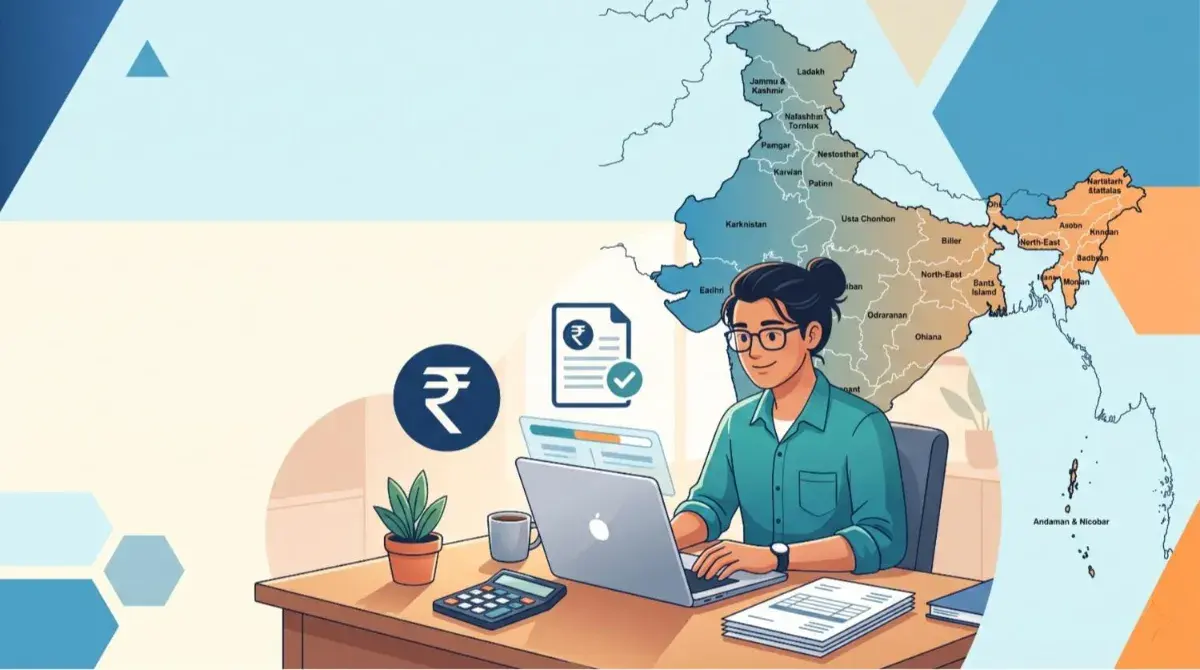

Income tax for freelancers in India FY 2025-26: slab rates, Section 44ADA, advance tax, TDS, deductions, and worked ₹ calculations for every scenario
As a freelancer in India, your tax liability depends on three things: your gross receipts, whether you opt for Section 44ADA (presumptive taxation), and which ITR form you file. This guide gives you every number, every deadline, and every scenario — including foreign clients, salary + freelance combinations, and first-year filers who don't know when advance tax kicks in.
Freelance income in India is taxed under the head "Profits and Gains of Business or Profession" (PGBP) under Section 28 of the Income-tax Act, 1961. Your taxable income is either 50% of gross receipts (Section 44ADA presumptive scheme) or actual net profit after expenses — whichever route you choose. The same individual slab rates apply; there is no separate "freelancer" rate.
This topic falls under the Income-tax Act, 1961, assessed in AY 2026-27. Section numbers verified against incometaxindia.gov.in for FY 2025-26. The Income-tax Act, 2025 applies only from Tax Year 2026-27 (i.e., income earned on or after 1 April 2026).
Applies To | Does NOT Apply To |
|---|---|
Individual resident freelancers (writers, designers, developers, consultants, architects, engineers, doctors) | Non-resident Indians (NRIs) earning only outside India |
Resident partnership firms (not LLP) with professional income | Companies and LLPs (different Act provisions apply) |
Salaried employees doing freelance work on the side | Freelancers earning purely from business activity (use Section 44AD instead) |
Indian freelancers working for foreign clients (Upwork, Fiverr, Toptal) | Individuals whose gross receipts exceed ₹75 lakh under 44ADA (must use ITR-3 with books) |
Partial/conditional note: Salaried employees with freelance income cannot use ITR-1 or ITR-4 if their total income exceeds ₹50 lakh or they have capital gains. In most cases, they must file ITR-3. See the combined income section below.
Under Section 115BAC(1A) of the Income-tax Act, 1961:
Total Income | Tax Rate |
|---|---|
Up to ₹3,00,000 | Nil |
₹3,00,001 – ₹7,00,000 | 5% |
₹7,00,001 – ₹10,00,000 | 10% |
₹10,00,001 – ₹12,00,000 | 15% |
₹12,00,001 – ₹15,00,000 | 20% |
Above ₹15,00,000 | 30% |
Section 87A rebate (AY 2026-27): Full tax rebate up to ₹60,000 if total income ≤ ₹12,00,000 under the new regime. Zero tax payable up to ₹12L.
Health & Education Cess: 4% on tax payable (after surcharge, if any).
Gross receipts ≤ ₹50,00,000: eligible for 44ADA (declare 50% as income).
Gross receipts ≤ ₹75,00,000: eligible if cash receipts ≤ 5% of total receipts.
Professional services: 10% TDS (threshold ₹30,000 per year per client).
Technical services: 2% TDS.
Instalment | Due Date | % of Annual Tax Liability |
|---|---|---|
1st | 15 June | 15% |
2nd | 15 September | 45% |
3rd | 15 December | 75% |
4th (final) | 15 March | 100% |
44ADA users: Can pay 100% in a single instalment by 15 March.
Every competitor article explains what 44ADA is. None shows you the rupee math to decide. Here it is.
The rule: If your actual professional expenses are below 50% of gross receipts, 44ADA saves tax. If your actual expenses exceed 50% of gross receipts, file ITR-3 with actual books.
Suresh is a software developer. FY 2025-26 gross receipts: ₹15,00,000. Actual expenses: ₹1,50,000 (internet, subscriptions, phone — 10% of receipts).
Under 44ADA (Section 44ADA, 1961 Act):
Taxable income = 50% × ₹15,00,000 = ₹7,50,000
Tax (new regime): ₹0 on first ₹3L + 5% on next ₹4L = 5% × ₹4,50,000 = ₹22,500
Cess (4%): ₹22,500 × 4% = ₹900
Total tax = ₹23,400
Under ITR-3 (actual expenses):
Net profit = ₹15,00,000 − ₹1,50,000 = ₹13,50,000
Tax (new regime): ₹0 on ₹3L + 5% × ₹4L + 10% × ₹3L + 15% × ₹2L + 20% × ₹1,50,000 = ₹20,000 + ₹30,000 + ₹30,000 + ₹30,000 = ₹1,10,000
Cess: ₹1,10,000 × 4% = ₹4,400
Total tax = ₹1,14,400
Saving with 44ADA = ₹1,14,400 − ₹23,400 = ₹91,000. 44ADA wins here.
Priya is a UI/UX designer. FY 2025-26 gross receipts: ₹15,00,000. Actual documented expenses: ₹9,00,000 (laptop, software licences, co-working space, travel — 60% of receipts).
Under 44ADA:
Taxable income = 50% × ₹15,00,000 = ₹7,50,000
Tax (new regime) = ₹22,500 + cess ₹900 = ₹23,400
Under ITR-3 (actual expenses):
Net profit = ₹15,00,000 − ₹9,00,000 = ₹6,00,000
Tax (new regime): 5% × ₹3,00,000 = ₹15,000
Cess: ₹600
Total tax = ₹15,600
Saving with ITR-3 = ₹23,400 − ₹15,600 = ₹7,800. More importantly, Priya's actual expenses exceed 50%, making 44ADA unfair — she'd pay tax on a "profit" that doesn't exist.
Use Toolisky's free professional income tax calculator to instantly compare your tax under both methods without manual arithmetic.
Every top article ignores this scenario. If you earn salary from a job AND freelance income in the same year, your filing is different from a pure freelancer's.
Key rules:
You cannot use ITR-1 (salary only) or ITR-4 (if total income exceeds ₹50L, or you have capital gains, or you are a director).
You must file ITR-3 — it handles both salary (Schedule S) and professional income (Schedule PGBP) together.
You can still claim Section 44ADA on the freelance portion alone.
Ramesh earns ₹8,00,000 salary (after standard deduction ₹75,000 = net ₹7,25,000) and ₹4,00,000 from freelance graphic design.
Step 1 — Freelance taxable income under 44ADA: 50% × ₹4,00,000 = ₹2,00,000
Step 2 — Combine both income heads: Total taxable income = ₹7,25,000 (salary) + ₹2,00,000 (freelance) = ₹9,25,000
Step 3 — Apply new regime slabs:
Nil on ₹3,00,000
5% on ₹3,00,001–₹7,00,000 = 5% × ₹4,00,000 = ₹20,000
10% on ₹7,00,001–₹9,25,000 = 10% × ₹2,25,000 = ₹22,500
Subtotal tax = ₹42,500
Cess (4%) = ₹1,700
Total tax = ₹44,200
Step 4 — Credit TDS already deducted: Employer deducted ₹19,500 TDS from salary. Ramesh owes ₹44,200 − ₹19,500 = ₹24,700 more, paid as advance tax by 15 March.
ITR-3 is mandatory here. In Schedule PGBP, Ramesh enters ₹4,00,000 gross receipts and ticks the 44ADA presumptive box. The portal auto-computes 50%. [VERIFY: ITR-3 schedule label for 44ADA election — confirm on live portal at incometax.gov.in before publishing, as portal UI labels change]
For choosing between regimes in your combined scenario, see Toolisky's old vs new tax regime comparison for FY 2025-26.
You received ₹12,00,000 from Upwork. Your Form 26AS shows ₹0 TDS. This is normal — foreign companies have no obligation to deduct Indian TDS. But your tax liability is real, and the interest clock starts if you miss advance tax.
Farida — freelance content strategist. FY 2025-26 gross receipts from Upwork: ₹12,00,000. She opts for 44ADA. Zero Indian clients.
Step 1 — Convert USD to INR: Use your bank's telegraphic transfer (TT) buying rate on each receipt date. Your bank statement shows the INR credited — that figure is your gross receipt. Do not use Google's exchange rate or RBI's reference rate for tax purposes. [VERIFY: confirm RBI/CBDT circular specifying the exact conversion rate rule for ITR purposes — search cbdt.gov.in]
Step 2 — Compute taxable income: 44ADA taxable income = 50% × ₹12,00,000 = ₹6,00,000
Step 3 — Compute annual tax liability: New regime: 5% × ₹3,00,000 = ₹15,000 + cess ₹600 = ₹15,600 This exceeds ₹10,000 — advance tax is mandatory.
Step 4 — 44ADA advance tax privilege: Freelancers using 44ADA can pay their entire advance tax in one instalment by 15 March 2026. They are exempt from the June, September, and December instalments.
Step 5 — If you miss 15 March: Interest accrues at 1% per month under Section 234B (for under-payment) and Section 234C (for missing instalments). On ₹15,600 liability, that is ₹156 per month of delay — small, but it creates a demand notice. Use Toolisky's Section 234A/234B/234C interest calculator to see your exact interest amount.
GST note: If your export of services exceeds ₹20 lakh in a year, GST registration may be required even for foreign clients. Services exported on a zero-rated basis (with LUT/bond) attract 0% GST but require registration. [VERIFY: current GST export of services threshold and LUT requirement — confirm at gst.gov.in]
This section only applies if you file ITR-3 with actual books — not if you use 44ADA (where all expenses are deemed included in the 50%).
Expense | Allowed % | Documentation Required | Rejected in Scrutiny If... |
|---|---|---|---|
Internet & phone | 50–70% of bill | Monthly bills, bank statements | 100% claimed for personal SIM |
Laptop/equipment | 40% WDV depreciation p.a. | Purchase invoice + WDV schedule | Personal use laptop with no work invoices |
Home office rent | Proportionate to workspace area ÷ total home area | Rent agreement, landlord PAN | Owned home claimed as rental expense |
Software subscriptions | 100% | Invoice/receipt showing professional purpose | Personal streaming services bundled |
Professional courses | 100% | Course certificate, payment receipt | Courses unrelated to your work domain |
Client travel | 100% actual | Flight/train tickets, hotel bills | Personal holidays mixed with client trips |
Example — Ramesh (18L income, ITR-3): A freelancer with ₹18,00,000 gross receipts claims:
Internet ₹18,000 (70% of ₹25,714 annual bill)
Phone ₹12,000 (50% of ₹24,000)
Laptop depreciation: Cost ₹80,000, WDV year 2 = ₹80,000 × 60% = ₹48,000, depreciation = 40% × ₹48,000 = ₹19,200
Co-working space ₹1,20,000 (receipts on file)
Software subscriptions ₹36,000 (Adobe, Figma)
Professional course ₹45,000 (UX certification)
Total deductible = ₹2,50,200
Net taxable income = ₹18,00,000 − ₹2,50,200 = ₹15,49,800
Most new freelancers don't know about advance tax until they get a demand notice. Here is what triggers it.
The rule: If your total tax liability for the year exceeds ₹10,000 after subtracting TDS, you must pay advance tax. This applies even in your first year of earning.
44ADA users: You owe advance tax only if your estimated annual tax exceeds ₹10,000. Since 44ADA lets you pay in one shot by 15 March, first-year freelancers who start in April have until 15 March of the same fiscal year.
Estimation mid-year: In October, add up all receipts so far. Multiply by the factor to annualise (e.g., 6 months of receipts × 2). Apply 44ADA (50%) or your estimated expenses. Compute tentative tax. If it crosses ₹10,000, pay advance tax.
Example — new freelancer Kavita: Started freelancing in May 2025. By September she received ₹3,00,000. Annualised estimate: ₹6,00,000. Under 44ADA: 50% = ₹3,00,000 taxable. Tax = 5% × ₹0 (below ₹3L basic exemption under new regime) = ₹0. No advance tax needed yet.
By December she received another ₹4,00,000 (total ₹7,00,000). New annualised estimate: ~₹12,00,000 × 50% = ₹6,00,000. Tax = 5% × ₹3,00,000 = ₹15,000. Exceeds ₹10,000 — she now pays advance tax by 15 March 2026.
What if she misses 15 March? She pays the tax with interest under Section 234B/234C when filing ITR by 31 July 2026. There is no separate penalty for a first-time small advance tax default — only the 1%/month interest. [VERIFY: confirm no separate penalty applies for first-time advance tax default — search incometaxindia.gov.in]
Your Situation | Correct Form |
|---|---|
Pure freelancer, 44ADA, gross receipts ≤ ₹50L (or ₹75L with 95% digital), no capital gains, total income ≤ ₹50L | ITR-4 (Sugam) |
Pure freelancer filing with actual books (ITR-3) OR total income > ₹50L OR you have capital gains OR salary + freelance | ITR-3 |
ITR filing steps on incometax.gov.in:
Log in at incometax.gov.in → click e-File → Income Tax Returns → File Income Tax Return.
Select AY 2026-27 → mode Online.
Choose ITR-4 (44ADA) or ITR-3 (books). The portal will ask a series of applicability questions — answer them to confirm the form.
Under Schedule PGBP, enter your gross receipts. If using 44ADA, tick the presumptive box; the portal auto-fills 50% as income.
Check your AIS (Annual Information Statement) — click e-File → AIS — to see all TDS deductions and receipts the department has. Reconcile these with your own records before submitting.
Enter TDS credits in Schedule TDS using Form 16A data from your clients.
Click Preview and Submit → verify using Aadhaar OTP or Net Banking EVC.
Download the ITR-V acknowledgement. No physical copy needs to be sent (EVC verification is complete).
Deadline: 31 July 2026 for freelancers not subject to tax audit. 31 October 2026 if tax audit under Section 44AB applies (gross receipts > ₹75L with 44ADA, or > ₹50L under normal method if declared profit < 50%).
For a full comparison of ITR-1 vs ITR-4 eligibility, see Toolisky's guide on ITR-1 vs ITR-4 for AY 2026-27.
You billed a client ₹2,00,000 and they should have deducted ₹20,000 TDS (10% under Section 194J), but the AIS shows ₹0.
Fix: First, ask the client for their TDS certificate (Form 16A). If they haven't filed their TDS return (Form 26Q), the credit will not appear in your AIS. You cannot claim TDS credit that doesn't appear in AIS at the time of filing. File your ITR claiming only what's in AIS. Separately, write to the client's finance team to file Form 26Q for the quarter. Once they do, you can file a revised return (before 31 December 2026) to claim the credit. Do not inflate TDS in your return to match what "should" have been deducted — that will trigger a demand notice.
You filed ITR-4 but actually had a capital gain from selling shares — ITR-4 is ineligible for capital gains.
Fix: File a revised return under Section 139(5) before 31 December 2026 using ITR-3. Log in → e-File → Income Tax Returns → select the same AY → choose Revised return → enter the original acknowledgement number. No penalty applies for a revised return filed before the due date. If filed after December, you need to apply for a condonation under Section 119(2)(b) — contact your Assessing Officer directly.
You forgot to file by 31 July 2026.
Fix: File a belated return under Section 139(4) any time before 31 December 2026. Penalty under Section 234F: ₹1,000 if total income ≤ ₹5,00,000; ₹5,000 if total income > ₹5,00,000. You also owe interest under Section 234A at 1% per month from August onwards on the unpaid tax. If you missed December too, file an updated return under Section 139(8A) — allowed up to 48 months from the end of the AY, with an additional tax of 25–50% on the incremental tax due.
Default | Section (1961 Act) | Amount |
|---|---|---|
Late ITR filing (income > ₹5L) | 234F | ₹5,000 |
Late ITR filing (income ≤ ₹5L) | 234F | ₹1,000 |
Under-payment of advance tax | 234B | 1% per month on shortfall |
Missed advance tax instalment | 234C | 1% per month on shortfall for 3 months |
Late ITR filing interest on tax due | 234A | 1% per month from due date |
Failure to maintain books (if required) | 271A | Up to ₹25,000 |
Concealment of income | 270A | 50–200% of tax on concealed income |
ITR deadline: 31 July 2026 (non-audit). 31 October 2026 (audit cases).
Yes, if your aggregate turnover exceeds ₹20 lakh in a year (₹10 lakh for north-eastern and hill states). For freelancers working with foreign clients, turnover counts even if the service is exported. Services exported under a Letter of Undertaking (LUT) are zero-rated, meaning no GST is charged but you must be registered. [VERIFY: current GST threshold for freelancers serving foreign clients — confirm at gst.gov.in]
ITR-4 if you use Section 44ADA, your gross receipts are ≤ ₹50 lakh (or ≤ ₹75 lakh with 95% digital receipts), and your total income is ≤ ₹50 lakh with no capital gains. ITR-3 in every other case, including if you have both salary and freelance income. Filing ITR-1 is a common mistake — ITR-1 is valid only for salary/pension income and does not accommodate freelance or business income.
Yes, but with a cost. If you opt out of 44ADA, you cannot re-enter the scheme for the next 5 assessment years. For example, if you opt out in AY 2026-27, you are locked out until AY 2031-32. Plan carefully — if your actual expenses are consistently below 50%, staying in 44ADA is usually better.
Yes. Indian tax residents are taxed on global income, regardless of which country the client is in or which platform processes the payment. You convert the foreign currency to INR using your bank's receipt rate and declare the full amount as professional income. The fact that no TDS was deducted does not reduce your liability — it only means you pay through advance tax instead.
Indian companies deduct 10% TDS on professional fees (design, content, consulting, legal, medical) and 2% on technical services (IT development, call centres). TDS applies if your aggregate payments from a single client exceed ₹30,000 in a financial year. Individual clients who are not subject to tax audit do not deduct TDS under 194J — they deduct at 5% under Section 194M if payments exceed ₹50 lakh.
Yes, but only on the freelance portion. The salary component is computed separately under the salary head. Your combined income is then taxed at slab rates. The combined income — not just freelance income — determines which tax bracket you fall into, so a high salary can push your freelance income into the 20% or 30% slab even if your freelance income alone would be tax-free.
Freelancers who opt for Section 44ADA can pay 100% of their estimated advance tax in a single instalment by 15 March 2026 for FY 2025-26. They do not need to pay in June, September, or December. This privilege does not apply to freelancers who file under ITR-3 with actual books — they follow the standard four-instalment schedule.
Not always. The ₹12 lakh zero-tax benefit under Section 87A rebate applies only if you opt for the new tax regime and your total income does not exceed ₹12,00,000. If your income is ₹12,50,000, the rebate does not apply at all (no marginal relief for amounts just above ₹12L under the business income rebate rules). Also, the rebate is unavailable against income taxed at special rates, such as short-term capital gains. Verify your exact situation using a calculator before assuming zero liability.
You can declare any income ≥ 50% of gross receipts under 44ADA — you cannot declare less. If your actual profit is genuinely below 50% (say, 20%) and your income exceeds the basic exemption limit, you must exit 44ADA, maintain books, get a tax audit under Section 44AB, and file ITR-3. Declaring artificially inflated income just to stay in 44ADA when your actual profits are much lower is not required — but declaring income below 50% without a tax audit is a violation.
Under 44ADA, you are legally exempt from maintaining books of account. However, keep: all client invoices, bank statements showing receipts, Form 16A from clients, Form 26AS / AIS printouts, and payment receipts for any expenses you may need to explain if called for scrutiny. CBDT's AI-assisted monitoring (noted in AIS updates from 2025) cross-checks your declared income against TDS data — discrepancies trigger notices even for 44ADA filers.
Check your Form 26AS / AIS on incometax.gov.in right now — confirm every TDS entry matches your invoices before filing. Use Toolisky's free professional income tax calculator to compare your tax under 44ADA vs actual expenses in under 60 seconds. File ITR-4 or ITR-3 by 31 July 2026 at incometax.gov.in.
For educational purposes only. Verify all figures at official sources before acting. Toolisky is not affiliated with any government body. Consult a qualified CA or legal professional before making compliance decisions. See toolisky.com/accuracy-and-limitations.
A complete guide to income tax for freelancers in India for 2026, slabs, Section 44ADA, GST, TDS, advance tax, and ITR filing, explained with real rupee examples.
Jul 9, 2026
No TAN for NRI property purchase applies only from 1 October 2026, and only to resident individual and HUF buyers. Get the rates, forms, and dates you need.
Jul 25, 2026

Did you lose the SGB premature redemption tax exemption? Here's exactly who's affected, how much tax applies now, and how to check your own bonds.
Jul 24, 2026