

Motor accident compensation interest tax exemption 2026: who qualifies, TDS removal rules, refund steps for old deductions, and how to file it in your ITR.
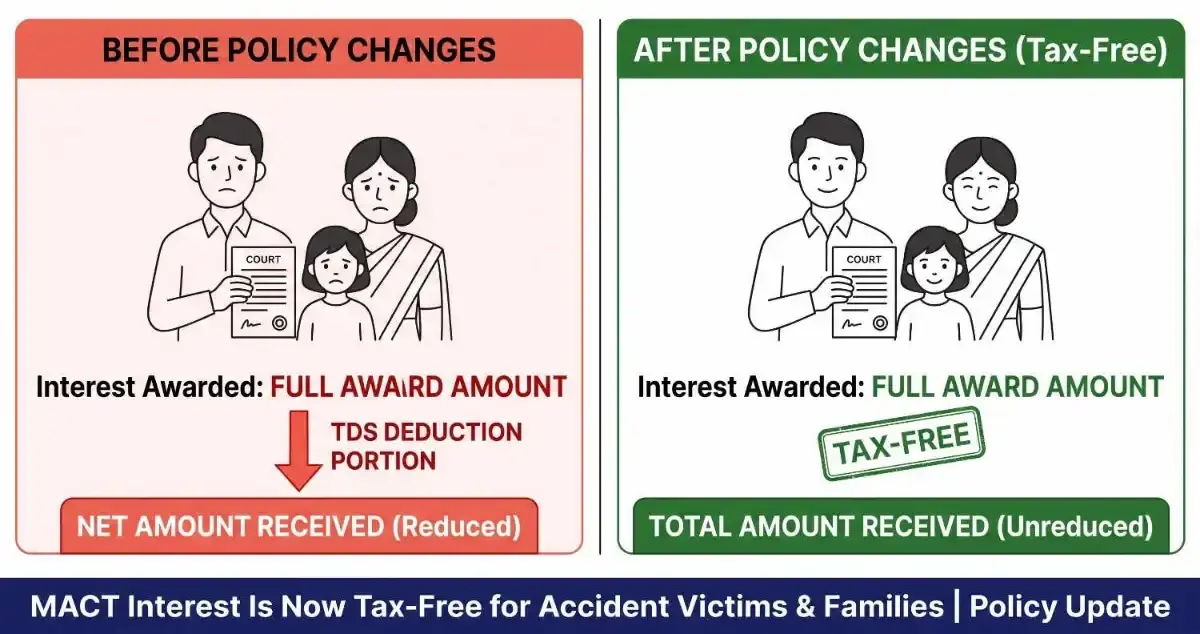
If you or your family got compensation from a Motor Accidents Claims Tribunal, here's the good news: the motor accident compensation interest tax exemption 2026 makes that interest fully tax-free, if you're an individual or a legal heir. TDS on it is gone too, no matter how large the amount is. Here's what changed, what stayed the same, and what to do if tax was already cut from your payout.
Most articles on this topic mix up two very different things. Let's fix that first.
Your motor accident compensation has two parts, taxed on completely different terms. The principal amount — the lump sum for injury or death — has been a capital receipt for decades. It was never taxed, and that hasn't changed in 2026.
The interest on that compensation is what everyone's actually asking about. It's money paid because your case sat in tribunal for years while the compensation waited to be released, and it's exactly what became tax-free this year.
Here's how it works in law. The Income-tax Act, 2025 exempts this interest under Section 11 read with Schedule III, when the recipient is an individual or their legal heir. This exemption comes from Clause 108 of the Finance Bill, 2026, and it kicks in from 1 April 2026, applying from Tax Year 2026-27 onward. In plain terms: this is the Schedule III Income Tax Act 2025 exemption everyone in the MACT interest tax exemption Budget 2026 discussion has been talking about since February.
But what if your award or TDS deduction happened before 1 April 2026? Then the old numbering applies instead — Section 194A(3)(ixa) of the Income-tax Act, 1961, the provision that let ₹50,000 a year pass without TDS.
So this is really a two-Act story. Interest received before 1 April 2026 sits under the 1961 Act's Section 194A. Interest received on or after that date sits under the 2025 Act's Section 11/Schedule III for the exemption, and Section 393(4) for TDS. Both numbers are checked directly against Finance Bill 2026 clause text, not pulled from memory.
Applies to | Doesn't apply to |
|---|---|
Individuals awarded MACT interest | Companies, firms, or trusts as claimants |
Legal heirs, if they're individuals, in death cases | Legal heirs that are institutions or entities |
Interest awarded under the Motor Vehicles Act, 1988 | Interest that has nothing to do with a MACT award |
Interest from the claim-petition date up to the award or appeal | Interest for delay in depositing the money after the award (see the note below) |
One tricky case: say a tribunal orders a minor's compensation parked in an FD until they turn 18. The MACT interest itself stays exempt — but once that money sits in the bank, the FD interest is ordinary bank interest, not MACT interest, and it's usually still taxable, clubbed into a parent's income under Section 99(1A) of the 2025 Act (the renumbered old Section 64(1A)).
Real figures matter more than vague descriptions. Here's the direct before-and-after.
What changed | Before 1 April 2026 (1961 Act) | From 1 April 2026 (2025 Act) |
|---|---|---|
Is the interest taxable? | Usually yes, unless court rulings like Rupesh Rashmikant Shah applied to your case | No — exempt for individuals and legal heirs under Schedule III |
TDS threshold for individual claimants | ₹50,000 a year, Section 194A(3)(ixa) | No TDS at all, any amount, Section 393(4) |
TDS threshold for non-individual claimants | ₹50,000 a year | Still ₹50,000 a year — unchanged |
Which section governs it | 194A, 1961 Act | 393, 2025 Act (with Schedule III for the exemption itself) |
Sources: Finance Bill 2026, Clause 72 and Clause 108; incometaxindia.gov.in Section 393.
This isn't the first time courts looked at whether motor accident claims tribunal TDS should apply. In Rupesh Rashmikant Shah v. Union of India (2019) 417 ITR 169, the Bombay High Court ruled that interest from the claim-petition date until the award or appellate judgment is really compensation, not income — so the old Section 194A motor accident claim interest rule shouldn't have applied in the first place. This 2026 exemption is Parliament catching up with what courts had already decided.
One thing the court flagged still matters: interest paid for delay after the award, separate from interest built into the award itself, counts as ordinary interest income and can still be taxed. Not every rupee of interest on your file is automatically tax-free — check what it's actually compensating you for.
Example 1 — the common case. Suresh was awarded ₹8,00,000 compensation plus ₹2,20,000 interest by the MACT in May 2026, for a case filed back in 2022. He's an individual claimant.
Principal: ₹8,00,000 — a capital receipt, so no tax either way.
Interest: ₹2,20,000. Under the old rule, TDS would've kicked in above ₹50,000, cutting roughly ₹22,000 to ₹44,000 (depending on whether PAN was on file) before Suresh ever saw the money.
Under the new rule: TDS is zero. He gets the full ₹2,20,000, and none of it enters his total income.
The gain: he keeps ₹22,000 to ₹44,000 that would've gone into TDS and then needed a separate refund claim.
Example 2 — the case most articles skip. Farida's late husband's claim was settled in March 2026. She and her two adult children, as legal heirs, jointly received ₹3,00,000 interest just before the 1 April cutoff.
Since payment happened before 1 April 2026, the old rule applies: Section 194A(3)(ixa), ₹50,000 threshold.
TDS deducted: roughly 10% on the amount over the threshold (PAN furnished), about ₹30,000.
Farida's income that year is below the taxable limit. To get the ₹30,000 back, she must file an ITR showing nil liability — there's no automatic pass-through like the 2026 rule gives.
The takeaway: it's the date the money actually reached her, not the date the case was filed, that decides which rule applies.
There's no special portal for this — MACT compensation ITR filing works like any regular return, you just need to put the exemption in the right place.
Log in at incometax.gov.in and pick the right ITR form — ITR-1 for salaried individuals under ₹50 lakh, or ITR-2/ITR-3 with capital gains or business income.
Report the MACT interest under exempt income, even though no tax is due — this keeps it on record. [VERIFY: exact schedule name for exempt income under AY 2027-28 forms — not yet notified]
Check Form 26AS or its successor, Form 168, to confirm no TDS was wrongly cut post-April 2026.
If TDS was cut by mistake, claim it back through the return itself — it shows as tax already paid, refunded to you.
If your award straddles the cutoff, split the reporting: pre-April interest through the old refund route if TDS applied; post-April interest is just exempt income to disclose, no tax math needed.
TDS got deducted on interest paid after 1 April 2026, even though it shouldn't have. This isn't supposed to happen for individual claimants, but insurers and courts are still catching up. Write to the deducting insurer or court registry, quote Section 393(4) and Clause 72 of Finance Bill 2026, and claim the TDS back as refund in that year's ITR.
You picked the wrong ITR schedule and forgot to disclose the exempt interest. Usually no penalty on its own, but it can trigger a mismatch notice since the payment may already show in the department's records. File a revised return and add the disclosure.
Your claim is jointly held, and one legal heir is an institution — say, a trust holding a minor's share. Schedule III is written for individuals and legal heirs, and an institutional heir doesn't automatically qualify. The old ₹50,000 TDS threshold likely still applies to that portion. Get a CA to check each co-claimant's status before assuming the whole award is exempt.
Document | Digital copy okay? | Where to get it |
|---|---|---|
MACT award copy | Yes | Tribunal registry or advocate |
PAN card | Yes | e-PAN via incometax.gov.in |
TDS certificate (Form 131), if deducted | Yes | Deductor (insurer) or TRACES |
Bank proof, for refund credit | Yes | Passbook or cancelled cheque |
Legal heir certificate, death claims | No, original needed | Tehsildar or municipal office |
The exemption carries no penalty risk of its own — it's relief, not a new burden. But related mistakes still cost real money:
Wrong TDS deduction, not corrected: the deductor risks interest under Section 398 of the 2025 Act — 1% a month for late deduction, 1.5% a month for late deposit.
Late ITR filing to claim a wrongly-deducted refund: ₹1,000 to ₹5,000 under Section 234F, plus 1% monthly interest under Section 234A on unpaid tax.
Missing the exempt-income disclosure, leading to a defective-return notice: issued under Section 263(7) of the 2025 Act (the renumbered version of old Section 139(9)), with the same 15-day correction window carried forward.
No, not the compensation itself. The principal amount for injury or death has always been a capital receipt, not income. The only part ever debated — and the only part this 2026 change touches — is the interest.
No. It applies from 1 April 2026 onward, Tax Year 2026-27. Interest received earlier still falls under the old Section 194A rules and whatever case law applied to your situation.
Yes, if your total income that year was below the taxable limit. File your ITR, show the TDS as tax already paid, and claim it as refund. There's no separate form for this.
No. Only interest actually awarded by the MACT is exempt. Once that money sits in a bank FD, the FD interest is ordinary bank interest, usually clubbed into a parent's or guardian's income.
This exemption doesn't settle succession disputes. Get a legal heir or succession certificate sorted first — tax treatment follows whoever the tribunal or court recognises as the rightful recipient.
No. Schedule III's wording is specific to compensation and interest under the Motor Vehicles Act, 1988, through a Motor Accidents Claims Tribunal. General civil court awards fall outside it.
Generally, no. Schedule III's "an individual or his legal heir" wording has traditionally meant natural persons only. A trust or company heir likely still faces the old ₹50,000 TDS threshold under Section 393(4). [VERIFY: whether "legal heir" can ever include a non-natural-person entity — check the latest CBDT circular]
For anything paid on or before 31 March 2026, Section 194A of the 1961 Act stays correct. From 1 April 2026 onward, quote Section 393 with the right table serial number under the 2025 Act.
Usually yes, through a belated return within that year's window, though you'll pay the late fee under Section 234F. Miss that window too, and the refund becomes harder, possibly needing a condonation-of-delay request.
No. There's no standalone exemption-claim form. You simply don't pay tax on the interest, and disclose it as exempt income in your regular ITR for the year you received it.
Check the exact date your MACT interest was paid or credited — that single fact decides which rule applies, not the date you filed the case. If TDS was wrongly cut after 1 April 2026, raise it with the deductor straightaway and claim the refund through your ITR. For the Section 393 TDS mechanics behind this exemption, see Toolisky's Section 393 Income Tax Act 2025 TDS rate chart, and for everything else that changed, read Income Tax Act 2025 vs 1961. To confirm which ITR form fits you, Toolisky's ITR-1 vs ITR-4 guide walks through it. For the bare-act text, the Income Tax Department's site is the final word.
For educational purposes only. Verify all figures at official sources before acting. Toolisky is not affiliated with any government body. Consult a qualified CA or legal professional before making compliance decisions. See toolisky.com/accuracy-and-limitations.
No TAN for NRI property purchase applies only from 1 October 2026, and only to resident individual and HUF buyers. Get the rates, forms, and dates you need.
Jul 25, 2026

Did you lose the SGB premature redemption tax exemption? Here's exactly who's affected, how much tax applies now, and how to check your own bonds.
Jul 24, 2026
MACT interest income TDS exemption 2026 explained: who qualifies, old vs new Act rules, the FD interest trap, refund steps, and how to report it in your ITR.
Jul 24, 2026