

Section 393 of the Income Tax Act 2025 TDS rate chart for FY 2026-27: old-to-new section mapping, Form 121, worked ₹ examples, and penalty rules explained.
If you've been quoting 194C or 194J on a TDS challan for years, forget it — from 1 April 2026, almost all of it sits under one section. Section 393 of the Income Tax Act 2025 is the umbrella provision that now covers rent, contractor payments, professional fees, commission, interest and a dozen other payment types that used to live under separate 194-series sections. This guide walks through the Section 393 TDS rate chart for FY 2026-27, the old-to-new mapping, and exactly what changes on your next TDS return.
Section 393 sits in Chapter XIX of the Income-tax Act, 2025, and it deals with TDS — the tax your payer cuts and deposits with the government before the money even reaches you. It replaces more than 20 separate 194-series sections from the 1961 Act with one long, table-driven provision. Salary TDS stays outside it, under Section 392. TCS (Tax Collected at Source) moves to Section 394.
Why bother restructuring something that already worked? Because the old Act had accumulated 25-plus standalone TDS sections over six decades, and every new type of payment needed its own numbered slot. Section 393 solves that with tables instead — Table 1 for payments to residents, Table 2 for non-residents, and Table 3 for anyone, covering things like lottery wins and cash withdrawals. The Income Tax Department's own FAQ confirms this three-table structure, split by payee category.
Not every payment you make triggers this. Check the table below before you assume the worst.
Applies to | Does NOT apply to |
|---|---|
Businesses, companies, and firms making payments for rent, contract work, professional fees, or commission | Individuals/HUFs below the turnover threshold, paying purely for personal use |
Individuals/HUFs whose business turnover crossed ₹1 crore, or professional receipts crossed ₹50 lakh, in the preceding tax year ("specified person") | Payments to the Government, RBI, and other exempt entities listed under Section 393(5) |
Banks, co-operative banks, and post offices paying interest | Interest a firm pays to its own partner in certain narrow carve-outs |
E-commerce operators paying sellers | Contractors who own 10 or fewer goods carriages and file the required declaration |
Anyone paying rent above ₹50,000/month, even without a TAN | Small landlords letting to a tenant below that ₹50,000/month threshold |
One thing that trips people up: individuals and HUFs who don't meet the turnover test still have to deduct TDS on a few high-value payments — rent above ₹50,000 a month is the classic example — and they can pay it using their own PAN through Form 141 instead of applying for a TAN.
This is the part most competitor articles get lazy about — they describe the rule instead of showing you the actual figure. Here's the Section 393 TDS rate chart, drawn straight from the bare act text, covering the resident table under Section 393(1).
Nature of Payment | Rate | Threshold | Table Reference |
|---|---|---|---|
Commission/brokerage (non-insurance) | 2% | ₹20,000 | 393(1) Sl. 1(ii) |
Insurance commission | Rates in force | ₹20,000 | 393(1) Sl. 1(i) |
Rent — non-specified person | 2% | ₹50,000/month | 393(1) Sl. 2(i) |
Rent — machinery/plant/equipment (specified person) | 2% | ₹50,000/month | 393(1) Sl. 2(ii)(a) |
Rent — land/building/furniture (specified person) | 10% | ₹50,000/month | 393(1) Sl. 2(ii)(b) |
Purchase of immovable property (non-agricultural) | 1% of consideration or stamp value, whichever is higher | ₹50 lakh | 393(1) Sl. 3(i) |
Compensation on compulsory land acquisition | 10% | ₹5,00,000 | 393(1) Sl. 3(iii) |
Dividend from mutual fund units/schemes | 10% | ₹10,000 | 393(1) Sl. 4(i) |
Interest on securities | Rates in force | ₹10,000 | 393(1) Sl. 5(i) |
Bank/co-op/post office interest — senior citizen | Rates in force | ₹1,00,000 | 393(1) Sl. 5(ii) |
Bank/co-op/post office interest — others | Rates in force | ₹50,000 | 393(1) Sl. 5(ii) |
Other interest (specified person as payer) | Rates in force | ₹10,000 | 393(1) Sl. 5(iii) |
Contractor payment — individual/HUF contractor | 1% | ₹30,000 single / ₹1,00,000 aggregate | 393(1) Sl. 6(i) |
Contractor payment — other than individual/HUF | 2% | ₹30,000 single / ₹1,00,000 aggregate | 393(1) Sl. 6(i) |
Contract/professional fee paid by an individual/HUF payer (the old 194M territory) | 2% | ₹50 lakh | 393(1) Sl. 6(ii) |
Professional fees | 10% | ₹50,000 | 393(1) Sl. 6(iii)(b) |
Technical fees/call centre/film royalty | 2% | ₹50,000 | 393(1) Sl. 6(iii)(a) |
Director's fees (where no salary TDS applies) | 10% | Nil | 393(1) Sl. 6(iii) |
Dividend (domestic company) | 10% | Nil | 393(1) Sl. 7 |
Life insurance maturity payout (non-exempt policies) | 2% on the income portion | ₹1,00,000 | 393(1) Sl. 8(i) |
Purchase of goods (specified person as buyer) | 0.1% | ₹50 lakh | 393(1) Sl. 8(ii) |
Benefit/perquisite from business/profession | 10% | ₹20,000 | 393(1) Sl. 8(iv) |
E-commerce operator to participant | 0.1% | Nil | 393(1) Sl. 8(v) |
Transfer of virtual digital asset (crypto/NFT) | 1% | Nil | 393(1) Sl. 8(vi) |
For non-resident payments covered by Section 393(2) TDS on NRI payments, royalty, fees, and interest generally attract "rates in force" — often 20-30% plus surcharge and cess, unless a DTAA and Tax Residency Certificate bring the rate down. A non-resident sportsman or entertainer is taxed flat at 20%.
For payments to any person under Section 393(3), you'll find lottery, card-game, and gambling winnings above ₹10,000 per transaction, online game winnings with no threshold at all, horse-race winnings above ₹10,000, cash withdrawals above ₹1 crore (₹3 crore for co-operative societies) at 2%, and partner remuneration or interest above ₹20,000 at 10%.
Head over to our Section 194T TDS threshold calculator if partner payments are what brought you here — it walks through the same ₹20,000 aggregate check that now sits inside 393(3).
Everyone searching "Section 194C to Section 393 mapping" or "Section 194J to Section 393 mapping" wants the same thing: a quick lookup table. Here it is.
Old Section (1961 Act) | Payment Type | New Section (2025 Act) |
|---|---|---|
194 | Dividend | 393(1) Sl. 7 |
194A | Interest (non-securities) | 393(1) Sl. 5(ii)/(iii) |
194C | Contractor payments | 393(1) Sl. 6(i) |
194D | Insurance commission | 393(1) Sl. 1(i) |
194H | Commission/brokerage | 393(1) Sl. 1(ii) |
194-I | Rent | 393(1) Sl. 2 |
194-IA | Immovable property purchase | 393(1) Sl. 3(i) |
194J | Professional/technical fees | 393(1) Sl. 6(iii) |
194N | Cash withdrawal | 393(3) Sl. 5 |
194O | E-commerce payments | 393(1) Sl. 8(v) |
194Q | Purchase of goods | 393(1) Sl. 8(ii) |
194S | Virtual digital assets | 393(1) Sl. 8(vi) |
194T | Partner remuneration/interest | 393(3) Sl. 7 |
195 | Payments to non-residents | 393(2) |
197A (Form 15G/15H) | Nil TDS declaration | 393(6), Form 121 |
197 | Lower/nil deduction certificate | Section 395(1) |
206AA | Higher rate for no PAN | Section 397(2) |
The rates and thresholds didn't move much in this reshuffle — what changed is the label. If you want the fuller picture of what stayed the same and what didn't across the whole Act (not just TDS), we've laid that out separately in Income Tax Act 2025 vs 1961: What Every Indian Taxpayer Must Know for FY 2026-27.
Example 1 — the common case: a freelance professional fee. Priya runs a graphic design freelance practice. A private company (a "specified person") hires her for a logo project and pays her ₹80,000 in July 2026.
Nature of payment: professional fees → 393(1) Sl. 6(iii)(b)
Rate: 10% | Threshold: ₹50,000 (crossed, so tax applies to the full ₹80,000)
TDS = 10% × ₹80,000 = ₹8,000
Priya receives ₹80,000 − ₹8,000 = ₹72,000 net, and claims that ₹8,000 back as credit when she files her ITR. Want to check what your own net tax liability looks like against that TDS? Our freelancer/professional income tax calculator runs the same 194J-style math end to end.
Example 2 — the edge case competitors skip: a small shop owner crossing the "specified person" line. Suresh runs a kirana store with ₹1.2 crore turnover in FY 2025-26 — that's over the ₹1 crore business threshold, so he becomes a "specified person" for Tax Year 2026-27. He pays ₹65,000 a month rent for his shop (a building) to his landlord, Ramesh.
Nature of payment: rent on land/building by a specified person → 393(1) Sl. 2(ii)(b)
Rate: 10% | Threshold: ₹50,000/month (crossed)
TDS = 10% × ₹65,000 = ₹6,500 per month
Ramesh receives ₹65,000 − ₹6,500 = ₹58,500 every month, and Suresh has to deposit that ₹6,500 by the 7th of the following month.
Would Suresh have owed anything last year, before his turnover crossed ₹1 crore? No. That's exactly why this threshold check needs redoing every April, not just once.
Form 121 is the single new form replacing both Form 15G and Form 15H, filed under Section 393(6). No more choosing based on age — one form works for everyone whose estimated tax liability for the year comes to nil. This is confirmed directly by the Income Tax Department's Form 121 FAQ.
Eligibility: your total estimated income for the tax year, after deductions, must result in nil tax. Individuals below 60 also face an income-ceiling test; senior citizens don't.
PAN is mandatory. Skip it, and the declaration is invalid — the payer deducts TDS at the applicable rate regardless.
File separately with every payer. Three FDs in three banks means three separate Form 121s.
Valid for one tax year only. File a fresh one every April, ideally before the income is credited.
A false declaration risks prosecution under Section 482.
The Income Tax Department's own Forms 130-133 notification confirms exactly how the old TDS certificates were renumbered, issued under Section 395(4):
Old Form (1961 Act) | New Form (2025 Act) | What it's for | Issued from |
|---|---|---|---|
Form 16 | Form 130 | Salary TDS certificate | Form 138 (quarterly salary return) |
Form 16A | Form 131 | Non-salary TDS certificate | Forms 140 & 144 |
Form 16B/16C/16D/16E | Form 132 | Property/VDA TDS certificate | Form 141 (challan-cum-statement) |
Form 27D | Form 133 | TCS certificate | Form 143 |
And the quarterly return forms behind those certificates: Form 138 replaces old Form 24Q for salary TDS, Form 140 replaces Form 26Q for resident non-salary TDS, Form 144 replaces Form 27Q for non-resident payments, and Form 141 replaces Form 26QB/26QC/26QD/26QE as the single challan-cum-statement individuals and HUFs use to deposit TDS on property purchase, high-value rent, and similar payments using just their PAN — no TAN needed.
1. You quoted the old section number (194C, 194J) on a Q1 FY 2026-27 return. The system flags or rejects it at validation. Fix: revise the statement, quote Section 393 with the correct table serial number, and refile before the due date to dodge the ₹200-a-day late fee.
2. You deducted TDS correctly but forgot to report the Form 121 declaration. The payer must still report the UIN in Form 140 even when no tax was cut. Miss it, and a mismatch notice can show up later — check your TRACES login and file a correction statement.
3. The payee's TDS credit isn't showing up in Form 26AS/Form 168. Usually this means the deductor quoted the wrong PAN, or the wrong Section 393 sub-clause. The payee should raise a grievance through TRACES, while the deductor files a correction statement with the right PAN attached.
Document | Digital copy accepted? | Where to get it |
|---|---|---|
PAN of payee | Yes | Payee's own PAN card / e-PAN |
TAN of deductor (or just PAN, for Form 141 cases) | Yes | e-filing portal TAN registration |
Form 121, if claiming nil TDS | Yes | Income Tax e-filing portal forms section |
Rent agreement / contract copy | Yes | Original agreement with landlord or vendor |
Transporter declaration (10-or-fewer-vehicle exemption) | Yes | Self-prepared, per the format under Section 393(4) Sl. 8 |
Late deduction: simple interest at 1% per month (or part of a month), from the date tax was deductible to the date it's actually deducted.
Late deposit: simple interest at 1.5% per month, from the date of deduction to the date it's actually paid.
Late TDS return filing: ₹200 per day under Section 427, capped at the TDS amount.
Non-deposit after deduction: prosecution under Section 476 — imprisonment ranging from three months to seven years, plus a fine.
Disallowance: 30% of the payment gets disallowed as a business expense under Section 35(b) if TDS wasn't deducted, or wasn't deposited by the return-filing due date.
Here's the math worked out: TDS of ₹20,000 for April 2026 gets deducted only in June 2026, then deposited on 8 August 2026. Late-deduction interest = 1% × 3 months (April, May, June, each part-month counted whole) × ₹20,000 = ₹600. Late-deposit interest = 1.5% × 2 months (June to August) × ₹20,000 = ₹600. Total interest payable = ₹1,200.
Structural renaming, not a new tax. Rates and thresholds are largely unchanged from the old 194-series — only a handful of rates, like e-commerce TDS dropping from 1% to 0.1%, actually moved.
No. Any sum paid or credited on or before 31 March 2026 stays under the Income-tax Act, 1961 and its old section numbers, even if you end up filing that return after 1 April 2026.
The Income Tax Department's own FAQ describes three tables, split by payee category — resident, non-resident, and any person. Some private guides break the resident table into further internal categories and call it "six," but the government's structure is three tables under sub-sections (1), (2), and (3).
The return may get flagged or rejected at the system-validation stage, since 194C no longer exists as a live section. You'll need to correct it to Section 393 with the right table serial number.
Only if their total estimated tax liability for the year works out to nil. Most freelancers earning above the basic exemption limit won't qualify — Form 121 isn't a tool to lower your tax, it's for people who genuinely owe none.
Yes. A non-specified individual/HUF tenant deducts 2%; a specified person — a company, or an individual/HUF that's crossed the turnover threshold — deducts 10% on land/building rent and 2% on machinery rent. Same ₹50,000/month threshold applies either way.
Payments to non-residents generally fall under Section 393(2), not 393(1), and often use "rates in force" rather than a flat percentage, subject to DTAA relief where applicable.
Yes. Any salary, remuneration, commission, bonus, or interest credited or paid to a partner above ₹20,000 attracts 10% TDS under Section 393(3) Sl. 7 — this is the old Section 194T rule, now folded into 393(3).
No TDS deduction is required under Section 393(1) Sl. 6(i), provided the contractor furnishes a PAN-backed declaration confirming they own 10 or fewer goods carriages — the exemption sits in Section 393(4) Sl. 8.
Yes, in one specific situation: under Section 398(2), if the deductee has already filed their return, included the income, and paid tax on it, and you obtain a Form 26A certificate confirming this, you won't be deemed an assessee-in-default — though the interest for the delay still applies.
Use the code your TDS software maps to Section 393(1) Sl. 6(i) for individual/HUF contractors — it's a different code from the one for non-individual contractors, even though both sit under the same table row.
Pull up last quarter's TDS working sheet and check every section number against the mapping table above — that's the fastest way to stop a return from getting rejected this quarter. If rent, professional fee, or partner-payment TDS applies to you, run the numbers through the relevant calculator linked above before you deduct a rupee. For the official bare-act text or a CBDT clarification, the Income Tax Department's portal remains the final word.
For educational purposes only. Verify all figures at official sources before acting. Toolisky is not affiliated with any government body. Consult a qualified CA or legal professional before making compliance decisions. See toolisky.com/accuracy-and-limitations.
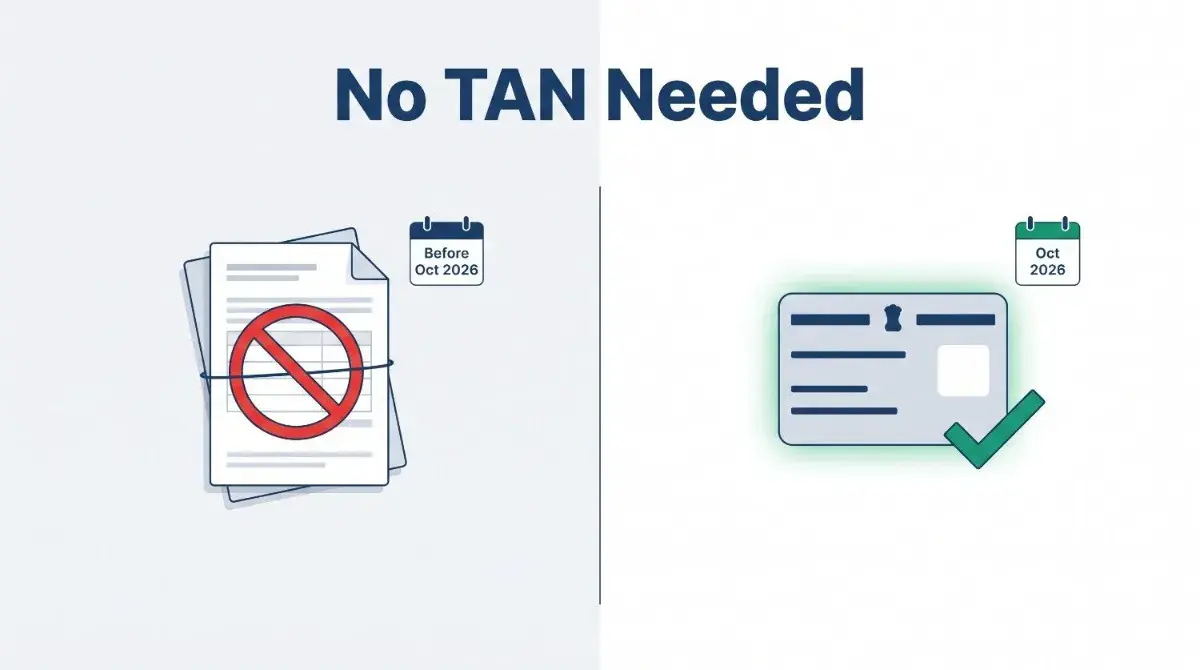
No TAN for NRI property purchase applies only from 1 October 2026, and only to resident individual and HUF buyers. Get the rates, forms, and dates you need.
Jul 25, 2026

Did you lose the SGB premature redemption tax exemption? Here's exactly who's affected, how much tax applies now, and how to check your own bonds.
Jul 24, 2026

Foreign assets disclosure scheme 2026 explained: ₹1 crore Category A limit, real penalty math across asset values, Black Money Act comparison, window status.
Jul 19, 2026