

Section 234A, 234B, 234C interest calculator: exact formulas, Rule 119A rounding, new Income Tax Act 2025 section numbers, waivers, and worked ₹ examples.
File your ITR late or underpay advance tax, and the department charges 1% simple interest per month under Section 234A (late filing), 234B (advance tax default), and 234C (deferred instalments). Under the Income Tax Act 2025, these become Sections 423, 424, and 425 from Tax Year 2026-27.
Sections 234A, 234B, and 234C of the Income-tax Act, 1961 charge simple interest when you file late, skip advance tax, or short-pay a quarterly instalment. Under the Income-tax Act, 2025, effective Tax Year 2026-27, they carry forward as Sections 423, 424, and 425. Rule 119A of the Income-tax Rules, 1962 governs the rounding.
Nothing about the underlying logic changed. Only the section number you cite on a rectification letter or CPC reply did.
Applies to | Does NOT apply to |
|---|---|
Salaried employees with tax payable after TDS | Taxpayers whose entire liability is covered by TDS/TCS |
Freelancers and professionals under regular assessment | Resident senior citizens (60+) with no business income, exempt from advance tax itself |
Business owners with assessed tax of ₹10,000 or more | Taxpayers with assessed tax below ₹10,000 after TDS |
MSME owners and traders paying advance tax quarterly | Presumptive taxpayers who pay 100% by 15 March |
Partial case: presumptive taxpayers still owe 234B if they miss 15 March entirely, even though they skip the quarterly 234C schedule. And here's something most guides get wrong: under the 2025 Act, the presumptive scheme itself moves from Sections 44AD/44ADA to Section 58, so anyone reading the new Act text and searching for "44AD" won't find it there anymore.
All three sections charge 1% simple interest per month or part of a month. It never compounds, no matter what a WhatsApp forward tells you.
Rule 119A rounding:
Round the tax amount down to the nearest ₹100. ₹8,989 becomes ₹8,900.
Treat any part of a month as a full month. Ten days counts as one month.
Round the final interest to the nearest ₹10.
234A, late filing: Charged from the day after the due date to the filing date, on tax payable minus TDS/TCS/advance tax. Due date: 31 July for non-audit taxpayers, 31 October for audit cases.
234B, advance tax default: Charged when advance tax paid is under 90% of assessed tax, from 1 April of the assessment year until payment.
234C, deferred instalments: Charged separately for each quarter you fall short of the required cumulative percentage, straight from the schedule the Income Tax Department itself uses:
Instalment due by | Cumulative % required | Interest period if short |
|---|---|---|
15 June | 15% | 3 months |
15 September | 45% | 3 months |
15 December | 75% | 3 months |
15 March | 100% | 1 month |
No 234C is charged if the shortfall comes from capital gains, lottery winnings, or similarly unforeseeable income, provided you pay the due tax in the next instalment or by 31 March.
Old (1961 Act) | New (2025 Act) | Covers | Applies to |
|---|---|---|---|
Section 234A | Section 423 | Late filing interest | Tax Year 2026-27 onward |
Section 234B | Section 424 | Advance tax default | Tax Year 2026-27 onward |
Section 234C | Section 425 | Deferred instalments | Tax Year 2026-27 onward |
Section 234D | Section 426 | Excess refund interest | Tax Year 2026-27 onward |
Section 234F | Section 428 | Late filing fee | Tax Year 2026-27 onward |
Section 139(1) | Section 263(1) | ITR filing due date | Tax Year 2026-27 onward |
Section 143(1) | Section 270(1) | Intimation/processing | Tax Year 2026-27 onward |
Sections 44AD/44ADA | Section 58 | Presumptive taxation | Tax Year 2026-27 onward |
The 1961 Act was repealed effective 1 April 2026 but still governs every tax year that began before that date. Your FY 2025-26 return, filed in 2026, uses Sections 234A, 234B, and 234C. Income earned from 1 April 2026 onward falls under Sections 423 to 426 instead, straight from CBDT's own FAQ compendium on the transition.
That same CBDT document also confirms the trickiest bit for advance tax specifically: even if your FY 2025-26 shortfall gets flagged and interest gets levied in FY 2026-27, after the new Act has already kicked in, you're still charged under the old Sections 234B and 234C, not the new numbering. The obligation is tied to when the income was earned, not when the interest lands in your inbox.
Want the full old-vs-new picture beyond this one section? Toolisky's Income Tax Act 2025 vs 1961 guide breaks down every major renumbered provision.
Example 1, the common case: Priya, salaried employee
Priya's total tax liability for FY 2025-26 is ₹52,380. Her employer and bank deducted ₹50,000 as TDS. Balance tax: ₹2,380, rounded under Rule 119A to ₹2,300.
She should have filed by 31 July 2026 but filed on 20 October 2026: August, September, October, three months.
Interest under Section 234A (2025 Act: 423) = ₹2,300 × 1% × 3 = ₹69, rounded to ₹70.
Her balance tax is under ₹10,000, so no advance tax was ever due. No 234B, no 234C. The whole bill is ₹70.
Example 2, the edge case competitors skip: Farida, freelance consultant
Farida runs a design consultancy, doesn't opt for the presumptive scheme, so the full quarterly schedule applies to her. Total tax liability for FY 2025-26: ₹2,40,000, zero TDS.
Her actual advance tax payments:
Due date | Required cumulative | Farida paid (cumulative) | Shortfall | Interest |
|---|---|---|---|---|
15 June 2025 | ₹36,000 (15%) | ₹0 | ₹36,000 | ₹36,000 × 1% × 3 = ₹1,080 |
15 Sept 2025 | ₹1,08,000 (45%) | ₹60,000 | ₹48,000 | ₹48,000 × 1% × 3 = ₹1,440 |
15 Dec 2025 | ₹1,80,000 (75%) | ₹1,20,000 | ₹60,000 | ₹60,000 × 1% × 3 = ₹1,800 |
15 March 2026 | ₹2,40,000 (100%) | ₹1,50,000 | ₹90,000 | ₹90,000 × 1% × 1 = ₹900 |
234C total = ₹5,220
By 31 March 2026 she had paid only ₹1,50,000 against an assessed tax of ₹2,40,000, just 62.5%, well under 90%, so 234B applies too. She paid the balance and filed on 10 September 2026, six months from 1 April 2026.
234B = ₹90,000 × 1% × 6 = ₹5,400
Her filing due date was 31 July 2026; she filed on 10 September 2026, a two-month delay.
234A = ₹90,000 × 1% × 2 = ₹1,800
Total across all three sections: ₹5,220 + ₹5,400 + ₹1,800 = ₹12,420, entirely avoidable if she had tracked her quarterly instalments. Read Toolisky's freelancer tax guide for how advance tax actually works for your income type.
Doing this by hand across three sections and four instalment dates is where people slip up: miscounting a part-month, forgetting to round the base, or applying 90% to the wrong figure.
Toolisky's Section 234A/234B/234C Interest Calculator takes your tax liability, TDS, advance tax paid by quarter, and filing date, and works out all three interest heads instantly with Rule 119A rounding built in.
The manual formula, if you'd rather check the calculator's output by hand:
Interest = Rounded shortfall × 1% × number of months (part-month counts as full)
Apply this separately for each section, using the right base: balance tax for 234A, assessed tax minus advance tax for 234B, quarterly shortfall for 234C. Then add them up.
1. CPC charged 234B/234C but you paid on time. Pull your Form 26AS/AIS (now Form 168 under the 2025 Act) and match every advance tax challan against the CPC computation in your intimation order. CPC software sometimes credits TDS to the wrong quarter. File a Section 154 rectification request online with challan proofs attached.
2. You filed the wrong ITR form and interest looks inflated. The wrong form, say ITR-1 instead of ITR-4 for presumptive income, can misstate your liability. File a revised return under Section 139(5) using the correct form. See Toolisky's ITR-1 vs ITR-4 guide to pick right the first time.
3. Your AIS doesn't match what your deductor filed. A delayed TDS return understates your credited TDS, inflating your apparent 234A/234B liability. Get the deductor to correct their TDS return, then recompute. Don't pay an inflated demand just to make it go away.
Interest under Section 234A and 234B can be reduced or waived, but only by the Principal Chief Commissioner or Chief Commissioner of Income Tax (or Principal DGIT/DGIT), never your local Assessing Officer. Three conditions must all be met: genuine hardship, a default caused by circumstances beyond your control (illness, natural disaster, genuine inability to estimate income), and full cooperation during assessment, all under Section 220(2A) of the 1961 Act.
Section 234C interest is treated as mandatory and generally isn't waived through this route, since quarterly instalment defaults are seen as more within a taxpayer's control. We couldn't confirm a fresh CBDT circular restating this waiver mechanism under the renumbered Section 425, so treat that specific point as unconfirmed until an official source says otherwise.
This interest is compensatory, not penal, but separate penalties can stack on top:
Late filing fee under Section 234F (2025 Act: Section 428): ₹5,000 if total income exceeds ₹5 lakh and you file after the due date; ₹1,000 if income is ₹5 lakh or below.
Under-reporting or misreporting penalty under Section 270A: 50% of tax on under-reported income, up to 200% for misreported income, on top of the interest already computed.
Interest on excess refund under Section 234D (2025 Act: Section 426): 0.5% per month if your refund is later found excessive on reassessment.
People searching "234ABC" often mean to include 234D, but it's a different animal. It charges interest when the department later finds it gave you a bigger refund than owed, at 0.5% per month from the refund date to the fresh assessment date. It sits next to 234A/B/C on the government's page because all four share a chapter, not because the mechanics match.
Does interest under Sections 234A, 234B, 234C compound monthly? No, that's a common misread. All three charge simple interest at 1% per month or part of a month on the outstanding amount. It never compounds, and the base doesn't grow unless a partial payment changes the balance.
I paid 100% of my tax by 31 March but not on the quarterly dates. Do I still owe 234C? Yes. Section 234C checks each cumulative percentage against each due date (15 June, September, December, March), not just the year-end total. Paying everything on 30 March still leaves earlier quarters short.
I missed the 15 March advance tax deadline. What should I do now? Pay the outstanding tax immediately through Challan 280 on the e-filing portal, since interest keeps accruing daily as a full month until you do. There's no separate penalty beyond the 234B/234C interest itself.
Are senior citizens exempt from 234B and 234C? Resident senior citizens, 60 or older, with no business income, are exempt from advance tax under Section 207, so 234B and 234C never arise. Senior citizens running a business don't get this exemption.
Is Section 234C the same as Section 234D? No. Section 234C charges interest for underpaying advance tax instalments. Section 234D charges interest when the department finds it refunded more than it owed, an unrelated trigger tied to refunds.
Can CPC reverse a wrongly charged 234B/234C interest? Yes, through a Section 154 rectification request on the e-filing portal, with Form 26AS/168 and advance tax challans attached. Most CPC errors trace back to TDS credited to the wrong quarter.
Does presumptive taxation exempt me from Section 234C entirely? Presumptive taxpayers pay 100% of advance tax in one instalment by 15 March, skipping the 15/45/75% checkpoints. Missing 15 March itself still attracts both 234B and 234C. Note that under the 2025 Act, this presumptive scheme sits at Section 58, not the old 44AD/44ADA numbers.
What are the new section numbers for 234A, 234B, and 234C under the Income Tax Act 2025? 234A becomes Section 423, 234B becomes 424, and 234C becomes 425 from Tax Year 2026-27 onward. Your FY 2025-26 return still uses the old numbering.
Do I owe 234A interest if my final tax payable is zero after TDS? No. Section 234A is calculated on tax outstanding after TDS, advance tax, and reliefs. If that balance is nil, there's nothing to charge interest on, even if filed late.
Is there a minimum tax liability below which none of these sections apply? Yes. If assessed tax after TDS/TCS is below ₹10,000, advance tax isn't required at all, so 234B and 234C don't apply. Section 234A can still apply to any balance tax if you file late.
Run your actual numbers through Toolisky's 234A/234B/234C calculator instead of guessing what you owe. FY 2025-26 filers stick with the old section numbers; Tax Year 2026-27 onward, think Sections 423, 424, 425. For the official provisions and the parallel-reading utility, visit the Income Tax Department's 1961-vs-2025 comparison tool.
For educational purposes only. Verify all figures at official sources before acting. Toolisky is not affiliated with any government body. Consult a qualified CA or legal professional before making compliance decisions. See toolisky.com/accuracy-and-limitations.
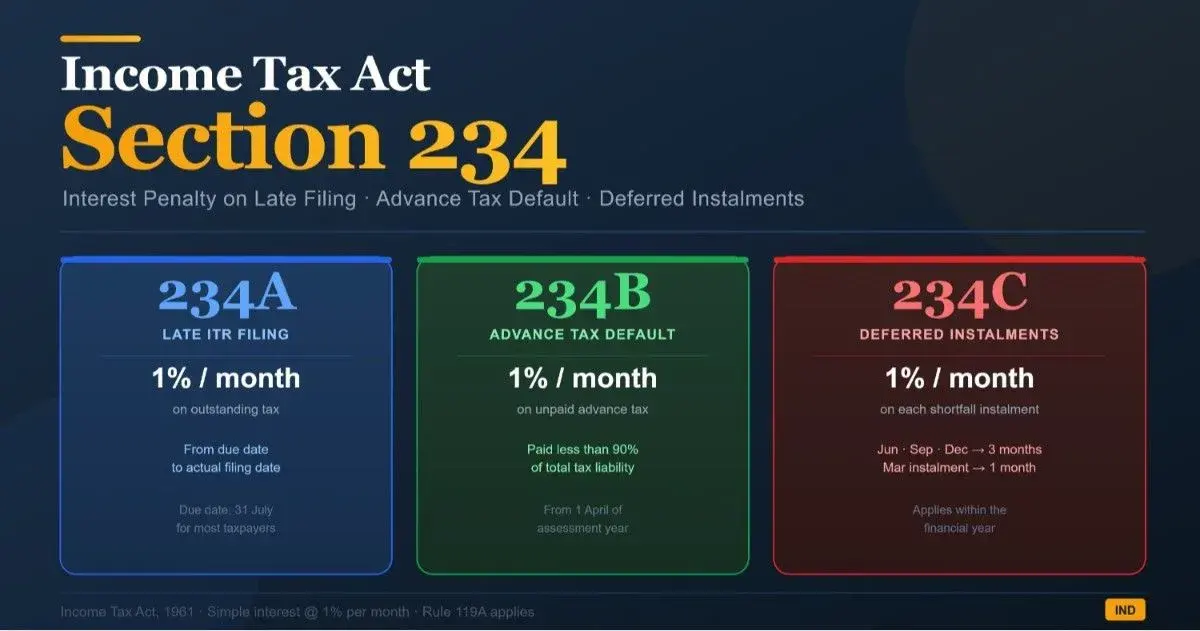
Learn how interest under Section 234A, 234B & 234C of Income Tax Act is calculated on late ITR filing, advance tax default & deferred instalments with examples.
Jun 27, 2026
No TAN for NRI property purchase applies only from 1 October 2026, and only to resident individual and HUF buyers. Get the rates, forms, and dates you need.
Jul 25, 2026

Did you lose the SGB premature redemption tax exemption? Here's exactly who's affected, how much tax applies now, and how to check your own bonds.
Jul 24, 2026