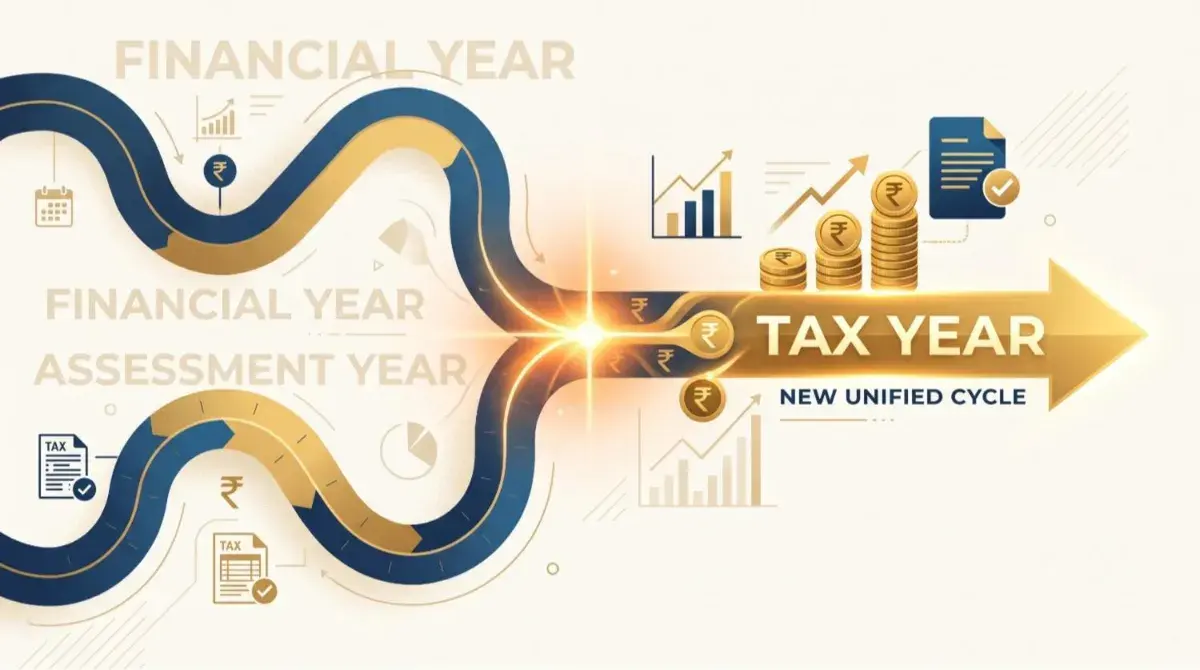

Confused about Tax Year vs Assessment Year? Here's the exact difference under the Income Tax Act, 2025 — with dates, examples, and what to use when filing.
From 1 April 2026, "Tax Year" replaces both "Previous Year" and "Assessment Year" under the Income-tax Act, 2025, but only for income earned on or after that date. If you're filing in July 2026 for FY 2025-26 income, you're still using Assessment Year 2026-27, since that income falls under the old 1961 Act. This tax year vs assessment year confusion trips up a lot of people right now, but there's no missing year and no overlap between the two systems.
This is a topic that sits right on the fence between two laws, so let's be upfront about that. Income earned up to FY 2025-26 falls under the 1961 Act (AY 2026-27). Income from 1 April 2026 falls under the 2025 Act (Tax Year 2026-27 onward). Every section number here has been checked against the Income Tax Department's own FAQs on the new Act, not pulled from memory.
Under the old 1961 Act, you earned your income in what the law called the Previous Year (PY), defined in Section 3. You then paid tax on it the following year, the Assessment Year (AY), defined in Section 2(9). Income from PY 2025-26 got taxed in AY 2026-27, same rupee, two different year labels.
Under the new 2025 Act, Section 3 drops both terms for one single Tax Year: a twelve-month block running from 1 April to 31 March. You earn it and get taxed on it in the same named year. That's the core of the tax year vs assessment year shift, no lag, nothing extra to remember.
Why should you care? Because your Form 16, your ITR utility, your CA's emails, and CBDT notices are all going to start using this new word. Just not yet, not for FY 2025-26.
Applies to | Does NOT apply to |
|---|---|
Income earned from 1 April 2026, labelled Tax Year 2026-27, taxed under the 2025 Act | An ITR filed in July or August 2026 for FY 2025-26 income, still Assessment Year 2026-27 |
Every taxpayer type, salaried, freelancers, MSMEs, companies, HUFs, firms, trusts, from Tax Year 2026-27 onward | Pending assessments, reassessments, or notices tied to years before 1 April 2026, which stay under the 1961 Act |
CAs and tax software updating TDS filings (Form 24Q, 26Q, 27Q) from Q1 of Tax Year 2026-27 | Anyone assuming PAN, TAN, or faceless assessment access needs fresh registration, it doesn't |
One thing worth flagging: a new business or income source started partway through a tax year runs from its start date to 31 March, not a full twelve months. This is written directly into Section 3 of the new Act.
Here's the three-way comparison most articles fumble.
Concept | Defined where | What it means | Still used today? |
|---|---|---|---|
Financial Year (FY) | Common usage, 1 April to 31 March | The year income is actually earned | Yes, informally, under both systems |
Previous Year (PY) | Section 3, Income-tax Act, 1961 | The formal legal name for FY under the old Act | Only for years before 1 April 2026 |
Assessment Year (AY) | Section 2(9), Income-tax Act, 1961 | The year after PY, when tax gets assessed and the return filed | Only up to AY 2026-27, the very last one |
Tax Year | Section 3, Income-tax Act, 2025 | One single label for the year income is earned and taxed | From Tax Year 2026-27 onward |
Here's a sense of scale: the 2025 Act runs to 536 sections and 16 schedules, against 819 sections and 14 schedules in the 1961 Act. Rules got trimmed too, from 511 rules and 399 forms down to 333 rules and 190 forms.
A quick timeline, since barely anyone lays this out clearly:
Year income is earned | Old-system label | New-Act label |
|---|---|---|
2023-24 | PY 2023-24, assessed as AY 2024-25 | Still referred to under the old Act |
2024-25 | PY 2024-25, assessed as AY 2025-26 | Still referred to under the old Act |
2025-26 | PY 2025-26, assessed as AY 2026-27 | Still under the old Act, no Tax Year label yet |
2026-27 | Not applicable, new Act begins | Tax Year 2026-27, first year under the new Act |
2027-28 | Not applicable | Tax Year 2027-28 |
Section 536, the repeal-and-savings clause across 22 sub-clauses, holds this transition together. Section 536(3) says any "tax year" reference for a period before the cutover reads back as the matching "previous year" under the old Act, the exact clause guaranteeing no missing or double-counted year. Section 536(2)(c) separately keeps every pending assessment, reassessment, rectification, or notice from before 1 April 2026 fully under the old Act, even years later.
Section numbers shifted too, and this is where older blog posts go wrong. A few worth knowing: the Section 87A rebate is now Section 156. The new tax regime, earlier Section 115BAC, is now Section 202. Presumptive taxation under the old 44AD, 44ADA, and 44AE has merged into Section 58. For the full breakdown, see our Income Tax Act 2025 vs 1961 guide.
For NRIs and anyone dealing with foreign accountants: India was one of the few big economies still splitting "the year you earn it" from "the year you're taxed on it." The UK, the US, and Australia already use one label for both. This change simply brings India in line with that.
Example 1: Suresh, a salaried employee filing in July 2026 (the common case, roughly 70% of readers)
Suresh earned ₹9,00,000 in FY 2025-26 (1 April 2025 to 31 March 2026), and he's filing his ITR in July 2026. Which label should he use?
Income earned: FY 2025-26
Governing law: Income-tax Act, 1961, since this income was earned before 1 April 2026
Filing label: Assessment Year 2026-27
Tax Year terminology: doesn't apply to this return at all
Suresh's Form 16 and his ITR-1 dropdown both say "AY 2026-27." He shouldn't go hunting for a "Tax Year" option here, it simply isn't there for this particular filing. If you're not sure which ITR form fits your own situation for AY 2026-27, our ITR-1 vs ITR-4 comparison breaks it down.
Example 2: Priya, a freelancer starting a new business mid-year (the edge case most guides skip)
Priya sets up her consulting practice on 1 August 2026. Under the old system, her first Previous Year would have run from her start date to 31 March. Under the new Act, that same idea carries over, just under a new name.
Business start date: 1 August 2026
Tax Year for this income source: 1 August 2026 to 31 March 2027 (8 months, not a full 12)
Governing law: the 2025 Act, Section 3
Label used in her first return: Tax Year 2026-27
Quick arithmetic check: August through March is eight calendar months. That confirms the shortened-year rule here works exactly the way the old "previous year for a newly set up business" provision used to.
You don't need a calculator for this, just one date check. Ask yourself: when was the income actually earned?
Before 1 April 2026? Use Previous Year or Assessment Year language. You're under the 1961 Act, and this covers every return you'll file up to and including your FY 2025-26 return in 2026.
On or after 1 April 2026? Use Tax Year language. You're under the 2025 Act, and your very first such filing will say "Tax Year 2026-27."
Starting a business or income source mid-year? That source's tax year runs from its actual start date to 31 March, following rule 2 above.
Still not sure which one applies? Just check the year printed on the document in front of you. "AY 20XX-YY" is old-Act language. "Tax Year 20XX-YY" is new-Act language. The two are never used for the same income.
1. Your CA or filing software still shows "AY 2027-28" instead of "Tax Year 2026-27." Both point to the same underlying period once the new Act era kicks in, but only one is technically correct going forward. Ask your CA which CBDT-notified terminology their software version actually uses, since some transitional builds lag behind the official switch. Cross-check against the ITR utility's own labelling before you file.
2. You get a notice quoting an old-Act section number for FY 2025-26 income, dated after 1 April 2026. This is expected, not a mistake. Section 536(2)(c) keeps every proceeding tied to a pre-cutover year under the old numbering, no matter when the notice actually lands in your inbox. Confirm the year first, then check the section number against the official mapping utility before you reply to anything.
3. You're a business owner and can't find "Tax Year" anywhere in your accounting software. Check whether your software has rolled out an Act-2025 update yet, since many mid-sized tools do this in phases. In the meantime, log every transaction by its actual date and let your CA map it to the right Tax Year manually. Don't let bookkeeping wait on a software release.
There's no direct penalty just for saying the "wrong" year label in casual conversation. But getting it wrong on an actual legal document, an ITR, a reply to a notice, or a Form 15G/15H, can misalign your filing with what the department expects. That risks a defective-return flag under Section 139(9) of the 1961 Act for any pre-2026-27 filing. [VERIFY: confirm the corresponding section number for defective-return notices under the Income-tax Act, 2025, on incometaxindia.gov.in before publishing.]
Separately, filing late for any year, no matter which label applies, still attracts the standard late fee under Section 234F of the 1961 Act: ₹1,000 if your income is under ₹5 lakh, ₹5,000 otherwise, for any pre-Tax-Year-2026-27 return. [VERIFY: confirm Section 234F's renumbered equivalent under the Income-tax Act, 2025, on incometaxindia.gov.in before publishing.]
The one fact that decides everything here is the date the income was earned, not the date you happen to be filing. For almost everyone reading this right now, it's still Assessment Year 2026-27. Our Old vs New Tax Regime Calculator can show you exactly where you stand once you've confirmed the correct filing year. And for the official word straight from the source, read the Income Tax Department's own FAQs on the interplay and transition between the two Acts.
Written by Anita Patil, Tax & Finance Editor | Last Updated: July 2026 Reviewed by Toolisky Editorial Team
For educational purposes only. Verify all figures at official sources before acting. Toolisky is not affiliated with any government body. Consult a qualified CA or legal professional before making compliance decisions. See toolisky.com/accuracy-and-limitations.
A Tax Year is the twelve-month period from 1 April to 31 March, defined under Section 3 of the Income-tax Act, 2025. It replaces both "Previous Year" and "Assessment Year" from the old Act, bringing the year income is earned and the year it's taxed under one single name. It applies from Tax Year 2026-27 onward, not to income earned before 1 April 2026.
Yes, for a limited window. Any income earned up to 31 March 2026 (FY 2025-26) is still governed by the 1961 Act and gets assessed in AY 2026-27, which will be the very last Assessment Year the system ever uses. From Tax Year 2026-27 onward, "Assessment Year" is gone from the vocabulary entirely.
No. The Income Tax Department's own FAQ confirms this: income earned in FY 2025-26 is governed by the 1961 Act and assessed in AY 2026-27, while income from 1 April 2026 onward is governed by the 2025 Act as Tax Year 2026-27 onward. No gap, no double-counted period.
Yes, if you're filing for FY 2025-26 income, the return most people file in July or August 2026. That return uses AY 2026-27. You'll switch to "Tax Year" only when filing for income earned from 1 April 2026 onward, your next filing cycle.
Your Assessment Year is the year right after the financial year you earned the income in. Income earned in FY 2025-26 gets filed and assessed in AY 2026-27. Check your Form 16 or the AY dropdown on the e-filing portal; it's already set to the correct year for you.
Section 536 is the repeal-and-savings clause, spread across 22 sub-clauses, managing the handover from the 1961 Act to the 2025 Act. It confirms the old Act is repealed from 1 April 2026 but keeps every pending proceeding, right, and liability fully alive under the old numbering.
They continue entirely under the 1961 Act, using its original section numbers, even years after 1 April 2026. Section 536(2)(c) spells this out for assessments, reassessments, rectifications, penalties, and revisions tied to any pre-cutover year.
If the return was filed against the correct year, and you just described it casually with the "wrong" word in a cover note, there's usually no real impact. If you picked the wrong year in the actual dropdown, file a revised return citing the correct year before the deadline.
No. Your existing PAN, TAN, and the faceless assessment and appellate framework continue without interruption under the 2025 Act, one of several continuity promises built into the transition.
Previous Year and Assessment Year are a 1961-Act pair: PY is when you earn the income, AY is the year it's assessed. Tax Year is the 2025 Act's replacement for both, one label for the same year of earning and taxing. Which pair applies depends entirely on when the income was earned.
Tax Year and India's fiscal year are the same thing, 1 April to 31 March. It isn't the calendar year (1 January to 31 December), which India never used for tax anyway. This also matches how the UK and Australia define their own tax years.
The old PY and AY system meant every provision had to specify which of the two years it meant, adding real drafting complexity across decades of amendments. Most major economies, including the UK, US, and Australia, already use one year concept for both, and the 2025 Act brings India in line with that.
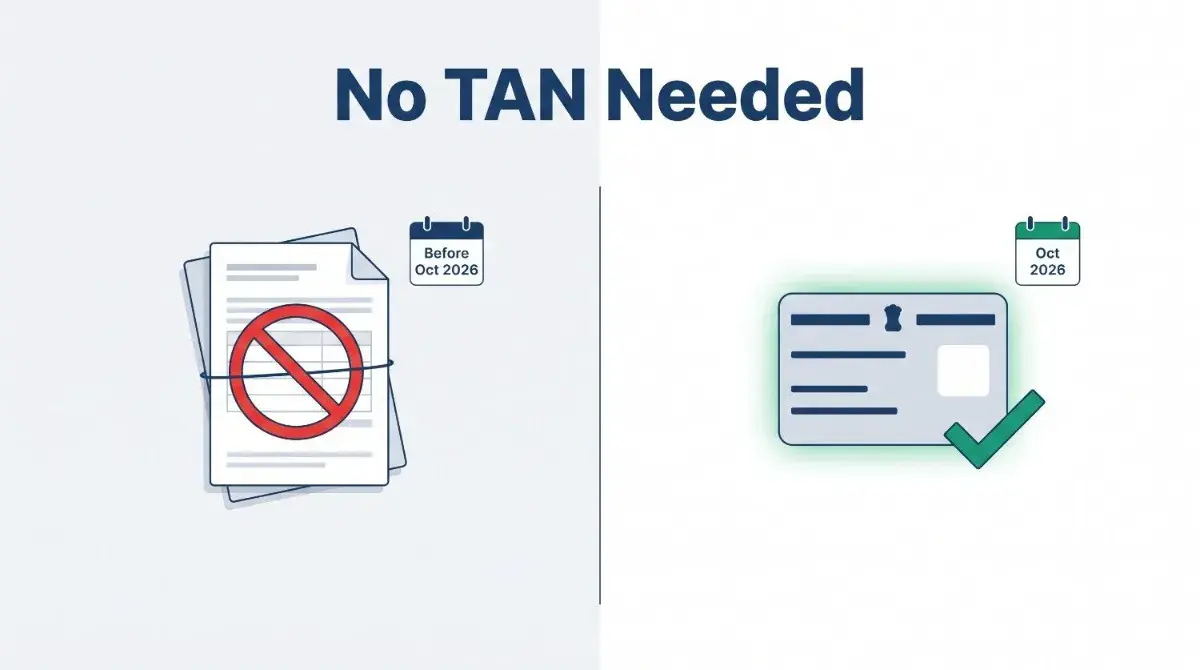
No TAN for NRI property purchase applies only from 1 October 2026, and only to resident individual and HUF buyers. Get the rates, forms, and dates you need.
Jul 25, 2026

Did you lose the SGB premature redemption tax exemption? Here's exactly who's affected, how much tax applies now, and how to check your own bonds.
Jul 24, 2026
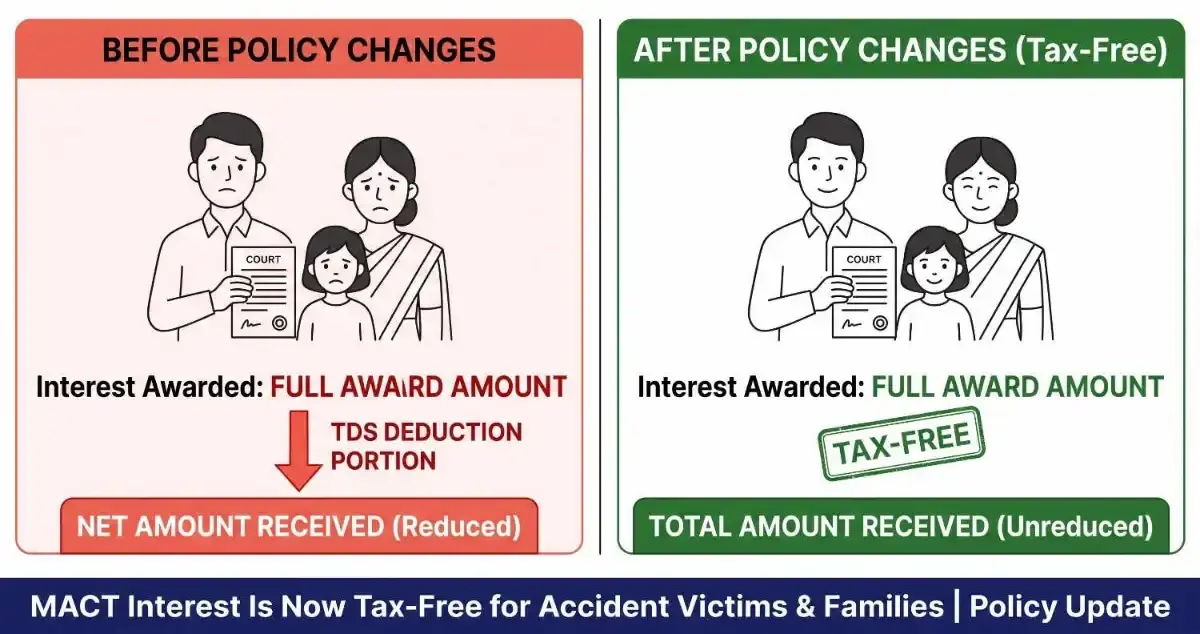
MACT interest income TDS exemption 2026 explained: who qualifies, old vs new Act rules, the FD interest trap, refund steps, and how to report it in your ITR.
Jul 24, 2026