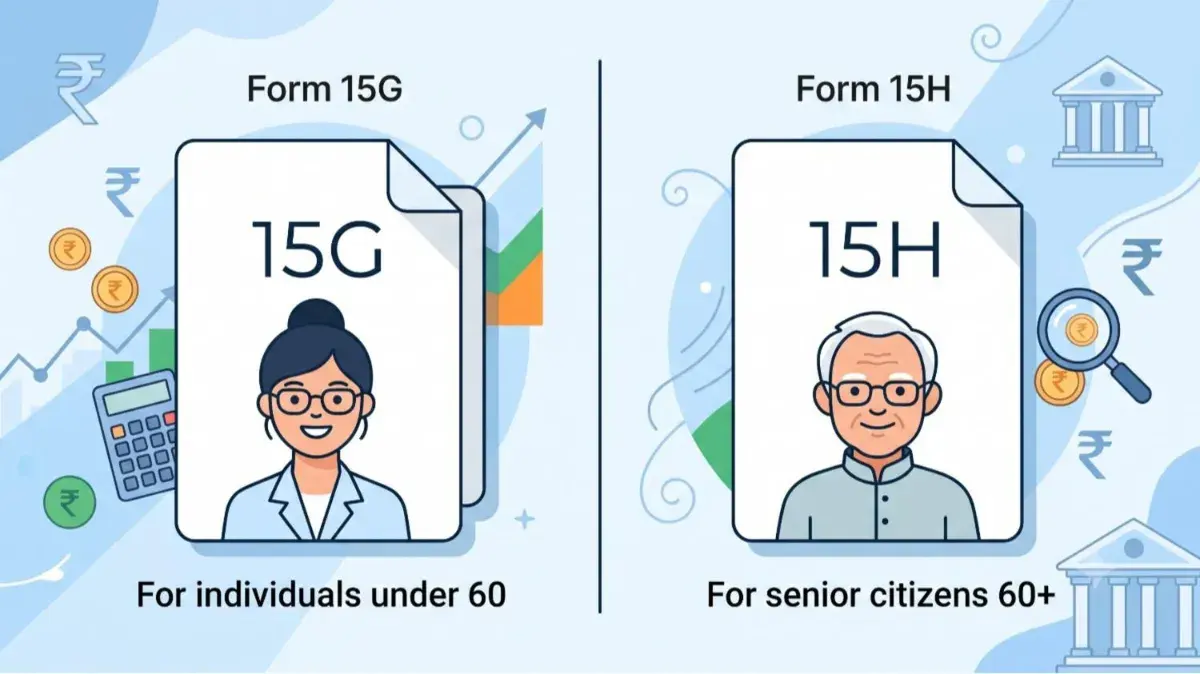

Form 15G vs Form 15H explained in plain language — age rules, income limits, eligibility, and how the new Form 121 replaces both from FY 2026-27, with real rupee examples.
If you earn interest from a bank, post office, or your EPF account, you've probably run into Form 15G or Form 15H. Both stop TDS from being cut on your interest, but they're not interchangeable. Form 15G is for residents under 60 whose income is below the basic exemption limit. Form 15H is for senior citizens whose final tax comes to nil, no matter how high their income is. And starting FY 2026-27, a new single form called Form 121 takes over from both.
This guide covers everything: who each form is for, the exact income limits, real examples with the maths worked out, and what changes once Form 121 arrives.
Both forms do the same basic job: you hand one to your bank, post office, or EPFO, and it tells them your final tax works out to nil, so they shouldn't deduct TDS on your interest. The difference comes down to age and how strict the income test is. Form 15G works for anyone below 60. Form 15H is built for senior citizens and applies a more relaxed test.
For FY 2025-26 (income earned up to 31 March 2026), both forms sit under Section 197A of the Income-tax Act, 1961. From FY 2026-27 onward (income earned from 1 April 2026), the same idea moves to Section 393(6) of the Income-tax Act, 2025, filed through a new unified Form No. 121 under Rule 211 of the Income Tax Rules, 2026.
So here's the short version: if you're filing for FY 2025-26, you still use Form 15G or Form 15H as before. From FY 2026-27, you'll be filing Form 121 instead, since it has genuinely replaced both older forms rather than existing alongside them. The rest of this guide walks through both stages so you're covered either way.
Age decides the first cut. Final tax liability decides the second.
Applies to | Does NOT apply to |
|---|---|
Resident individuals below 60 (Form 15G), income under the basic exemption limit | Non-resident Indians (NRIs) — residential status rules them out of both forms |
Resident senior citizens 60+ (Form 15H), nil final tax liability | Companies and partnership firms |
HUFs (Form 15G only, never Form 15H) | Anyone whose actual tax liability is above zero |
Trusts and AOPs/BOIs, under the same nil-tax condition as HUFs | Anyone without a valid PAN — the declaration is invalid without one |
A couple of points that trip people up. HUFs can file Form 15G, but never Form 15H — that one is reserved strictly for individual senior citizens. Trusts generally fall into the same "any person other than a company or firm" bucket as HUFs, so they follow Form 15G-style rules rather than Form 15H's more relaxed condition.
NRIs are ruled out completely. Both forms ask you to declare your residential status, and only "Resident" qualifies. If you're an NRI earning NRO interest, neither form will help — you'll need a Tax Residency Certificate and the DTAA route instead.
This is the real dividing line between the two forms, laid out in numbers. Form 15G checks your total income against a fixed ceiling. Form 15H drops that ceiling entirely and checks only whether your final tax is nil.
Condition | Form 15G | Form 15H |
|---|---|---|
Who can file | Resident individual below 60, or an HUF | Resident individual aged 60 or above |
Governing section | Section 197A(1) / 197A(1A), Income-tax Act 1961 | Section 197A(1C), Income-tax Act 1961 |
Income condition | Total income must be below the basic exemption limit (₹2.5 lakh old regime, ₹4 lakh new regime for FY 2025-26) | No income ceiling — only your final tax liability needs to be nil |
TDS threshold that triggers the need for the form | Bank/post office interest over ₹50,000 a year, per bank | Bank/post office interest over ₹1,00,000 a year, per bank |
PAN | Mandatory | Mandatory |
Validity | One financial year | One financial year |
That "no income ceiling" row for Form 15H confuses a lot of readers. A senior citizen earning ₹9 lakh in FD interest can still file Form 15H, as long as the Section 87A rebate and deductions like Section 80TTB bring the final tax down to zero. Form 15G doesn't offer that same flexibility — the moment total income crosses the basic exemption limit, you're out, even if a deduction would technically bring the tax to zero.
The move to Form 121. Both older forms stay valid for FY 2025-26 filings, and banks will honour them through 31 March 2026. From 1 April 2026, Form 121 takes over from both under Section 393(6), and age no longer decides which form you pick — only the nil-tax condition does. This is confirmed in the Income Tax Department's FAQs on the transition from the 1961 Act to the 2025 Act.
Form 15G / 15H (up to FY 2025-26) | Form 121 (FY 2026-27 onward) | |
|---|---|---|
Number of forms | Two, split by age | One, for every eligible age group |
Governing law | Section 197A, Income-tax Act 1961 | Section 393(6), Income-tax Act 2025 |
Old declarations still valid? | Yes, until 31 March 2026 | No — must be filed fresh; old forms don't carry forward |
Tracking | UIN per declaration per payer | UIN per declaration, reported quarterly through Form 140 |
EPF withdrawal, specifically. TDS on a premature EPF withdrawal (before 5 years of continuous service) kicks in once the withdrawal crosses ₹50,000 — this is confirmed on the EPFO's own FAQ page. Complete 5 years of continuous service, and TDS doesn't apply at all, regardless of the amount. Form 15G or Form 15H (Form 121 from FY 2026-27) can bring that TDS down to nil if your total income for the year stays under the exemption limit.
Example 1: Ramesh, 34, salaried, common case. Ramesh has one FD earning ₹68,000 in interest this year at a single bank. His only other income is a ₹3.2 lakh salary (new regime, FY 2025-26). Total income works out to ₹3.2 lakh + ₹68,000 = ₹3.88 lakh, which sits under the ₹4 lakh new-regime exemption limit. He's eligible for Form 15G. Without it, TDS = ₹68,000 × 10% = ₹6,800, recoverable only through an ITR refund. File Form 15G before the interest is credited, and he keeps the full ₹68,000.
Example 2: Priya, 66, retired senior citizen, edge case. Priya has no salary or pension, just ₹9,40,000 in FD interest spread across three banks (new regime, FY 2025-26). Under the new regime, the Section 87A rebate brings tax to nil on net taxable income up to ₹12 lakh. Since her ₹9.4 lakh sits well under that ceiling, her final tax comes to zero. Even though ₹9.4 lakh is nowhere near "below the exemption limit," she's still eligible for Form 15H, because the only condition that applies to her is nil final tax, not an income cap. Without Form 15H, once one bank's interest crosses ₹1,00,000 — say Bank A pays her ₹4,00,000 — TDS = ₹4,00,000 × 10% = ₹40,000, locked up until she files her return.
Example 3: an HUF with FD income. An HUF earns ₹1,10,000 in FD interest this year and has no other taxable income. Since that ₹1,10,000 sits below both ₹2.5 lakh (old regime) and ₹4 lakh (new regime), Form 15G applies, filed by the karta on the HUF's own PAN, not any individual member's PAN.
Example 4: Farida, an NRI with an NRO fixed deposit (ineligible). Farida lives in Dubai and holds an NRO FD earning ₹2 lakh in interest. She can't file Form 15G or Form 15H under any circumstance — her residential status alone rules her out. TDS applies at a flat 30% plus surcharge and cess, with no threshold at all: ₹2,00,000 × 30% = ₹60,000, before cess. Her only relief route is a Tax Residency Certificate plus Form 10F under the relevant DTAA, not Form 15G or 15H.
Run through these four questions, and you'll land on the right form faster than you'd fix a wrongly filed one:
Are you a resident of India for tax purposes? No? Then neither form applies to you, full stop.
Are you 60 or older at any point during the financial year? Yes? Go straight to Form 15H. The only real question left is whether your final tax will be nil.
Below 60, or filing on behalf of an HUF? Then it's Form 15G — check whether total income sits below the basic exemption limit (₹2.5 lakh old regime, ₹4 lakh new regime).
Filing for FY 2026-27 or later? Skip both older forms and use Form 121 instead. It applies the same age logic internally, just without separate form names.
Screen names and menu labels shift slightly from one institution to the next, but the process stays close to identical everywhere:
Net banking: Log in, look for "Tax Center," "e-Services," or "Forms 15G/15H" under deposits or tax, select the FD account, fill Part I, and e-sign with your net-banking OTP.
Bank branch: Ask for the physical Form 15G/15H (or Form 121 after the transition), fill Part I by hand, attach a self-attested PAN copy, and submit before your next interest credit date.
EPFO portal: Log in to the Member Unified Portal with your UAN, go to Online Services, then Claim (Form 31/19/10C/10D), and the portal prompts you for the declaration automatically if your withdrawal attracts TDS.
Post office: Available at the counter for post office time deposits — carry your PAN and passbook.
Bond issuer: Some corporate bond and NCD issuers accept the declaration through their registrar, such as KFin Technologies or Link Intime, via a physical or emailed form.
Insurance company: For maturity payouts that attract TDS, submit through the insurer's customer portal or branch office, much like the bank branch route.
Submit at the start of the financial year, or before your first interest credit. A mid-year submission only protects interest credited after that date, not TDS already deducted before you filed.
TDS deducted despite submitting the form on time. Ask the branch for the unique identification number logged against your declaration. No UIN on file usually means the form wasn't recorded properly. File a written complaint with the branch manager, and if that goes nowhere, raise a grievance at incometax.gov.in under "Grievance & Support." Already-deposited TDS can't be reversed at the bank — you recover it only by claiming credit in your ITR.
Wrong form submitted (15G instead of 15H, or the reverse). The declaration is invalid, and TDS applies as if no form was submitted at all. Refile the correct form right away for future interest credits. For interest already credited, claim the TDS back as a refund when you file your ITR.
Missed the deadline, and TDS was already cut. There's no penalty for filing Form 15G/15H late — no one gets fined simply for not submitting them. But you can't claw back deducted TDS at the bank. Report the full interest income under "Income from Other Sources" in your ITR, claim the TDS shown in your Form 168 (formerly Form 26AS) as credit, and the excess comes back as a refund.
PAN card (mandatory): physical or digital copy accepted by most banks online.
Proof of age for Form 15H (Aadhaar, PAN, or passport showing date of birth): digital copy usually accepted.
Bank account or FD account details where the declaration applies: usually already on file with the bank.
UAN and linked bank details for EPFO submissions: available on the EPFO member portal if you don't have them handy.
Filing Form 15G or Form 15H when you know the declaration is false — for instance, claiming nil tax liability when it isn't — is prosecutable. For FY 2025-26 filings, that falls under Section 277 of the Income-tax Act, 1961. For FY 2026-27 filings under Form 121, it's the corresponding Section 482 of the Income-tax Act, 2025.
Where the tax that would have been evaded exceeds ₹25 lakh, the punishment is rigorous imprisonment of 6 months to 7 years plus a fine. In every other case, it's 3 months to 2 years plus a fine.
This isn't aimed at honest estimation errors. Courts have consistently held that a genuine, corrected mistake doesn't attract these provisions. The law targets knowingly false declarations, not people who misjudged their income by a few thousand rupees.
No. You file one or the other, based on your age during the financial year, not both. If you turn 60 partway through the year, use Form 15H for that entire year, since eligibility is checked as of any day during the year you're 60 or above.
From FY 2026-27 (income from 1 April 2026), you don't choose between 15G and 15H at all. You file the single Form 121 under Section 393(6), which uses the same age-based eligibility internally but drops the separate form names entirely.
You're treated as a senior citizen for that whole financial year and should file Form 15H, not Form 15G, even if you were under 60 for most of it. The eligibility check looks at your age on any single day during the financial year, not your age on 1 April or 31 March specifically.
No. It's a benefit, not an obligation. Skip it, and if your tax liability is genuinely nil, the bank still deducts TDS anyway, and you claim it back at ITR time. There's no fine for choosing not to submit it — you just lose the cash-flow benefit for that year.
No, same as Form 15G — it's optional. Skipping it means TDS gets deducted upfront even if your final tax works out to zero, and you recover it only through your return. Many senior citizens skip it without realising it, then wait months for a refund that a five-minute form would have avoided.
Yes. Most major banks and the EPFO portal accept these declarations digitally, through net banking or the member portal, with OTP-based e-signing instead of a wet signature. Smaller cooperative banks and some post offices still prefer a physical form submitted at the branch, so check with each institution.
Yes, and you must. Each bank only sees its own records, so a Form 15G or 15H filed at Bank A does nothing for interest earned at Bank B. Submit a separate declaration to every institution where TDS could apply to your interest.
The deductor should reject or disregard it, and TDS gets deducted as though no declaration was made at all. You'd then claim the TDS back through your income tax return rather than getting it corrected at the bank directly. Double-check your age as of the financial year before submitting, since this mistake is common and entirely avoidable.
No. Both forms require the declarant to tick "Resident" as their residential status, and NRIs don't qualify under either form, regardless of their actual income level or tax liability. NRO account interest instead attracts a flat 30% TDS, reducible only through a Tax Residency Certificate and the relevant DTAA.
No. Form 15H is reserved exclusively for individual resident senior citizens aged 60 or above. An HUF, whatever the karta's age, can only use Form 15G, subject to the HUF's own total income staying below the basic exemption limit.
No. Both forms are free to file, whether through net banking, the branch, or the EPFO portal. You're only submitting a declaration, not making a payment. The only real cost is your own time, and the only risk from a wrong entry is a rejected form, not a fee.
If your bank interest is heading past ₹50,000 this year (or ₹1,00,000 if you're 60 or above), and your tax is genuinely nil, file Form 15G or Form 15H with each bank now, not later. A mid-year submission only saves future TDS, not what's already deducted.
Work out the exact numbers first so you know for certain whether you actually qualify, and check the official form PDFs and the latest Form 121 rules before you file.
For educational purposes only. Verify all figures at official sources before acting. Consult a qualified CA or legal professional before making compliance decisions.
Income Tax Department, Form No. 121 details: https://www.incometaxindia.gov.in/documents/d/guest/fn-121
Income Tax Department, FAQs on Interplay and Transition from the Income Tax Act, 1961 to the Income Tax Act, 2025: https://www.incometaxindia.gov.in/documents/81799/11848482/Updated-FQAs-on-Interplay%26Transitions.pdf
Income-tax Act, 1961, full text: https://www.incometaxindia.gov.in/income-tax-act
Income-tax Act, 2025, full text: https://www.incometaxindia.gov.in/income-tax-act-20251
EPFO, official FAQ on TDS and Form 15G/15H for PF withdrawal: https://www.epfindia.gov.in/site_en/FAQ.php
Income Tax e-Filing Portal: https://www.incometax.gov.in/iec/foportal/
No TAN for NRI property purchase applies only from 1 October 2026, and only to resident individual and HUF buyers. Get the rates, forms, and dates you need.
Jul 25, 2026

Did you lose the SGB premature redemption tax exemption? Here's exactly who's affected, how much tax applies now, and how to check your own bonds.
Jul 24, 2026
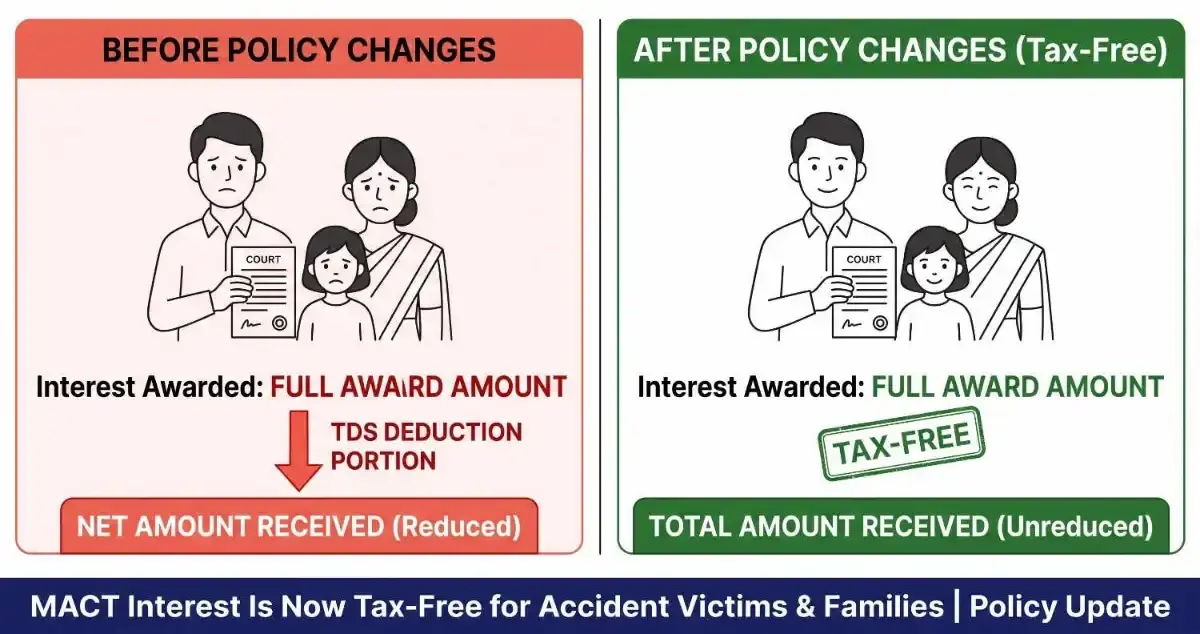
MACT interest income TDS exemption 2026 explained: who qualifies, old vs new Act rules, the FD interest trap, refund steps, and how to report it in your ITR.
Jul 24, 2026