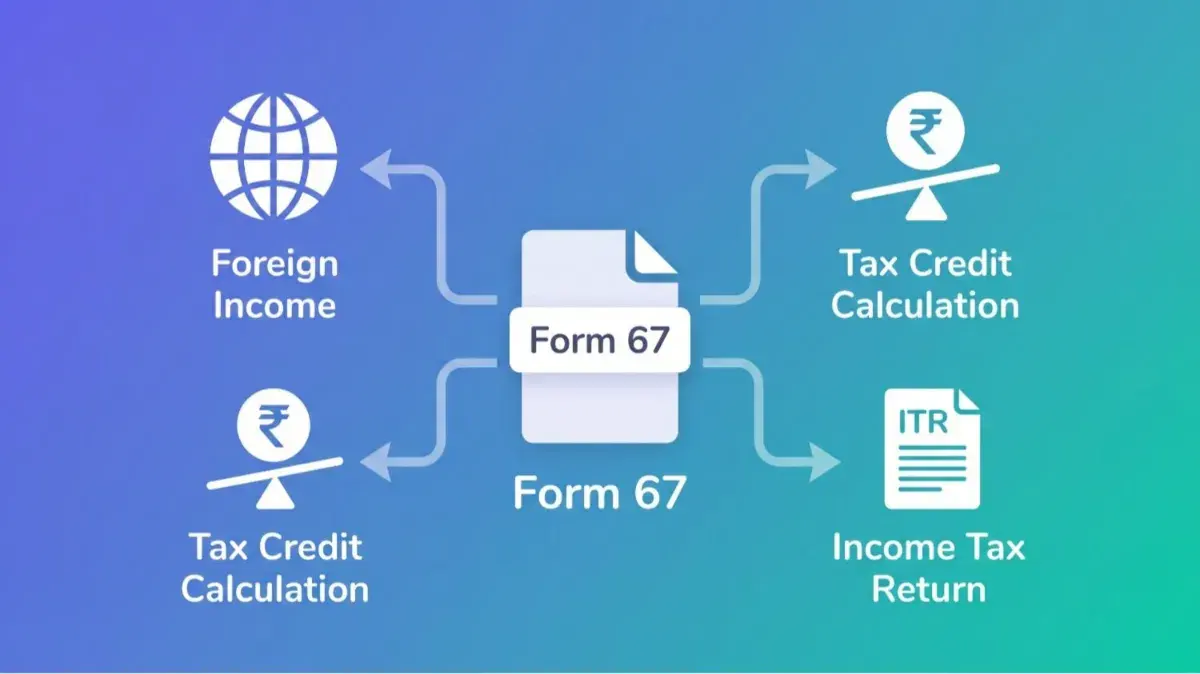

Complete Form 67 income tax guide for 2026 — deadlines, DTAA credit rules, TTBR conversion rates, ITAT relief for late filing, and the switch to Form 44, with real rupee examples.
If you're a resident Indian who paid tax on income earned abroad, you can claim credit for that tax back home. But only if you file Form 67 correctly and on time. Miss the deadline, get a detail wrong, or skip it altogether, and the tax department's processing system will simply ignore the tax you already paid overseas — even though several tribunals have said that isn't fair to taxpayers.
This guide covers what Form 67 is, who needs it, the current deadlines and rates, what changes once the new Income-tax Act, 2025 takes over, and what to do if your claim gets rejected.
A quick note on which law applies: income earned up to FY 2025-26 (Assessment Year 2026-27) is assessed under the Income-tax Act, 1961, and Form 67 is filed under Rule 128 of the Income-tax Rules, 1962. That's what this guide covers, and it's what applies to every return you're filing right now. Income earned from 1 April 2026 onward falls under the new Income-tax Act, 2025, where several tax-filing platforms report that Form 67 is being replaced by Form 44. More on that switch further down.
Form 67 is an online statement, filed on the income tax e-filing portal, that lets a resident taxpayer claim Foreign Tax Credit (FTC) for tax already paid or deducted outside India. The credit itself comes from Section 90 of the Income-tax Act (where India has a Double Taxation Avoidance Agreement, or DTAA, with the other country) or Section 91 (where no such treaty exists). Rule 128 of the Income-tax Rules, 1962 sets out how you actually claim it, and Rule 128(9) specifically fixes the filing deadline.
Why bother with a separate form at all? Because without it, the Centralised Processing Centre (CPC) — the system that processes your return — has no record of what you paid abroad. Left alone, it taxes your full income in India as if you'd paid nothing anywhere else.
Applies to | Doesn't apply to |
|---|---|
Resident Indians with salary, dividend, interest, or capital gains from abroad | Non-residents — Form 67 is built for residents, so they can't use it |
RNORs (Resident but Not Ordinarily Resident), once their foreign income becomes taxable in India | Pure NRIs with no foreign income that's taxable in India |
Freelancers with overseas clients who had tax withheld at source | Anyone whose foreign income is fully exempt in India |
RSU or ESOP holders who had US tax withheld at vesting or sale | Taxpayers using ITR-1 — it has no Schedule FSI or Schedule TR, so Form 67 has nothing to attach to |
Returning NRIs who've become ROR (Resident and Ordinarily Resident), for the year their foreign income becomes taxable here | Someone who's already chosen the domestic tax-rate option over the treaty route — they still need FTC paperwork, just not under this framing |
If you're an RNOR, check first whether you even need FTC. Only your India-sourced and India-received income is taxable here in the first place, so foreign tax credit may not come into it at all.
Legal basis: Section 90 covers DTAA relief and Section 91 covers unilateral relief where there's no treaty, both under the Income-tax Act, 1961. Rule 128 of the Income-tax Rules, 1962 governs the filing mechanics. The income tax department's own explainer on double taxation relief is a useful primary reference if you want the rule text itself. (Once the Income-tax Act, 2025 takes over for income earned from FY 2026-27 onward, tax platforms report that this shifts to Section 159 of the new Act — but that only affects income you earn from 1 April 2026, not the return you're filing right now.)
Deadline: Rule 128(9) requires Form 67 to be filed on or before the end of the relevant assessment year, provided you've already filed your return within the time allowed under Section 139(1), or a belated return under Section 139(4). This "end of assessment year" rule came from CBDT Notification No. 100/2022, which replaced an older, tighter deadline that tied Form 67 to your return's due date. For AY 2026-27 (income earned in FY 2025-26), the assessment year runs through 31 March 2027, so that's your outer limit. You may come across a few tax platforms quoting 31 December 2026 for the same assessment year — that figure doesn't match the "end of assessment year" wording in the rule itself, so treat 31 March 2027 as the more reliable date, and double-check the assessment year field on the portal before you file.
Updated returns: If you're reporting foreign income through an updated return under Section 139(8A), Form 67 for that income is due on or before the date you file the updated return, not the general assessment-year deadline.
How the credit is worked out: FTC is the lower of (a) the Indian tax payable on that foreign income, and (b) the actual foreign tax you paid, converted to rupees using the SBI Telegraphic Transfer Buying Rate (TTBR).
Which TTBR date to use: this trips up a lot of people, because the answer depends on the type of income. For most foreign income — dividends, interest, business income, capital gains — you convert using the TTBR published for the last day of the month before the month the income arose or the tax was paid. For RSU or ESOP perquisite value specifically, the rules point to a different reference date: the TTBR on the vesting date itself. Mix these up and both your perquisite value and the tax credit tied to it will be wrong.
Where to find TTBR: SBI publishes it daily on its forex rates page but doesn't keep a public archive, so for past dates you'll need a third-party historical TTBR tracker or your broker's records.
DTAA articles for common countries (always check the current treaty text before filing): India-US, Article 25; India-Australia, Article 24; India-UK, Article 24 (the exact application can vary by income head).
This is the one thing confusing almost everyone searching for this right now.
Your situation | Form to use |
|---|---|
Filing for FY 2025-26 or any earlier year (AY 2026-27 or before) | Form 67 — even if you're filing in mid or late 2026 |
Income earned from 1 April 2026 onward (Tax Year 2026-27) | Reportedly Form 44, once the Income-tax Act, 2025 framework applies |
Filing an updated return for AY 2026-27 during FY 2026-27 | Still Form 67 — the form follows the year the income belongs to, not the year you're filing in |
Multiple tax-filing platforms now describe Form 67 as having been replaced by Form 44 for income earned from Tax Year 2026-27 onward, under the Income-tax Act, 2025. In practice, that means you'll only deal with Form 44 when filing returns for income earned after 1 April 2026 — something most people will actually file in 2027. During the transition, the e-filing portal may keep showing "Form 67" as the on-screen label even for that later period, so don't be thrown off if the name doesn't match what you've read elsewhere; the underlying fields and requirements are expected to stay much the same.
Don't pick a form based on today's date. Pick it based on which assessment year the income belongs to.
Example 1 — the everyday case. Priya, a software engineer in Pune, earns ₹6,00,000 in FY 2025-26 from a US client as a freelancer. The US withholds 20% tax at source: ₹1,20,000. Back home, this ₹6,00,000 gets added to her total income, and the Indian tax on this slice works out to ₹1,50,000. Since the India-US DTAA (Article 25) allows credit, and her foreign tax paid (₹1,20,000) is lower than the Indian tax on the same income (₹1,50,000), she claims the full ₹1,20,000 as FTC through Form 67. She still owes ₹30,000 in India on this income.
Example 2 — the RSU case. Suresh, an engineer at a Bengaluru tech firm, has 50 RSUs vest at $150 each on 15 October 2025 — a perquisite of $7,500. His US employer withholds 22% federal tax: $1,650. Converting at the SBI TTBR for the vesting date itself (say ₹84.20 to the dollar), the perquisite works out to ₹6,31,500 and the US tax withheld to ₹1,38,930. This gets added to his Form 16 salary and taxed at his marginal rate of 30%, i.e., ₹1,89,450 in Indian tax on this perquisite. FTC allowed is the lower of the two: ₹1,38,930. He reports this in Schedule FSI, claims the credit in Schedule TR, and files Form 67 with his employer's RSU vesting statement and W-2 attached — all before filing ITR-2, since ITR-1 doesn't carry Schedule FSI or Schedule TR. (If you're holding RSUs, it's worth reading up separately on the capital-gains side of things once you sell — that's a different calculation from the vesting perquisite covered here.)
Log in to the income tax e-filing portal.
Go to e-File → Income Tax Forms → File Income Tax Forms.
Search for and select Form 67.
Choose the correct Assessment Year — it must match the AY of the return you're claiming FTC against.
Under Part A, enter country-wise details: nature of income, amount, and foreign tax paid or deducted, for each country separately.
If you have income and tax paid in more than one country in the same year, add each one as a separate row — one Form 67 can cover multiple countries.
Under Part B, report any foreign tax refund relating to FTC you claimed in an earlier year, if that applies to you.
Attach your certificate or statement of foreign tax paid — an employer letter, a foreign tax authority certificate, or a broker statement — along with proof of payment.
Complete the verification section and submit.
File your ITR only after Form 67 is submitted and acknowledged. The portal cross-checks the two, and a mismatch between them can get your claim flagged.
CPC denied your FTC because Form 67 was filed late or after your ITR. You're not necessarily out of options. Several ITAT (Income Tax Appellate Tribunal) benches, including Bangalore, Jaipur, Hyderabad, and Indore, have held that filing Form 67 is a directory requirement rather than a mandatory one, and that a procedural delay shouldn't override your substantive right to FTC under Section 90 read with the relevant DTAA. The Madras High Court reached a similar conclusion in Duraiswamy Kumaraswamy v. ITO. The case cited most often on this point is Brinda RamaKrishna v. ITO (ITAT Bangalore, ITA No. 454/Bang/2021, AY 2018-19, decided under the India-Australia DTAA), and later benches have consistently followed it. The practical route: file a rectification application under Section 154, attach your Form 67 acknowledgment, and cite this line of rulings. If the assessing officer or CPC still rejects it, you can escalate to the CIT(A) — the Commissioner of Income Tax (Appeals) — or the National Faceless Appeal Centre.
You filed Form 67 but picked the wrong assessment year. This creates a mismatch between your form and your return, and CPC will flag it. File a fresh Form 67 with the correct AY as soon as you spot the error. Don't wait for a notice to arrive first.
You got a foreign tax refund after your Indian return was already processed. Under Rule 128, if a foreign country later refunds tax for which you'd already claimed credit, you're required to reduce that credit. In practice this usually means filing an updated Form 67 or return for the year you originally claimed it, and it may trigger a small additional tax outgo. Don't sit on this — automatic exchange of information between tax authorities means an unreported refund can surface on its own, later.
Document | Digital copy okay? | Where to get it |
|---|---|---|
Certificate or statement of foreign tax deducted (Form 16 equivalent, W-2, broker TDS certificate) | Yes | Foreign employer, broker, or payer |
Proof of tax payment or deduction | Yes | Bank remittance advice, payslip, or the foreign country's tax portal |
Tax Residency Certificate (if also claiming treaty relief on the foreign side) | Yes | Foreign tax authority — for example, IRS Form 6166 in the US |
PAN | Yes | You'll already have this to file Form 67 in the first place |
Form 10F (only if a foreign payer needs it to apply a lower withholding rate) | Yes | Income tax e-filing portal |
Rule 128(9) itself doesn't set out a rupee penalty for filing Form 67 late — CPC simply denies the credit administratively, which is exactly why the "directory, not mandatory" line of ITAT rulings matters so much for relief. But related compliance failures do carry a real cost. File your ITR late while you're sorting out an FTC claim, and Section 234F applies — typically ₹1,000 if your total income is under ₹5 lakh, ₹5,000 otherwise. Under-report foreign income that should have gone through Schedule FSI, and Section 270A can apply, running up to 200% of the tax on the under-reported amount in misreporting cases. And if undisclosed foreign assets are involved on top of this, the Black Money Act carries its own separate penalty regime — including a flat penalty for failing to disclose a foreign asset in your return — quite apart from anything under Form 67. If that's a live concern for you, it's worth reading up specifically on Black Money Act compliance rather than assuming Form 67 covers it.
Rule 128(9) requires it, but ITAT benches across the country have held it's a directory requirement, not a mandatory one. Your underlying right to foreign tax credit under Section 90 and the treaty usually survives a procedural delay, subject to the assessing officer verifying your claim.
CPC will likely deny the credit at the intimation stage. File a Section 154 rectification with your Form 67 acknowledgment attached, cite the directory-not-mandatory precedents, and escalate to the CIT(A) if that's rejected too.
If the income belongs to FY 2025-26 or an earlier year (AY 2026-27 or before), use Form 67. Income earned from Tax Year 2026-27 onward reportedly moves to Form 44 — confirm the exact form label on the portal when you actually file, since the transition is still playing out.
ITR-2 for salaried individuals, capital gains, and returning NRIs with no business income. ITR-3 if the foreign income is business or professional income, such as freelance or consulting work. ITR-1 is off the table either way, since it has no Schedule FSI or Schedule TR.
For most income types, use the SBI TT Buying Rate on the last day of the month before the one in which the foreign tax was paid or deducted. RSU and ESOP perquisite values are the exception — for those, use the TTBR on the vesting date itself.
Yes. Enter each country as a separate line in Part A, work out FTC separately for each country and income head, and let Schedule TR add up the total credit in your ITR.
You'll need to reduce the credit you'd previously claimed, usually by revising the Form 67 or return for the year you first claimed it. Don't ignore this — cross-border information sharing means it can catch up with you regardless.
They serve different purposes. Form 10F is what a foreign payer asks a non-resident for, to apply a lower withholding rate at source. Form 67 is what a resident files in India to claim credit for tax already paid abroad. You may need both in a returning-NRI year, but one doesn't substitute for the other.
That's a common misconception, and it's wrong. Multiple ITAT rulings, including Brinda RamaKrishna and several benches since, have allowed FTC despite belated Form 67 filing, on the basis that the requirement is procedural rather than a condition for the underlying treaty right.
No. If there's no DTAA, you fall back on Section 91 for unilateral relief, and Form 67 still applies — you just work out the credit as the lower of the Indian and foreign tax, rather than following a specific treaty article.
A foreign tax payment or deduction certificate, proof of income such as a payslip, dividend statement, or broker report, and, for treaty claims, a Tax Residency Certificate. Keep these on hand even after your return is processed, since scrutiny can come later.
Yes, the form itself works the same way. The difference is which ITR it attaches to (ITR-3 for business or professional income, not ITR-2), and that your "certificate" of foreign tax paid is usually a client-side withholding statement rather than a W-2.
Pull together your foreign tax certificates today, confirm your assessment year, and file Form 67 well before the deadline rather than in the last week. If your FTC claim was already denied for a late filing, don't assume it's over — a rectification citing the ITAT precedents above is worth trying. Running the numbers through a foreign tax credit calculator before you submit can also catch conversion errors early, especially if you're juggling more than one country or income type. And always cross-check the current rules on the official income tax e-filing portal before you submit anything, since forms and deadlines can shift with each new notification.
This article is for general information only and isn't a substitute for professional advice. Tax rules, deadlines, and interpretations can change, and your situation may involve details this guide doesn't cover. Verify current figures on the income tax e-filing portal or the Income Tax India reference site, and consult a qualified Chartered Accountant before making any compliance decisions.
Reviewed by the Toolisky Editorial Team. Toolisky is not affiliated with any government body — see our accuracy and limitations page for how we source and verify content on this site.
No TAN for NRI property purchase applies only from 1 October 2026, and only to resident individual and HUF buyers. Get the rates, forms, and dates you need.
Jul 25, 2026

Did you lose the SGB premature redemption tax exemption? Here's exactly who's affected, how much tax applies now, and how to check your own bonds.
Jul 24, 2026
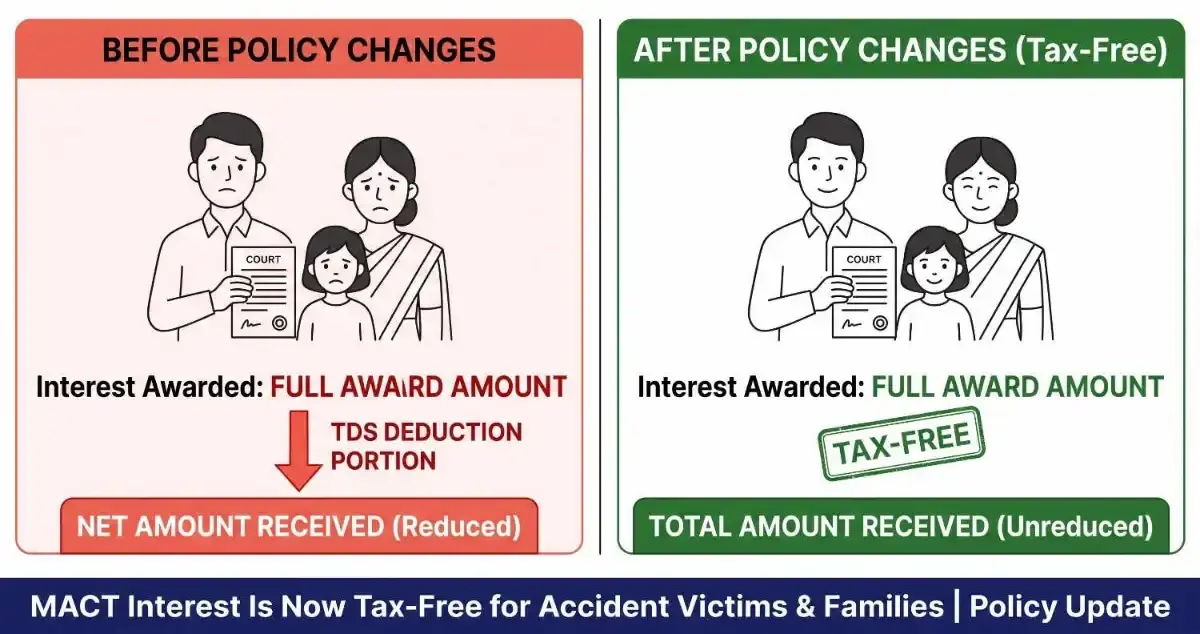
MACT interest income TDS exemption 2026 explained: who qualifies, old vs new Act rules, the FD interest trap, refund steps, and how to report it in your ITR.
Jul 24, 2026