

Gift Tax India: Is a gift from a friend taxable? Learn Section 56(2)(x), ₹50,000 limit, relatives list, Schedule OS ITR reporting, and FY 2025-26 examples.
A ₹70,000 birthday transfer from your college friend is fully taxable. The same amount from your father is tax-free — no limit, no questions. That one distinction is the entire gift tax rule in India for FY 2025-26.
Tax on gifts in India FY 2025-26 falls under Section 56(2)(x) of the Income-tax Act, 1961. It doesn't create a separate gift tax — it simply adds the gift amount to your income under "Income from Other Sources" and taxes it at your normal slab rate. Whether that gift comes from a friend, cousin, colleague, or NRI contact matters enormously. This guide gives you the exact rules, real ₹ calculations, and a step-by-step ITR filing walkthrough — so you don't get a notice six months later.
Gift from Cousin Taxable India — Why the Lineal Chain Matters
Who Counts as a Relative Under Section 56(2)(x)? Full List + Indian Family Examples
Real ₹ Examples: Common Case + Edge Case with Step-by-Step Math
How the IT Department Detects Unreported Gift Income: AIS and SFT
How to Show Gift Income in ITR 2025 — Schedule OS ITR Gift Income Step-by-Step
India scrapped the old Gift Tax Act in 1998. But gifts didn't become tax-free. The Income-tax Act, 1961 stepped in through Section 56(2)(x), which treats gifts above a threshold as "Income from Other Sources" — taxed at your applicable slab rate in the same ITR you file for salary or business income.
The rule is brutally simple: if you receive gifts from non-relatives during a financial year that total more than ₹50,000, the entire amount is taxable — not just the excess. So ₹49,999 from a friend? Tax-free. ₹50,001? The full ₹50,001 hits your taxable income.
Governing law for FY 2025-26: Section 56(2)(x), Income-tax Act, 1961 — assessed in AY 2026-27.
From Tax Year 2026-27 onwards: The same rules continue under Section 92(2)(m) of the Income-tax Act, 2025, which replaced the 1961 Act effective 1 April 2026. The section number changed; the substantive rules did not.
Use Toolisky's free Gift from Non-Relative Tax Calculator to check your exact tax liability before you file.
Section 56(2)(x) applies to | Section 56(2)(x) does NOT apply to |
|---|---|
Gifts from friends (cash, property, jewellery) | Gifts from specified relatives (full list below) |
Gifts from colleagues or bosses | Gifts received on the occasion of your own marriage |
Gifts from cousins, mausa, chacha, mama, nana | Assets received under a will or inheritance |
Gifts from NRI friends | Gifts in contemplation of the donor's death |
Cash/movable/immovable property from any non-relative exceeding ₹50,000 aggregate in a year | Gifts from registered trusts/institutions under Section 12A/12AA/12AB |
Gift from fiancé before marriage | Gifts from approved local authorities |
Partial case — gifts from employer: Non-cash gifts from an employer up to ₹5,000 per year are exempt as a perquisite under the salary head [VERIFY: Rule 3(7)(iv), Income-tax Rules, 1962 — confirm limit at incometaxindia.gov.in/income-tax-rules]. Cash gifts from an employer above ₹50,000 fall under Section 56(2)(x); non-cash gifts above ₹5,000 are taxed as salary perquisites, not other income.
Yes — if the total from all non-relatives in the financial year exceeds ₹50,000.
A friend is not a "relative" under Section 56(2)(x) of the Income-tax Act, 1961. There's no exception for close friends, childhood friends, or best friends. The law uses a strict legal definition — and "friend" doesn't appear on that list.
The ₹50,000 threshold is aggregate across the entire financial year. ₹20,000 from Friend A in April, ₹20,000 from Friend B in August, and ₹15,000 from Friend C in December = ₹55,000 total. The entire ₹55,000 becomes taxable income. Not just ₹5,000.
So is a gift from a friend taxable in India? Every time, if you cross that ₹50,000 aggregate line. Calculate it now with Toolisky's Gift from Non-Relative Tax Calculator — enter your total non-relative gifts for the year and get the exact tax figure instantly.
A gift from a cousin is taxable in India above the ₹50,000 threshold. A cousin is not a "relative" under Section 56(2)(x).
This confuses almost everyone. A cousin feels like close family. But the Income-tax Act defines "relative" through a strict lineal chain — it covers your direct blood line up and down (parents, grandparents, children, grandchildren) and siblings. Cousins sit one step outside that chain.
Here's the exact logic: your cousin is your uncle or aunt's child. The Act covers "brother or sister of either of the parents of the individual" — that's your uncle or aunt. But it does not extend to their children. That makes gift from cousin taxable in India the same way a gift from any non-relative is.
A ₹1 lakh transfer from your first cousin — chacha ka beta, mama ka beta, bua ki beti, regardless of which parent's side — is fully taxable if it crosses the ₹50,000 annual aggregate threshold with other non-relative gifts. Second cousins: same answer.
The exact definition from Section 56(2)(x), Explanation, Income-tax Act, 1961:
IS a relative — gift fully exempt (no limit) | Indian family equivalent |
|---|---|
Spouse of the individual | Husband / wife |
Brother or sister of the individual | Bhai / behen |
Brother or sister of the spouse | Sala, saali, nand, nandoi |
Brother or sister of either parent | Chacha, chachi, mama, mami, bua, fufa, mausi, mausaji |
Any lineal ascendant of the individual | Father, mother, dada, dadi, nana, nani |
Any lineal descendant of the individual | Son, daughter, grandson, granddaughter |
Any lineal ascendant of the spouse | Sasur, saas, and their parents |
Any lineal descendant of the spouse | Spouse's children |
Spouse of anyone in the above list | Their husbands/wives |
NOT a relative — gift taxable above ₹50,000 aggregate | Indian family equivalent |
|---|---|
Cousin (parent's sibling's child) | Chacha ka beta, mama ki beti, bua ka beta |
Nephew / niece (sibling's children) | Bhatija, bhanji |
Grand-uncle / grand-aunt | Dada ka bhai, nani ki behen |
In-laws beyond the above list | Bhabhi's parents, jija's siblings |
Friend | Any friend regardless of closeness |
Colleague | Office colleague, manager, subordinate |
Common confusion — are nephews and nieces covered? No. Your nephew or niece is your sibling's child. They are a lineal descendant of your parent, not of you personally. A gift from a nephew above the threshold is taxable. So is a gift to one, if you're looking at it from their side.
Is mausa (mother's sister's husband) a relative? Yes. Your mausi (mother's sister) is covered as "sister of either of the parents." Mausa, as the spouse of a listed relative, is also covered. His gift is fully exempt.
Governing section: Section 56(2)(x), Income-tax Act, 1961. Applies to FY 2025-26 (AY 2026-27).
Type of gift from non-relative | Threshold | What gets taxed if threshold crossed |
|---|---|---|
Cash / cheque / bank transfer / UPI | Aggregate > ₹50,000 in the FY | Entire aggregate amount |
Movable property (gold, shares, jewellery, crypto) — gifted free | Fair Market Value (FMV) > ₹50,000 | Entire FMV |
Movable property bought below FMV | Difference > ₹50,000 | Entire FMV minus consideration paid |
Immovable property — gifted free | Stamp duty value > ₹50,000 | Entire stamp duty value |
Immovable property bought below stamp duty value | Difference > ₹50,000 AND > 10% of consideration | Stamp duty value minus consideration paid |
Key rules you must know:
The ₹50,000 threshold resets on 1 April each year. It's a per-financial-year aggregate — not per gift, not per person. Gifts from relatives carry no monetary cap. A ₹2 crore property from your father is fully exempt. Gifts received on the occasion of your own marriage are fully exempt from anyone — friends, colleagues, even strangers — with no monetary cap. This exemption covers only your marriage, not birthdays, anniversaries, or festivals.
NRI friend gift taxable in India? Yes. The NRI status of the sender creates no exemption. If your NRI friend sends ₹80,000 via international bank transfer, the full ₹80,000 is taxable income in your hands — provided the aggregate from all non-relatives in the year crosses ₹50,000.
Crypto / VDA gifts: Virtual Digital Assets like Bitcoin are included in the definition of "property" under Section 56(2)(x) since the Finance Act 2022 amendment. A friend gifting you Bitcoin worth ₹80,000 triggers gift tax the same way as cash.
Car gifts: Vehicles are not listed in the definition of "property" under Section 56(2)(x). A gifted car is currently outside this provision — though such transactions may face scrutiny under other provisions.
Priya works as a marketing manager in Pune. During FY 2025-26, she received:
₹30,000 cash from her college friend Suresh on her birthday
₹28,000 via GPay from a colleague as a contribution toward a team trip
₹5,00,000 from her father for a flat down payment
Step 1 — Identify non-relative gifts. Suresh (friend) = ₹30,000. Colleague = ₹28,000. Father = exempt (lineal ascendant = specified relative).
Step 2 — Aggregate non-relative gifts. ₹30,000 + ₹28,000 = ₹58,000.
Step 3 — Does aggregate exceed ₹50,000? Yes. ₹58,000 > ₹50,000.
Step 4 — Entire aggregate is taxable. Taxable gift income = ₹58,000. Not ₹8,000. The whole amount.
Step 5 — Calculate tax (Priya in the 20% slab, new regime): Tax = ₹58,000 × 20% = ₹11,600 Add 4% health and education cess: ₹11,600 × 1.04 = ₹12,064
The ₹5,00,000 from her father? Zero tax. Father is a lineal ascendant = specified relative, exempt without any limit.
Ramesh, a salaried professional in Bengaluru, receives during FY 2025-26:
₹75,000 from his mausa (mother's sister's husband) for Diwali
₹40,000 from his first cousin (mama ka beta) for his birthday
₹35,000 from his NRI friend Farida via international bank transfer
Step 1 — Classify each gift.
Mausa: Mausi (mother's sister) is "sister of either parent" — she's a listed relative. Mausa, as her spouse, is also covered under Section 56(2)(x). Gift from mausa = exempt.
First cousin (mama ka beta): Not a relative. Taxable.
NRI friend Farida: Not a relative. Taxable.
Step 2 — Aggregate non-relative gifts. ₹40,000 (cousin) + ₹35,000 (NRI friend) = ₹75,000.
Step 3 — ₹75,000 > ₹50,000. Full ₹75,000 is taxable.
Step 4 — Calculate tax (Ramesh in the 30% slab): Tax = ₹75,000 × 30% = ₹22,500 Add 4% cess: ₹22,500 × 1.04 = ₹23,400
The ₹75,000 from mausa goes in Schedule EI (Exempt Income) in the ITR — not Schedule OS. Document the family relationship with proof.
Your friend sent ₹70,000 via Google Pay "for a shared trip." Is it a taxable gift? This is one of the most-searched scenarios — and most articles skip the real answer.
The tax character depends on intent and documentation, not the payment mode. UPI, NEFT, IMPS, cheque — mode doesn't change whether a transfer is a gift or a loan.
If it's a genuine loan or reimbursement, it's not a gift. Not taxable under Section 56(2)(x). But the IT Department's AIS shows ₹70,000 credited to your account with no matching category in your return. That mismatch triggers a scrutiny flag.
How to protect yourself:
For a shared expense reimbursement: save the group chat showing the trip plan, your initial payment, and the reimbursement message. A WhatsApp thread saying "returning ₹70K for Goa trip, you paid first" is real, usable evidence.
For a loan: a simple written note or email stating the amount, date, and repayment plan is enough. It doesn't need a notary. Even a text message will do in most cases.
For a genuine gift above ₹50,000: report it in Schedule OS. Pay the slab tax. The cost of disclosure is lower than the cost of a penalty.
What you cannot do: label a large one-way transfer as "a loan" with zero documentation two years after the fact. Assessing Officers see this pattern constantly in scrutiny cases.
Most people assume unreported gift income is invisible. It's not — and this is the angle almost no competitor article explains properly.
The Annual Information Statement (AIS) on the income tax portal pulls data from banks, sub-registrars, mutual funds, stockbrokers, and foreign remittance processors — all mapped to your PAN. It shows bank credits, property registrations, high-value purchases, and foreign inward remittances. If you receive ₹80,000 from a friend and your return shows no corresponding income, that gap shows up automatically in the AIS.
The Statement of Financial Transactions (SFT) is the deeper layer. Banks report: cash deposits above ₹10 lakh per year in savings accounts, credit card payments above ₹1 lakh (cash) or ₹10 lakh (total) per year, and large property purchase or sale transactions. Sub-registrars report property registrations. These all flow into your AIS under the "SFT Information" tab.
Specific triggers that flag gift income:
Large one-time credit to your bank account not matching salary, business, or investment patterns
Property registered in your name without a corresponding purchase reflected in your return
Inward foreign remittance above threshold (banks file Form 15CC, which appears in AIS under "Other Information")
Cash deposits after receiving property or asset gifts
When your ITR income doesn't match what AIS shows, the system generates a compliance notice automatically. If you can't explain the gap — and you haven't reported the gift — you'll pay tax plus 1% per month interest plus a 50% underreporting penalty. Possibly 200% if it looks deliberate.
The far smarter move? Report the gift correctly from the start.
Taxable gifts from non-relatives go under Schedule OS (Income from Other Sources) in ITR-1 or ITR-2 for AY 2026-27. Exempt gifts from relatives go under Schedule EI (Exempt Income).
Which ITR form do you need?
ITR-1 (Sahaj): Salaried individuals with total income up to ₹50 lakh. Gift income from non-relatives fits here under "Other Sources."
ITR-2: Use this if you have capital gains, more than one house property, or foreign income (such as a gift from an NRI friend received abroad).
Step 1: Go to https://www.incometax.gov.in/iec/foportal/. Click Login in the top-right corner. Enter your PAN and password.
Step 2: After login, go to e-File in the top menu → select Income Tax Returns → click File Income Tax Return.
Step 3: Select Assessment Year 2026-27 and choose Online mode. Click Continue.
Step 4: Choose your ITR form — ITR-1 or ITR-2 depending on your income type. Click Proceed.
Step 5: In the pre-filled return, go to the "Income from Other Sources" section. Look for the field labelled "Any other income earned."
Step 6: Click "Add Details." Enter the total taxable gift amount — the aggregate of all non-relative gifts that crossed ₹50,000. From the nature dropdown, select "Gift/Deemed Gift under Section 56(2)(x)."
Step 7: For exempt gifts from relatives, scroll to Schedule EI — Exempt Incomes. Click "Add Details." Enter the amount and select "Any other exempt income" with a note: "Gift received from specified relative under Section 56(2)(x)."
Step 8: Review the auto-computed tax. If you didn't pay advance tax on this income, you may see interest under Section 234B or 234C. Check those figures carefully.
Step 9: Go to "Taxes Paid" to add any self-assessment tax paid via Challan 280. Then go to "Verification," choose your method (Aadhaar OTP, Net Banking, or EVC), and submit.
Step 10: Download the ITR-V acknowledgement and keep it.
The ITR portal UI is updated every assessment year. Field names may shift slightly. Always confirm against the live portal at incometax.gov.in before filing.
If your total tax liability for FY 2025-26 (after TDS) is more than ₹10,000, you must pay advance tax. Gift income is added to your total income — which can push you past that ₹10,000 threshold even if your employer already deducts TDS on your salary.
Advance tax instalment schedule for FY 2025-26 (Section 211, Income-tax Act, 1961):
Instalment | Due Date | Minimum Cumulative % of Total Tax Payable |
|---|---|---|
1st | 15 June 2025 | 15% |
2nd | 15 September 2025 | 45% |
3rd | 15 December 2025 | 75% |
4th / Final | 15 March 2026 | 100% |
Worked example: You receive ₹1,20,000 from a non-relative friend in August 2025. Expected tax on this gift (at 20% slab) = approximately ₹24,960 (₹1,20,000 × 20% × 1.04 cess). Since this exceeds ₹10,000, advance tax applies.
By 15 September 2025: 45% × ₹24,960 = ₹11,232 (cumulative due, reduced by 15% instalment if already paid)
By 15 December 2025: 75% × ₹24,960 = ₹18,720 (cumulative)
By 15 March 2026: ₹24,960 (full 100%)
Miss any instalment and you owe 1% per month interest under Section 234C. Miss the overall 90% threshold by year-end and Section 234B interest also kicks in. Use Toolisky's Section 234A 234B 234C Interest Calculator to get the exact interest figure for your situation.
The IT Department sends a notice under Section 148A asking you to explain an income mismatch. Don't ignore it — that escalates to reassessment.
Log in to incometax.gov.in → e-Proceedings → find the notice under your DIN number. Respond within the stated deadline (usually 15–30 days).
If the gift was from a relative: attach proof of relationship — birth certificate, Aadhaar-linked family details, marriage certificate — and state the gift is exempt under Section 56(2)(x).
If the gift was from a non-relative and you missed reporting it: file a revised return under Section 139(5) if the deadline hasn't passed. For AY 2026-27, the revised return deadline is 31 December 2026. Pay the self-assessment tax and interest via Challan 280 before responding.
The system raises a tax demand for the unpaid amount.
Log in → e-File → Income Tax Returns → find your return → click File Revised Return. Move the gift from Schedule EI to Schedule OS. Recompute the tax, pay the difference via Challan 280, and resubmit before 31 December 2026.
Your AIS shows ₹80,000 credited from a friend — it was actually a trip reimbursement, but there's no matching expense in your return.
Log in → e-File → AIS → find the transaction → click "Optional" in the Feedback column. Select "Income not taxable" or the relevant feedback option. Add a short explanation and reference your supporting evidence (bank statements, WhatsApp messages, written agreement). If the AIS source doesn't accept the correction, file your return accurately and provide a written explanation in response to any subsequent notice.
Default | Penalty / Interest | Governing Section |
|---|---|---|
Underreporting of income | 50% of tax on the underreported amount | Section 270A, Income-tax Act, 1961 |
Misreporting of income (deliberate concealment) | 200% of tax on the misreported amount | Section 270A, Income-tax Act, 1961 |
Late filing of ITR (income > ₹5 lakh) | ₹5,000 | Section 234F, Income-tax Act, 1961 |
Late filing of ITR (income ≤ ₹5 lakh) | ₹1,000 | Section 234F, Income-tax Act, 1961 |
Interest on unpaid advance tax (shortfall below 90%) | 1% per month from 1 April after the FY | Section 234B, Income-tax Act, 1961 |
Interest on deferred advance tax instalments | 1% per month for 3 months per instalment | Section 234C, Income-tax Act, 1961 |
Wilful concealment prosecution | Imprisonment of 6 months to 7 years | Section 276C, Income-tax Act, 1961 |
The 200% misreporting penalty is applied when taxpayers actively conceal income — such as claiming a large non-relative gift as a "loan" with no documentation at all. The difference between the 50% and 200% rate often comes down to whether you have genuine paper trail or not.
Yes — if the total of all gifts from non-relatives in the financial year exceeds ₹50,000, the entire aggregate amount is taxable under Section 56(2)(x) as Income from Other Sources. A friend is not a "relative" under the Act regardless of closeness. If total non-relative gifts stay at or below ₹50,000 in the year, no tax applies at all.
The ₹50,000 is an annual aggregate threshold — not per gift, not per person. If the sum of all non-relative gifts in the FY crosses ₹50,001, the full aggregate is taxable — not just the excess. It's all or nothing. ₹49,999 = zero tax. ₹50,001 = entire ₹50,001 taxed at your slab rate.
Yes. A cousin — first or second, maternal or paternal — is not a "relative" under Section 56(2)(x). Only siblings, lineal ascendants and descendants, their spouses, and siblings of your parents qualify. Your cousin is your parent's sibling's child — one step outside the defined list.
Yes, if the total of cash gifts from colleagues and all other non-relatives in the FY exceeds ₹50,000. For non-cash gifts from your employer specifically, the first ₹5,000 per year is exempt as a perquisite — amounts above that are taxed as salary perquisite, not under Section 56(2)(x). [VERIFY: confirm this ₹5,000 limit against Rule 3(7)(iv), Income-tax Rules, 1962 at incometaxindia.gov.in]
Yes. An NRI friend is not a relative. Standard Section 56(2)(x) rules apply regardless of the sender's residency status. If the aggregate from all non-relatives crosses ₹50,000 in the FY, the total is taxable in your hands. Foreign remittances also show up in AIS via Form 15CC filed by the bank.
Taxable gifts go in Schedule OS (Income from Other Sources) in ITR-1 or ITR-2 for AY 2026-27. Select the nature as "Gift/Deemed Gift under Section 56(2)(x)." Exempt gifts from relatives go in Schedule EI. Always keep your bank statement, gift deed or written communication, and proof of relationship handy.
Section 56(2)(x) of the Income-tax Act, 1961 taxes money or property received without consideration — or for inadequate consideration — as Income from Other Sources when the aggregate value from non-relatives exceeds ₹50,000 in a year. It covers individuals, HUFs, firms, and companies. From Tax Year 2026-27, the equivalent provision is Section 92(2)(m) of the Income-tax Act, 2025 — same rules, new section number.
Yes. Section 56(2)(x) is not a deduction or regime-specific benefit. It applies under both regimes. The gift income is added to your total income and taxed at whichever slab rate applies under your chosen regime — 5%, 20%, or 30% accordingly.
No. Gifts received on the occasion of your own marriage are fully exempt under Section 56(2)(x) — from anyone, including non-relatives, with no monetary cap. The exemption specifically covers marriage. Engagement party gifts, baby shower gifts, or birthday gifts from non-relatives do not get this exemption.
File a revised return under Section 139(5) before 31 December 2026 (for AY 2026-27). Pay the self-assessment tax and interest under Section 234A via Challan 280 on incometax.gov.in under "Self-Assessment Tax" before submitting the revised return. Acting before the department notices you is always better than responding to a notice.
No, currently. Motor vehicles are not listed in the definition of "property" under Section 56(2)(x). The provision covers immovable property, shares, securities, jewellery, bullion, drawings, paintings, sculptures, works of art, and virtual digital assets — not vehicles. A gifted car falls outside this provision, though it may attract scrutiny under other provisions for high-value one-way transfers.
No. Mausa (mother's sister's husband) qualifies as a relative. Your mausi is your mother's sister — covered under "sister of either parent." Mausa, as her spouse, is also included in the relative list under Section 56(2)(x). The ₹2 lakh is fully exempt. Report it under Schedule EI with a note on the relationship.
Check your total non-relative gifts for FY 2025-26 right now. If the aggregate is above ₹50,000, report it in Schedule OS of your ITR — it takes under five minutes and protects you from a 50–200% penalty later. Use Toolisky's free Gift from Non-Relative Tax Calculator to work out the exact tax before you file. For the official rules, verify every number at incometaxindia.gov.in.
For educational purposes only. Verify all figures at official sources before acting. Toolisky is not affiliated with any government body. Consult a qualified CA or legal professional before making compliance decisions. See toolisky.com/accuracy-and-limitations.
No TAN for NRI property purchase applies only from 1 October 2026, and only to resident individual and HUF buyers. Get the rates, forms, and dates you need.
Jul 25, 2026

Did you lose the SGB premature redemption tax exemption? Here's exactly who's affected, how much tax applies now, and how to check your own bonds.
Jul 24, 2026
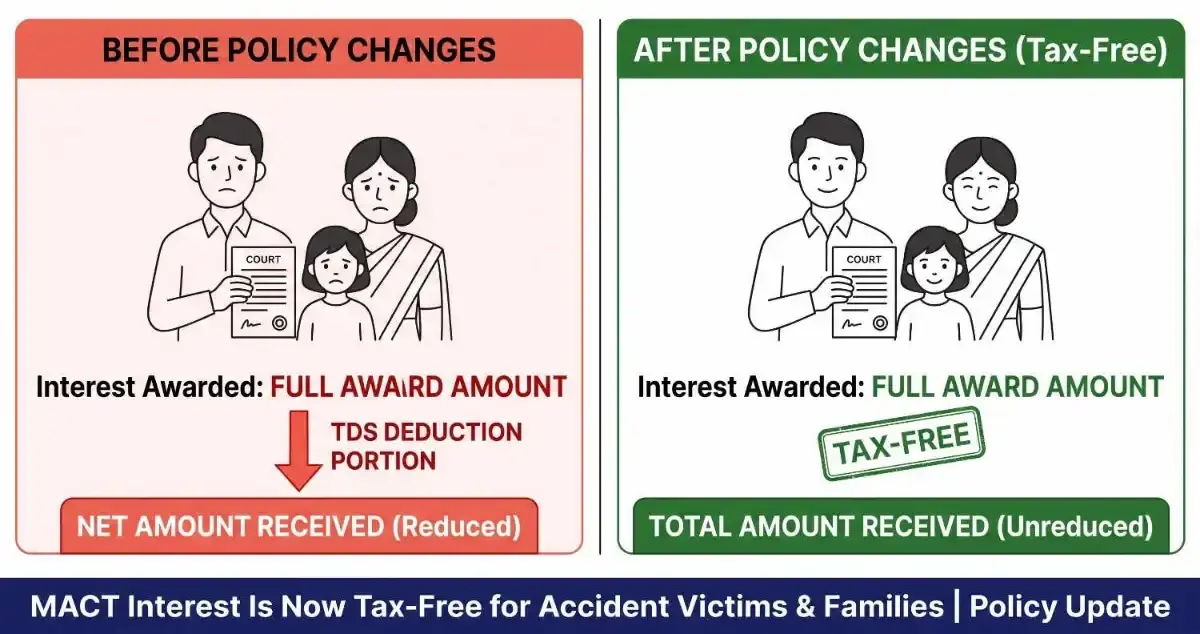
MACT interest income TDS exemption 2026 explained: who qualifies, old vs new Act rules, the FD interest trap, refund steps, and how to report it in your ITR.
Jul 24, 2026