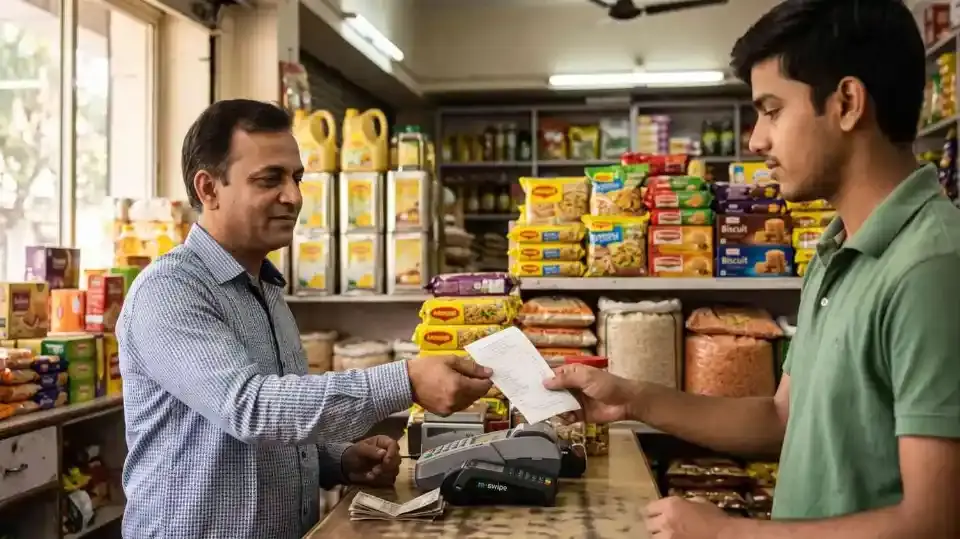

Goods and Services Tax in India changed on 22 Sep 2025. New slabs: 5%, 18%, 40%. See exact rates, what got cheaper, and how to calculate GST on your bill.
India's biggest overhaul to the Goods and Services Tax in India happened quietly on 22 September 2025. The 12% and 28% GST slabs are gone. Two rates now cover almost everything you buy — 5% and 18%. A new 40% "special rate" applies to a narrow set of luxury and sin goods. If you're still confused about what changed, what didn't, and what rate applies to your next grocery run or bike purchase, this guide settles it.
Last Updated: July 2026
GST — Goods and Services Tax — is India's unified indirect tax that replaced a cluttered mix of central excise duty, VAT, service tax, and entry tax from 1 July 2017. It's governed by the CGST Act, 2017 and the IGST Act, 2017.
Here's how it actually works. Every seller charges GST on top of the product price. They collect it from the buyer, then deposit it with the government. If that buyer is a registered business, they can claim back whatever GST they paid on their purchases — this is called Input Tax Credit (ITC). So tax is paid only on the value that's added at each step, not on the full price every single time.
For you as a consumer? You pay GST on the final bill and you're done. No ITC for individuals.
GST Applies To | GST Does NOT Apply To |
|---|---|
Businesses selling goods with turnover above ₹40 lakh/year | Businesses below the turnover threshold |
Service providers with turnover above ₹20 lakh/year (₹10 lakh in special category states) | Agriculturists supplying their own produce |
All e-commerce operators, regardless of turnover | Petrol, diesel, ATF, natural gas, alcohol for drinking |
Inter-state sellers of any turnover size | Free samples and gifts below prescribed limits |
Partial/conditional cases: Businesses on the GST Composition Scheme — manufacturers below ₹1.5 crore, restaurants, eligible service providers — pay flat GST at 1%, 5%, or 6% on turnover. They can't charge GST on invoices or claim ITC. Registration thresholds for goods remain unchanged after the 56th Council. (Source: PIB FAQ, Q2)
The 56th GST Council met on 3 September 2025. The new structure took effect from 22 September 2025 — just before Navratri. Here's the before and after, clearly laid out.
Slab | Before 22 Sep 2025 | After 22 Sep 2025 | What Happened |
|---|---|---|---|
Nil (0%) | Fresh produce, eggs, milk | Same + all Indian breads (roti, paratha, porotta, pizza bread), pre-packaged paneer, UHT milk | More essentials added |
5% | Essential goods, medicines | Daily essentials, medicines, EVs, individual health and life insurance, bicycles, ghee, butter, toiletries, personal care items | Most 12% items moved here |
12% | Mid-range goods, some services | Abolished for most goods and services | Merged into 5% or 18% |
18% | Standard goods, most services | Electronics, cement, vehicles (small cars, bikes up to 350cc), all TVs and monitors, ACs, most services | Many 28% items moved here |
28% | Luxury goods + compensation cess | Abolished for most items | Replaced by 18% or 40% |
40% | Did not exist | Pan masala, aerated drinks, luxury cars/SUVs, yachts, private aircraft, lottery, casinos, IPL tickets | Brand new slab replacing 28%+cess |
One important carve-out: Cigarettes, beedis, chewing tobacco, zarda, and unmanufactured tobacco are still at old rates with compensation cess. The new 40% rate will apply to them only after the government discharges its compensation cess loan obligations — no date fixed yet as of July 2026. (Source: PIB FAQ Q1)
All rates below are verified against the official PIB FAQ on the 56th GST Council.
Item | Old Rate | New Rate (from 22 Sep 2025) |
|---|---|---|
Ghee, butter (packaged) | 12% | 5% |
Pre-packaged paneer | 12% | Nil |
All Indian breads — roti, paratha, porotta, pizza bread, khakra | 5–12% (varied) | Nil |
Namkeen, bhujia, mixtures | 12% | 5% |
Biscuits, ice cream, pastries | 18% | 5% |
Mineral water | 18% | 5% |
Plant-based milk, soya milk | 12–18% | 5% |
UHT milk | Taxable | Nil |
Item | Old Rate | New Rate |
|---|---|---|
Soap bar (toilet soap) | 18% | 5% |
Toothpaste, toothbrush, dental floss | 18% | 5% |
Shampoo, hair oil, face powder | 18% | 5% |
Policy | Old Rate | New Rate |
|---|---|---|
Individual life insurance (term, ULIP, endowment) | 18% | Nil (Exempt) |
Individual health insurance (family floater, senior citizen) | 18% | Nil (Exempt) |
Group insurance policies for employers are treated separately — check with your insurer.
Vehicle Type | Old Rate | New Rate |
|---|---|---|
Small petrol/CNG/LPG cars (engine up to 1200cc, length up to 4000mm) | 28% + cess | 18% |
Small diesel cars (engine up to 1500cc, length up to 4000mm) | 28% + cess | 18% |
Motorcycles up to 350cc (includes exactly 350cc) | 28% + cess | 18% |
Motorcycles above 350cc | 28% + cess | 40% |
Mid-size/large cars, SUVs above 1500cc and 4000mm length | 28% + cess (~45–50% total) | 40% |
Three-wheelers (HSN 8703) | 28% | 18% |
Trucks and lorries (HSN 8704) | 28% | 18% |
Buses (10+ passengers, HSN 8702) | 28% | 18% |
Item | Old Rate | New Rate |
|---|---|---|
Smartphones, laptops | 18% | 18% (unchanged) |
Air conditioners | 28% | 18% |
All TVs and monitors (any size) | 18% (≤32") / 28% (>32") | 18% uniform |
Dishwashers | 28% | 18% |
All batteries (HSN 8507) | 18% (lithium-ion) / 28% (others) | 18% uniform |
Service | Old Rate | New Rate |
|---|---|---|
Hotel rooms ₹7,500/night or below | 12% | 5% (no ITC) |
Hotel rooms above ₹7,500/night | 18% | 18% (unchanged) |
Standalone restaurants | 5% (no ITC) | 5% (no ITC) — unchanged |
Restaurants in hotels (specified premises) | 18% (with ITC) | 18% (with ITC) — unchanged |
Gyms, salons, spas, yoga centres | 18% | 5% (no ITC) |
Economy class air travel | 5% | 5% (unchanged) |
Business class air travel | 12% | 18% |
Item | Old Rate | New Rate |
|---|---|---|
Cement | 28% | 18% |
Marble and granite blocks | 12% | 5% |
Spectacles for vision correction | 12–18% | 5% |
Item | Old Rate | New Rate |
|---|---|---|
Pan masala | 28% + cess | 40% |
Aerated drinks, sweetened beverages | 28% + cess | 40% |
Luxury cars, SUVs (above thresholds) | 28% + cess (45–50%) | 40% |
Yachts and private aircraft | 28% | 40% |
Lottery, casinos, horse racing, online gaming | 28% | 40% |
IPL and premium sporting event tickets | 28% | 40% |
Every GST rate splits into two equal parts. When you buy something within your own state and pay 18% GST, it's actually 9% CGST (Central GST) + 9% SGST (State GST). Your invoice will show both lines.
Buy from a seller in another state? The whole 18% becomes IGST — Integrated GST — collected by the central government, which then shares the state's portion with the destination state. Imports into India also attract IGST.
The total rate doesn't change either way. It's just about who gets which slice.
Adding GST to a base price:
GST Amount = Base Price × GST Rate % Total = Base Price + GST Amount
Extracting GST from a price that already includes GST:
GST Amount = (Inclusive Price × Rate%) ÷ (100 + Rate%)
Suresh buys a new Bajaj Pulsar 200 from a Pune dealer in October 2025. Ex-showroom price (before GST): ₹1,20,000.
Old rate: 28% + cess (roughly 17%) = ~45% total.
Old GST: ₹1,20,000 × 45% = ₹54,000
Old total: ₹1,74,000
New rate from 22 Sep 2025: 18% (bikes up to 350cc).
New GST at 18%: ₹1,20,000 × 18% = ₹21,600
CGST (9%): ₹10,800
SGST (9%): ₹10,800
New total: ₹1,41,600
Suresh saves ₹32,400 just on GST. That's before any dealer offers.
Priya places an order on 20 September for shampoo (₹200), toothpaste (₹80), and butter (₹120). Delivery and invoice happen on 23 September 2025 — after the rate change.
Under Section 14 of the CGST Act, 2017: if goods are supplied after the rate change and payment is received after the change, time of supply is the date of invoice or payment, whichever is earlier. The invoice is dated 23 September — so new rates apply. (Source: PIB FAQ Q4)
Item | Value | Old Rate (18%) | New Rate (5%) | Saving |
|---|---|---|---|---|
Shampoo | ₹200 | ₹36 | ₹10 | ₹26 |
Toothpaste | ₹80 | ₹14.40 | ₹4 | ₹10.40 |
Butter | ₹120 | ₹14.40 | ₹6 | ₹8.40 |
Total | ₹400 | ₹64.80 | ₹20 | ₹44.80 |
Nearly ₹45 saved on a ₹400 grocery order. Multiply that across a family's monthly spending and it adds up fast.
Most articles gloss over this. Let's be direct about what's unchanged under the Goods and Services Tax in India framework.
Still completely outside GST:
Petrol, diesel, ATF (aviation fuel), natural gas, crude oil — taxed under state VAT and central excise. No GST applies.
Alcohol for drinking — state governments tax this separately. Always has been outside GST.
Electricity — exempt from GST.
Unchanged within GST:
Gold and precious metals: 3% GST — no change.
Diamonds and precious stones: 0.25% GST — no change.
GST registration threshold: still ₹40 lakh (goods) and ₹20 lakh (services). Unchanged. (Source: PIB FAQ Q2)
Standalone restaurants: still 5% without ITC — no change despite media confusion.
Cigarettes, beedis, chewing tobacco: old rates + compensation cess still apply as of July 2026.
Is GST going to apply to petrol anytime soon? It's been discussed at multiple council meetings. No formal decision has been taken as of this update.
Say a supermarket is still charging 18% on shampoo or toothpaste. That's excess GST collection — and it should have been passed on to you. The government chose not to reinstate formal anti-profiteering provisions, but CBIC told businesses to pass benefits on.
Your options:
Call the National Consumer Helpline: 1915 (toll-free)
WhatsApp: 8800001915
File a complaint at consumerhelpline.gov.in via the INGRAM portal
Keep the invoice showing the incorrect rate as evidence.
You've underpaid GST. File a correction in the relevant return period. Pay the difference plus interest at 18% per annum from the original due date under Section 50 of the CGST Act, 2017. Do this before a department notice — voluntary correction before a notice avoids penalties.
If your supplies became exempt post-22 Sep 2025 (for example, you're an insurer and insurance went exempt), you must reverse the ITC on proportionate inputs. If your credit was blocked due to a supplier-side mismatch, raise a grievance on the GST portal under Services → Grievances. CBIC issued clarification circulars in September–November 2025 on ITC treatment during the transition — check cbic.gov.in for those circulars.
Offence | Penalty | Law |
|---|---|---|
Short payment or non-payment (no fraud) | 10% of tax due, minimum ₹10,000 | Section 73, CGST Act 2017 |
Short payment due to fraud or suppression | 100% to 300% of tax due | Section 74, CGST Act 2017 |
Late filing of GSTR-3B | ₹50/day (₹20/day for nil returns), max ₹10,000 per return | CGST Act |
Not registering despite being liable | 100% of tax evaded or ₹10,000, higher of the two | Section 122, CGST Act 2017 |
Incorrect invoice (wrong rate) | Up to ₹25,000 | Section 122, CGST Act 2017 |
Interest on delayed payment | 18% per annum | Section 50, CGST Act 2017 |
One thing to remember: if you pay before receiving a show-cause notice under Section 73, you avoid the penalty entirely. Once the notice lands, the minimum 10% applies even if there's no fraud.
GST stands for Goods and Services Tax. The Goods and Services Tax in India is a single, destination-based indirect tax that replaced central excise duty, VAT, service tax, and several other levies from 1 July 2017. It's governed by the CGST Act, 2017 and IGST Act, 2017. Every buyer pays GST to the seller, who deposits it with the government. Registered businesses can claim Input Tax Credit on GST paid on purchases.
From 22 September 2025, India has four active GST rates: Nil (0%), 5%, 18%, and 40%. The 12% and 28% slabs are abolished for most goods. Special rates of 3% for gold and 0.25% for diamonds continue for those specific categories. (Source: PIB FAQ on 56th GST Council)
Mostly yes. The 12% slab was formally removed for the vast majority of goods and services. Items moved to either 5% or 18% depending on their nature. A handful of niche transitional categories may still reference 12% in specific CBIC notifications — always check the official HSN-level rate notification at gst.gov.in for specific products.
Pan masala, gutkha, aerated drinks, sweetened beverages, high-end cars and SUVs above the defined size thresholds, motorcycles above 350cc, yachts, private aircraft, lottery tickets, betting, casinos, horse racing, online gaming, and premium IPL-style sporting event tickets. The 40% rate was designed to absorb the old 28% rate plus the compensation cess that's now being wound down. (Source: PIB FAQ Q38, Q73, Q74)
No. Petrol, diesel, ATF, natural gas, and crude oil remain outside the GST framework. They're taxed through state VAT and central excise duty. GST 2.0 didn't change this. Bringing petroleum products under GST requires a constitutional amendment and consensus among states — it hasn't happened yet.
Standalone restaurants pay 5% GST without ITC — completely unchanged. Restaurants inside hotels classified as "specified premises" charge 18% with ITC. If you order from Swiggy or Zomato from a standalone restaurant, you pay 5% on the food and 18% separately on the delivery fee. (Source: PIB FAQ Q on restaurant services; 56th Council recommendations)
Yes — for individual policies. All individual life insurance policies (term, ULIP, endowment) and individual health insurance (family floater, senior citizen policies) are fully exempt from GST from 22 September 2025. Group insurance policies for employers are not covered by this exemption. (Source: PIB FAQ Q56, Q57)
If you overcharged, you collected more GST than required and must deposit what you collected. Issue a credit note to the buyer for the excess, and adjust it in your next GST return. If you undercharged, pay the difference immediately plus 18% per annum interest under Section 50. Don't wait for a department notice.
When the Goods and Services Tax in India launched in 2017 (GST 1.0), it had five slabs — 0%, 5%, 12%, 18%, 28% — plus a compensation cess. GST 2.0 (September 2025) cut this to two working slabs (5% and 18%), added a 40% special rate for sin/luxury goods, and ended compensation cess for most categories. The goal was to reduce classification disputes and make compliance simpler for businesses of all sizes.
On an intra-state transaction: 18% splits as 9% CGST + 9% SGST. Seller deposits CGST with the centre and SGST with the state. On an inter-state transaction: 18% IGST is collected as one line by the centre, which then shares the destination state's portion. The total rate is the same — it's just the route that differs.
No. Alcohol for human consumption is taxed by state governments through their own excise and VAT frameworks. It's explicitly outside GST and GST 2.0 didn't touch this. Each state sets its own rates — that's why alcohol prices differ so much between states.
Use the HSN code lookup on gst.gov.in → Search HSN/Services. Every product has an HSN (Harmonized System of Nomenclature) code and the official rate notification is tied to those codes. Don't rely on third-party blogs or memory for classification decisions that affect your compliance.
Check your bills for personal care products, food, and insurance from after 22 September 2025. If you're still seeing 18% on soap or toothpaste, raise a complaint at the National Consumer Helpline (1915). For HSN-level rate lookups, use the official GST portal directly. And if you need to work out your income tax alongside all this, check Toolisky's Income Tax Calculator for FY 2025-26 for a clear number.
For educational purposes only. Verify all figures at official sources before acting. Toolisky is not affiliated with any government body. Consult a qualified CA or legal professional before making compliance decisions. See toolisky.com/accuracy-and-limitations.
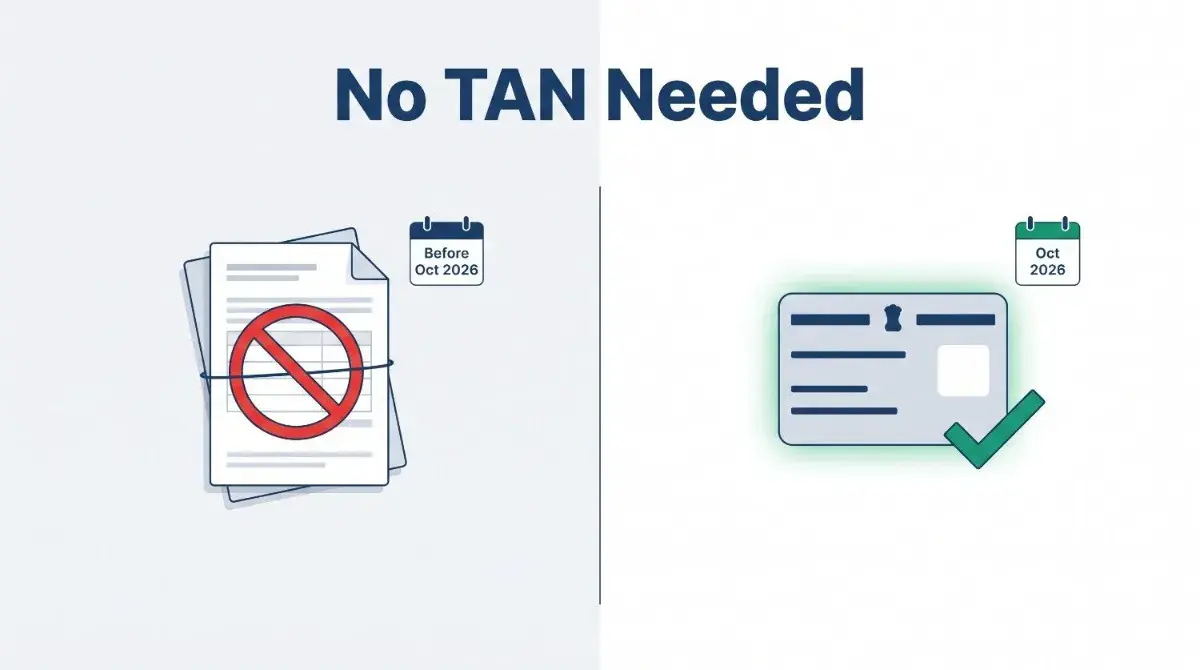
No TAN for NRI property purchase applies only from 1 October 2026, and only to resident individual and HUF buyers. Get the rates, forms, and dates you need.
Jul 25, 2026
Did you lose the SGB premature redemption tax exemption? Here's exactly who's affected, how much tax applies now, and how to check your own bonds.
Jul 24, 2026
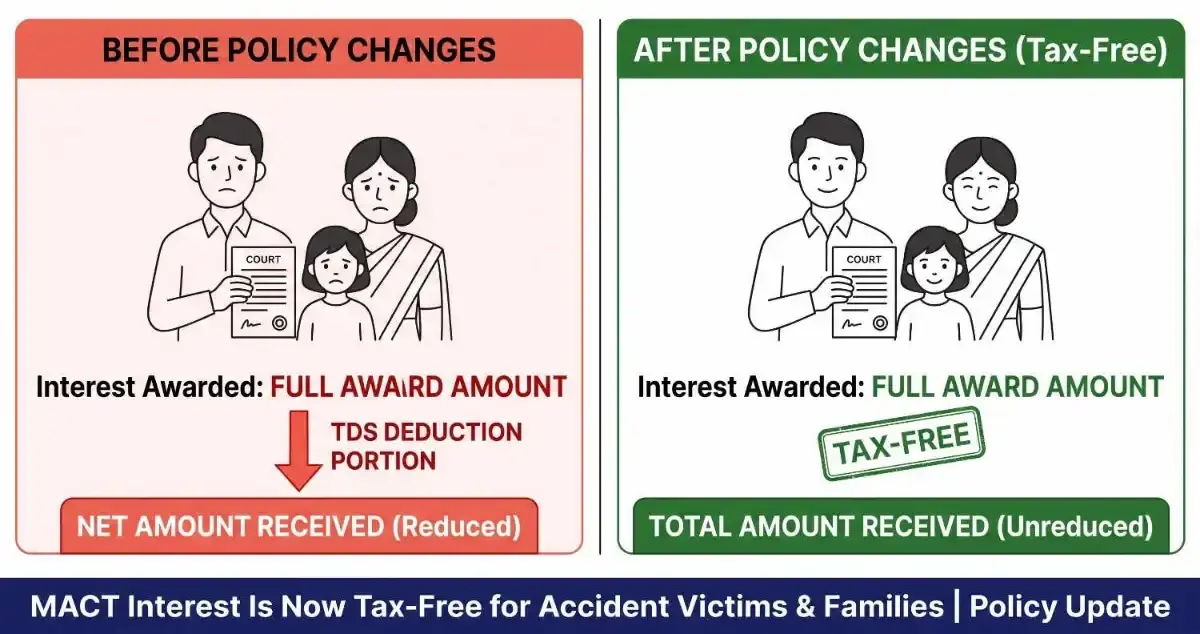
MACT interest income TDS exemption 2026 explained: who qualifies, old vs new Act rules, the FD interest trap, refund steps, and how to report it in your ITR.
Jul 24, 2026