

Income Tax Act 2025 for NRIs in the USA: residency rules, FATCA, FBAR, DTAA relief, and property sale TDS — fact-checked for 2026 filing.
If you're an NRI living in the USA, here's the short version: the Income Tax Act 2025 for NRIs in the USA does not touch your residency test. Section 6 stays exactly where it was, with the same 182-day rule and the same 60-plus-365-day rule. What actually changed is the section numbers, the TDS process for selling property in India, and a new foreign-asset disclosure window that, if you're an active NRI, probably doesn't even apply to you.
Income you earned up to 31 March 2026 (Financial Year 2025-26, Assessment Year 2026-27) is still governed by the old Income-tax Act, 1961. Income earned from 1 April 2026 onward falls under the new Income-tax Act, 2025, which formally repealed the 1961 law on that date. The new Act cuts what had grown into a sprawling 800-plus-section code down to 536 sections across 23 chapters, a change the Income Tax Department confirms directly on its own FAQ page.
Because this guide spans the handover period, both sets of section numbers are given side by side wherever a provision is mentioned. Everything here was checked against the Income Tax Department's official pages and the 1961-to-2025 section mapping utility this session. Anywhere a number couldn't be pinned down against an official source, it's marked [VERIFY] so you know to double-check before relying on it.
This article was fact-checked in July 2026. Rules are still settling down during this transition, so always confirm the figures that matter to you on incometaxindia.gov.in before you file.
The Income-tax Act, 2025 is India's new direct-tax law, effective from 1 April 2026. It doesn't raise anyone's tax bill — rates and slabs haven't changed. What it does is renumber almost every section and replace the old "Previous Year" and "Assessment Year" split with one single idea: the Tax Year.
For NRIs, residential status still lives at Section 6 in both Acts, with no change in the number. TDS on payments to non-residents, which used to sit at Section 195, is now folded into Section 393(2), under the TDS rate table. The application for a lower-TDS certificate, previously Form 13, is now Form 128. This is exactly where NRI tax planning tends to go wrong, since plenty of older guides and even some professionals are still quoting the 1961 numbering out of habit.
Applies to | Does NOT apply to |
|---|---|
US green card holders and citizens with Indian income, at any level | Foreign nationals with no green card, citizenship, or India-source income |
H-1B/L-1 holders who cross 182 days in India in a Tax Year | NRIs who stay under India's residency thresholds all year |
Indian citizens or PIOs earning over ₹15 lakh from Indian sources (the 120-day rule kicks in) | NRIs earning under ₹15 lakh from Indian sources (the standard 60-day test applies instead) |
NRIs selling Indian property, earning Indian rent, or holding NRO deposits | NRIs with only NRE account interest, which stays exempt |
Returning NRIs inside their RNOR window | Full residents (ROR) — once RNOR ends, worldwide income becomes taxable |
One myth worth killing here: a lot of sites claim the 120-day rule and the deemed-residency rule are brand new under the 2025 Act. They aren't. Both already existed under the 1961 Act. The 120-day rule has been around since Budget 2020, and deemed residency (now Section 6(7), formerly Section 6(1A)) since that same year. The 2025 Act simply carried both tests forward, unchanged, under the same section number. Don't let anyone tell you your residential status flipped overnight — it didn't.
This is the part most articles gloss over: what the Income Tax Act 2025 for NRIs in the USA actually changed for FATCA and FBAR compliance in 2026, and what quietly stayed the same.
Residency (Section 6, both Acts). You're a Resident once you spend 182 or more days in India in a Tax Year, or 60-plus days that year combined with 365-plus days across the preceding four years. Citizens and PIOs get the 60-day test replaced by a 120-day test, but only once their India-source income crosses ₹15 lakh. Source: Income Tax Department, non-resident guidance
Selling property in India — TDS in 2026 (Section 393(2), formerly Section 195). There's no minimum threshold here, unlike the ₹50 lakh threshold that applies to resident sellers. Long-term gains (property held over 24 months) attract 12.5% TDS; short-term gains are taxed at slab rates. From 1 October 2026, the plan is that buyers purchasing from NRI sellers will no longer need a TAN — the process is expected to shift to a challan-cum-statement (Form 141, replacing Form 26QB) run off the buyer's PAN instead. [VERIFY: confirm the exact commencement date and the Form 141 rollout on incometax.gov.in closer to October 2026, since this detail wasn't independently confirmed on an official page this session.]
LRS does not apply to NRIs — and this trips people up constantly. The Liberalised Remittance Scheme is built for resident Indians sending money abroad, not for NRIs. NRIs move money out through NRO accounts, governed by TDS under Section 393(2) and by FEMA rules, not by LRS or TCS. If a bank or a blog quotes you an "LRS limit" as an NRI, that's simply the wrong framework being applied to your case.
There's no India-US Totalization Agreement, as of this writing. India isn't among the roughly 30 countries on the US Social Security Administration's official list of agreement countries — a gap it shares with China, the UAE, and Mexico. H-1B and L-1 workers on Indian payroll can end up contributing to both countries' social security systems unless a detached-worker arrangement applies. India has pushed for a totalization agreement, but nothing is in force yet.
FAST-DS 2026 (Foreign Assets of Small Taxpayers Disclosure Scheme) mostly skips active NRIs. It runs on two tracks. Category A covers undisclosed foreign income or assets that were never taxed anywhere, capped at ₹1 crore, with a combined 60% charge (30% tax plus a 30% penalty). Category B covers assets bought with money that was already taxed but simply never showed up on Schedule FA, capped at ₹5 crore, with a flat ₹1 lakh fee covering every missed year together. Active NRIs generally don't have a Schedule FA obligation in the first place, since their foreign assets already sit outside India's tax net. FAST-DS is really aimed at residents, RNORs, and returning NRIs who picked up foreign assets while they were resident and never disclosed them.
FATCA and FBAR thresholds (US side — untouched by anything happening in India):
Filing status & residence | FBAR (FinCEN Form 114) | Form 8938 (FATCA) |
|---|---|---|
Single, living in the US | $10,000 aggregate | $50,000 year-end / $75,000 any time |
Married filing jointly, living in the US | $10,000 aggregate | $100,000 year-end / $150,000 any time |
Single, living abroad | $10,000 aggregate | $200,000 year-end / $300,000 any time |
Married filing jointly, living abroad | $10,000 aggregate | $400,000 year-end / $600,000 any time |
Source: IRS, Form 8938 filing thresholds. These dollar thresholds haven't moved since 2011 and stay the same for the 2025 tax year, filed in 2026. One thing worth flagging: the IRS quietly took down its Delinquent FBAR Submission Procedures page at the end of June 2026 (removed 30 June/1 July 2026), which had previously promised no penalty for qualifying late filers. That specific guaranteed-penalty-free route is gone for now, so late FBAR fixes lean more heavily on the Streamlined Filing Compliance Procedures, though the underlying law hasn't changed and penalties still aren't automatic.
India-US DTAA relief currently runs through Sections 90, 90A, and 91 of the 1961 Act on the Indian side [VERIFY: 2025-Act section numbers for these DTAA provisions weren't confirmed on an official source this session — check the mapping utility linked above], paired with Form 1116 (Foreign Tax Credit) on the US side. You'll also need Form 67 filed on India's e-filing portal before your ITR due date, plus a Tax Residency Certificate and Form 10F to claim treaty rates at source.
Example 1 — the common case. Ramesh, on an H-1B in Texas, sells an inherited flat in Nashik for ₹80 lakh after holding it 6 years, so it counts as a long-term gain. The buyer deducts TDS under Section 393(2) at 12.5% — on the capital gain, not the sale price. His indexed cost plus improvement expenses come to ₹35 lakh, so his gain is ₹45 lakh. TDS works out to ₹45,00,000 × 12.5% = ₹5,62,500, plus surcharge and 4% cess. Without a lower-TDS certificate (Form 128), the buyer would instead withhold tax on the full ₹80 lakh. Applying for Form 128 ahead of the sale genuinely protects his cash flow.
Example 2 — the edge case most guides skip. Farida holds a US green card, lives in Chennai full-time, and never sets foot in the US that Tax Year. India taxes her as a Resident because she clears 182-plus days, so her worldwide income — including gains from her US brokerage account — becomes taxable in India too. Meanwhile, her green card alone makes her a US tax resident regardless of how many days she spent there, so she still files Form 1040, claims a Foreign Tax Credit on Form 1116 for the tax she already paid in India, and checks her FBAR threshold separately.
Planned to take effect from 1 October 2026:
Buyer obtains the seller's PAN and confirms residential status through the seller's declaration.
Buyer computes TDS at 12.5% (long-term) or slab rate (short-term) on the capital gain — or on the full sale consideration if no lower-TDS certificate exists.
Buyer deposits TDS via a challan-cum-statement, using Form 141, in place of the older Form 26QB-plus-TAN route. [VERIFY: confirm the exact live process on incometax.gov.in once Form 141 goes live for NRI sellers.]
Seller applies for Form 128 (the Lower/Nil TDS Certificate, formerly Form 13) in advance, through the TRACES-linked portal, if the flat rate would overshoot actual tax liability.
Buyer issues a TDS certificate to the seller within 15 days of the return's due date, so the seller can claim credit for it while filing ITR-2.
Buyer deducted TDS on the full sale price instead of the capital gain. The seller claims the excess back as a refund by filing ITR-2 and reconciling it against Form 168 (the renamed Form 26AS). A faster fix is to apply for Form 128 before the next instalment falls due, rather than trying to recover the excess afterward.
Wrong ITR form filed — say, ITR-1 instead of ITR-2 as an NRI. File a revised return under Section 139(5) before the assessment year's deadline closes. NRIs can never use ITR-1 or ITR-4, no matter how simple the income looks on paper.
Missed the FBAR or Form 8938 deadline. There's no automatic penalty if the IRS hasn't already contacted you. File as soon as you can through the Streamlined Filing Compliance Procedures rather than waiting, since penalties tend to escalate sharply once the IRS finds the gap on its own rather than you disclosing it first.
PAN card and passport (digital copies work fine)
Form 168 (the renamed Form 26AS) and Form 131 (the renamed Form 16A), for TDS credit
Sale deed, purchase deed, and improvement cost proof, if you're dealing with a property sale
Tax Residency Certificate and Form 10F, for claiming DTAA benefits
US W-2s, 1099s, and foreign account statements, for FBAR and FATCA
Green card or visa documents, where relevant to your filing status
Default | Consequence | Section |
|---|---|---|
Late ITR filing (income above ₹5 lakh) | ₹5,000 fee | Section 234F (1961 Act) / Section 428 (2025 Act) |
Late ITR filing (income under ₹5 lakh) | ₹1,000 fee | Section 234F / Section 428 |
Unpaid tax, monthly interest | 1% per month | Section 234A |
Undisclosed foreign assets (once Resident/ROR) | ₹10 lakh per asset per year, waived below ₹20 lakh for movable assets | Black Money Act, 2015, Sections 42-43 |
US FBAR, non-willful | Up to $16,536 per report (2026 inflation-adjusted) | 31 U.S.C. § 5321 |
US FBAR, willful | Greater of $165,353 or 50% of account balance | 31 U.S.C. § 5321 |
Form 8938 non-filing | $10,000 initial, up to $50,000 more after an IRS notice | IRC § 6038D |
No. Section 6 keeps its number and its tests in both Acts. The 182-day rule, the 60-plus-365-day rule, and the 120-day exception for high earners all carry forward exactly as they were.
No — and this is one of the most repeated myths online. It's existed since Budget 2020 under the 1961 Act, and simply continues under Section 6 of the 2025 Act, unchanged.
The 1961 Act. Your filing date doesn't decide which Act governs you — the year you earned the income does. FY 2025-26 income is always assessed under 1961 Act rules, even if you file the return after 1 April 2026.
Generally, yes. Indian mutual funds are foreign entities generating passive income, which usually classifies them as Passive Foreign Investment Companies under US tax law — triggering Form 8621 and often unfavourable US tax treatment. It's worth talking to a cross-border tax advisor before investing in Indian mutual funds while you're a US taxpayer.
Not currently. India isn't on the US Social Security Administration's list of agreement countries, so H-1B and L-1 workers can end up facing dual Social Security contributions under certain employment structures.
Usually not. Active NRIs typically have no Schedule FA obligation in the first place, so FAST-DS is really aimed at residents, RNORs, and returning NRIs who picked up foreign assets while resident and never disclosed them.
File a revised return under Section 139(5) before the assessment year's deadline closes, backed by travel records or bank statements that support the correct figures.
No. LRS is built for resident Indians sending money abroad, not for NRIs. NRIs move money through NRO and NRE accounts instead, governed by FEMA and TDS rules rather than LRS.
12.5% on long-term capital gains (property held over 24 months), or slab rates on short-term gains, deducted by the buyer under Section 393(2). Unlike resident property sales, there's no minimum threshold that triggers this.
Only if they have India-source income or meet India's residency day-count test. The green card itself creates no automatic Indian filing duty — but it always creates a US filing duty, no matter where in the world you happen to live.
Confirm which Act governs your Tax Year before you touch a single section number — filing under the wrong Act's numbering is the single most common mistake right now. And if any of the figures above shift once CBDT notifies the final Form 141 rollout, or once India and the US move on a totalization agreement, it's worth re-checking this guide, since parts of the 2026 transition are still being finalised.
For educational purposes only. Tax rules are still settling down during this transition period — always verify current figures at official sources such as incometaxindia.gov.in and irs.gov before making filing or compliance decisions, and consult a qualified CA or cross-border tax professional for advice specific to your situation.
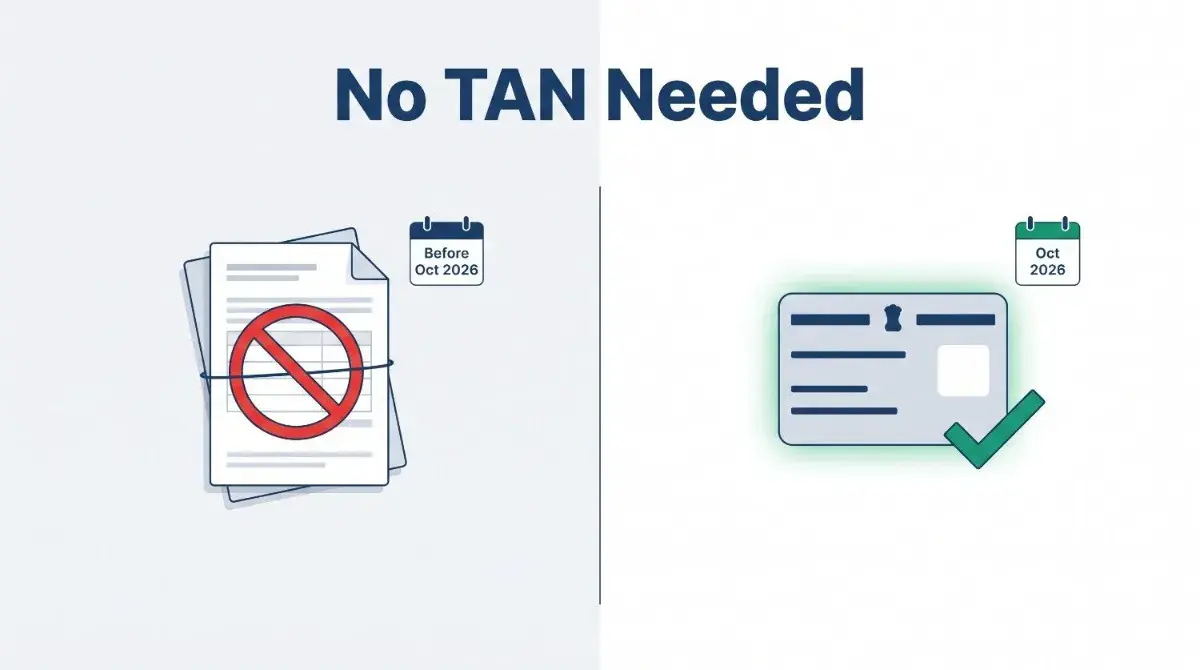
No TAN for NRI property purchase applies only from 1 October 2026, and only to resident individual and HUF buyers. Get the rates, forms, and dates you need.
Jul 25, 2026

Did you lose the SGB premature redemption tax exemption? Here's exactly who's affected, how much tax applies now, and how to check your own bonds.
Jul 24, 2026
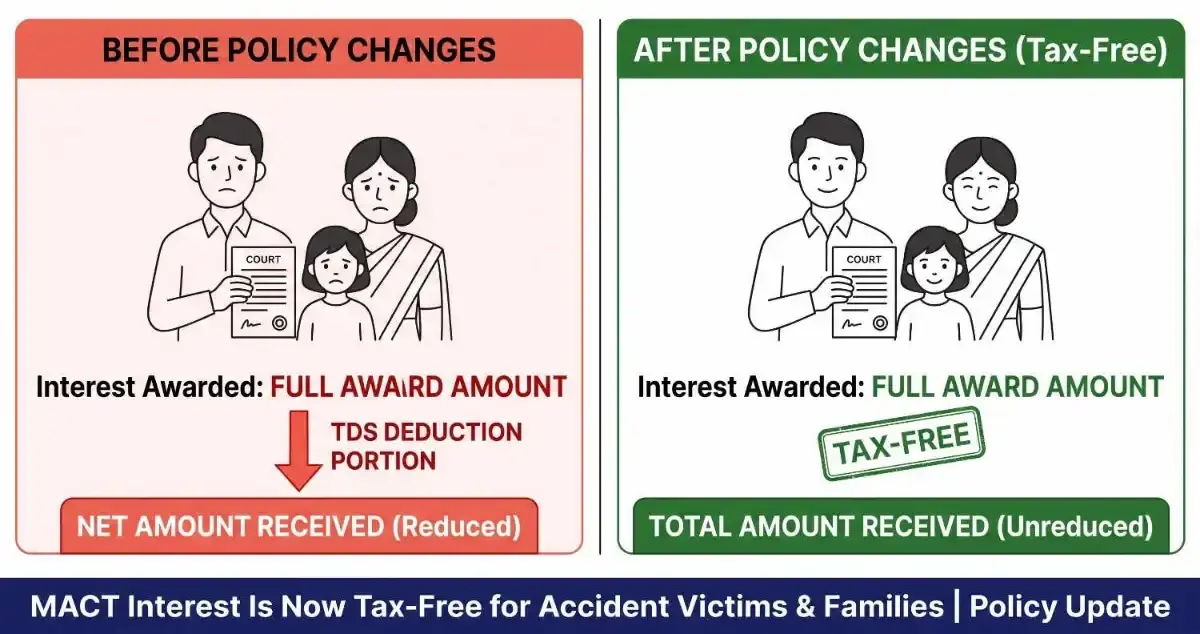
MACT interest income TDS exemption 2026 explained: who qualifies, old vs new Act rules, the FD interest trap, refund steps, and how to report it in your ITR.
Jul 24, 2026