
MSME tax benefits in India 2026 explained: new classification limits, Section 43B(h), presumptive tax, GST composition, and Udyam perks, with real ₹ figures.
MSME tax benefits in India 2026 come from four places at once — the Income Tax Act, GST law, the Companies Act, and Udyam registration itself. Get your classification wrong and you lose all four together. This guide walks through every rule with the exact ₹ figures, so you know precisely what you qualify for this year.
Which law applies here? This guide covers FY 2025-26 (AY 2026-27) — the return you're filing right now. That return is governed entirely by the Income-tax Act, 1961; the Income-tax Act, 2025 only takes over from Tax Year 2026-27 (income earned after 1 April 2026), and that return isn't due until 2027. So every section number below is the familiar 1961 number. Where a 2025 Act renumbering is confirmed, it's noted; where it isn't confirmed yet, it's tagged [VERIFY].
An MSME is a business classified as Micro, Small, or Medium under the MSME Development Act, 2006, based on investment in plant and machinery and annual turnover. Udyam is the registration system that formalises this status.
MSME tax benefits in India 2026 mean the specific reliefs — presumptive taxation under Section 44AD/44ADA, the Section 43B(h) payment protection, GST composition, and startup deductions under Section 80-IAC — that kick in once you're correctly classified and registered.
Not every business gets every benefit. Here's the honest split.
Applies to | Does NOT apply to |
|---|---|
Proprietorships, partnerships, LLPs, and companies registered on Udyam | Businesses that never registered on Udyam, even if they'd qualify by numbers |
Micro and Small enterprises, for the 45-day payment rule | Medium enterprises — Section 43B(h) and MSME-1 filing skip them entirely |
Resident individuals, HUFs, and partnership firms (not LLPs), for Section 44AD | LLPs and companies — they use regular books, not 44AD presumptive tax |
DPIIT-recognised Pvt Ltd or LLP startups, for Section 80-IAC | Proprietorships and partnership firms — not eligible for 80-IAC even with DPIIT tag |
Note the partial case: a Medium enterprise still gets Udyam benefits like priority lending, but not the 45-day payment protection or MSME-1 disclosure — that's Micro and Small only.
This is where most explainers go generic. Here are the real numbers.
MSME classification, revised 1 April 2025 [Source: pib.gov.in]:
Category | Investment | Turnover |
|---|---|---|
Micro | Up to ₹2.5 crore | Up to ₹10 crore |
Small | Up to ₹25 crore | Up to ₹100 crore |
Medium | Up to ₹125 crore | Up to ₹500 crore |
Both conditions must hold together — cross either one and you move up a category. [VERIFY: whether reverse-graduation under the older 2020 notification pushes the effective date to 1 April 2026 for some enterprises — confirm with your CA before relying on the 2025 date for a borderline case.]
Section 43B(h) — the 45-day rule. Pay a registered Micro or Small vendor within 15 days (no written agreement) or up to 45 days (with one), and the expense is deductible in the same year. Miss it, and the deduction shifts to whichever year you actually pay. [Source: incometaxindia.gov.in] [VERIFY: exact section number under the Income-tax Act, 2025 — one source names it Section 37(2)(g), but this isn't independently confirmed against the CBDT concordance table yet.]
Presumptive taxation, FY 2025-26 [Source: incometax.gov.in ITR-4 FAQ]:
Section 44AD (business): turnover up to ₹3 crore if 95%+ receipts are digital, else ₹2 crore. Presumptive profit: 6% digital, 8% cash.
Section 44ADA (professionals): gross receipts up to ₹75 lakh digital, else ₹50 lakh. Presumptive profit: 50%.
Not sure which return to file once you know your scheme? Our ITR-1 vs ITR-4 guide breaks down the exact 44AD/44ADA eligibility split.
Tax audit threshold, Section 44AB (becomes Section 63 under the 2025 Act, confirmed same thresholds): business turnover over ₹1 crore, or ₹10 crore if cash receipts and cash payments both stay under 5%; professionals over ₹50 lakh flat, with no digital bump.
GST composition scheme: ₹1.5 crore turnover for traders and manufacturers (₹75 lakh in special category states), ₹50 lakh for service providers. Tax at 1% (traders/manufacturers), 5% (restaurants), or 6% (services) — but zero input tax credit. [Source: gst.gov.in]
Corporate tax for MSME companies: normal rate 25% (turnover up to ₹400 crore in FY 2023-24) or 30% above that; Section 115BAA gives 22% flat (~25.17% effective) with no MAT, but you give up most deductions; Section 115BAB's 15% rate needed production to start by 31 March 2024, so it's now closed to new companies. See our corporate tax rate comparison for the full 115BA vs 115BAA vs 115BAB breakdown.
Startup deduction, Section 80-IAC: 100% deduction on profit for any 3 consecutive years out of the first 10, for DPIIT-recognised Pvt Ltd companies or LLPs incorporated before 1 April 2030, turnover under ₹100 crore. [Source: pib.gov.in]
Example 1 — the common case. Priya runs a small garment trading firm, Udyam-registered as Micro, with FY 2025-26 turnover of ₹1.4 crore, all through digital payments. She opts for Section 44AD. Presumptive income = 6% of ₹1.4 crore = ₹8.4 lakh. No books, no audit — she files ITR-4 and pays tax on ₹8.4 lakh under the applicable slab.
Example 2 — the edge case competitors skip. Ramesh's electronics assembly company (a Small enterprise) buys ₹18 lakh of components from a Udyam-registered Micro vendor on 10 February 2026, with a written 45-day agreement. He pays on 15 April 2026 — 64 days later. Because he crossed 45 days, the ₹18 lakh is disallowed as a deduction in FY 2025-26 and pushed to FY 2026-27, the year he actually paid. At a 25% effective tax rate, that's ₹4.5 lakh in tax pulled forward a full year — a real cash-flow hit most buyers don't see coming until their CA flags it at year-end.
Go to udyamregistration.gov.in — the only official portal; third-party sites charging a fee are not legitimate.
Click "For New Entrepreneurs who are not Registered yet as MSME or those with EM-II."
Enter your Aadhaar number and name exactly as on the Aadhaar card, then click "Validate & Generate OTP."
Enter the OTP sent to your Aadhaar-linked mobile.
On the PAN verification page, select your organisation type, enter PAN, and click Validate — the system checks it against Income Tax records.
Fill in enterprise name, address, bank details, and search for your NIC code (add more than one if you run multiple activities).
Enter your investment in plant/machinery and annual turnover — the classification is calculated automatically.
Accept the declaration and submit for the final OTP, then confirm. Your Udyam Registration Number (URN) is generated immediately, and the e-certificate follows to your registered email.
Your Udyam classification looks wrong after submission. Log back into the portal with your URN and mobile OTP, go to "Update Udyam Certificate," and correct the investment or turnover figures. A wrong NIC code or overstated turnover is the single most common reason MSMEs get bumped to the wrong category and lose benefits.
A vendor's MSME status is disputed at audit time. Ask for their Udyam certificate directly, or verify the URN yourself on the portal's "Verify Udyam Registration Number" page. If they can't produce one, Section 43B(h) simply doesn't apply to that payment — it's not automatically an MSME just because it's small.
You missed the Section 43B(h) 45-day deadline and only realised at year-end. There's no fix for the current year — the deduction moves to the year of actual payment, full stop. What you can do is pay immediately to stop further delay interest (3x the RBI-notified bank rate under the MSMED Act, and that interest itself isn't tax-deductible), and build a payment-ageing tracker so it doesn't repeat next quarter.
Aadhaar of the proprietor, managing partner, or authorised signatory (mandatory; digital copy accepted)
PAN of the business (mandatory for companies, LLPs, and trusts; get one from the Income Tax e-filing portal if you don't have it)
Bank account number and IFSC code
GSTIN, if already registered (link it during Udyam registration; not mandatory to obtain one first)
Prior-year investment and turnover figures, ideally matching your ITR and GST returns
Late/incorrect MSME Form 1 filing: ₹20,000 on the company and every defaulting officer, plus ₹1,000 per day of continuing default, capped at ₹3 lakh, under Section 405(4), Companies Act, 2013.
Missed 45-day MSME payment (Section 43B(h)): no direct fine, but the deduction is lost for the year, and delayed-payment interest at 3x the RBI bank rate accrues under the MSMED Act — and that interest is not deductible either.
Tax audit default under Section 44AB: the lower of 0.5% of turnover/gross receipts or ₹1,50,000, under Section 271B — unless you can show reasonable cause under Section 273B.
Check both numbers together: investment and turnover must each stay within your category's limit as of 1 April 2025. A Small enterprise, for instance, now has room up to ₹25 crore investment and ₹100 crore turnover — nearly double the old limits — so many businesses that outgrew MSME status in 2023 or 2024 are back inside it now.
No. The 45-day rule and MSME Form 1 filing cover only Micro and Small enterprise suppliers. Medium enterprises get Udyam's other benefits — priority lending, tender preference — but not this specific payment protection.
The entire payment is disallowed as a deduction for that financial year, not just the excess days. It's added back to your taxable income and can only be claimed as a deduction in the year you actually pay.
Yes — Section 44ADA, if your profession is one of the specified ones (legal, medical, engineering, accounting, technical consultancy, and similar) and gross receipts stay within ₹75 lakh (digital) or ₹50 lakh otherwise.
₹50 lakh is the flat Section 44AB(b) audit trigger — no digital enhancement exists for it. ₹75 lakh is a separate number: the 44ADA presumptive-scheme ceiling when 95%+ receipts are digital. Confusing the two is a common and costly mistake.
Log in with your URN and mobile OTP, select "Update Udyam Certificate," and correct the figures. There's no penalty for an honest correction, but leaving it wrong risks disqualification from schemes that cross-check your turnover against GST or ITR data.
No. GSTIN is optional at the Udyam stage — you can register without one and link it later once you cross the GST threshold.
No. Once a company opts for the 22% flat rate under Section 115BAA, it permanently forfeits Section 80-IAC and most other profit-linked deductions. Model both scenarios before choosing — the decision is irreversible.
6% on turnover up to ₹50 lakh, with no input tax credit or inter-state supply. Suits consultants billing individuals, not B2B firms whose clients want ITC.
Not for FY 2025-26 — that return stays under the 1961 Act entirely. From Tax Year 2026-27, thresholds and rates carry over unchanged; only section numbers and terminology shift, with "tax year" replacing "previous year" and "assessment year."
File immediately. The penalty is ₹20,000 plus ₹1,000 per day, capped at ₹3 lakh — every day of delay adds to the bill. File late rather than not at all.
Check your FY 2025-26 investment and turnover against the revised limits today, not in September. If you're not yet Udyam-registered, use Toolisky's MSME Classification Calculator to confirm your category, then complete registration on udyamregistration.gov.in — it takes under 15 minutes and costs nothing. If a tax audit might apply to you, check it against the exact thresholds in our Section 44AB tax audit guide or run the numbers directly on the Tax Audit Applicability Checker. For the official word on any of these provisions, the Income Tax Department's presumptive taxation FAQ is the primary source.
For educational purposes only. Verify all figures at official sources before acting. Toolisky is not affiliated with any government body. Consult a qualified CA or legal professional before making compliance decisions. See toolisky.com/accuracy-and-limitations.
No TAN for NRI property purchase applies only from 1 October 2026, and only to resident individual and HUF buyers. Get the rates, forms, and dates you need.
Jul 25, 2026

Did you lose the SGB premature redemption tax exemption? Here's exactly who's affected, how much tax applies now, and how to check your own bonds.
Jul 24, 2026
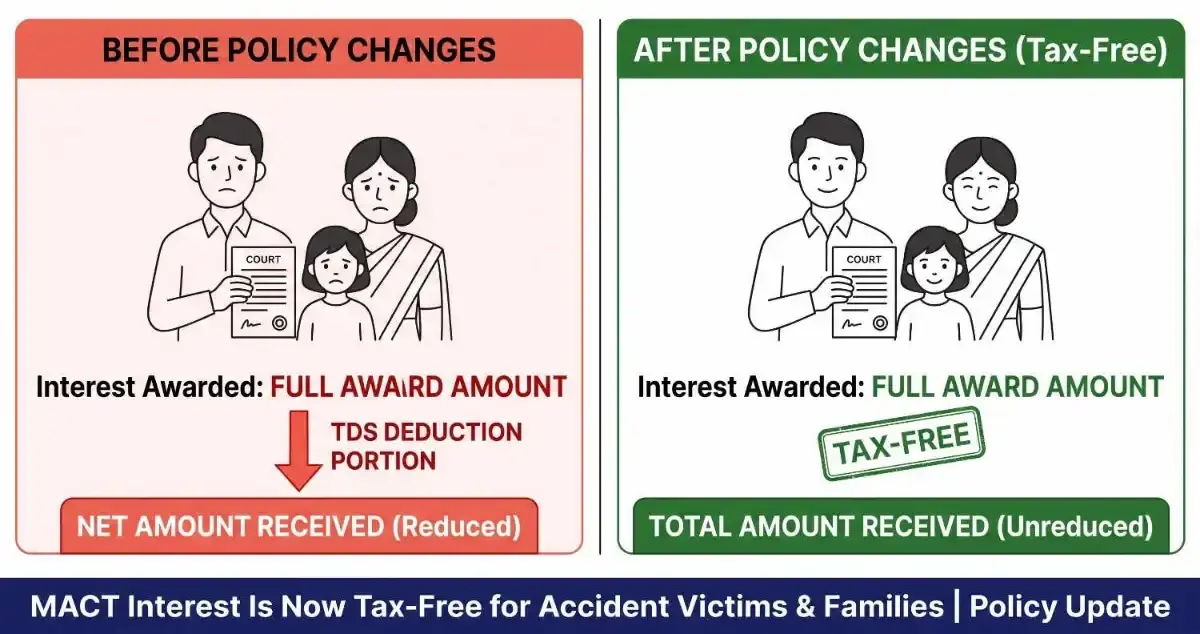
MACT interest income TDS exemption 2026 explained: who qualifies, old vs new Act rules, the FD interest trap, refund steps, and how to report it in your ITR.
Jul 24, 2026