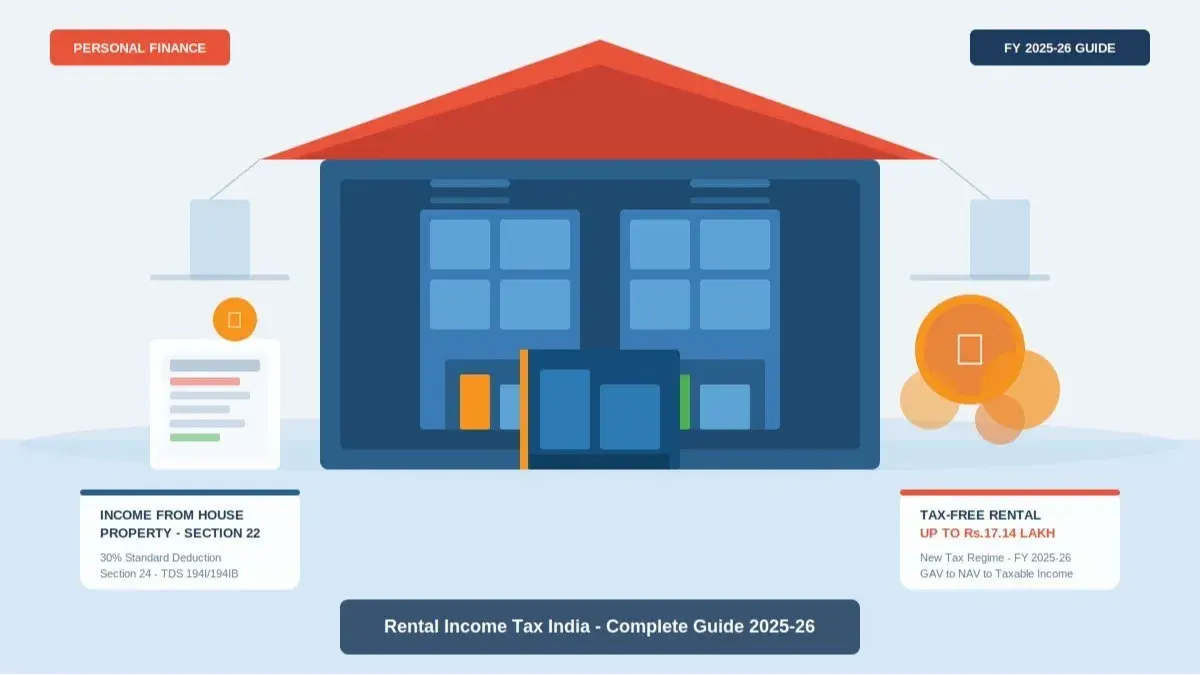

Rental income tax India 2025–26 explained: GAV to NAV calculation, old vs new regime comparison, TDS rules, NRI provisions, penalties, 7 legal ways to save tax.
If you earn rent from a property in India, that income is taxable — no exceptions, no minimum exemption for rental income alone. For FY 2025-26 (AY 2026-27), rental income is still governed by the Income-tax Act, 1961, and is taxed under the head "Income from House Property" at your applicable slab rate. The good news? The deductions are generous — a 30% standard deduction is automatic, no receipts needed.
One thing to flag upfront: the Income-tax Act, 2025 has already been passed and takes effect from 1 April 2026, but it governs income earned from FY 2026-27 onward. Everything you file in 2026 for FY 2025-26 still uses the 1961 Act's section numbers. We've noted the corresponding 2025 Act sections throughout, since you'll start seeing them in TDS challans and CA correspondence well before you actually need them for filing.
Old vs New Tax Regime for Landlords — Full Worked Comparison
TDS on Rent: Section 194I & 194IB (Rates, Thresholds, Who Deducts)
Deemed Rent: When the Tax Department Assumes You're Earning Rent
Subletting & Composite Rent (Furnished Flats): The Tax Treatment Nobody Explains
How to Save Maximum Tax on Rental Income: 7 Legal Strategies
Rental income tax is the income tax you pay on money earned by renting out a property — residential or commercial, let to individuals or businesses, furnished or bare.
Under Section 22 of the Income-tax Act, 1961 (FY 2025-26, AY 2026-27), the annual value of any building or land appurtenant thereto owned by you is taxable under the head "Income from House Property." From Tax Year 2026-27 onwards, this moves to Section 20 of the Income-tax Act, 2025 (with annual value computation under Section 21, and the standard 30% deduction and home loan interest deduction moving to Section 22 of the new Act — not the same Section 22 number as the old Act, so don't assume continuity just because the digits match). The substantive rules — how you compute tax, which deductions you get — remain largely unchanged between the two Acts; mainly the section numbers shifted.
The tax is not directly on the rent you receive. It's on the annual value of the property, with specific deductions applied before you arrive at the taxable figure.
Applies To | Does NOT Apply To |
|---|---|
Resident individuals owning a let-out property | Agricultural buildings used for farming purposes |
NRIs earning rent from Indian property | Properties used exclusively for your own business/profession |
HUFs, companies, firms owning rental property | Vacant land (no building) — taxed under "Other Sources" |
Co-owners of a jointly let-out property | Self-occupied property (annual value = nil for up to 2 houses) |
Salaried employees earning side rental income | Income from subletting a rented property (see subletting section below) |
Partial/conditional cases: If you own 3 or more properties, at most 2 can be treated as self-occupied. All others are deemed let-out and taxable — even if actually vacant.
Four steps, in order:
Gross Annual Value (GAV) → subtract municipal taxes paid → Net Annual Value (NAV) → subtract 30% standard deduction → subtract home loan interest → Taxable Income from House Property → apply your slab rate → Tax Payable
Take Priya, a salaried person in Bengaluru with a 2BHK flat rented at ₹25,000/month.
Step 1: Gross Annual Value (GAV)
The GAV is the higher of:
Reasonable expected rent (fair market rent for a comparable property in that area), or
Actual rent received
Priya receives ₹25,000/month × 12 = ₹3,00,000/year. The fair market rent for her flat is ₹24,000/month (₹2,88,000/year). So GAV = ₹3,00,000 (actual rent wins).
Step 2: Deduct Municipal Taxes Paid
Priya paid ₹12,000 in BBMP property tax during FY 2025-26.
NAV = ₹3,00,000 − ₹12,000 = ₹2,88,000
Step 3: Standard Deduction under Section 24(a) — 30% of NAV
This is automatic. No receipts required. Works in both old and new regimes.
30% of ₹2,88,000 = ₹86,400
Step 4: Deduct Home Loan Interest under Section 24(b)
Priya has a home loan on this property with ₹1,40,000 annual interest.
For a let-out property, the full interest amount is deductible — no cap.
Taxable Income = ₹2,88,000 − ₹86,400 − ₹1,40,000 = ₹61,600
This ₹61,600 gets added to Priya's salary income and taxed at her applicable slab rate.
If she's in the 20% slab (old regime), tax on rental income = ₹61,600 × 20% = ₹12,320.
[Use our Rent Income Tax Calculator at toolisky.com/rent-income-tax-calculator-india to run this calculation for your own numbers in under 60 seconds.]
Which regime saves you more? It largely comes down to one thing — whether you have a home loan on the rental property.
New Tax Regime Slabs for AY 2026-27:
Income Slab | Rate |
|---|---|
Up to ₹4,00,000 | Nil |
₹4,00,001 – ₹8,00,000 | 5% |
₹8,00,001 – ₹12,00,000 | 10% |
₹12,00,001 – ₹16,00,000 | 15% |
₹16,00,001 – ₹20,00,000 | 20% |
₹20,00,001 – ₹24,00,000 | 25% |
Above ₹24,00,000 | 30% |
Old regime slabs are 5% (₹2.5L–₹5L), 20% (₹5L–₹10L), 30% (above ₹10L) — but allow far more deductions.
Worked Comparison: Ramesh, Salary ₹12L + Rental Income ₹3.6L/year
Ramesh owns a flat in Pune rented at ₹30,000/month. His home loan interest on the flat is ₹2,00,000/year. Municipal taxes paid: ₹15,000/year.
Step | Amount |
|---|---|
GAV | ₹3,60,000 |
Minus: Municipal taxes | ₹15,000 |
NAV | ₹3,45,000 |
Minus: 30% standard deduction | ₹1,03,500 |
Minus: Home loan interest (let-out, no cap) | ₹2,00,000 |
Income from House Property | ₹41,500 |
Now let's compute total tax:
Old Regime | New Regime | |
|---|---|---|
Salary | ₹12,00,000 | ₹12,00,000 |
House property income | ₹41,500 | ₹41,500* |
Standard deduction on salary (old: ₹50K; new: ₹75K) | −₹50,000 | −₹75,000 |
80C (PPF/LIC etc.) | −₹1,50,000 | Not allowed |
Taxable income | ₹10,41,500 | ₹11,66,500 |
Approx. tax (+ 4% cess) | ~₹1,29,244 | ~₹1,05,876 |
*Under the new regime: the 30% standard deduction on rental income still applies, and so does the full home loan interest deduction on a let-out property under Section 24(b) — there's no cap, and this is one of the few deductions that survives the switch to the new regime. Only Section 24(b) interest for a self-occupied property is disallowed under the new regime.
Verdict: For Ramesh, new regime saves around ₹23,000. But if his salary were higher or he had bigger 80C investments, the old regime could flip the result. Always run your own numbers.
These are the deductions you can claim on rental income in India — each one has a condition attached, so read carefully:
1. Municipal taxes paid — 100% deductible (Section 23 of 1961 Act) Deductible only if you — the owner — actually paid it during the year. Accrued but unpaid taxes don't qualify.
2. Standard deduction — 30% of NAV (Section 24(a)) Covers repairs, maintenance, collection charges. Available in both old and new regimes. No receipts, no caps, completely automatic.
3. Home loan interest — Section 24(b)
Let-out property: full interest deductible, no upper limit, available in both old and new regimes
Self-occupied (old regime only): capped at ₹2,00,000/year for loans taken on/after 01/04/1999 for purchase or construction completed within 5 years
Self-occupied (new regime): interest deduction not available
Pre-construction interest is allowed in 5 equal instalments from the year construction completes, and this is available for let-out properties as well as self-occupied ones
4. Section 80EEA — Additional ₹1.5L interest deduction Available only in old regime, only for first-time buyers, only for loans sanctioned between 01/04/2019 and 31/03/2022, stamp duty value ≤ ₹45 lakh. Check your loan date — this window has closed for new loans. (Maps to Section 130 of the Income-tax Act, 2025.)
5. Section 80C — Repayment of principal Up to ₹1.5 lakh under old regime. Covers principal repayment of home loan. Not available in new regime. (Maps to Section 123 of the Income-tax Act, 2025.)
What you CANNOT deduct:
Actual repair expenses (covered by the 30% flat)
Insurance premiums on the property
Brokerage paid to agents for finding tenants
Property management fees
Depreciation (this is not available for house property)
Two separate TDS sections cover rent — and which one applies depends entirely on who your tenant is. There was also a significant threshold change here from Budget 2025 that a lot of landlords and tenants have missed.
Type of Property | TDS Rate | Annual Threshold |
|---|---|---|
Land or building (or both), furniture, fittings | 10% | ₹6,00,000/year (~₹50,000/month) |
Plant & machinery | 2% | ₹6,00,000/year |
This applies to any entity other than an individual or HUF not required to get a tax audit.
Important recent change: Budget 2025 raised this threshold from the earlier ₹2,40,000/year to ₹6,00,000/year, effective 1 April 2025. In practice this is applied as a ₹50,000-per-month-or-part-of-month test on the rent for any single month — so if rent in any month crosses ₹50,000, TDS applies on that month's rent even if the running annual total hasn't hit ₹6 lakh yet. Below that threshold, no TDS is required under this section.
From April 1, 2026 (Tax Year 2026-27), this provision is consolidated under Section 393 of the Income-tax Act, 2025 in a table-driven format, with the same rates and thresholds carried forward. The old section number 194I should no longer be quoted on challans for transactions on or after that date.
Monthly Rent | TDS Rate |
|---|---|
Exceeds ₹50,000/month | 2% (reduced from 5% w.e.f. October 1, 2024) |
TDS is deducted once a year — at the end of the tenancy or last month of the financial year, whichever is earlier. No TAN (Tax Account Number) required under 194IB; PAN of both parties is used instead. The tenant files Form 26QC on the Income Tax portal and issues a Form 16C certificate.
Common mistake: Some tenants still deduct at the old 5% rate. The correct rate since October 2024 is 2%. If your tenant has over-deducted, check Form 26AS to verify what was actually deposited — you'll get the credit and can claim a refund.
Important: TDS under 194I/194IB applies to the rent amount only, not the GST component, per CBDT Circular No. 23/2017 — provided GST is shown separately on the invoice or in the agreement. If your commercial tenant pays ₹1,00,000 rent + ₹18,000 GST (shown separately), TDS is on ₹1,00,000 only.
If PAN is not furnished to the deductor, TDS jumps to 20% under Section 206AA regardless of which section otherwise applies.
NRI landlords face a harder TDS burden than resident owners.
TDS rate: The tenant must deduct TDS under Section 195 at 30% + applicable surcharge + 4% cess (effectively around 31.2% at the base rate, more at higher income slabs) from every rent payment before remitting it to you. There's no monthly threshold — this applies from the first rupee.
Steps for the tenant:
Get a TAN (Tax Deduction Account Number)
Deduct TDS at 30% + surcharge + cess each month
File Form 15CA online before remitting funds
Get Form 15CB certificate from a CA if the remittance exceeds ₹5 lakh in a year
Deposit TDS using the TAN, and file quarterly TDS returns in Form 27Q (not the usual Form 26Q)
NRO Account: Rent from Indian property must be credited to your NRO (Non-Resident Ordinary) account, not NRE. You can repatriate funds from the NRO account after tax compliance, subject to the RBI's prevailing remittance limits.
DTAA (Double Tax Avoidance Agreement): India has DTAA with 90+ countries. If your country of residence has a DTAA with India, you may pay reduced TDS or get credit for Indian taxes paid against your foreign tax liability. To claim DTAA benefit, you typically need a Tax Residency Certificate (TRC) from your foreign country of residence.
Lower/nil TDS option (the part most NRIs miss): Since your actual tax liability — after the 30% standard deduction, municipal tax deduction, and Section 24(b) home loan interest — is often far lower than 30% flat TDS, you can apply to your jurisdictional Assessing Officer under Section 197 (Form 13) for a Lower Deduction Certificate before the financial year starts. This is the only way the home loan interest deduction reduces your TDS upfront — by default, Section 24(b) interest only reduces your liability at the time of filing your ITR and claiming a refund, not automatically at the point the tenant deducts TDS.
Refund option: If you skip the Section 197 route, file an ITR in India and claim a refund for the excess TDS once your actual liability (after deductions) is computed. This is very common — many NRIs with home loans end up with a low actual liability but have 30%+ deducted upfront.
Multi-property owners get surprised by this one. The rule is simple: you can treat up to two properties as self-occupied, with nil annual value. Every property beyond two gets treated as "deemed let-out" — even if it's genuinely sitting empty — and you owe tax on its notional rent.
Example: Suresh owns three flats
Flat A in Mumbai: self-occupied — annual value = ₹0
Flat B in Pune: self-occupied — annual value = ₹0
Flat C in Bengaluru: vacant — deemed let-out
For Flat C, the tax officer will determine the reasonable expected rent (what a similar flat would fetch in that area). Say that's ₹18,000/month = ₹2,16,000/year. That's the deemed GAV.
Tax computation for Flat C:
Step | Amount |
|---|---|
GAV (deemed) | ₹2,16,000 |
Municipal taxes (if paid) | −₹0 (not paid for vacant flat) |
NAV | ₹2,16,000 |
Standard deduction 30% | −₹64,800 |
Home loan interest (if any) | −₹0 |
Taxable income | ₹1,51,200 |
Suresh pays tax on ₹1,51,200 even though Flat C earned zero rent. Most multi-property owners don't find out about this until they get a notice.
If a property that was previously self-occupied can't actually be occupied for genuine reasons — for example, employment requiring the owner to live elsewhere — it can still be treated as self-occupied with nil annual value, subject to the two-property cap; this is an existing relief and not a new change for AY 2026-27.
This is one of the most commonly misunderstood areas, so it's worth being precise.
Residential property rented to an unregistered individual, for use as residence: exempt from GST. No registration required, no GST to collect.
Residential property rented to a GST-registered person — even for use as residence: taxable under Reverse Charge Mechanism (RCM). This has been the position since 13 July 2022 (Notification No. 05/2022-Central Tax (Rate)) and remains in force; it was never reversed. Under RCM, the registered tenant — not the landlord — is liable to pay GST at 18%, self-invoice the transaction, and remit it through their own GSTR-3B. The landlord, even if unregistered, has no GST liability or registration requirement purely because of this rule. A narrow carve-out exists for a registered person who is a sole proprietor renting the dwelling in their personal capacity to live in it themselves (not for the business) — that specific case remains exempt.
Commercial property (shops, offices, warehouses) rented out: 18% GST applies once the landlord's aggregate turnover exceeds ₹20 lakh/year (₹10 lakh for special category states like Manipur, Nagaland, Sikkim, and others) — charged by the landlord under the normal forward charge mechanism if the landlord is GST-registered.
Commercial property rented from an unregistered landlord to a registered tenant: since 10 October 2024 (Notification No. 09/2024-Central Tax (Rate)), this is also taxable under RCM, with the registered tenant liable to pay and remit the GST. This was a separate, later change from the residential-property RCM rule above, and it specifically targets unregistered landlords of commercial space.
If your total commercial rental income (or your residential income added to other taxable supplies) crosses the relevant threshold and you're liable to register:
Register for GST (apply at gst.gov.in — select "New Registration")
Charge 18% GST on each invoice (forward charge, where applicable)
File GSTR-1 (monthly/quarterly) and GSTR-3B monthly
ITC (Input Tax Credit): Tenants who are GST-registered and use the property for taxable business purposes can generally claim ITC on the GST paid — whether charged by the landlord under forward charge or self-paid under RCM. This materially reduces the real cost of the GST for compliant business tenants.
Bottom line for most individual landlords: if your tenant is a private individual renting your flat to live in, you have no GST exposure. The moment your tenant is a GST-registered entity — even one person running a small registered business out of a rented flat — RCM applies and the tenant (not you) carries the GST compliance burden.
Most rental income guides skip this completely. Airbnb income has a split tax treatment in India, and using the wrong classification means losing deductions you're entitled to.
The first thing to settle is which income head applies to your Airbnb income — house property or business/profession?
Occasional, infrequent lets with minimal services: Generally treated as income from house property. Standard 30% deduction applies.
Regular short-term lets with hotel-like services (cleaning, breakfast, linen, check-in management): Likely taxable as business income under "Profits and Gains from Business or Profession." This means actual expenses are deductible — but the 30% flat deduction does not apply.
India has no statutory day-count rule like some other countries do. What matters is whether you're providing hotel-like services or just handing over keys. A bare flat listed on Airbnb occasionally leans toward house property; a managed holiday home with a caretaker, housekeeping, and check-in service leans toward business income. This is a genuinely grey, fact-dependent area with real tribunal disputes on where simple letting ends and business activity begins — get a CA's opinion before you file if your situation isn't clearly one or the other.
GST for Airbnb hosts: If your short-term rental income (combined with other taxable supplies) exceeds ₹20 lakh/year, you need to register for GST. The applicable rate is 18% (SAC code 9963 for accommodation services). Airbnb (as an e-commerce operator) is required to collect TCS (Tax Collected at Source) on the booking value before paying you, which you can claim credit for in your ITR — verify the current TCS rate applicable to your account at the time, since e-commerce TCS rates have been revised more than once in recent years.
TDS note: Individual guests booking through Airbnb for short stays are not required to deduct TDS on those payments.
Your Situation | File This Form |
|---|---|
Salaried + one or two let-out properties, total income ≤ ₹50L, no STCG | ITR-1 (Sahaj) — from AY 2026-27, can report up to two house properties |
Three or more properties, or NRI, or capital gains beyond the small LTCG carve-out | ITR-2 |
Short-term Airbnb treated as business income | ITR-3 (business income) |
Salaried + rental income + business income under presumptive taxation | ITR-4 (also now allows up to two house properties for AY 2026-27) |
Company or LLP owning rental property | ITR-6 |
Big changes from AY 2026-27 (confirmed via the CBDT-notified forms dated 30 March 2026): ITR-1 (and ITR-4) now allow income from up to two house properties instead of just one, and ITR-1 also now permits a small amount of long-term capital gains under Section 112A (up to ₹1.25 lakh from listed shares/equity mutual funds, with no carried-forward losses) without forcing a move to ITR-2. A new dedicated field for "rent which cannot be realized" (unrealised rent) has also been added to ITR-1 and ITR-4 this year.
What documents you'll need: Rent agreements, bank statements showing rent credits, property tax receipts, home loan interest certificate from your bank, Form 26AS/AIS showing TDS deducted by your tenant (if any), and municipal tax payment receipts.
If your total tax liability for the year (after TDS credits) exceeds ₹10,000, you must pay advance tax. Landlords without TDS being deducted — especially those receiving cash rent or renting to individuals below the TDS threshold — need to pay this quarterly.
Advance Tax Due Dates for AY 2026-27 (FY 2025-26):
Instalment | Due Date | Minimum % to Pay |
|---|---|---|
1st | 15 June 2025 | 15% of estimated annual tax |
2nd | 15 September 2025 | 45% (cumulative) |
3rd | 15 December 2025 | 75% (cumulative) |
4th (final) | 15 March 2026 | 100% |
How to pay: Go to incometax.gov.in → e-Pay Tax → select Tax Year/Assessment Year → choose "Advance Tax" (code 100).
What happens if you miss it? You pay 1% per month interest under Section 234B (shortfall in total advance tax, computed from 1 April of the assessment year) and Section 234C (deferment at each individual instalment date). A small cushion exists under 234C: no interest at the June or September checkpoint if you've paid at least 12% or 36% of the final tax by those dates respectively. These interest amounts are non-deductible. For a landlord earning ₹5 lakh from rent with a ₹50,000 tax liability and zero advance tax paid, the combined 234B/234C interest bill can meaningfully add to the final demand, so it's worth estimating your liability early rather than waiting for the ITR filing deadline.
Income earned by a tenant from subletting a rented property doesn't go under "Income from House Property." It goes under "Income from Other Sources" (Section 56, 1961 Act) — because that head requires you to be the owner, not just a tenant.
You can't claim the 30% standard deduction. Add the subletting income to your total income and deduct only the proportional rent you're paying your own landlord (and any other expenses directly and wholly incurred to earn that subletting income).
Renting out a furnished flat with a single monthly amount that covers building, furniture, and services? That gets split for tax purposes:
Portion for use of building: Taxed under "Income from House Property" — 30% deduction applies
Portion for use of furniture, equipment, or services: Taxed under "Profits and Gains from Business" OR "Income from Other Sources" — actual expenses deductible
Don't ignore this split. If you're renting a furnished flat for ₹40,000/month, and ₹5,000 of that covers furniture, that ₹5,000 × 12 = ₹60,000 gets taxed separately with no 30% flat deduction.
Best move: split this in the rent agreement itself. Something like "rent for premises: ₹35,000 + rent for furniture/fittings: ₹5,000." That makes your position clear if the tax officer asks.
Co-owned property gets split in the ownership ratio — income, deductions, and tax liability all go to each owner in their respective share.
Example: Farida and her husband Irfan own a flat 50:50, rented at ₹50,000/month
Total annual rent = ₹6,00,000.
Item | Farida (50%) | Irfan (50%) |
|---|---|---|
Share of GAV | ₹3,00,000 | ₹3,00,000 |
Municipal taxes paid (total ₹20,000) | −₹10,000 | −₹10,000 |
NAV | ₹2,90,000 | ₹2,90,000 |
Standard deduction (30%) | −₹87,000 | −₹87,000 |
Home loan interest (total ₹3,00,000) | −₹1,50,000 | −₹1,50,000 |
Taxable income (each) | ₹53,000 | ₹53,000 |
Each co-owner reports their ₹53,000 separately in their own ITR. For a let-out property, each co-owner can independently claim the full proportional share of the interest with no upper cap; the ₹2,00,000 self-occupied ceiling under Section 24(b) is a separate scenario and applies per co-owner only when the property is self-occupied.
Don't skip declaring rent. The tax department pulls data from Form 26QC TDS filings, the Annual Information Statement (AIS) which logs bank credits, and increasingly from Aadhaar-linked rent agreements. Getting caught is not rare.
If caught:
Under-reporting (accidental or unintentional): Penalty under Section 270A of the 1961 Act (Section 439 of the 2025 Act) = 50% of the tax payable on the under-reported income.
Misreporting (deliberate — false entries, suppressed receipts, unsubstantiated expense claims, misrepresentation of facts): 200% of the tax payable on the under-reported income. This is where you're looking at substantial penalties for a mid-income landlord, on top of the underlying tax and interest. Repeated or wilful evasion can also trigger prosecution risk under Section 276C.
A limited immunity route exists under Section 270AA: if you accept the assessment, pay the tax and interest demanded in full, and don't appeal, you can apply (Form 68, within one month of receiving the assessment order) for immunity from the Section 270A penalty and from prosecution under Sections 276C/276CC — but this immunity is not available where the case is classified as misreporting rather than plain under-reporting.
Plus interest: Section 234A (1% per month for late filing of the return) and Section 234B/234C (advance tax shortfall interest) apply on top of any penalty.
Illustrative example: Ramesh earned ₹3,60,000 in rent and didn't declare it. He's in the 20% slab. After the 30% standard deduction, the under-reported taxable income is ₹2,52,000; tax on that at 20% is ₹50,400. If this is treated as plain under-reporting, the penalty is 50% × ₹50,400 = ₹25,200, on top of the ₹50,400 tax itself plus interest — a total exposure well over ₹75,000 before any misreporting classification is even considered.
1. Claim the 30% standard deduction every time — automatic, no documentation, works in both regimes. This alone eliminates ₹30 in tax for every ₹100 of net rental income.
2. Take a home loan on the rental property — for a let-out property, the full interest is deductible with no cap, in either tax regime. A large loan with substantial annual interest can offset most or all of the rental income.
3. Maximise municipal tax payments — pay your property tax on time and keep receipts. It's a 100% deduction from GAV.
4. Joint ownership with a spouse — splits the rental income between two PAN holders, potentially pushing each into a lower slab. Works best when both spouses have meaningfully different total incomes or both want to use the basic exemption thresholds independently.
5. Choose the new tax regime strategically — if you don't have a self-occupied home loan and your old-regime deductions (80C, 80D, HRA etc.) are modest, the new regime's lower slabs plus the unaffected 30% standard deduction and let-out interest deduction often give a better outcome.
6. Declare vacant periods correctly — if your property was genuinely vacant for months despite genuine efforts to find tenants, the annual value for that vacancy period is computed only on actual rent received, not extrapolated to the full year. Keep documentation: broker correspondence, listing screenshots, etc.
7. Get a Lower Deduction Certificate if you're an NRI landlord — rather than accepting 30%+ TDS and waiting for a refund, apply under Section 197 (Form 13) before the financial year starts so your tenant deducts TDS closer to your actual liability.
Usually happens when the tenant filed Form 26QC late or used the wrong PAN.
Fix: Ask the tenant to check their Form 26QC filing status on the TDS portal. If the form was filed with a wrong PAN, the tenant needs to file a correction. Once corrected, it should reflect in your AIS within a few days. Don't file your ITR until Form 26AS shows the correct TDS credit if you can avoid it. If your ITR deadline is near, file and then file a revised return after the correction shows up.
You used ITR-1 but actually had three let-out properties or capital gains beyond the small LTCG carve-out — which required ITR-2.
Fix: File a revised return. The window for revised returns has been extended to 31 March of the relevant assessment year from AY 2026-27 onward, but if you file after 31 December, a fee applies under Section 234I (₹1,000 if total income is up to ₹5 lakh, ₹5,000 above that). Log in at incometax.gov.in → e-File → Income Tax Returns → File Income Tax Return → select "Revised Return" and choose the correct ITR form.
Fix: Don't ignore it. Go to incometax.gov.in → Pending Actions → e-Proceedings. Read the notice carefully — it might be a simple mismatch notice (Section 143(1)) or a scrutiny notice (Section 143(2)). For 143(1): you can usually respond online by agreeing or disagreeing with the discrepancy. For 143(2): consult a CA. Deadlines on these notices are strict — missing them converts mismatches into demands with interest and penalty.
Q1. Is rental income below ₹2.5 lakh tax-free?
A lot of people believe this, but it's wrong. There's no minimum exemption specific to rental income. What's exempt is your total income if it stays under the basic exemption limit (₹4L in new regime for FY 2025-26, ₹2.5L in old regime for individuals under 60). If your only income is rent under that limit, you pay zero tax. But add a salary on top of that rent, and the rent portion is fully taxable at your slab — it gets no special pass.
Q2. Is the 30% standard deduction available under the new tax regime?
Yes, it is — and that surprises people. The 30% standard deduction on Net Annual Value is one of the very few property-related deductions that survives in both regimes, alongside the full home loan interest deduction for let-out properties. HRA, 80C, 80D, and the self-occupied interest deduction are old-regime-only.
Q3. My tenant is a company that pays me ₹60,000/month. Do they have to deduct TDS?
Yes. A company paying rent exceeding the ₹6,00,000-a-year threshold (effectively ₹50,000/month, raised from ₹2,40,000/year by Budget 2025) must deduct TDS at 10% under Section 194I (1961 Act) / Section 393 of the 2025 Act. The company needs a TAN, deposits the TDS by the 7th of the following month, and issues a Form 16A certificate to you quarterly. If they're not deducting, raise it with them — you both face scrutiny otherwise.
Q4. I inherited a property. Is rental income from inherited property taxable?
Yes. The property is yours now, so the rental income is yours to declare. From the year the property transfers to you, it's taxable in your hands at your applicable slab rate — all standard deductions apply. For capital gains later, the cost of acquisition is generally the original cost in the previous owner's hands, subject to the specific rules in force for that asset class.
Q5. I rented my flat for 8 months and it was vacant for 4 months. How is tax computed?
Only the 8 months of actual rent counts. Annual value is computed on what you actually received during the let-out period — it's not extrapolated to 12 months. A genuine vacancy shrinks your taxable income proportionally, and no deemed rent applies for a property that was let out and then sat vacant for the remaining months.
Q6. Can I show rental income as business income to claim more deductions?
Generally no, for ordinary rent. Simply leasing out a residential or commercial property — without providing significant additional services like housekeeping, security, or business-centre facilities — is taxed as "Income from House Property," not business income, and this position has been consistently upheld in tax disputes. The 30% standard deduction (rather than actual expenses) is the trade-off for that simpler treatment. The carve-out is genuine short-term/hospitality letting where you're providing hotel-like services, which can shift the classification to business income — see the Airbnb section above.
Q7. My NRI brother sends me rent from his foreign account every month. Do I deduct TDS?
Wait — are you the tenant? If your brother (NRI) owns the property and you're paying rent, yes — you must deduct TDS at 30% + surcharge + 4% cess before remitting. Get a TAN, file Form 15CA/15CB, and deposit TDS, filing Form 27Q quarterly. If you're a family member living rent-free, there's no rent payment and no TDS obligation.
Q8. I paid ₹5,000/month as a security deposit. Does TDS apply on deposits?
No TDS on a refundable deposit. A security deposit is not rent and sits outside TDS rules entirely. The catch is if your landlord later adjusts the deposit against unpaid rent — at that point the adjusted amount becomes rent and TDS kicks in. Write "refundable security deposit" clearly in the lease so there's no ambiguity.
Q9. What if I didn't pay advance tax on my rental income?
Miss advance tax when your net liability crosses ₹10,000 and you'll pay 1% per month interest under Section 234B (shortfall in total advance tax, from 1 April of the assessment year) and Section 234C (instalment-level deferment). Partial payments help — even paying late cuts the interest bill compared to paying nothing.
Q10. I own a shop. My tenant pays me ₹25,000/month. Any TDS?
At ₹25,000/month (₹3,00,000/year) you're under the ₹6,00,000/year threshold, so an individual or HUF tenant not under tax audit doesn't need to deduct TDS under Section 194I, and you're also below the ₹50,000/month Section 194IB threshold for individual tenants. But if the tenant is a company or an audit-liable entity, the same ₹6,00,000/year (₹50,000/month) threshold under Section 194I applies — so a company paying you ₹25,000/month is still below that threshold and wouldn't need to deduct either, unless your total annual rent from them crosses ₹6 lakh.
Q11. Can I claim both Section 80C (principal repayment) and Section 24(b) (interest) on the same loan?
Yes, and many people miss this. They're separate deductions under separate sections — 80C covers principal repayment (up to ₹1.5L) and Section 24(b) covers interest (up to ₹2L for self-occupied in the old regime, no cap for let-out in either regime). In the old regime, both 80C and 24(b) work together. In the new regime, 80C doesn't apply at all, but the 24(b) interest deduction on a let-out property still does.
Q12. If I make a loss on house property (interest exceeds rental income), can I offset it against salary?
Yes, in the old regime — up to ₹2,00,000 of house property loss can be set off against salary or other income in the same year. Whatever's left carries forward for 8 assessment years and can only be set off against future house property income. In the new regime, this set-off against other heads of income isn't permitted.
Calculate your actual rental tax liability using the Rent Income Tax Calculator at toolisky.com/rent-income-tax-calculator-india — input your rent, municipal taxes, and loan interest to see an old vs new regime comparison in 60 seconds. Then file ITR-1 or ITR-2 (as applicable) at incometax.gov.in before 31 July 2026 to avoid late-filing fees.
Written by Anita Patil, Income Tax Specialist | Last Updated: June 2026 Reviewed by Toolisky Editorial Team
For educational purposes only. Verify all figures at official sources before acting. Toolisky is not affiliated with any government body. Consult a qualified CA or legal professional before making compliance decisions. See toolisky.com/accuracy-and-limitations.
No TAN for NRI property purchase applies only from 1 October 2026, and only to resident individual and HUF buyers. Get the rates, forms, and dates you need.
Jul 25, 2026

Did you lose the SGB premature redemption tax exemption? Here's exactly who's affected, how much tax applies now, and how to check your own bonds.
Jul 24, 2026
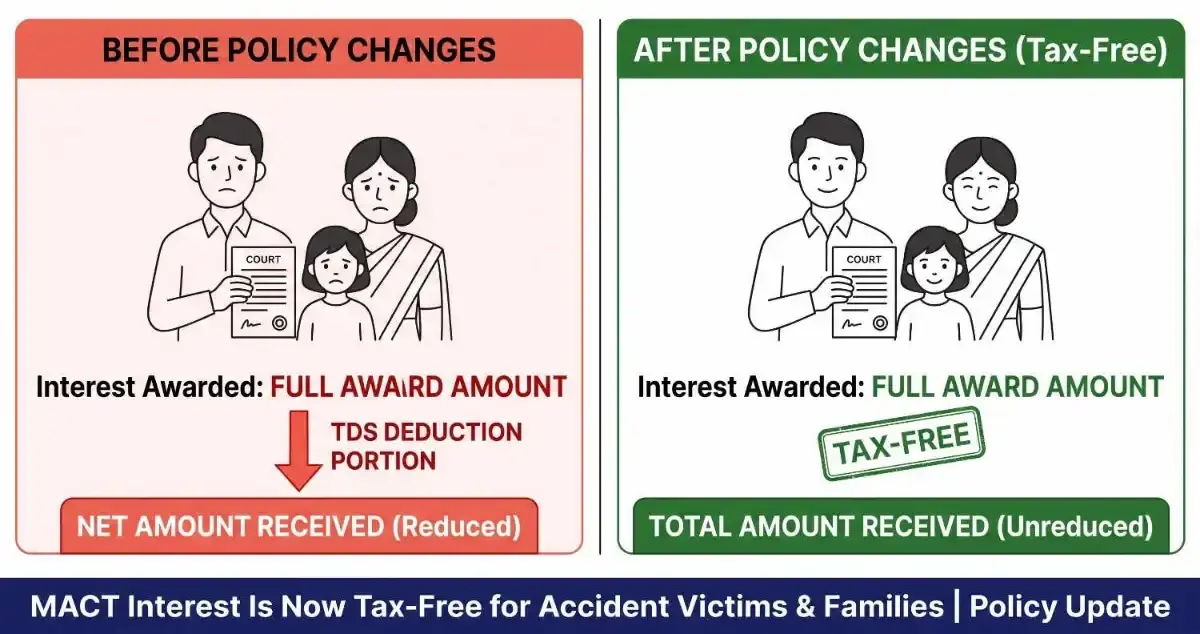
MACT interest income TDS exemption 2026 explained: who qualifies, old vs new Act rules, the FD interest trap, refund steps, and how to report it in your ITR.
Jul 24, 2026