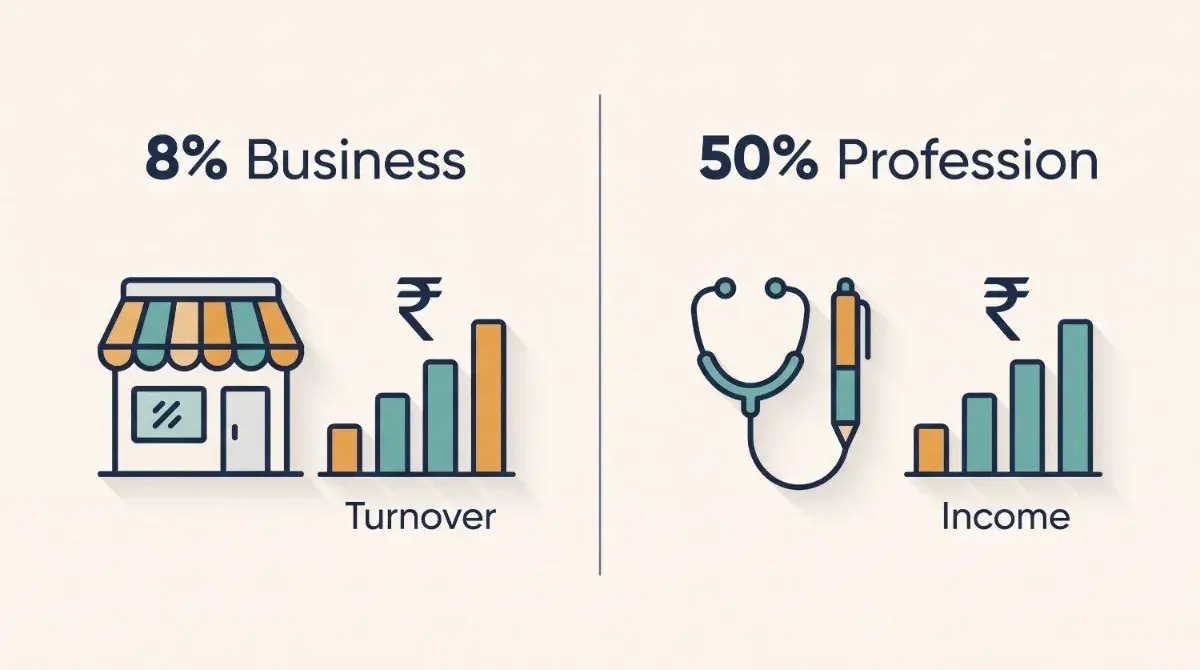

Section 44AD and 44ADA explained in plain language for FY 2025-26: turnover limits, 8%/6%/50% rates, tax audit triggers, ITR-4 deadline, worked examples, and FAQs.
If you run a small business or work as a doctor, CA, architect, or another specified professional, you've probably heard that you don't always need to maintain full books of account. That's what Section 44AD and 44ADA are for. Section 44AD lets small businesses declare 8% of turnover (or 6% on digital receipts) as taxable income. Section 44ADA lets specified professionals declare 50% of their gross receipts. Neither requires detailed books or a tax audit, as long as you stay within the limits.
For FY 2025-26 (the year you're filing now, as AY 2026-27), your return is still governed by the old Income-tax Act, 1961. From 1 April 2026 onward, these same rules move into Section 58 of the new Income-tax Act, 2025 — same math, new numbering. This guide covers both, with worked examples, filing deadlines, and answers to the questions people actually ask their CAs.
A quick note on which law applies: Income you earned in FY 2025-26 and are filing now under AY 2026-27 is assessed entirely under the 1961 Act. Sections 44AD, 44ADA, and 44AE apply exactly as described below. Income earned from 1 April 2026 onward (Tax Year 2026-27) falls under the new Income-tax Act, 2025, where these three sections combine into one, Section 58. We checked the numbers below against the Income Tax Department's official presumptive taxation page and its Section 87A rebate guidance, and cross-checked them against recent commentary on the Section 58 transition.
Section 44AD is a simple way for small businesses to pay tax. Instead of keeping detailed accounts and getting them audited, you declare a fixed percentage of your turnover as income and file your return. That's it.
Section 44ADA works the same way for specified professionals — doctors, chartered accountants, architects, engineers, and a few others on a set list — but at 50% of gross receipts instead of 8%.
There's also Section 44AE, a separate scheme for people who own goods-carriage vehicles (trucks, tempos, and similar). We'll touch on it briefly for comparison, but it works differently since it's based on the number of vehicles you own, not your turnover.
Once the new Income-tax Act, 2025 kicks in from Tax Year 2026-27, all three of these move into one section — Section 58 — organised in a table format. Nothing about the rates or limits changes; only the numbering and layout do.
Not everyone with business or professional income can opt for presumptive taxation. Here's a simple breakdown.
Applies to | Does not apply to |
|---|---|
Resident individuals, HUFs, and partnership firms (44AD) | LLPs, companies, and non-residents |
Specified professionals listed under Section 44AA(1): legal, medical, engineering, architecture, accountancy, technical consultancy, interior decoration, film, company secretary, and information technology | Freelancers or consultants whose specific work doesn't fall on this list |
Small traders, shopkeepers, and wholesalers within the turnover limit | Commission or brokerage income, insurance agency business |
Transporters with up to 10 goods vehicles (Section 44AE, a different scheme) | Anyone claiming deductions under Sections 10AA or 80-IA to 80RRB in that year |
One thing that confuses people: "company secretary" and "information technology" were added to the Section 44AA(1) list a long time ago through separate CBDT notifications — company secretary in 1992, and the IT profession in 2001. So this isn't a recent addition. What actually matters for 44ADA eligibility is whether your specific work genuinely fits one of these notified categories, not how new or old the notification is.
Also worth knowing: if a partnership firm uses Section 44AD, it can't separately deduct partner salary or interest under Section 40(b). That's already factored into the 6%/8% rate.
Here are the actual numbers for FY 2025-26 (AY 2026-27).
Section 44AD (business):
Turnover up to ₹2 crore — the standard limit
Turnover up to ₹3 crore — allowed only if your cash receipts and cash payments each stay under 5% of the total (the "95% digital receipts" condition)
Rate: 8% of turnover for cash receipts, 6% for digital receipts (UPI, NEFT, RTGS, cheque, bank transfer)
You can mix the two: 6% on the digital portion and 8% on the cash portion, in the same return
Section 44ADA (specified professions):
Gross receipts up to ₹50 lakh — the standard limit
Gross receipts up to ₹75 lakh — allowed only if cash receipts stay under 5% of the total
Rate: a flat 50% of gross receipts, regardless of the cash-digital mix
Section 44AE (goods carriage), for comparison: this one covers transporters who own up to 10 vehicles at any point during the year. Heavier vehicles attract a higher rate per vehicle per month than lighter ones, and even part of a month counts as a full month. It's based on how many vehicles you own, not your turnover — genuinely different math from 44AD or 44ADA.
The 5-year lock-in rule (Section 44AD(4)): if you opt into 44AD one year, then later declare profit below 8%/6% or switch to regular books without a valid reason (like your turnover simply exceeding the limit), you're locked out of 44AD for the next five assessment years. If your income during that lock-out period is above the basic exemption limit, you'll need to maintain books and get a tax audit done — no way around it. Importantly, this lock-in only kicks in when you were eligible for the scheme but chose to report lower profit. If you become ineligible for some other reason, like crossing the turnover cap, the lock-in doesn't apply.
Under the Income-tax Act, 2025: Section 58 brings 44AD, 44ADA, and 44AE together into one table-based provision, sorted by serial number for business, goods carriage, and professionals. The lock-in rule carries forward too. The rates and turnover thresholds stay the same — this is a restructuring, not a policy change.
Numbers make this easier to understand than formulas alone. Here are two examples that cover the common case and a trickier one.
Priya runs a design studio in Pune. Her gross receipts for FY 2025-26 are ₹42,00,000, all received through UPI and bank transfer. She opts for Section 44ADA.
Gross receipts: ₹42,00,000
Presumptive income (50%): ₹21,00,000
No further deductions are allowed against this figure
Under the new tax regime slabs for FY 2025-26, tax on ₹21,00,000 works out to roughly ₹2,34,000, including 4% cess (no Section 87A rebate applies here, since her income is above the ₹12 lakh threshold)
She skips books of account and a tax audit entirely, and files ITR-4
If she'd claimed actual expenses under the regular provisions instead, she'd need full books, invoices, and possibly a tax audit past ₹50 lakh in receipts — often for a similar, or even higher, tax bill.
Ramesh runs a hardware store with a turnover of ₹1,80,00,000 for FY 2025-26. Of this, ₹1,50,00,000 came through digital modes and ₹30,00,000 in cash — that's 16.7% cash, above the 5% limit.
Since his cash receipts exceed 5%, Ramesh can't use the extended ₹3 crore limit — but he's still under ₹2 crore, so 44AD is still available to him
Digital portion (₹1,50,00,000 × 6%): ₹9,00,000
Cash portion (₹30,00,000 × 8%): ₹2,40,000
Total presumptive income: ₹11,40,000
Under the new tax regime slabs, tax on ₹11,40,000 works out to roughly ₹54,000 before cess. Since his taxable income is under ₹12 lakh, the Section 87A rebate (up to ₹60,000) wipes this out completely, so his final tax is nil
This dual-rate calculation — 6% on one part of your turnover and 8% on another, in the same return — is something a lot of guides skip over, but it's exactly the kind of situation many small traders run into.
The steps are short. The decisions behind them matter more.
Figure out if you're a business (44AD) or a specified professional under Section 44AA(1) (44ADA). If you don't fit either and your income isn't commission-based, you may still qualify under 44AD as a business.
Check whether your turnover or receipts fall under the base limit (₹2 crore or ₹50 lakh), or the extended limit (₹3 crore or ₹75 lakh) with 95%+ digital receipts.
Apply the rate: 8%/6% of turnover for 44AD, or a flat 50% of gross receipts for 44ADA.
Add any other income you have, apply the new-regime slab rates (nil up to ₹4 lakh, 5% up to ₹8 lakh, 10% up to ₹12 lakh, 15% up to ₹16 lakh, 20% up to ₹20 lakh, 25% up to ₹24 lakh, 30% above that), and claim the Section 87A rebate — up to ₹60,000 — if your net taxable income is ₹12 lakh or below.
File ITR-4 (Sugam).
One more thing that catches people off guard: advance tax works differently under presumptive taxation. Instead of paying in four quarterly instalments like most taxpayers, you pay your entire advance tax liability in one go, by 15th March.
Your client deducted TDS under Section 194J, but you filed under 44AD instead of 44ADA, and now you've got a scrutiny notice. This happens more often than you'd think. TDS under 194J is the payer's decision, often made conservatively, and it doesn't decide what your income actually is. If your work is genuinely a business rather than a Section 44AA(1) profession, respond with invoices, contracts, and a short explanation of why 44AD applies to you.
You declared profit below 8%/6% (under 44AD) or 50% (under 44ADA), and now you're facing an audit demand. First, check if your total income after deductions actually crosses the basic exemption limit. If it doesn't, the audit requirement under Section 44AB doesn't apply, even with a lower declared profit. If it does apply, you'll need proper books and a CA-signed audit report before your due date.
You filed the wrong ITR form. ITR-4 is only for presumptive income. The moment you drop out of the scheme, or your turnover crosses the limit, you need ITR-3 instead. Filing ITR-4 by mistake when you're over the threshold gets flagged as a defective return, and you'll get a notice under Section 139(9) with 15 days to correct it.
Even under presumptive taxation, it's worth keeping these ready. Digital copies are fine.
Bank statements for the full year, as proof of your digital versus cash receipts
Client invoices or sale bills showing your gross turnover or receipts
Form 26AS and AIS, to check your TDS claims against what your clients actually deducted
PAN and Aadhaar
Details of any other income — salary Form 16, interest certificates, capital gains statements
If your AIS looks out of date, download a fresh copy from the e-filing portal before you file.
For FY 2025-26 (AY 2026-27), taxpayers filing ITR-3 or ITR-4 without an audit requirement get until 31st August 2026 — a month later than the 31st July deadline for salaried ITR-1/ITR-2 filers. Miss it, and Section 234F kicks in: a ₹5,000 fee if your total income exceeds ₹5 lakh, or ₹1,000 if it doesn't. Section 234A adds 1% interest per month on any unpaid tax from the due date onward.
If a tax audit becomes mandatory and you skip it, Section 271B applies — a penalty of 0.5% of your turnover or gross receipts, capped at ₹1,50,000, whichever is lower. Audit cases must file by 31st October 2026, with the audit report itself due a month earlier, on 30th September 2026.
You can find the full ITR-4 filing FAQs on the official e-filing portal if you want to check anything directly against the source. If you're unsure whether ITR-3 or ITR-4 is right for you, our ITR-1 vs ITR-4 guide breaks down the differences form by form.
Yes, as long as you genuinely have two separate sources of income — say, a small trading business and a specified profession. You can't apply both sections to the same receipts, though. Each income stream is checked against its own turnover limit and rate on its own.
Neither is better in a general sense. It depends entirely on your actual profit margin. If your real margin is well below 8% (for business) or 50% (for a profession), presumptive taxation could actually cost you more tax than declaring your real profit under the regular provisions with proper books.
Only if your specific work falls under the "profession of information technology" as notified under Section 44AA(1) — a category CBDT notified back in 2001, so it's nothing new. General software development or IT services aren't automatically covered, since the notification doesn't spell out the term precisely, and interpretation matters here. Most IT freelancers whose work doesn't clearly fit this category use Section 44AD instead.
No, in most cases. Content creation isn't a specified profession under Section 44AA(1). YouTubers, bloggers, and influencers, along with their AdSense and sponsorship income, usually fall under Section 44AD as a business, as long as the income isn't commission or brokerage in nature.
No. Section 44AD is limited to resident individuals, HUFs, and partnership firms. LLPs and companies are excluded entirely, no matter their turnover, and this stays the same under Section 58 of the new Act.
No — this is a common misunderstanding. The TDS section a client uses is just their compliance choice; it doesn't decide what your income actually is. Whether you're eligible for 44ADA depends only on whether your work is a notified profession under Section 44AA(1), regardless of which TDS section shows up in your Form 26AS.
You're allowed to, but only if your total income after deductions stays below the basic exemption limit. If you cross that limit while declaring under 8%/6%, a tax audit becomes mandatory for that year.
Say Suresh opts for 44AD in FY 2024-25, then switches to regular books in FY 2025-26 and declares a lower profit. He's now barred from opting into 44AD again until FY 2030-31. If his income exceeds the exemption limit in any of those years, he'll need books and an audit for that year too.
It means your cash receipts and payments (for 44AD) or just your cash receipts (for 44ADA) must each stay under 5% of the total, to unlock the higher ₹3 crore or ₹75 lakh limit. Cross that 5% cash threshold, and you drop back to the base ₹2 crore or ₹50 lakh cap.
File a belated return under Section 139(4) by 31st December 2026, along with the Section 234F late fee and Section 234A interest. Keep in mind you'll lose the option to carry forward certain business losses, so it's best not to delay any further.
If your turnover or receipts fall within these limits, Section 44AD and 44ADA can genuinely save you time and audit hassle. Run your own numbers through an income tax calculator before you file, and if you're not sure which ITR form applies to you, it's worth checking properly rather than guessing — a wrong form can cost you more time than it saves.
This article is for educational purposes only. Figures are illustrative and based on the new tax regime slabs for FY 2025-26. Always verify against official sources, such as the Income Tax Department's website, or consult a qualified Chartered Accountant before making compliance decisions.
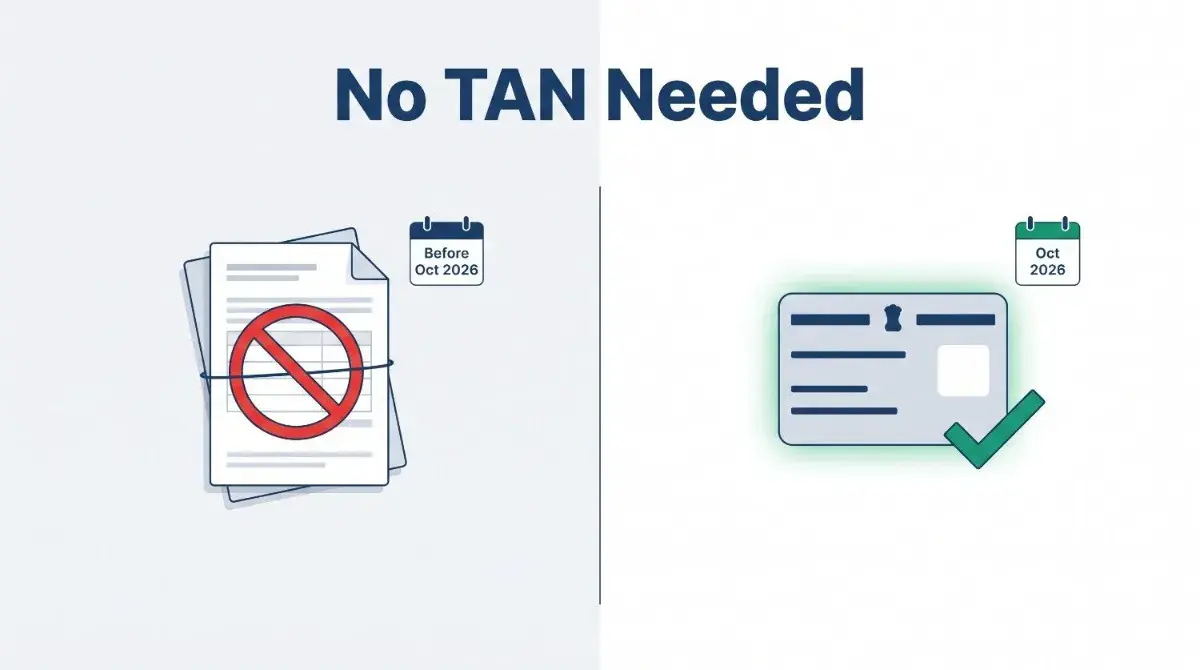
No TAN for NRI property purchase applies only from 1 October 2026, and only to resident individual and HUF buyers. Get the rates, forms, and dates you need.
Jul 25, 2026

Did you lose the SGB premature redemption tax exemption? Here's exactly who's affected, how much tax applies now, and how to check your own bonds.
Jul 24, 2026
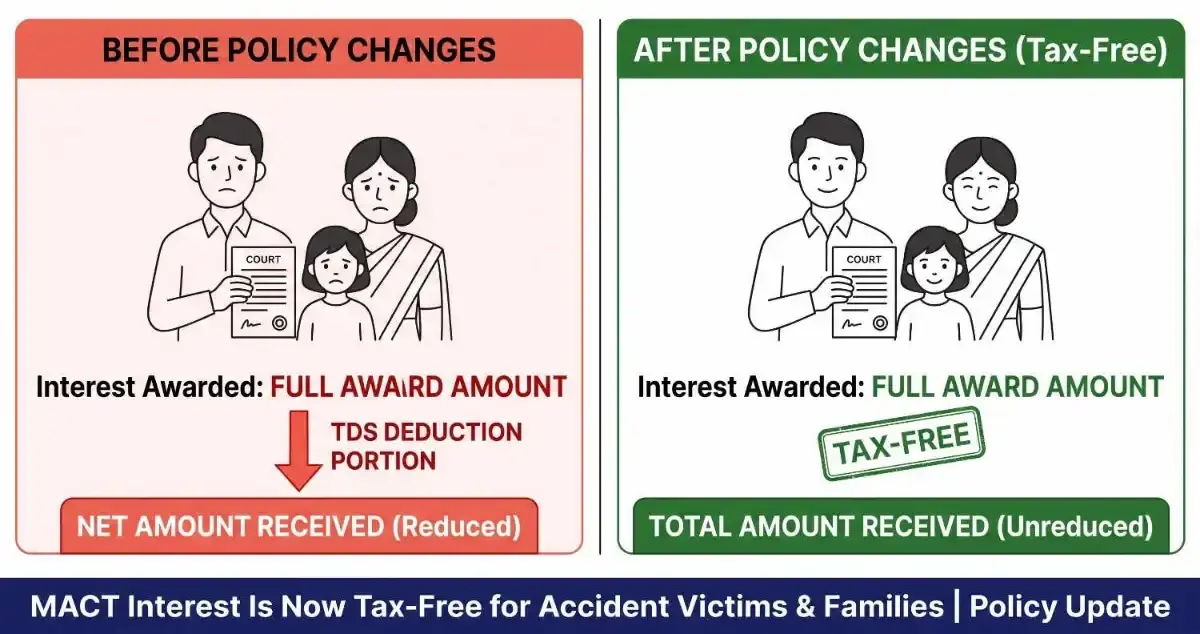
MACT interest income TDS exemption 2026 explained: who qualifies, old vs new Act rules, the FD interest trap, refund steps, and how to report it in your ITR.
Jul 24, 2026