

SGB capital gains tax exemption 2026 rules explained: who still qualifies, secondary market tax, LTCG rate, premature redemption, and real ₹ examples.
Budget 2026 hasn't scrapped the SGB tax break, but it has narrowed it a lot. From 1 April 2026, capital gains on Sovereign Gold Bonds are tax-free only for people who subscribed directly with the RBI at the original issue and held the bond all the way to its 8-year maturity. Everyone else — secondary market buyers, and even original subscribers who exit early — now owes capital gains tax.
In this article:
Sovereign Gold Bonds are government securities issued by the RBI, with returns linked to the price of gold. For years, gains on redemption were treated as tax-free — but that exemption was never quite as broad as most investors believed.
For redemptions completed up to 31 March 2026 (FY 2025-26, Assessment Year 2026-27), the old law applies: Section 47(1)(viic) of the Income-tax Act, 1961. It says SGB redemption doesn't count as a "transfer" at all, so no capital gains tax is triggered. From 1 April 2026 onward (Tax Year 2026-27), a new law takes over — the Income-tax Act, 2025 — and the same idea now lives in Section 70(1)(x), as amended by the Finance Act 2026.
Both versions say more or less the same thing on paper. What's changed is how strictly the exemption is enforced.
Here's the breakdown that actually decides your tax bill, so don't skim it.
You get the exemption if... | You pay tax if... |
|---|---|
You subscribed directly with the RBI at the original issue | You bought the bond on NSE or BSE (secondary market) |
You held the bond continuously for the full 8-year term | The bond was transferred or gifted to you (except between spouses, under clubbing rules) |
You redeemed with the RBI exactly on the maturity date | You redeemed early, even after the 5-year lock-in, even as an original subscriber |
— | You're an HUF, trust, firm, company, or LLP — this group was never covered |
That last point isn't new for 2026. Both the old Section 47(viic) and the new Section 70(1)(x) use the word "individual." An HUF that redeems SGBs with the RBI has always faced LTCG at 12.5%, regardless of this year's budget.
Conditions for the exemption (Section 70(1)(x), Income-tax Act 2025):
You're an individual — not an HUF, trust, firm, or company.
You subscribed at the original RBI issue, not through a later purchase.
You held the bond continuously until maturity, with no early exit and no transfer along the way.
Miss even one of these, and the entire gain becomes taxable. The Income Tax Department has confirmed this reading in its official FAQs on the transition from the 1961 Act to the 2025 Act, and it has also pointed to a Department of Economic Affairs office memorandum dated 6 December 2022 that took the same position on secondary-market bonds well before Budget 2026.
Where the exemption doesn't apply, here's the tax treatment:
Situation | Holding period | Tax treatment |
|---|---|---|
Bought on the secondary market, redeemed at maturity | Any | LTCG if held over 12 months, otherwise STCG |
Bought on the secondary market, sold on the exchange before maturity | Any | LTCG if held over 12 months, otherwise STCG |
Original subscriber, redeemed early (even after year 5) | Usually over 12 months | LTCG at 12.5% |
Original subscriber, held the full 8 years, redeemed with RBI at maturity | 8 years | Fully exempt |
Rates once the exemption doesn't apply:
LTCG (held more than 12 months): a flat 12.5%, with no indexation benefit.
STCG (held 12 months or less): added to your total income and taxed at your slab rate.
Surcharge: nil up to ₹50 lakh income, rising in steps to 37% above ₹5 crore. Note that SGB secondary-market gains fall outside Section 112A, so the 25% surcharge cap that applies to listed equity doesn't apply here.
Cess: 4% on the tax plus surcharge, as usual.
The 2.5% annual interest on SGBs is always taxable as "Income from Other Sources" at your slab rate — nothing has changed there.
Effective date: 1 April 2026, applying to Tax Year 2026-27 returns onward.
One thing worth understanding clearly: the tax department maintains this isn't really a new rule. It points to that 2022 office memorandum as proof that secondary-market SGBs were always meant to be taxable, and says Budget 2026 is simply enforcing that position rather than changing it. Tax practitioners are divided on whether that "nothing has changed" framing holds up, since most brokers and investment platforms marketed secondary-market SGBs as tax-free at maturity for years. If you redeemed a secondary-market SGB before 1 April 2026, this dispute doesn't affect you — talk to a chartered accountant about your specific filing before assuming anything either way.
Farida bought 5 units of an SGB 2020 series on the NSE in March 2024, at ₹5,900 a unit — a total cost of ₹29,500. She used the RBI's premature redemption window in April 2026, when the redemption price was fixed at ₹15,254 a unit.
Redemption value: 5 × ₹15,254 = ₹76,270
Gain: ₹76,270 − ₹29,500 = ₹46,770
Holding period: March 2024 to April 2026, roughly 25 months → treated as LTCG
Tax at 12.5%: ₹46,770 × 12.5% = ₹5,846
Cess at 4%: ₹5,846 × 4% = ₹234
Total tax payable: ₹6,080
Before Budget 2026, Farida's entire ₹46,770 gain would have escaped tax at redemption. Now it doesn't, simply because she never subscribed at the original issue.
Suresh subscribed directly with the RBI to an SGB 2018-19 series in October 2018, at ₹2,942 a gram, buying 10 grams for ₹29,420. His bond became eligible for premature redemption from October 2023 onward. He chose to exit in October 2026 — three years short of the full 8-year maturity — when the redemption price worked out to ₹15,100 a gram.
Redemption value: 10 × ₹15,100 = ₹1,51,000
Gain: ₹1,51,000 − ₹29,420 = ₹1,21,580
Tax at 12.5%: ₹1,21,580 × 12.5% = ₹15,198
Cess at 4%: ₹15,198 × 4% = ₹608
Total tax payable: ₹15,806
Suresh is exactly the kind of investor Section 70(1)(x) is meant to reward — an original subscriber. But because he redeemed early instead of waiting out all 8 years, he loses the exemption entirely. This is the trap a lot of articles on this topic skip over.
Run through this sequence every time:
Check whether you fail any of the exemption conditions — secondary-market purchase, early exit, or a non-individual holder like an HUF or trust.
Work out your holding period, from the date you bought or acquired the bond to the date of redemption or sale.
Calculate the gain: redemption or sale price minus purchase price. No indexation is available on SGB gains, even for bonds bought before 2024.
If you held it for more than 12 months, apply the 12.5% LTCG rate. If 12 months or less, add the gain to your total income and use your slab rate.
Add any applicable surcharge to the tax amount, then apply 4% cess on the tax plus surcharge.
If you'd rather not do this by hand, Toolisky's Long-Term Capital Gains Tax Calculator will apply the correct LTCG slab and cess once you enter your gain. For a broader breakdown across different asset types, the Capital Gains Tax Calculator works too.
You claimed the exemption as a secondary-market buyer, but shouldn't have. File a revised return under Section 263 of the Income-tax Act, 2025 (the successor to the old Section 139(5) revision timelines) before the deadline for the relevant Tax Year. If that deadline has already passed, file an updated return (ITR-U) instead, and pay the additional tax along with interest under Section 234.
Your broker's contract note doesn't clearly show whether it was a primary issue or a secondary-market purchase. Check your demat Consolidated Account Statement (CAS). RBI primary allotments show up as a direct credit from "RBI SGB" dated on the original issue date. Secondary-market purchases show a trade with a broker counterparty and a settlement date instead.
You redeemed early, thinking the 5-year lock-in alone made you exempt. It doesn't, not after 1 April 2026 — not even for original subscribers. Report the gain in Schedule CG of ITR-2 or ITR-3 for the relevant Tax Year, work out whether it's LTCG or STCG, and pay any shortfall with interest before an AIS mismatch flags your return.
RBI allotment advice or broker contract note showing the acquisition date and price
Redemption advice from the RBI, your bank, or SHCIL, showing the redemption date and price
Your demat CAS, to prove whether the purchase was primary or secondary — download it from your depository participant's app
Form 26AS or AIS, to cross-check the interest income already reported
Bank statement showing the credit of redemption proceeds
If you've lost your original allotment advice, your depository participant (NSDL or CDSL) can reissue a transaction statement covering the allotment date on request.
Under-reporting SGB capital gains attracts a penalty under Section 439 of the Income-tax Act, 2025 — the direct successor to Section 270A of the 1961 Act. This works out to 50% of the tax on the under-reported income, or 200% if it's treated as misreporting. Interest under Section 234 (the successor to the old Sections 234A, 234B and 234C) applies at 1% a month on the shortfall from the original due date.
The ITR filing deadline for individuals who don't need an audit, for Tax Year 2026-27, is 31 August 2027 — extended from the earlier 31 July norm.
Yes, but only for original RBI subscribers who hold the bond continuously for its full 8-year term. Anyone who bought from the secondary market, or who exits early even as an original subscriber, now pays capital gains tax on redemption.
No — it's narrower, not gone. Section 70(1)(x) of the Income-tax Act, 2025 still grants a full exemption. It just now applies to a smaller group of investors than most people assumed for years.
The government calls it prospective, effective from 1 April 2026, and says it merely enforces a position the tax department already held through a 2022 office memorandum. Independent tax commentators dispute the "nothing changed" framing, since most brokers and platforms marketed secondary-market SGBs as tax-free at maturity for years. If you're unsure how this affects a past filing, it's worth a quick check with a CA rather than assuming either way.
Yes. After Budget 2026, secondary-market SGBs never qualify for the exemption — regardless of how long you hold them or whether you redeem exactly on the maturity date.
Check your demat CAS. Primary allotments show as an RBI credit dated on the original issue date, with no broker counterparty involved. Secondary-market purchases show a trade execution date and broker details instead.
No — and this was never available, budget or no budget. The exemption text specifically uses the word "individual." HUF- or trust-held SGBs are taxed as ordinary capital gains on any RBI redemption.
Yes. Even original subscribers using the RBI's post-5-year exit window now lose the exemption if they redeem before the full 8-year maturity.
If you held it for more than 12 months, you'll pay 12.5% LTCG on the gain, with no indexation, plus any applicable surcharge and 4% cess. If held 12 months or less, the gain is added to your income and taxed at your slab rate.
No. This new restriction applies only from Tax Year 2026-27 onward. Redemptions completed up to 31 March 2026 fall under the old Section 47(1)(viic) framework, and the tax position for secondary-market SGBs under that older law is a separate, disputed question. Don't amend a pre-April-2026 return on the basis of this rule alone — check with a CA first.
This changes tranche by tranche and month by month, so it isn't something a general article can pin down reliably. Check the RBI's press release calendar or the NSDL SGB page for the current schedule before you act, since these windows shift with each notification.
For secondary-market SGB buyers, taxation is now broadly similar to Gold ETFs — both attract 12.5% LTCG without indexation once held past 12 months. SGBs still carry the 2.5% annual interest that ETFs don't pay, which remains a genuine edge for anyone who bought at the original issue.
Start by checking your demat CAS to confirm whether your SGB was a primary allotment or a secondary-market buy — that one fact decides your entire tax bill. Run the numbers through the Long-Term Capital Gains Tax Calculator before you redeem, and for the official wording, read the Finance Act 2026 memorandum at incometaxindia.gov.in.
This article is for educational purposes only. Please verify all figures against official sources before acting on them. Toolisky is not affiliated with any government body — consult a qualified CA or legal professional before making compliance decisions. See toolisky.com/accuracy-and-limitations.
No TAN for NRI property purchase applies only from 1 October 2026, and only to resident individual and HUF buyers. Get the rates, forms, and dates you need.
Jul 25, 2026

Did you lose the SGB premature redemption tax exemption? Here's exactly who's affected, how much tax applies now, and how to check your own bonds.
Jul 24, 2026
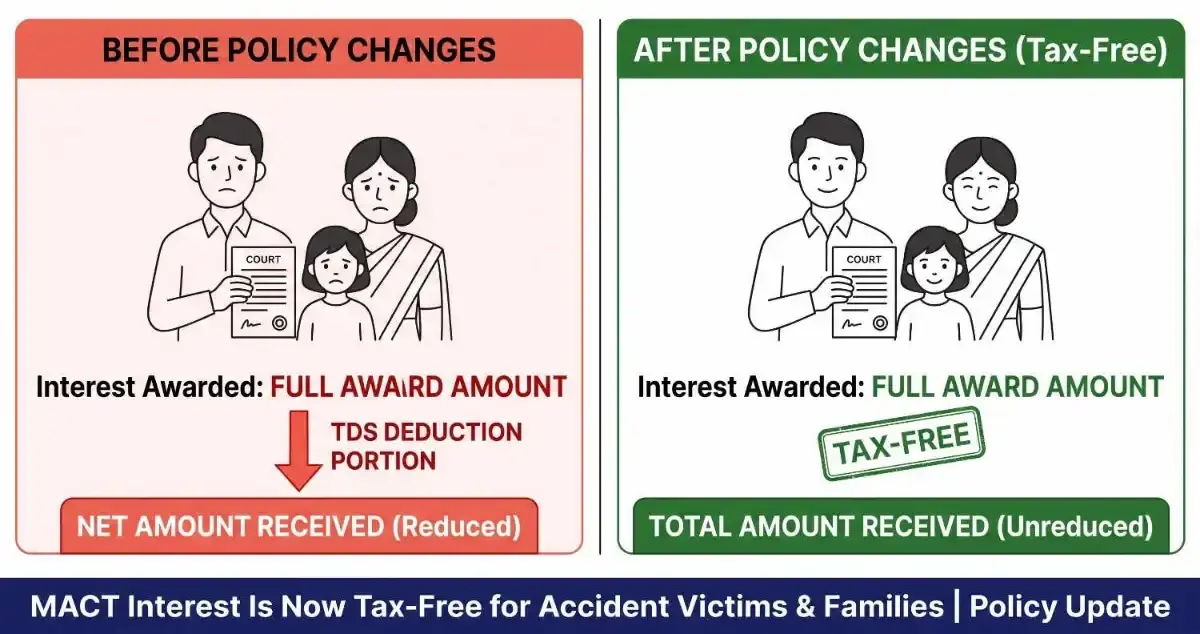
MACT interest income TDS exemption 2026 explained: who qualifies, old vs new Act rules, the FD interest trap, refund steps, and how to report it in your ITR.
Jul 24, 2026