
Annual salary increment in India 2026: exact formula, sector-wise hike %, basic vs CTC rules, increment letter format, and tax impact, with worked ₹ examples.
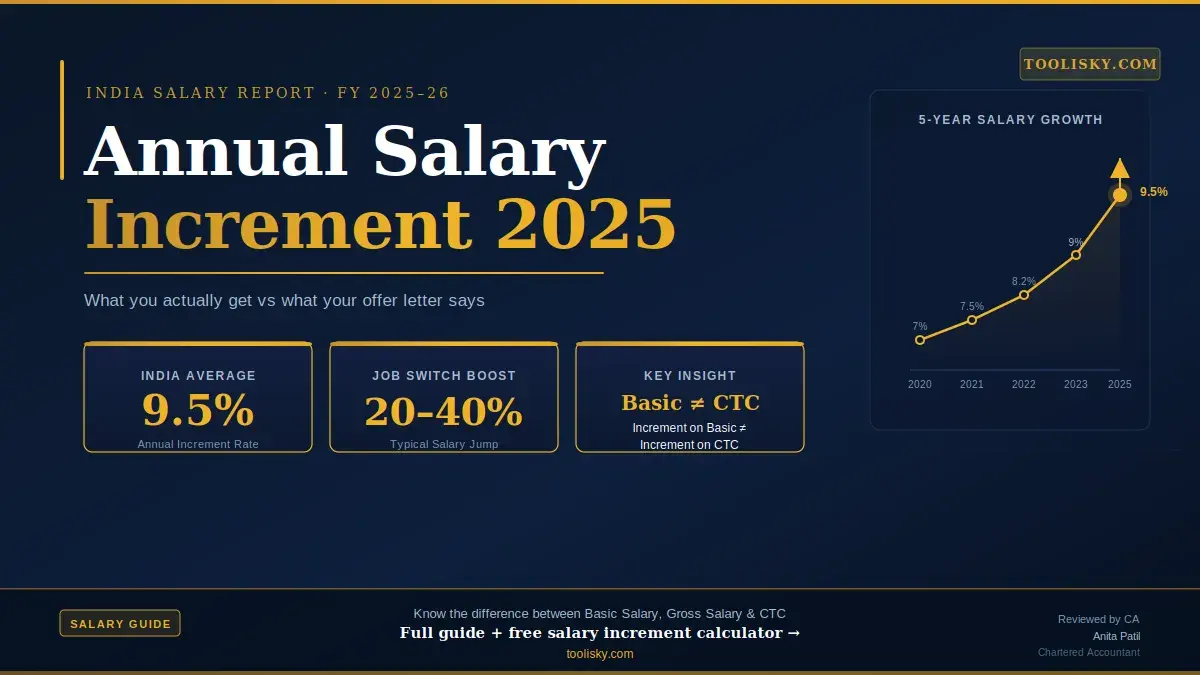
An annual salary increment is the yearly raise your employer adds to your fixed pay, calculated as [(New Salary − Current Salary) ÷ Current Salary] × 100. For 2026, India Inc.'s average increment is 9.1%, per Deloitte's Talent Outlook, though your real number depends on your performance rating, your industry, and whether you're switching jobs.
An annual salary increment is a yearly increase to your fixed pay, decided at your performance appraisal or budget cycle. It isn't defined under any tax section, it's a contractual HR decision between you and your employer.
Once it lands in your salary, tax law steps in. Your employer deducts TDS (Tax Deducted at Source) on your revised pay under Section 192 of the Income-tax Act, 1961, for salary paid up to 31 March 2026. From 1 April 2026, the same duty shifts to Section 392 of the Income-tax Act, 2025, per the Income Tax Department's transition guidance.
Applies To | Does NOT Apply To |
|---|---|
Salaried employees on company payroll, private and government | Freelancers and consultants billed per invoice (no employer-employee relationship, no Section 192 TDS) |
Employees inside a defined appraisal or increment cycle | Gig and platform workers paid per task or per trip |
Central and state government employees (flat increment + DA) | Daily-wage workers without a fixed monthly pay structure |
Employees renegotiating pay during a job switch | N/A |
Partial case: employees on probation usually don't enter the increment cycle until confirmation. Check your appointment letter, this isn't standardised across companies.
Deloitte's India Talent Outlook 2026, built from a January-February 2026 survey of 500+ companies across seven sectors, puts the national average increment at 9.1% for 2026, against 9.0% in 2025. EY's Future of Pay 2026 survey lands at almost the same figure, 9.1%.
Here's how that breaks down by sector for 2026, versus actuals from 2025:
Sector | 2026 Projected | 2025 Actual |
|---|---|---|
Automotive OEM | 10.3% | 10.1% |
Pharma & life sciences | 10.1% / 9.9% | 9.8% / 9.7% |
Manufacturing (overall) | 9.8% | 9.6% |
Real estate / infra | 9.8% | 10.2% |
IT product companies | 9.2% | 9.3% |
Global Capability Centres | 8.8% | 9.0% |
Telecom | 8.2% | 8.6% |
Media & entertainment | 8.1% | 8.5% |
IT services | 6.9% | 7.6% |
[Source: Deloitte India Talent Outlook 2026]
Switching companies pays more than waiting for your annual review:
Switch Type | Typical Hike |
|---|---|
Same role, different company (general) | 20%–35% |
IT services to IT services | 20%–35% |
IT services to a product company | 40%–100% |
Banking and finance | 20%–30% |
Freshers / entry-level (0–2 years) | 15%–25% |
Skill-scarce roles (AI, cloud, cybersecurity) | 40%–80%+ |
Internal promotion, entry to mid-level | 15%–20% |
Internal promotion, mid to senior level | 20%–30% |
Central government employees get a flat 3% annual increment built into the pay matrix, granted every 1 July, separate from Dearness Allowance (DA), revised twice a year. DA moved from 58% to 60% of basic pay from 1 January 2026.The 8th Pay Commission, constituted on 3 November 2025, was still at the consultation stage as of its Lucknow meeting on 22–23 June 2026.
[VERIFY: 8th Pay Commission's final fitment factor and effective date, check pib.gov.in once notified; any figure you see today is a projection, not a confirmed rate.]
What changed since November 2025: the four Labour Codes, including the Code on Wages, 2019, are now in force, and they redefine "wages." If allowances like HRA exceed 50% of total pay, the excess gets added back for PF and gratuity calculation. In effect, basic pay now needs to sit at 50% of CTC or more, which changes how much of your next increment reaches your PF and gratuity, not just your take-home allowance.
Salary Increment % = [(New Salary − Current Salary) ÷ Current Salary] × 100
Priya works as a marketing executive in Pune on a monthly salary of ₹62,000. At her annual appraisal, she gets a 10% hike. Here's the math, step by step:
Increment amount = ₹62,000 × 10 ÷ 100 = ₹6,200
New monthly salary = ₹62,000 + ₹6,200 = ₹68,200
Annual increment = ₹6,200 × 12 = ₹74,400
Old annual salary = ₹62,000 × 12 = ₹7,44,000
New annual salary = ₹7,44,000 + ₹74,400 = ₹8,18,400
Check: ₹74,400 ÷ ₹7,44,000 × 100 = 10%. The math closes.
Run your own numbers through Toolisky's Salary Increment Calculator for the tax-adjusted take-home, including New vs Old Regime comparison.
Ramesh is a factory supervisor in Nashik on ₹19,500 gross per month, comfortably inside the ESIC wage ceiling. In October, his company gives a 9% increment.
Increment amount = ₹19,500 × 9 ÷ 100 = ₹1,755
New gross salary = ₹19,500 + ₹1,755 = ₹21,255
That's above the ₹21,000 ESIC ceiling. Does he lose his ESIC card immediately? No. Per Rule 50 of the ESI (Central) Rules, 1950, he stays covered until the end of the running contribution period (October–March), and only exits from the next cycle. If you want the full picture on the ceiling itself, see our ESIC New Rules 2026 guide.
Here's where most people get confused, and forums are full of it: does your increment apply to your basic salary, or your full CTC? The two give very different numbers.
Say your basic is ₹30,000 and your CTC is ₹50,000 a month, and you get a 10% increment.
On basic: ₹30,000 × 1.10 = ₹33,000 new basic. That's a ₹3,000 jump that also raises your PF (12% of basic) and your future gratuity base.
On CTC: ₹50,000 × 1.10 = ₹55,000 new CTC. That's a ₹5,000 jump, but your basic may not move at all. The extra ₹5,000 often just gets parked in a flexible allowance.
Since November 2025, this matters more than before. Under the Code on Wages, your basic plus DA now has to be at least 50% of your CTC, by law. A company that used to quietly route increments into allowances has far less room to do that today.
Ask HR one direct question before you sign: is this on basic, or on CTC? It changes your PF, gratuity, and real take-home, not just the figure on the letter. Our guide on calculating income tax on salary covers how a mid-year increment shifts your TDS.
A salary increment letter should carry exactly five things: your name and employee ID, the effective date, your old and new fixed pay (plus CTC if it differs from basic), the revised breakup of basic, HRA, and special allowance, and the reason, annual review, promotion, or retention offer.
If your letter only shows a percentage and a new CTC number, ask for the breakup separately. Without it, you can't check whether the hike landed on basic, work out your new PF contribution, or catch a payroll error before your first revised payslip.
1. Your TDS doesn't match your new salary. Your increment kicked in from August, but your December payslip still shows TDS on your old, lower pay. Fix: ask payroll to re-run your projected annual income. Mid-year hikes need the employer to re-estimate full-year income and adjust the remaining months' TDS under Section 192. If they don't fix it, you'll owe the shortfall as self-assessment tax while filing your ITR, possibly with interest under Section 234B.
2. The letter says one number, your payslip shows another. Compare the letter's "new basic" and "new CTC" against your first revised payslip. If they don't match, email HR within the same pay cycle, corrections get far harder once the financial year closes and TDS is already deposited against the wrong figure.
3. You were promised an increment verbally, and it never showed up in writing. Send a confirmation email the same day, "confirming the X% increment discussed on [date], effective [date]," copying HR. If it still doesn't reflect in payroll within one full cycle, escalate formally in writing, verbal commitments without a paper trail are very hard to enforce later.
These penalties fall on your employer, not you, but they're what actually forces a correction.
If your employer deducts less TDS than your revised salary needs, Section 201(1A) of the Income-tax Act, 1961 charges interest at 1% a month for short-deduction and 1.5% a month for late deposit, plus a penalty equal to the shortfall under Section 271C.
Under Section 54(1) of the Code on Wages, 2019, if an employer pays less than what's due, including a sanctioned increment never processed, the fine runs up to ₹50,000 for a first offence, rising to ₹1,00,000 or up to three months' imprisonment for a repeat offence within five years.
For ESIC, a delayed contribution deposit attracts 12% annual interest from the 16th, plus damages of up to 25% of the arrears for prolonged delay.
Anything around Deloitte's 2026 average of 9.1% counts as a healthy increment. 8% to 10% is standard for steady performers; 12% to 15% or higher usually signals a strong rating or a hard-to-replace skill. Below 5% to 6%, you're losing ground against inflation, even though the payslip number went up.
It depends entirely on company policy, there's no single rule across India. Some companies raise basic salary directly, which also lifts PF and future gratuity. Others raise only CTC and route the extra into an allowance, leaving basic untouched. Always ask HR which one applies before comparing offers or signing your letter.
Most professionals get a 20% to 35% jump switching companies for the same role, well above the 9.1% annual average. IT services-to-product moves and AI, cloud, or cybersecurity roles can command 40% to 80% or more. Freshers typically see 15% to 25%. The exact number depends on your current pay gap versus the market, not a flat formula.
Because CTC includes employer costs you never see in hand: PF, gratuity provision, and insurance. A 15% CTC hike often becomes a smaller bank-account jump once income tax and PF also rise on the higher base. Ask for a CTC-to-in-hand breakup, not just the headline percentage.
Yes. It's added to salary income and taxed at your slab rate for the year; there's no separate tax on the increment itself. Your employer adjusts monthly TDS under Section 192 once the revised salary kicks in. If that adjustment is wrong, you may owe a shortfall while filing your ITR.
Arrears are added to the year you actually receive them, not the year they were due, for TDS under Section 192. If the lump sum pushes you into a higher slab only because of timing, claim relief under Section 89(1) via Form 10E before your ITR. This spreads the arrear's tax impact across the years it relates to, instead of taxing it all at once.
Yes. No law in India mandates a minimum annual increment for private-sector staff, unlike the statutory minimum wage. Companies can freeze increments in a loss-making year or hiring slowdown. What they can't legally do is pay you below your last sanctioned salary or below the minimum wage for your category.
Flag it in writing to HR and your manager before your next payslip is processed. A typo in the percentage or effective date is usually fixed with a revised letter. If the error already fed into a payslip and TDS deduction, ask for a corrected Form 16 at year-end, otherwise your Form 26AS won't match what you actually earned.
No. DA is a cost-of-living adjustment, revised twice a year for government employees and pensioners based on inflation data, currently 60% of basic pay as of January 2026. An annual increment is a separate, performance-linked raise on top of DA. Private-sector employees rarely have a formal DA line; their raise runs through the increment cycle.
An increment is a permanent raise that repeats every month going forward. A bonus is usually a one-time payment tied to a target, festival, or company performance, and it doesn't change your base salary or next year's increment math. The two are budgeted, taxed, and processed differently inside payroll.
Check whether your raise applies to basic or to CTC before you celebrate the percentage, that one question decides your PF, gratuity, and real take-home. Run your exact numbers through Toolisky's Salary Increment Calculator to see the rupee math instantly. For the TDS rules behind your revised salary, the Income Tax Department's e-filing portal remains the only source worth trusting over a forwarded message.

8th pay commission arrears will likely arrive as a lump sum once notified, covering January 2026 onward. Here's the real timeline, the math, and the tax rules.
Aug 20, 2026

Section 87A proviso explained: first proviso rebate limits vs the second proviso's capital-gains bar, with FY 2025-26 math and real fixes for demand notices.
Aug 19, 2026

Salary arrears letter format samples for HR requests, promotions, resignations, and government staff — plus the Section 89(1) tax check most people skip.
Aug 13, 2026