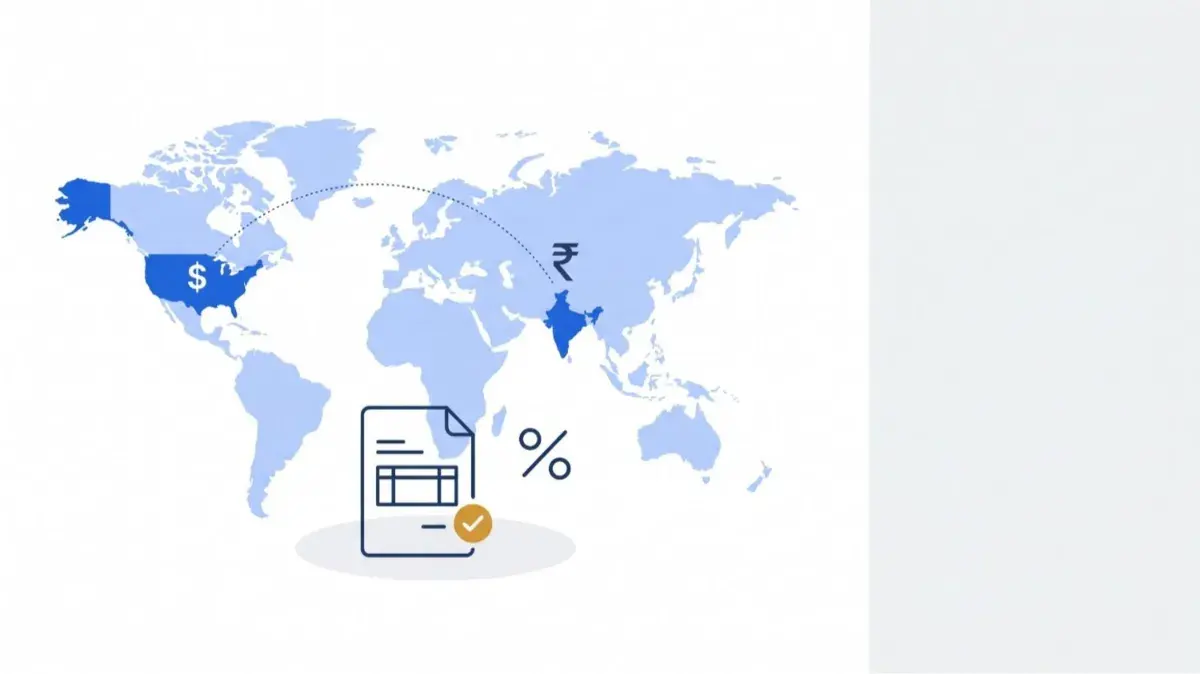

Foreign dividend tax in India 2026: the real 25% US withholding rate, DTAA relief, Form 67 filing, and Budget 2026's interest-deduction ban explained.
Dividends from your US, UK, or Singapore stocks are not tax-free just because the money was earned abroad. India taxes them at your full slab rate under "Income from Other Sources," and the popular claim that DTAA cuts US withholding to 15% is wrong for almost every retail investor — the real rate is 25%.
Foreign dividend tax is what India charges a resident when a company incorporated outside India pays them a dividend — think Apple, Microsoft, or a UK-listed ETF.
For FY 2025-26, this income is charged under Section 56(2)(i) of the Income-tax Act, 1961 — the "Income from Other Sources" head. From Tax Year 2026-27 onward, the equivalent provision moves to Section 92 of the Income-tax Act, 2025, which replaced the 1961 Act from 1 April 2026. If you want a complete walkthrough of how the two statutes map against each other, see our Income Tax Act 2025 vs 1961 section mapping guide.
There is no special flat rate for foreign dividends. They get added to your total income and taxed at your normal slab — exactly like dividends from Infosys or TCS.
Applies to | Does NOT apply to |
|---|---|
Resident Indians (ROR) holding foreign stocks, ETFs, or mutual funds that pay dividends | NRIs — their foreign dividends are not taxed in India at all |
RNOR individuals, if the foreign income is otherwise taxable in India | Foreign companies and non-resident firms (different rules entirely) |
HUFs holding foreign dividend-paying investments | Investors holding only Indian-listed stocks (Section 194/Section 393 of the 2025 Act covers that instead) |
A quick note on RNOR status: if you recently returned to India, your foreign dividends usually stay outside the Indian tax net during the RNOR window. That depends entirely on your exact travel history across the past several years, so verify before assuming.
Here is the table almost no one publishes correctly.
Country | Withholding for Indian retail investors | Why |
|---|---|---|
USA | 25% (with Form W-8BEN filed; 30% without) | Article 10(2) of the India-US DTAA gives the 15% rate only to companies owning 10%+ of the paying company's voting stock — not to individuals under any circumstance |
Canada | 25% (15% only for companies controlling 10%+ voting power) | Identical two-tier structure under Article 10 of the India-Canada DTAA |
UK | 0% | The UK levies no domestic withholding tax on dividends, full stop |
Singapore | 0% | One-tier corporate tax system; no dividend WHT under domestic law |
UAE | 0% | No income tax on dividends at all |
Source: Article 10(2) of the India-US DTAA (text confirmed via IRS Technical Explanation); Article 10 of the India-Canada DTAA; incometaxindia.gov.in tax-rates page for surcharge rules.
On top of whatever the source country withholds, India taxes the gross dividend at your slab rate: 5% to 30% under the new tax regime, 0% to 30% under the old. The Section 87A rebate wipes out the Indian tax entirely if your total income is ₹12 lakh or less under the new regime (₹5 lakh under the old). Surcharge on the tax attributable to dividend income — foreign or domestic — is capped at 15%, as confirmed on the incometaxindia.gov.in tax-rates page, even if your other income pushes you into the 25% or 37% surcharge bracket. Add 4% cess on top, no exceptions.
The ₹10,000 TDS threshold does not apply here. Section 194 (now Section 393 of the 2025 Act) governs TDS on dividends paid by Indian companies. A US or UK company has no Indian TDS obligation whatsoever — do not expect that threshold to appear anywhere near your foreign dividend.
Budget 2026 changed the deduction rules, effective right now. Until 31 March 2026, you could deduct loan interest against dividend income under Section 57 of the 1961 Act, capped at 20% of the gross dividend. The Finance Act 2026 (which received Presidential assent and amended Section 93(2) of the Income-tax Act, 2025) disallowed this deduction entirely for income from 1 April 2026 onward — that is Tax Year 2026-27, which started this April. If you have taken a margin loan to buy dividend-paying stocks this year, that interest earns you nothing against this income anymore.
Note on the 57 deduction and foreign dividends: There has been practitioner-level debate over whether the pre-April 2026 Section 57 interest deduction explicitly applied to foreign dividend income (versus domestic dividends only). The CBDT did not issue a specific circular settling this point for foreign-dividend interest, and some advisors treated the position as an interpretive grey area. The Finance Act 2026 makes the question moot from Tax Year 2026-27: the deduction is simply gone. But if you are filing for FY 2025-26 and claimed such interest, note this ambiguity and, if challenged, be prepared to defend the position with your CA.
Example 1 — Suresh, the common case. Suresh, 34, is a product manager in Pune holding Apple and Microsoft shares via INDmoney. He filed Form W-8BEN, so the US withheld 25%.
Gross dividend: $2,000. US tax withheld: $500. Net received: $1,500.
SBI TT buying rate that month: ₹85/USD.
Gross dividend in INR: $2,000 × ₹85 = ₹1,70,000.
US tax paid in INR: $500 × ₹85 = ₹42,500.
Suresh's total income: ₹28 lakh (30% slab, no surcharge).
Indian tax on dividend: ₹1,70,000 × 30% = ₹51,000.
FTC = lower of ₹42,500 and ₹51,000 = ₹42,500.
Net tax payable to India: ₹51,000 − ₹42,500 = ₹8,500, plus 4% cess (₹340) = ₹8,840.
He reports the full ₹1,70,000 in Schedule OS, claims ₹42,500 FTC in Schedule TR, backed by Form 67 and his broker's Form 1042-S.
Example 2 — Farida, the edge case most guides skip. Farida is a freelance UX consultant in Bengaluru holding a US stock and a UK-listed ETF, partly bought on a margin loan. Her marginal slab is 20%, and this dividend falls in Tax Year 2026-27.
US dividend: $1,000, 25% withheld = $250. At ₹85/USD: gross ₹85,000, US tax ₹21,250.
Indian tax on ₹85,000 at 20%: ₹17,000.
FTC = lower of ₹21,250 and ₹17,000 = ₹17,000. Net India tax: ₹0.
But ₹21,250 − ₹17,000 = ₹4,250 of US tax is gone permanently. No refund from the US, no carry-forward in India.
UK dividend: £500, 0% withholding, full amount kept. At ₹107/GBP: ₹53,500, taxed in India at 20% = ₹10,700. No FTC needed since no foreign tax was paid.
Her ₹15,000 loan interest against these dividends? Zero deduction, because she is past 1 April 2026.
Whenever your Indian slab rate sits below the foreign withholding rate, part of that foreign tax becomes an unrecoverable dead cost. That is the deadweight loss almost no guide explains with actual rupee figures.
Timing note: For FY 2025-26 (AY 2026-27) returns being filed right now, the form to use is Form 67. Form 67 continues to apply for this assessment year. Form 44 (the renumbered successor under the Income-tax Rules, 2026) comes into force for Tax Year 2026-27 income, which you will file in the 2027 season.
Log in to the Income Tax e-filing portal with your PAN and OTP.
Go to e-File → Income Tax Forms → File Income Tax Forms.
Under "Persons not having Business/Professional Income," search for and select Form 67 – Statement of Income from a Country or Specified Territory Outside India.
Select Assessment Year 2026-27 and click File Now.
In Part A, enter the country name, head of income (Income from Other Sources), gross income in INR, foreign tax paid in INR, and the relevant DTAA article (Article 10 for US dividends).
Attach your Form 1042-S or equivalent foreign tax certificate, plus your broker's annual statement.
Submit and verify with Aadhaar OTP or DSC. Note the acknowledgment number.
File this before completing ITR-2 or ITR-3 — Schedules FSI and TR ask for that acknowledgment number. If you file Form 67 after your ITR, expect the CPC to reject the FTC claim outright.
New from 2027 onwards: Under the Draft Income-Tax Rules, 2026, Form 44 (replacing Form 67) will require a Chartered Accountant's certificate for all companies and for individuals where foreign taxes paid outside India total ₹1 lakh or more. This doesn't affect your FY 2025-26 return, but plan accordingly for next year.
You filed ITR-1 by mistake. Foreign dividends disqualify Sahaj entirely. Fix this by filing a revised return under Section 139(5) using ITR-2, before 31 December 2026, with no extra penalty fee. Budget 2026 also proposed allowing revised returns until 31 March 2027 (with a late filing fee after 31 December), but the deadline to revise without any additional cost remains 31 December 2026.
You missed the Form 67 deadline. The CPC typically rejects the FTC claim outright once this happens. File Form 67 anyway immediately, then request rectification under Section 154, citing the Brinda Ramakrishna ITAT ruling that treats the deadline as procedural rather than mandatory. This route is not guaranteed — treat it as damage control, not a plan.
Your AIS shows a different dividend figure than your broker statement. This usually comes from a currency-conversion mismatch. Reconcile using your broker's tax P&L statement and the correct SBI TT buying rate for the relevant month end, then respond to any Section 143(1) notice with that statement attached.
Broker/platform dividend and tax statement — digital copy accepted
Form 1042-S (US) or equivalent foreign withholding certificate — digital accepted
Signed Form W-8BEN copy held on file with your broker — digital accepted
A valid PAN — check our PAN format and status validator
Form 67 acknowledgment number (generated when you file the form before your ITR)
Tax Residency Certificate — only required if claiming treaty relief in a second jurisdiction simultaneously
Schedule FA non-disclosure: up to ₹10 lakh under the Black Money (Undisclosed Foreign Income and Assets) and Imposition of Tax Act, 2015. This applies even if the account has zero income — simply holding a foreign brokerage account you failed to report is enough to trigger it.
Under-reporting your dividend: 50% of the tax on the under-reported amount, under Section 270A of the 1961 Act (now Section 439 of the Income-tax Act, 2025, which carries the same structure forward).
Misreporting (claiming a fake DTAA rate, suppressing income, or recording false entries): 200% of the tax on the misreported amount, same section.
Late filing fee: ₹5,000 under Section 234F of the 1961 Act if your total income exceeds ₹5 lakh; ₹1,000 if it does not. Under the Income-tax Act, 2025, the equivalent provision is Section 428, with identical amounts — confirmed on the official incometax.gov.in transition FAQ page.
Missing Form 67's deadline: no standalone fine, but it almost always costs you the entire year's FTC claim — which is nearly always more expensive than any of the monetary penalties above.
No — and this is the single most repeated error on Indian personal finance platforms. Article 10(2) of the treaty sets two rates. The 15% rate applies only when the beneficial owner is a company holding at least 10% of the voting stock of the US company paying the dividend. Every individual retail investor pays 25%, period, even with a valid Form W-8BEN on file. Skip the W-8BEN and the full 30% US statutory rate applies instead.
You still get relief through a separate route. Section 91 of the 1961 Act (now Section 160 of the Income-tax Act, 2025) provides unilateral credit for the foreign tax paid, capped using the same "lower of" rule as treaty relief. Keep proof of the foreign deduction to support the claim.
Yes. A DRIP-style automatic reinvestment does not change the tax position. The dividend is taxable in the year it is declared, and the reinvested amount becomes your new cost basis for capital gains when you eventually sell those shares. You can still claim the FTC for the foreign tax withheld, even on reinvested amounts.
The CPC typically denies the FTC outright. File it immediately regardless, then pursue rectification under Section 154 citing the procedural argument from ITAT precedent. Treat this as damage control, not a reliable backup strategy.
No. NRIs are taxed only on income earned or accrued in India. A dividend sitting in an NRI's overseas brokerage account from Apple or any other foreign company never enters the Indian tax net. This is specific to residents — ordinary resident (ROR) status is what triggers worldwide income taxation.
ITR-2 if you have no business income, ITR-3 if you do. ITR-1 and ITR-4 do not carry Schedule FA, FSI, or TR — the fields foreign income requires — so using either form will misreport your return and expose you to penalties.
The State Bank of India's Telegraphic Transfer (TT) buying rate as on the last day of the month before you received the dividend, per Rule 115 of the Income-tax Rules, 1962. Your bank's actual conversion rate, or a rate from a quick web search, will not survive scrutiny.
Not at all. That threshold under Section 194 (now Section 393 of the 2025 Act) governs only Indian companies deducting TDS on domestic dividends. A foreign company has no Indian deductor anywhere in the payment chain.
No — not for your FY 2025-26 return (due 31 July 2026). That return still uses Form 67 under the existing Income-tax Rules, 1962. Form 44 takes over only for income earned in Tax Year 2026-27 onward, which you will file during the 2027 season. Multiple practitioner platforms (Tax2Win, EZTax, ClearTax) confirm this, and the official Income Tax Department transition FAQ corroborates the changeover date.
Only for dividends received up to 31 March 2026, with the deduction capped at 20% of gross dividend income under the old Section 57. The Finance Act 2026 scrapped this deduction entirely for income from 1 April 2026 onward through an amendment to Section 93(2) of the Income-tax Act, 2025. Factor this into any leveraged investing plan you are considering this financial year.
Check your broker's Form W-8BEN status today. Most of the preventable tax leakage happens because that form quietly expired three years ago and no one flagged it. Run your own numbers through our Foreign Dividend Tax Calculator and file Form 67 before your ITR — not after.

Do NRIs need to file tax returns in both India and the US? Here's who must file in each country, which forms apply, and how DTAA relief works in 2026
Jul 5, 2026
No TAN for NRI property purchase applies only from 1 October 2026, and only to resident individual and HUF buyers. Get the rates, forms, and dates you need.
Jul 25, 2026

Did you lose the SGB premature redemption tax exemption? Here's exactly who's affected, how much tax applies now, and how to check your own bonds.
Jul 24, 2026