

Form 3520 gift from India: 2026 IRS thresholds, penalties, exchange rates, HUF rules, and the Zhang v. IRS court ruling, explained with worked examples.
If your parents in India sent you more than $100,000 this year, or you inherited property from a relative back home, the IRS probably wants to hear about it — even though you won't owe a single dollar of tax on the money itself. Skip the paperwork, and the penalty can run as high as 25% of the gift. This guide walks through exactly when a Form 3520 gift from India needs to be reported, what it costs to get wrong, and where a lot of the advice floating around online is out of date.
One quick note before we start. This is a U.S. federal tax topic, governed by the Internal Revenue Code, the Bank Secrecy Act, and IRS guidance — not India's Income-tax Act, 1961, or the newer Income-tax Act, 2025. You won't see an Indian section number anywhere in this guide, because none of them apply to a U.S. filing duty. Every figure below has been checked against IRS.gov, the current Form 3520 instructions, and a federal court ruling from May 2026.
Form 3520 is an information return. U.S. persons file it to tell the IRS about large gifts or inheritances from foreign individuals, along with certain transactions involving foreign trusts. It is not a tax return. Filing it doesn't mean you owe anything, and it doesn't calculate a tax bill. The IRS simply wants to confirm that a large sum landing in your account is really a gift, and not income you forgot to declare.
The filing duty comes from two different parts of the tax code. IRC Section 6039F covers gifts and bequests. Section 6048 covers foreign trusts. The penalties for getting it wrong sit in separate sections too: 6039F(c) for gifts, and 6677 for trusts. That split matters, because most of the confusion around this form comes from mixing up the two sets of rules. You can read the full requirements in the official Form 3520 instructions on IRS.gov.
This applies to you if... | This does NOT apply to you if... |
|---|---|
You're a U.S. citizen who received $100,000 or more from a nonresident Indian parent, relative, or estate in a single year | The gift was under $100,000 and came from one unrelated donor in India |
You're a green card holder or another kind of U.S. resident alien | You're a nonresident alien with no U.S. filing obligation |
Your gifts from related donors in India — parents, siblings, grandparents — add up to more than $100,000 combined | You simply moved money between your own U.S. accounts |
You inherited Indian property, cash, or mutual fund units worth $100,000 or more | The gift came from a U.S.-citizen relative who happens to live in India (it's the donor's citizenship that matters, not where they live) |
One case worth flagging: if you were a nonresident alien for part of the year and became a green card holder partway through, your Form 3520 clock for gifts received starts on the date you became a U.S. person — not on January 1. A cross-border CPA can help you work out that split correctly.
Here are the actual numbers for this year, not just a description of the rule.
Gifts or bequests from a nonresident alien individual or foreign estate. You must file once your total for the year goes over $100,000. This figure is fixed by statute — unlike the entity threshold below, it doesn't rise each year with inflation. You can confirm the current rule directly on the IRS gifts-from-foreign-person page.
Gifts from a foreign corporation or partnership. This bar sits much lower, and it does move with inflation: $20,116 for 2025, rising to $20,573 for 2026, under the IRS's annual adjustment (Rev. Proc. 2025-32). The IRS calls these "purported gifts" and reserves the right to recharacterize them as disguised compensation.
The aggregation rule. You combine gifts from related donors — parents, grandparents, siblings, spouses, and children all count as one pool. Say your father sends $60,000 and his sister sends $55,000 in the same year. That's $115,000 combined, over the line, even though neither gift alone crossed $100,000.
Due date. The 15th day of the 4th month after your tax year ends — April 15, 2027, for gifts received in calendar-year 2026. Living abroad pushes that to June 15. A timely Form 4868 extension moves it further, to October 15 at the latest, with no additional extension available after that.
Exchange rate — where most guides get vague. Use the spot USD/INR rate on the date you received the gift, or the date of death for an inheritance, not the date Indian probate actually released the funds. If the same money also triggers an FBAR because it sat in a foreign account above $10,000 at any point, the FBAR uses a different rate entirely — the Treasury Reporting Rate of Exchange for December 31, published quarterly by the Bureau of the Fiscal Service. Mixing up the two rates is one of the most common cross-border filing mistakes.
The $10,000 penalty floor doesn't apply here. Some India-focused guides claim a missed six-figure gift triggers a flat $10,000 minimum penalty. That floor is real, but it belongs to IRC Section 6677, which governs foreign trust transfers and distributions (Form 3520, Parts I through III). The gift penalty under Section 6039F (Part IV) has no floor at all — just 5% of the unreported gift per month, capped at 25%.
The October 2024 policy shift. The IRS used to auto-assess the 25% gift penalty the moment a late Form 3520 hit processing, before anyone read the reasonable-cause explanation attached to it. Following an October 2024 announcement from then-Commissioner Danny Werfel, and now written into the Internal Revenue Manual as of early 2026, staff at the Ogden, Utah service center review a reasonable-cause statement first, before assessing anything. It isn't automatic relief, but it beats fighting an abatement after the fact.
Zhang v. IRS: a new ruling most India-focused guides haven't caught up with yet. In Zhang v. Internal Revenue Service (N.D. Cal., decided May 4, 2026), a federal court ruled that the IRS does have the authority to assess Section 6039F penalties directly, without suing the taxpayer first. The taxpayer had tried to stretch an earlier, taxpayer-favorable Tax Court ruling in Farhy v. Commissioner — a case about a different penalty, on Form 5471 — to cover foreign-gift penalties too. (Worth knowing: even Farhy itself was later reversed on appeal for its own facts, so leaning on it as a shield is getting harder across the board.) The court in Zhang rejected the argument for Section 6039F specifically. The taxpayer, who had self-reported about $287,100 in late wedding gifts from family in China, was hit with a $71,777 penalty, later reduced to $57,422 on internal appeal. She still gets to argue reasonable cause when the case goes to trial — that claim survived — but the door is now shut on the broader "the IRS has to sue me first" argument. The lesson for anyone with a late Form 3520 gift from India: don't count on a legal loophole around assessment. Put your energy into a solid reasonable-cause statement instead.
The new remittance tax doesn't touch money coming from India. Starting January 1, 2026, a 1% federal excise tax under IRC Section 4475 applies to certain cash-funded transfers leaving the United States. It has zero bearing on money family sends into the U.S. — the two move in opposite directions and are governed by completely different rules.
State-level inheritance tax: usually a non-issue. Only five states still tax inheritances — Kentucky, Maryland, Nebraska, New Jersey, and Pennsylvania (Iowa phased its version out for deaths on or after January 1, 2025). These taxes generally target property tied to a decedent who was domiciled, or held property, in that state. An inheritance from a relative who died in India typically falls outside their reach entirely. If you live in one of those five states, it's worth a quick check with a local attorney just in case.
Example 1: Suresh, a green card holder in New Jersey. His mother in Pune wires him ₹91,00,000 toward a house down payment in March 2026. Say the spot rate that day is 90 INR to the dollar (a reasonable estimate for that time of year — always use the actual rate for your exact transaction date). ₹91,00,000 ÷ 90 works out to roughly $101,111. That's over the $100,000 line, so he files Form 3520 Part IV for the year. He owes zero tax, since it's a gift, but skipping the form risks a penalty of up to about $25,000.
Example 2: Priya, an H-1B holder whose grandmother's estate spans two tax years. Priya's grandmother in Chennai dies in November 2025, leaving Priya a flat and some bank balances worth ₹1,20,00,000. Indian probate doesn't clear until March 2026, and the funds don't reach Priya's NRO account until April 2026. None of that changes which tax year she reports in — she values and files based on the date of death, using the November 2025 spot rate (roughly 88 INR to the dollar that month). ₹1,20,00,000 ÷ 88 comes to about $136,364. That's well over $100,000, so she files Form 3520 for tax year 2025, even though she hadn't actually received a rupee of the money by the end of that year.
There's no tax formula here, because the tax owed on a genuine foreign gift or inheritance is, almost always, zero. What you're really calculating is whether a reporting obligation exists.
Add up everything you received this year from related, nonresident family members in India, or from a foreign estate.
Crossed $100,000? Form 3520 Part IV is due, even though the tax owed is still zero.
Separately, check whether the foreign account holding that money crossed $10,000 at any point in the year. If so, file an FBAR — a completely separate question from Form 3520.
Check your Form 8938 (FATCA) thresholds too. They depend on your filing status and whether you live in the U.S. or abroad.
If the gift included mutual fund units, ULIPs, or similar pooled Indian investments, you may now hold a PFIC. That triggers a separate Form 8621 requirement that doesn't go away just because you already filed Form 3520.
You discover a Form 3520 you should have filed two years ago. File it now, with a detailed, dated, fact-specific reasonable-cause statement attached. Don't quietly start filing correctly going forward while ignoring the gap — that pattern tends to draw more scrutiny than a clean voluntary correction. Since October 2024, your statement gets read before any penalty is assessed, not after.
Your Form 3520 and FBAR numbers don't match because you used the wrong exchange rate. This is common, and fixable. Amend whichever form used the wrong rate — remember, Form 3520 wants the spot rate on the transaction date, while FBAR wants the Treasury year-end rate — and keep a saved record of your source for both.
You're not sure whether your family's HUF distribution counts as a "gift" or a "foreign trust" distribution. This one is genuinely unresolved. The IRS has never formally classified the Hindu Undivided Family for U.S. tax purposes as a trust, corporation, or partnership, and each classification triggers different forms (3520/3520-A, 5471, or 8865). Get a cross-border tax professional to review the specific HUF deed before you file, rather than guessing.
Document | Digital copy OK? | Where to get it |
|---|---|---|
Signed gift letter (amount, date, relationship) | Yes | The sender drafts and signs it; no official format is required |
Succession certificate or legal heir certificate (for inheritance) | Yes | An Indian civil court, through a local advocate |
Proof of the source of funds (sale deed, FD statement, bank record) | Yes | The sender's bank, registrar, or broker in India |
Form 145 (formerly Form 15CA) and Form 146 (formerly Form 15CB) — needed on the India side before repatriating more than ₹5 lakh | No, filed on the Indian Income Tax e-filing portal | A practicing Indian Chartered Accountant |
Form 3520 itself | No, paper-filed separately from your Form 1040 |
A quick heads-up on that fourth row: as of April 1, 2026, India's Income-tax Act, 2025, renamed Form 15CA to Form 145 and Form 15CB to Form 146. The underlying rule hasn't changed — you (or the person sending you money) still need Form 146 once a taxable remittance to a non-resident passes ₹5 lakh in a financial year — but banks and CAs will now refer to it by the new numbers. If you're also researching the India side of a property sale, our guide to selling property in India as a U.S. resident walks through the ₹1 million FEMA repatriation cap and related paperwork in more detail.
Form 3520 Part IV (gifts and bequests), late or missing. 5% of the unreported gift's value per month, capped at 25% total, under IRC Section 6039F. There's no $10,000 floor — that number belongs to the separate foreign-trust penalty under Section 6677, which is a common point of confusion.
Reasonable cause. No penalty applies if you can show the failure was due to reasonable cause rather than willful neglect. Since Zhang, though, expect the IRS to hold firm on its authority to assess the penalty first — reasonable cause gets argued through the normal administrative process, not through a challenge to the IRS's power to assess in the first place.
Deadlines to circle: April 15, 2027, for calendar-year 2026 gifts (June 15, 2027, if you live abroad; October 15, 2027, with a timely Form 4868 extension).
No. Foreign gifts and inheritances aren't taxable income to the U.S. recipient. The obligation is purely to report on Form 3520 once your total crosses $100,000 — no tax attaches to the gift itself.
Up to $100,000 combined from your parents (and other related donors) in a year triggers no filing. Cross that line, and Form 3520 is due, even though you still owe no tax on the gift.
A penalty of 5% of the gift's value for each month it goes unreported, capped at 25%, under Section 6039F. Since the May 2026 Zhang ruling confirmed the IRS can assess this penalty directly, filing late with a reasonable-cause statement is a far better move than waiting to get caught.
Yes. The IRS aggregates gifts from related donors, and parents count as related. $60,000 plus $60,000 is $120,000, which crosses the $100,000 line even though neither gift alone did.
Yes, if its fair market value on the date of death exceeded $100,000. You report it regardless of whether you later sell it, keep it, or rent it out.
The spot INR/USD rate on the date you received the money, or the date of death for an inheritance. Don't use the Treasury Reporting Rate — that's for FBAR only, and mixing the two up is a common mistake.
Genuinely unresolved. The IRS has never formally classified the HUF, so U.S.-person coparceners should get individual professional review of the specific HUF's deed rather than assume one classification applies.
Yes, and this catches people off guard more often than you'd think. The Section 6039F penalty applies purely for late or missing reporting, completely independent of whether any tax was ever due.
That can count as a gift of a partial ownership interest, valued as of the transfer date. If it, combined with other gifts from related donors in India that year, crosses $100,000, Form 3520 applies. Get a professional valuation rather than estimating the number yourself.
Yes, separately. If the account — or your combined foreign accounts — crossed $10,000 at any point in the year, file FinCEN Form 114 using the December 31 Treasury Reporting Rate, not your Form 3520 rate. Our guide to money transferred from abroad covers how FBAR and FATCA fit together with Form 3520.
Generally yes, once your NRO outward remittance passes ₹5 lakh in a financial year. A Chartered Accountant issues Form 146 (the old Form 15CB) confirming Indian taxes are settled, and you file Form 145 (the old Form 15CA) online before the bank processes the transfer. The overall FEMA cap on repatriation from an NRO account is $1 million per financial year.
Add up everything you've received this year from related, nonresident donors in India, and if the total is anywhere near $100,000, start your Form 3520 paperwork now rather than waiting for tax season. For the India-side repatriation mechanics — Form 145/146 and the $1 million NRO cap — see our guide on selling property in India as a U.S. resident. For how FBAR and FATCA fit alongside Form 3520, see money transferred from abroad. And for the official filing itself, start at the IRS Form 3520 page.
For educational purposes only. Verify all figures at official sources before acting. Toolisky is not affiliated with any government body. Consult a qualified CA or a U.S.-licensed cross-border tax professional before making compliance decisions. See toolisky.com/accuracy-and-limitations for more.
No TAN for NRI property purchase applies only from 1 October 2026, and only to resident individual and HUF buyers. Get the rates, forms, and dates you need.
Jul 25, 2026

Did you lose the SGB premature redemption tax exemption? Here's exactly who's affected, how much tax applies now, and how to check your own bonds.
Jul 24, 2026
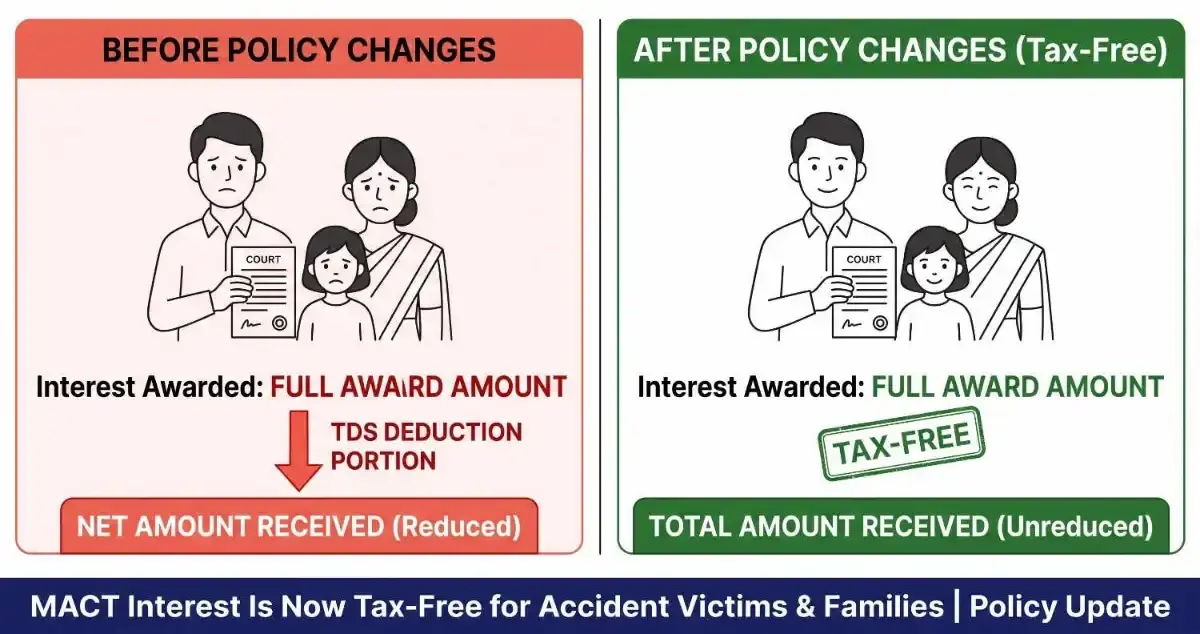
MACT interest income TDS exemption 2026 explained: who qualifies, old vs new Act rules, the FD interest trap, refund steps, and how to report it in your ITR.
Jul 24, 2026