

Capital gains tax for NRI selling property in India as a US resident: TDS, Section 82/85/86 exemptions, DTAA, and Form 1116 explained.
If you're an NRI selling property in India while living in the US, you're really dealing with two tax bills, not one. India taxes the sale first — 12.5% on long-term gains, with the buyer withholding tax (TDS) before you even see the money. Then the US wants its own accounting, since citizens and green card holders are taxed on income earned anywhere in the world. The good news: you're not meant to pay the full tax twice. A Foreign Tax Credit, claimed on Form 1116, is built to prevent that. This guide walks through both sides of the process, from the Indian sale deed to the US Form 1116.
When an NRI sells a house, flat, or plot in India, the profit counts as a capital gain. India taxes that gain under its own income tax law. Separately, because the US taxes citizens and green card holders on their worldwide income, the same gain has to be reported on a US return too.
This is a slightly awkward moment to be writing about it, because India is mid-transition between two tax laws. A sale that closes by 31 March 2026 (financial year 2025-26) is governed by the old Income-tax Act, 1961, using the familiar Sections 54, 54EC, 54F, and 195. A sale that closes from 1 April 2026 onward falls under the new Income-tax Act, 2025, where those same rules now live at Sections 82, 85, 86, and 393(2). Section 6, which decides who counts as a resident, kept its number in both laws. None of this renumbering touches the US side of things — your Schedule D, Form 8949, and Form 1116 filings work exactly the same either way.
This applies to you if... | This does not apply to you if... |
|---|---|
You're a US citizen or green card holder who sold, or is selling, property in India | You have no US filing obligation and no property in India |
You're an NRI or OCI on an H-1B, L-1, or similar visa selling inherited or self-purchased Indian real estate | You sold Indian property and are not a US tax resident |
The buyer already withheld TDS under Section 393(2) (formerly Section 195) | You're a resident Indian selling property — a different rule, 1% TDS under Section 194-IA, applies to you instead |
You're a green card holder who also spent enough days in India to become an Indian tax resident that year | You only hold an NRE account with no property sale involved |
There's a middle case worth flagging: if you're a green card holder who also crossed India's residency threshold in the same year, you could end up owing capital gains tax as an Indian resident and filing as a US resident on the same transaction. The two obligations run side by side — meeting one doesn't excuse you from the other.
How long you held it matters first. Property held for more than 24 months counts as a long-term asset. Anything shorter is short-term, and taxed differently.
India's long-term rate. For any property sold on or after 23 July 2024, long-term gains are taxed at a flat 12.5%, with no indexation, plus surcharge and a 4% health-and-education cess.
The rule most guides skip. After the July 2024 change caused an outcry, the government let resident individuals and HUFs choose between 12.5% without indexation or 20% with indexation, for property bought before 23 July 2024. NRIs were left out of that concession entirely. If you're an NRI, you pay 12.5% without indexation, no matter when you originally bought the property. It's one of the clearer disadvantages built into NRI status right now, and worth knowing before you assume your tax bill will match a resident seller's.
Short-term rate. Taxed at your regular slab rate, which can run as high as 30%, plus surcharge and cess.
TDS on sale of property by NRI in India. This is where NRI sellers get caught off guard. Resident sellers face a flat 1% TDS with a ₹50 lakh threshold. NRI sellers don't get that threshold — under Section 393(2) (the successor to Section 195), the buyer withholds roughly 12.5%–14.95% on long-term gains, and up to 30% or more on short-term gains, calculated on the full sale price, not your actual profit, unless you've applied for relief in advance. Before your buyer deducts anything, it's worth running your own numbers with a long-term capital gains tax calculator so you know roughly what to expect.
Lower TDS certificate — Form 13, now Form No. 128. File this on the income tax e-filing portal before your sale deed is registered, and the buyer can deduct TDS on your actual computed gain instead of the full sale price. Skip this step, and you'll be waiting for a refund on money the tax department held interest-free for months.
Reinvestment exemptions — Sections 54, 54EC, and 54F under the old law, now Sections 82, 85, and 86 under the Income-tax Act, 2025.
Section 54 / Section 82 — reinvest your long-term gain in one residential house in India, bought within 1 year before to 2 years after the sale, or built within 3 years. The exemption is capped at ₹10 crore.
Section 54EC / Section 85 — put up to ₹50 lakh of your gain into specified capital gains bonds within 6 months. These come with a 5-year lock-in.
Section 54F / Section 86 — if you sold something other than a house (land, shares, gold), you can reinvest the entire net sale amount, not just the gain, into a residential house within the same timelines.
Why your Indian cost basis and your US cost basis rarely match — probably the biggest gap NRIs miss. India lets you substitute the fair market value as of 1 April 2001 for property bought before that date. The US doesn't recognize that rule at all. If you bought the property yourself, your US cost basis is the original purchase price, converted to dollars at the exchange rate on the date you paid it, plus any improvements converted at their own respective dates. If you inherited the property, the US instead gives you a stepped-up basis — fair market value on the date the person you inherited it from died, converted at that date's exchange rate. Not the 2001 value India might use, and not the rate on the day you eventually sell.
Which exchange rate the IRS wants. Use the spot rate on the date of each transaction — purchase, improvement, sale — separately. Not the RBI's reference rate, and not a yearly average, unless you've formally elected to use the annual average method for your US return. This one detail trips up more filers than almost anything else in this process.
Form 1116 and the foreign tax credit. Once you've filed your Indian return and know your actual Indian tax liability — not just the TDS that was withheld — that amount becomes a dollar-for-dollar credit against your US tax on the same gain. You claim it using the Form 1116 instructions from the IRS. Any credit you can't use this year can be carried back one year or forward up to ten.
Net Investment Income Tax — the part the credit can't touch. If your modified adjusted gross income is above $200,000 (single) or $250,000 (married filing jointly), a 3.8% Net Investment Income Tax applies to the gain. Form 1116's foreign tax credit only offsets your regular US income tax, not NIIT. So it's entirely possible to have your regular tax fully wiped out by the credit and still owe NIIT in cash.
Section 121, if it happens to apply. If the Indian property was your main home for at least 2 of the 5 years before the sale, you may be able to exclude $250,000 (single) or $500,000 (married filing jointly) of the gain from your US return. It's rare for NRIs, since the property usually wasn't lived in during their US-filing years, but it's worth checking if you moved to the US relatively recently.
Don't forget your state. The federal foreign tax credit doesn't automatically flow through to your state return. California, in particular, is well known for not conforming to federal FTC rules — meaning you could owe California tax on the same gain with no matching state credit. Check your own state's approach before assuming the federal credit covers everything.
Bringing the money home. You can repatriate up to $1 million per financial year (April to March) from your NRO account under FEMA rules, using Forms 15CA and 15CB. Proceeds from your first two residential properties move fairly freely; the cap gets tighter starting with a third property.
Watch for structure risk. If the property is held through an Indian company or HUF rather than in your own name, you can trigger PFIC or CFC complications on the US side — Form 8621, GILTI exposure, and a much heavier filing burden. If that describes your situation, it's worth a conversation with a cross-border CPA before you do anything else.
Example 1 — the common case. Suresh lives in California on an H-1B visa. He bought a flat in Pune in 2016 for ₹40,00,000, when the rupee was worth about 67 to the dollar. He sells it in 2026 for ₹90,00,000, with the rupee now at 86. His Indian gain is ₹50,00,000 (₹90,00,000 minus ₹40,00,000), taxed at 12.5% plus 4% cess, which comes to ₹6,50,000.
On the US side, the numbers look different. His cost basis in dollars is ₹40,00,000 ÷ 67 = $59,701. His sale proceeds are ₹90,00,000 ÷ 86 = $104,651. That gives him a USD gain of $44,950 — smaller than his rupee gain, because the rupee weakened against the dollar over those ten years. His Indian tax, converted at the same rate, comes to roughly $7,558. His US tax on $44,950 at a 15% long-term capital gains rate is about $6,743. The foreign tax credit fully covers his regular US tax. But if his income crosses the $200,000 NIIT threshold, he'll still owe roughly $1,708 in NIIT, since the credit can't reduce that.
Example 2 — the case most guides skip. Priya inherited a flat in Mumbai from her father, who passed away in 2015, when its fair market value was ₹60,00,000. On the Indian side, her cost basis depends on rules that can get complicated for older properties — a CA should confirm the exact figure for her situation. She sells the flat in 2026 for ₹1,50,00,000.
Her US basis works completely differently. It's stepped up to the dollar value of ₹60,00,000 on the date her father died, using the 2015 exchange rate of about 62 rupees to the dollar — roughly $96,774. Her sale proceeds convert to $174,419 at the 2026 rate. That puts her USD gain at $77,645. Because the inheritance itself was worth more than $100,000 when she received it, she also had a Form 3520 filing obligation that year — a step people who inherit Indian property often miss entirely.
Work out your actual capital gain, using the non-indexed method that applies to NRIs, minus any exemptions you plan to claim under Sections 82, 85, or 86.
Log in to the income tax e-filing portal and file Form No. 128 (the successor to Form 13) before your sale deed gets registered.
Attach your supporting documents — the purchase deed, bills for any improvements, your computation sheet, and PAN.
Wait for the certificate. If your application is complete, it's usually issued within about 30 days.
Give the certificate to your buyer, so they deduct TDS based on your actual gain instead of the full sale price.
The buyer deducted TDS on the full sale price instead of your gain. File ITR-2 to claim the excess back as a refund. These refunds commonly take 6 to 12 months to land in your NRO account, so it's worth planning your cash flow around that delay rather than assuming a quick turnaround.
You claimed a Section 82 (old Section 54) exemption but haven't bought the new house yet. Deposit the unused amount into a Capital Gains Account Scheme before your return's due date. Miss that step, and the exemption gets reversed, making the gain taxable in that year.
You realize you never filed FBAR or Form 8938 for earlier years. If the omission was genuinely accidental, the Streamlined Filing Compliance Procedures exist for exactly this situation. Don't just start filing correctly going forward without addressing the gap — that pattern tends to draw more scrutiny, not less.
Document | Digital copy OK? | Where to get it |
|---|---|---|
Sale deed and purchase deed | Yes | Sub-registrar's office, or your own records |
Proof of improvement costs | Yes | Contractor invoices, bank statements |
PAN and passport | Yes | UTIITSL or Protean; the passport office |
Form No. 128 (lower TDS certificate) | No — filed directly on the e-filing portal | |
Tax Residency Certificate and Form 10F | Yes | IRS Form 6166 request (US side); India e-filing portal (Indian side) |
Form 1116, Schedule D, Form 8949 | Yes |
Late Indian return, income over ₹5 lakh: a ₹5,000 fee.
Missed the Capital Gains Account Scheme deadline: your exemption gets reversed, and the gain becomes taxable in the year the deadline passes.
FBAR, non-willful violation: up to $16,536 per report (2026, inflation-adjusted).
FBAR, willful violation: the greater of $165,353 or 50% of the account balance.
Form 8938, not filed: a $10,000 starting penalty, rising to as much as $50,000 after an IRS notice.
Form 3520, late or missing for inherited property over $100,000: 5% of the value per month it's late, capped at 25%.
Yes. US citizens and green card holders are taxed on worldwide income, and that includes gains on foreign real estate. You report the sale on Schedule D and Form 8949, then claim a foreign tax credit on Form 1116 for the Indian tax you already paid, so you generally aren't paying the full amount twice.
Under the India-US tax treaty, India gets the first right to tax the gain, since the property is located there. You then claim that Indian tax as a credit on your US Form 1116. The credit usually wipes out your regular US tax on the gain, but it doesn't touch NIIT if your income is above the threshold.
Use the USD/INR spot rate on the date of each transaction — purchase, improvement, and sale, calculated separately. Not the RBI's reference rate, and not a yearly average unless you've elected that method. Staying consistent across your whole return matters more than which specific spot rate source you pick.
Yes. The US gives inherited property a stepped-up basis, equal to its fair market value on the date the previous owner died, converted at that date's exchange rate. India uses a different set of basis rules, including an option to use 1 April 2001 fair market value for older properties, so the two countries' gain figures rarely line up.
Only if the property was your main home for at least 2 of the 5 years before the sale, during a period when you were already a US taxpayer. Most NRIs don't meet this test, since the property usually wasn't their home during their US filing years.
The Net Investment Income Tax is an extra 3.8% federal tax on investment income once your modified AGI passes $200,000 (single) or $250,000 (married filing jointly). It applies to foreign property gains too, and the foreign tax credit can't offset it, since Form 1116 only reduces your regular income tax.
Roughly 12.5% plus surcharge and 4% cess on long-term gains, and up to 30% or more on short-term gains. The buyer deducts it under Section 393(2), on the full sale price by default, with no minimum-value threshold — unlike the 1% TDS rule that applies to resident sellers.
The fair market value on the date the previous owner died, converted to dollars at the exchange rate on that same date. Not the original purchase date, and not any valuation method India might use for its own return.
Usually 6 to 12 months after you file ITR-2, and longer if there's a scrutiny notice or a mismatch in your TDS credit. Applying for a lower TDS certificate before the sale avoids this wait entirely, since the right amount gets deducted upfront.
Possibly, yes. The federal foreign tax credit doesn't automatically apply at the state level, and California is well known for not conforming to it. You could end up owing California tax on the same gain with no matching state credit, so it's worth checking your specific state's rules.
File it late, along with a written reasonable-cause statement explaining the delay. The IRS can waive the 5%-per-month penalty for a genuinely non-willful delay, but you have to request that — it isn't automatic. It's better to fix this yourself than to wait for a notice.
No. TDS is only a withholding mechanism in India — it isn't your final Indian tax liability, and it has no bearing on your separate US filing requirement. You still need to report the sale on Schedule D, file Form 1116, and possibly pay NIIT in the US, regardless of how much was withheld in India.
Run your numbers through a long-term capital gains tax calculator before your buyer deducts anything, and if you're planning to reinvest, take a look at the deeper guide on claiming Section 54/54EC/54F exemptions. For FBAR, Form 3520, and the mechanics of moving money out of India, see the guide on money transferred from abroad, along with the companion piece on the Income Tax Act 2025 for NRIs in the USA. For the official Indian rules, start at incometaxindia.gov.in, and for the US side, irs.gov.
This article is for general information only and isn't a substitute for advice from a qualified CA or cross-border CPA. Tax rules change, and your specific situation may differ from the examples above — verify current figures at the official sources linked throughout before filing.

Capital gains tax on property sale in India for FY 2025-26: LTCG/STCG rates, Section 54, 54EC, 54F exemptions, TDS rules and two worked rupee examples.
Jul 14, 2026
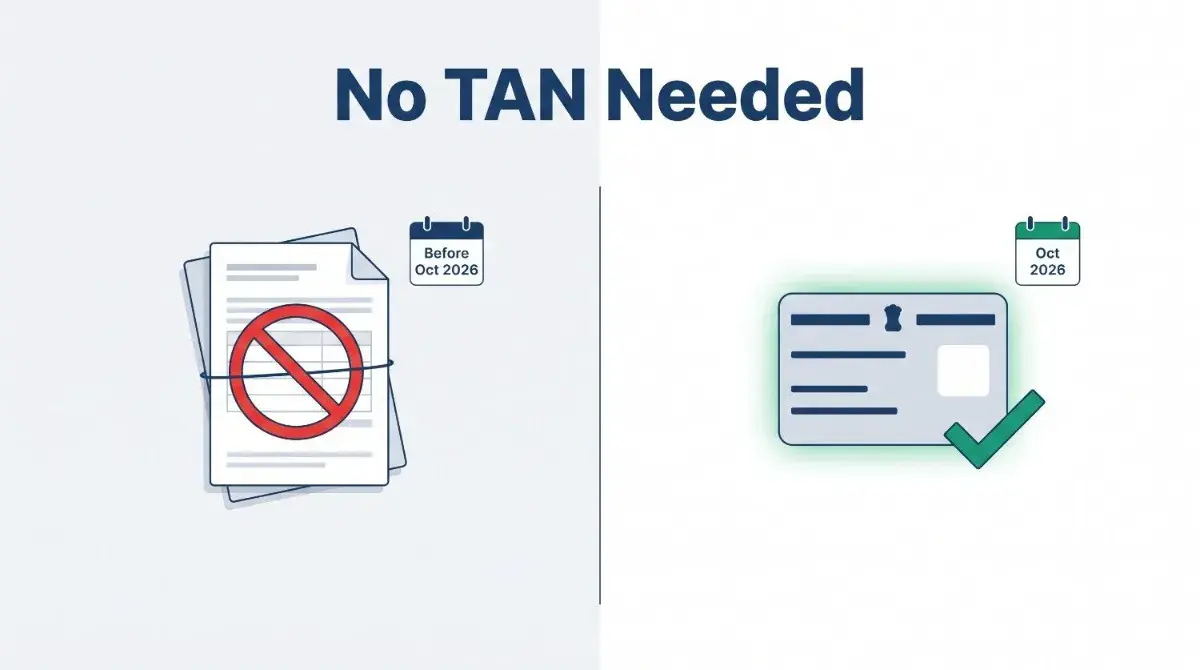
No TAN for NRI property purchase applies only from 1 October 2026, and only to resident individual and HUF buyers. Get the rates, forms, and dates you need.
Jul 25, 2026

Did you lose the SGB premature redemption tax exemption? Here's exactly who's affected, how much tax applies now, and how to check your own bonds.
Jul 24, 2026