

How to save LTCG tax legally in India: 8 strategies covering Section 54, 54EC, 54F, CGAS, HUF and loss set-off with real ₹ math.
LTCG tax in India is 12.5% on long-term capital gains above ₹1.25 lakh a year, but you can legally cut or wipe out that bill using exemption harvesting, Section 54/54EC/54F reinvestment, HUF splitting and loss set-off — all explained below with real numbers.
What Is LTCG Tax?
Who Does This Apply To?
LTCG Tax Rates and Limits for FY 2025-26
8 Legal Ways to Save LTCG Tax
The Section 87A Rebate Trap
LTCG Tax on Shares: FY 2026-27 and the Income Tax Act 2025
Worked Examples
What If Something Goes Wrong?
Documents Needed
Penalties
FAQs
Long-term capital gains (LTCG) tax is what you pay when you sell an asset held beyond the qualifying period — 12 months for listed shares and equity mutual funds, 24 months for property, gold and unlisted shares — at a profit. Section 112A of the Income-tax Act, 1961 governs LTCG on listed equity and equity-oriented funds; Section 112 covers everything else.
Here's the part most investors miss: holding one extra day past the 12-month mark can shift your tax rate from 20% (STCG) to 12.5% (LTCG). That's not a rounding error — it's real money.
Applies To | Does NOT Apply To |
|---|---|
Individuals, HUFs, NRIs selling listed shares, mutual funds, property, gold | Traders treating shares as business stock (taxed as business income) |
Anyone with LTCG above the ₹1.25 lakh annual threshold | Short-term gains (held under 12/24 months — taxed separately under Section 111A/normal slabs) |
Resident and non-resident sellers of Indian property | Companies and firms claiming Section 54/54F (only individuals and HUFs can) |
Partial case: if you're an NRI selling shares, your LTCG is still taxed under Section 112A, but TDS is deducted at the time of sale itself — refundable only by filing an ITR.
This is the LTCG tax free limit 1.25 lakh FY 2025-26 rule: the first ₹1.25 lakh of LTCG on listed equity and equity mutual funds in a financial year is completely tax-free. Only the amount above that is taxed at 12.5%, with no indexation benefit.
Listed shares & equity MFs (Sec 112A): 12.5% above ₹1.25 lakh/year, no indexation, STT must be paid on both buy and sell legs.
Property, gold, unlisted shares (Sec 112): 12.5% without indexation, or 20% with indexation for assets bought before 23 July 2024 — whichever is lower, available to residents/HUFs.
Grandfathering: gains accrued before 31 January 2018 on listed shares stay protected — cost is the higher of actual cost or FMV on that date, capped at sale price.
54EC bonds cap: ₹50 lakh per financial year, REC/PFC/IRFC, plus HUDCO bonds notified under Notification 31/2025 dated 07-04-2025.
Every March, sell shares with unrealised gains up to ₹1.25 lakh, then buy them right back. You lock in tax-free profit and reset your cost basis — same holding, zero tax.
This works because there's no wash sale rule India LTCG shares face — unlike the US, selling and immediately repurchasing the same security is completely legal here. No 30-day waiting period, no penalty. This is the core of LTCG tax harvesting India strategy that most retail investors never use.
Got a ₹2.5 lakh gain sitting in one stock? Sell half (₹1.25 lakh worth) before 31 March and the rest after 1 April. Each financial year gets its own ₹1.25 lakh exemption, so you use both windows instead of one.
Sold a residential house? Buy another one within 1 year before or 2 years after the sale, or build one within 3 years, and the entire gain is exempt — capped at ₹10 crore from FY 2023-24 onward. Only individuals and HUFs qualify; not companies.
Invest your LTCG from land or building (up to ₹50 lakh) in NHAI/REC/PFC bonds and the gain is exempt. Here's the 54EC bonds 6 month deadline mistake that catches people out: the clock starts from your sale date, not from 31 March of that financial year. Sell on 10 October and you must invest by 10 April — miss it by even a day and the whole exemption is gone.
Sold shares, gold or commercial property (not a house) and want the gain exempt? Reinvest the entire net sale consideration — not just the gain — into one residential house, within the same 1-3 year window as Section 54. You must not own more than one other house on the sale date, or the exemption is denied outright.
Sold an asset but haven't found the right property yet? Open a Capital Gains Account at any authorised public sector bank — SBI, PNB, Bank of Baroda all offer it — before your ITR filing due date. Choose Type A (savings, flexible withdrawal) or Type B (term deposit, better interest). You then get up to 2 years to buy, or 3 years to construct, without losing the Section 54/54F exemption.
A Hindu Undivided Family is a separate taxpayer with its own ₹1.25 lakh annual LTCG exemption. Run investments through husband, wife and the family HUF together, and you get ₹3.75 lakh of combined tax-free LTCG every year — completely legal, provided the HUF genuinely owns the funds and isn't just a name on a folio.
Sell loss-making long-term holdings in the same year as your winners. Long-term capital losses can only be set off against long-term capital gains — not short-term gains, not salary income. Unabsorbed loss carries forward for 8 assessment years, but only if you file your ITR before the due date.
Here's a gotcha that surprises first-time investors: Section 87A rebate LTCG shares don't mix. Even if your total income is below ₹12 lakh and would normally get a full rebate under the new regime, that rebate cannot be claimed against LTCG taxed under Section 112A. You will owe 12.5% LTCG tax above ₹1.25 lakh regardless of how low your other income is.
The Income-tax Act, 2025 took effect from 1 April 2026, replacing the 1961 Act for Tax Year 2026-27 onward. The substantive LTCG rules — the 12.5% rate, the ₹1.25 lakh exemption, the holding periods — carry forward unchanged; only the section numbers shift. [VERIFY: exact 2025-Act section numbers for 112A, 54, 54EC and 54F + incometaxindia.gov.in parallel-reading utility]
If you're filing for FY 2025-26 (AY 2026-27) right now, none of this affects you — you still cite the 1961 Act sections. The renumbering only matters for transactions from 1 April 2026 onward.
Example 1 — Common case: Suresh, salaried investor. Suresh sold equity mutual fund units in December 2025 for a ₹3,00,000 LTCG. Exemption: ₹1,25,000. Taxable LTCG: ₹3,00,000 − ₹1,25,000 = ₹1,75,000. Tax at 12.5%: ₹1,75,000 × 12.5% = ₹21,875 (plus applicable cess).
Example 2 — Edge case: Farida, NRI selling property with reinvestment. Farida, an NRI, sold an inherited flat in Pune for ₹1.2 crore in August 2025, with an LTCG of ₹45 lakh (no indexation option chosen). She bought a new flat in Mumbai for ₹30 lakh in November 2025 and invested the remaining ₹15 lakh in REC bonds under Section 54EC within 4 months of the sale — well inside the 6-month window. Exemption under Section 54: ₹30 lakh. Exemption under Section 54EC: ₹15 lakh. Total exempt: ₹45 lakh. Taxable LTCG: zero.
1. You missed the 54EC 6-month deadline. There's no extension and no condonation for delay in most cases — the exemption is lost permanently for that gain. Your only fallback is checking if Section 54/54F reinvestment in a house is still possible within its own window.
2. Your CGAS deposit wasn't used in time. If the 2-year (purchase) or 3-year (construction) window lapses without the funds being used, the unutilised amount becomes taxable LTCG in the year the deadline expires — not the year you sold the original asset. File that year's ITR with this disclosed.
3. You claimed Section 54F while owning two houses. If scrutiny reveals you owned more than one other house on the sale date, the exemption gets reversed entirely, and you'll receive a notice for the shortfall tax plus interest under Section 234B. Respond with documentary proof of house ownership dates, or consult a CA before replying.
Sale deed/contract note for the asset sold (digital copy accepted)
Purchase deed or allotment letter for the new asset (Sections 54/54F)
54EC bond allotment certificate with ISIN (Section 54EC)
CGAS passbook and deposit receipt, if used
Broker's capital gains statement (for shares/MFs) — get this from your demat/broker portal
Form 26AS/AIS to cross-check TDS on property sales
Claiming an exemption you're not entitled to invites a penalty of 100-300% of the tax evaded under Section 271(1)(c). Missing an advance tax instalment on LTCG attracts 1% monthly interest under Section 234B/234C. Filing your ITR late forfeits your right to carry forward LTCG losses — there is no exception for "I forgot."
No — the gain must arise from shares held for more than 12 months to qualify as long-term. Sell on the exact 12-month anniversary and it's typically treated as short-term, taxed at 20% instead of 12.5%.
No. Reinvesting LTCG into other shares or mutual funds gives you no exemption — Sections 54, 54EC and 54F apply only to reinvestment in specific assets like a residential house or notified bonds, not other securities.
No, India has no wash sale rule. You can sell shares to book a ₹1.25 lakh tax-free gain and buy them back the same day — this is fully legal under current Income-tax Act, 1961 provisions.
If you opened a CGAS account before your ITR due date, you still have until the full 2-year (purchase) or 3-year (construction) window to use the funds. If you didn't open one, the exemption may already be lost — check with a CA immediately.
Yes, provided each entity genuinely owns its own investments and isn't merely a name used to route someone else's funds. The Income Tax Department can reclassify gains under clubbing provisions if the underlying money traces back to one person.
No. Section 87A rebate excludes all LTCG taxed under Section 112A (equity) and generally does not offset Section 112 LTCG (property, gold) either when the new regime's rebate cap applies — check current rebate rules before assuming.
Generally no. Courts have occasionally granted relief in genuine hardship cases (e.g., bank-side processing delays proven in writing), but this requires litigation, not a simple request. Don't rely on this as a backup plan.
Yes. An NRI can claim Section 54 on the portion reinvested in a new Indian residential house and Section 54EC on the remaining gain (up to ₹50 lakh) invested in bonds, provided TDS already deducted is reconciled via ITR.
Each HUF gets its own ₹1.25 lakh equity LTCG exemption, separate from its members. A husband, wife and HUF together can shelter ₹3.75 lakh in tax-free LTCG annually — a saving of roughly ₹46,875 in tax versus running everything through one person.
No. Loss carry-forward under Section 80 requires filing the original ITR by the due date under Section 139(1). A belated return filed after the deadline forfeits this right permanently for that year's losses.
Start by checking your broker's capital gains statement for unrealised LTCG you can harvest before this financial year closes. LTCG tax calculator can show your exact tax in seconds, and for property sales, capital gains exemption Section 54/54EC/54F guide walks through reinvestment timelines. For official rules, always cross-check at incometaxindia.gov.in.
For educational purposes only. Verify all figures at official sources before acting. Toolisky is not affiliated with any government body. Consult a qualified CA or legal professional before making compliance decisions. See toolisky.com/accuracy-and-limitations.
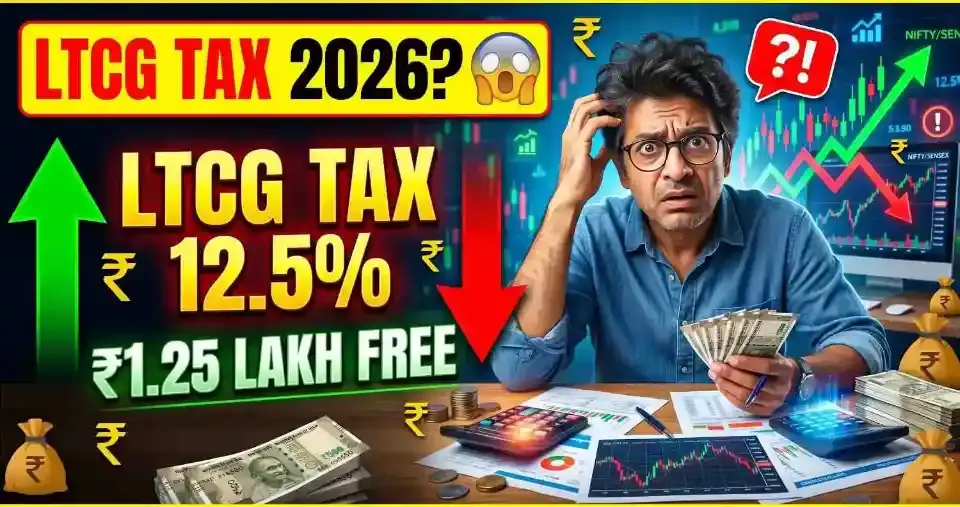
Understand LTCG tax rate India 2026 (12.5%). Check exemption ₹1.25 lakh, property & mutual fund rules, examples and tax saving tips.
Apr 28, 2026
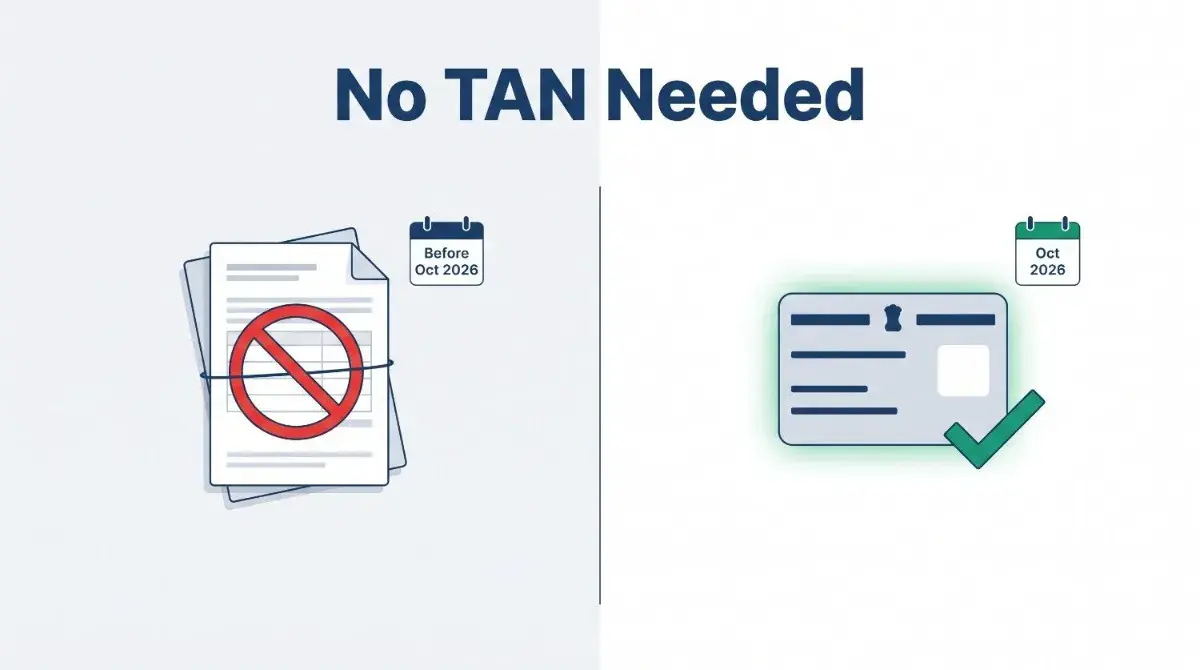
No TAN for NRI property purchase applies only from 1 October 2026, and only to resident individual and HUF buyers. Get the rates, forms, and dates you need.
Jul 25, 2026

Did you lose the SGB premature redemption tax exemption? Here's exactly who's affected, how much tax applies now, and how to check your own bonds.
Jul 24, 2026