

Income tax slab FY 2026-27 unchanged after Budget 2026. See new regime rates (5%–30%), old regime comparison, and find out which saves you more tax this year.
For FY 2025-26 (AY 2026-27), the new tax regime is the default under Section 115BAC. Under it, income up to Rs 4 lakh is fully tax-free at the slab level, and with the Rs 75,000 standard deduction plus the Section 87A rebate of Rs 60,000, a salaried person earning up to Rs 12.75 lakh gross pays zero tax. The old regime still applies if your total eligible deductions are high enough to make it worthwhile. Here is every official rate, slab, and worked example you need.
The Union Budget 2025 (Finance Act 2025) introduced two major changes effective from FY 2025-26 (AY 2026-27):
First, the new regime slab structure was overhauled into 7 slabs, with the nil-tax base raised to Rs 4 lakh. Second, the Section 87A rebate under the new regime was raised to Rs 60,000, meaning residents with taxable income up to Rs 12 lakh owe zero tax after the rebate.
For salaried employees, the standard deduction under the new regime remains Rs 75,000 (introduced in Budget 2024). Combined with the rebate, a salaried person with gross income up to Rs 12.75 lakh has zero final tax liability under the new regime.
The old regime slabs remain unchanged. The new regime became the default regime from AY 2024-25 (FY 2023-24) per the Finance Act 2023 and continues as default for AY 2026-27.
Source: incometaxindia.gov.in, page last reviewed 19-May-2026.
The new regime under Section 115BAC of the Income Tax Act applies uniformly to all ages — below 60, senior citizens, and super seniors are all taxed at the same slab rates under the new regime.
Income Tax Slab | Tax Rate |
|---|---|
Up to Rs 4,00,000 | Nil |
Rs 4,00,001 to Rs 8,00,000 | 5% above Rs 4,00,000 |
Rs 8,00,001 to Rs 12,00,000 | Rs 20,000 + 10% above Rs 8,00,000 |
Rs 12,00,001 to Rs 16,00,000 | Rs 60,000 + 15% above Rs 12,00,000 |
Rs 16,00,001 to Rs 20,00,000 | Rs 1,20,000 + 20% above Rs 16,00,000 |
Rs 20,00,001 to Rs 24,00,000 | Rs 2,00,000 + 25% above Rs 20,00,000 |
Above Rs 24,00,000 | Rs 3,00,000 + 30% above Rs 24,00,000 |
Section 87A rebate: up to Rs 60,000 rebate (100% of tax) if total taxable income does not exceed Rs 12,00,000. Add 4% Health and Education Cess on tax after rebate.
Deductions allowed under new regime: standard deduction of Rs 75,000 for salaried and pensioners, employer NPS contribution under Section 80CCD(2) up to 14% of salary, Section 80CCH (Agniveer Corpus Fund), and interest on home loan for let-out property under Section 24(b). No other Chapter VI-A deductions are available.
Get your exact figure in seconds — use our Old vs New Tax Regime Calculator on Toolisky.
The old regime allows deductions under Chapter VI-A — Section 80C (up to Rs 1.5 lakh), Section 80D (health insurance), HRA (House Rent Allowance), LTA (Leave Travel Allowance), home loan interest under Section 24(b) for self-occupied property up to Rs 2 lakh, and many more.
Income Tax Slab | Tax Rate |
|---|---|
Up to Rs 2,50,000 | Nil |
Rs 2,50,001 to Rs 5,00,000 | 5% above Rs 2,50,000 |
Rs 5,00,001 to Rs 10,00,000 | Rs 12,500 + 20% above Rs 5,00,000 |
Above Rs 10,00,000 | Rs 1,12,500 + 30% above Rs 10,00,000 |
Income Tax Slab | Tax Rate |
|---|---|
Up to Rs 3,00,000 | Nil |
Rs 3,00,001 to Rs 5,00,000 | 5% above Rs 3,00,000 |
Rs 5,00,001 to Rs 10,00,000 | Rs 10,000 + 20% above Rs 5,00,000 |
Above Rs 10,00,000 | Rs 1,10,000 + 30% above Rs 10,00,000 |
Income Tax Slab | Tax Rate |
|---|---|
Up to Rs 5,00,000 | Nil |
Rs 5,00,001 to Rs 10,00,000 | 20% above Rs 5,00,000 |
Above Rs 10,00,000 | Rs 1,00,000 + 30% above Rs 10,00,000 |
Section 87A rebate under old regime: up to Rs 12,500 if taxable income does not exceed Rs 5,00,000.
Parameter | New Regime | Old Regime |
|---|---|---|
Default status | Yes — default from AY 2024-25 (FY 2023-24) onwards | Must opt in each year (salaried non-business); once only for business income |
Nil-tax base slab | Rs 4,00,000 | Rs 2,50,000 (below 60); Rs 3L (senior); Rs 5L (super senior) |
Zero tax after rebate | Up to Rs 12,00,000 (Section 87A rebate Rs 60,000) | Up to Rs 5,00,000 (Section 87A rebate Rs 12,500) |
Standard deduction | Rs 75,000 (salaried and pensioners) | Rs 50,000 (salaried and pensioners) |
Section 80C | Not available | Up to Rs 1,50,000 |
HRA exemption | Not available | Available under Section 10(13A) |
Home loan interest — self-occupied (Section 24b) | Not available | Up to Rs 2,00,000 |
Home loan interest — let-out (Section 24b) | Available (no cap; loss set-off restricted) | Available (actual interest; loss set-off up to Rs 2L against other heads) |
Section 80D — health insurance | Not available | Up to Rs 25,000; Rs 50,000 for senior citizens |
NPS employer contribution (Section 80CCD2) | Available — up to 14% of salary | Available — up to 10% of salary (PSU/others); 14% (Govt) |
Section 80CCH — Agniveer | Available | Available |
Best suited for | Lower deduction claimers, early-career earners | Active investors, home loan payers, high HRA claimers |
Total Income | Surcharge — New Regime | Surcharge — Old Regime |
|---|---|---|
Up to Rs 50 lakh | Nil | Nil |
Rs 50 lakh to Rs 1 crore | 10% | 10% |
Rs 1 crore to Rs 2 crores | 15% | 15% |
Rs 2 crores to Rs 5 crores | 25% | 25% |
Above Rs 5 crores | 25% (capped) | 37% |
Note: The enhanced surcharge of 25% and 37% does not apply to income taxable under Sections 111A, 112, 112A, or dividend income. Maximum surcharge on such income is 15%. Add 4% Health and Education Cess on tax plus surcharge in all cases.
The process is identical under both regimes. The difference is only in which deductions you subtract before applying slab rates.
Step 1 — Add up all income heads: salary including all allowances, rental income, capital gains (short-term and long-term separately), interest income, and any freelance or business income.
Step 2 — Under the new regime: subtract only the Rs 75,000 standard deduction (for salaried and pensioners) and employer NPS contribution under Section 80CCD(2). Under the old regime: subtract all eligible deductions — HRA, LTA, standard deduction of Rs 50,000, 80C, 80D, Section 24(b), and all others you qualify for.
Step 3 — Apply the applicable slab rates on the resulting total income to arrive at gross tax.
Step 4 — Apply Section 87A rebate if your total income is within the eligible threshold (Rs 12 lakh under new regime; Rs 5 lakh under old regime).
Step 5 — Add surcharge if total income exceeds Rs 50 lakh (see surcharge table above). Then add 4% Health and Education Cess on the combined tax and surcharge.
Riya works at a Pune IT firm. She has Rs 60,000 in provident fund and Rs 50,000 in ELSS mutual funds under Section 80C, and pays Rs 18,000 annual health insurance premium under Section 80D. No HRA because she lives in her own flat.
Under the new regime
Particulars | Amount |
|---|---|
Gross salary | Rs 9,00,000 |
Less: standard deduction | Rs 75,000 |
Taxable income | Rs 8,25,000 |
Tax on Rs 4L to Rs 8L at 5% | Rs 20,000 |
Tax on Rs 8L to Rs 8.25L at 10% | Rs 2,500 |
Gross tax | Rs 22,500 |
Add: 4% Health and Education Cess | Rs 900 |
Total tax payable | Rs 23,400 |
Note: Taxable income is Rs 8,25,000 — above Rs 8 lakh so not eligible for Section 87A rebate (which requires total income up to Rs 12 lakh, but that rebate only brings tax to nil if income is up to Rs 12L, not reduces it partially — rebate fully covers tax if total income up to Rs 12L).
Correction: Rs 8,25,000 is below Rs 12 lakh, so Section 87A rebate of Rs 60,000 applies. Since gross tax is only Rs 22,500 (less than Rs 60,000 cap), entire tax is waived.
Total tax payable (new regime) | Rs 0 (full rebate under Section 87A) |
|---|
Under the old regime
Particulars | Amount |
|---|---|
Gross salary | Rs 9,00,000 |
Less: standard deduction Rs 50,000 + 80C Rs 1,50,000 + 80D Rs 18,000 | Rs 2,18,000 |
Taxable income | Rs 6,82,000 |
Tax on Rs 2.5L to Rs 5L at 5% | Rs 12,500 |
Tax on Rs 5L to Rs 6.82L at 20% | Rs 36,400 |
Gross tax | Rs 48,900 |
Add: 4% Health and Education Cess | Rs 1,956 |
Total tax payable | Rs 50,856 |
Note: Taxable income Rs 6,82,000 exceeds Rs 5,00,000, so Section 87A rebate under old regime is not available.
Verdict: New regime saves Riya Rs 50,856. At Rs 9 lakh salary with modest deductions, the new regime is decisively better.
Sameer is a senior manager in Mumbai. He pays Rs 96,000 home loan interest on a self-occupied flat, claims full Section 80C of Rs 1.5 lakh, HRA exemption of Rs 1.2 lakh, and Section 80D of Rs 25,000.
Under the new regime
Particulars | Amount |
|---|---|
Gross salary | Rs 25,00,000 |
Less: standard deduction | Rs 75,000 |
Taxable income | Rs 24,25,000 |
Tax on Rs 4L to Rs 8L at 5% | Rs 20,000 |
Tax on Rs 8L to Rs 12L at 10% | Rs 40,000 |
Tax on Rs 12L to Rs 16L at 15% | Rs 60,000 |
Tax on Rs 16L to Rs 20L at 20% | Rs 80,000 |
Tax on Rs 20L to Rs 24L at 25% | Rs 1,00,000 |
Tax on Rs 24L to Rs 24.25L at 30% | Rs 7,500 |
Gross tax | Rs 3,07,500 |
Add: 4% Health and Education Cess | Rs 12,300 |
Total tax payable | Rs 3,19,800 |
Under the old regime
Particulars | Amount |
|---|---|
Gross salary | Rs 25,00,000 |
Less: standard deduction Rs 50K + 80C Rs 1.5L + HRA Rs 1.2L + Section 24(b) Rs 96K + 80D Rs 25K | Rs 4,41,000 |
Taxable income | Rs 20,59,000 |
Tax on Rs 2.5L to Rs 5L at 5% | Rs 12,500 |
Tax on Rs 5L to Rs 10L at 20% | Rs 1,00,000 |
Tax on Rs 10L to Rs 20.59L at 30% | Rs 3,17,700 |
Gross tax | Rs 4,30,200 |
Add: 4% Health and Education Cess | Rs 17,208 |
Total tax payable | Rs 4,47,408 |
Verdict: New regime saves Sameer Rs 1,27,608. This is because the new regime slabs are significantly lower with the 7-slab structure. At Rs 25 lakh, even with Sameer's deductions, the old regime's steep 20% and 30% slabs make it costlier. Sameer should verify with a CA if he has additional deductions like NPS or home loan on a let-out property that could further shift this calculation.
The new regime's revised 7-slab structure with rates as low as 5% for income between Rs 4 lakh and Rs 8 lakh makes it favourable for most taxpayers at most income levels for AY 2026-27. The old regime can still win for taxpayers who have very large HRA exemptions combined with home loan interest on a let-out property (which is also allowed under the new regime but capped differently) and full 80C utilisation.
Run both calculations with actual numbers. The Old vs New Tax Regime Calculator on Toolisky does this instantly.
If you received maturity proceeds from a ULIP (Unit Linked Insurance Plan) policy where annual premiums exceeded Rs 2.5 lakh and the policy was issued after February 2021, those proceeds are taxable as capital gains, not exempt under Section 10(10D). This interacts with your slab income and could push you above the Rs 12 lakh rebate threshold under the new regime, costing you the full Rs 60,000 rebate in one go. Use the ULIP Capital Gains Tax Calculator on Toolisky to model the impact before filing.
Many people assume the Rs 12 lakh zero-tax benefit gradually phases out. It does not. The Section 87A rebate of Rs 60,000 under the new regime is available only if total taxable income is Rs 12,00,000 or below. If your income is Rs 12,00,001, you owe full slab-level tax with no rebate whatsoever — roughly Rs 60,000 in tax on Rs 12,00,001. Earning one extra rupee above Rs 12 lakh can cost you Rs 60,000. If your income is near this threshold, plan proactively — maximise NPS employer contribution under Section 80CCD(2) to bring taxable income to or below Rs 12 lakh.
Log into the income tax portal at incometaxindia.gov.in and check your Annual Information Statement (AIS) to confirm what income and TDS are already recorded against your PAN. If TDS deducted by your employer assumed the new regime but you want the old regime, communicate your regime choice to your employer in writing before the end of the financial year. For business income taxpayers who want the old regime, file Form 10-IEA on or before the ITR due date under Section 139(1).
Old vs New Tax Regime Calculator — compare both regimes side by side for your income
Salary Tax Calculator — compute exact take-home for any CTC
Section 87A Marginal Relief Calculator — find the rebate cliff at Rs 12 lakh under the new regime
Standard Deduction Tax Impact Calculator — see what the Rs 75,000 deduction saves you
Old vs New Tax Regime Guide FY 2025-26 — full written comparison
Income Tax Act 2025 vs 1961 — What Every Indian Taxpayer Must Know
Get your exact figure in seconds — use our Salary Tax Calculator on Toolisky.
It is the default regime per the Finance Act 2023 (applicable from AY 2024-25 onwards). Your employer deducts TDS on new regime rates unless you communicate a preference for the old regime. It is not compulsory — salaried individuals without business income can switch each year when filing their ITR.
The new regime has 7 slabs: nil up to Rs 4 lakh, 5% from Rs 4 to Rs 8 lakh, 10% from Rs 8 to Rs 12 lakh, 15% from Rs 12 to Rs 16 lakh, 20% from Rs 16 to Rs 20 lakh, 25% from Rs 20 to Rs 24 lakh, and 30% above Rs 24 lakh. These rates are the same for all ages under the new regime.
Rs 60,000 — or 100% of tax liability, whichever is lower — if total taxable income does not exceed Rs 12,00,000. Under the old regime the rebate is Rs 12,500 if total income does not exceed Rs 5,00,000.
Rs 75,000 under the new regime and Rs 50,000 under the old regime, both for salaried employees and pensioners. Freelancers and business owners do not get this deduction under either regime.
The new regime allows: Rs 75,000 standard deduction (salaried/pensioners), employer NPS contribution under Section 80CCD(2) up to 14% of salary, Section 80CCH (Agniveer Corpus Fund contribution), and interest on home loan for let-out property under Section 24(b). Chapter VI-A deductions including 80C, 80D, HRA, and home loan interest on self-occupied property are not available.
Salaried individuals and other non-business taxpayers can switch regimes each year by indicating their choice in the ITR filed on or before the Section 139(1) due date. Business and professional taxpayers can switch to the old regime only once in their lifetime by filing Form 10-IEA — after switching back to the old regime, they cannot re-enter the new regime again, except by filing Form 10-IEA once more.
With the new regime's revised 7-slab structure and Rs 60,000 rebate, it is better for most salaried taxpayers at most income levels compared to prior years. The old regime may still win for taxpayers with combined deductions (HRA plus 80C plus 80D plus home loan interest on self-occupied) exceeding Rs 5 to Rs 6 lakh at higher income brackets. Always run both calculations with your actual numbers rather than using a rule of thumb.
If your total taxable income after all allowed deductions is Rs 12,00,000 or below, the Section 87A rebate of up to Rs 60,000 wipes out your entire tax liability under the new regime. Salaried employees earning up to Rs 12.75 lakh gross reach Rs 12 lakh taxable after the Rs 75,000 standard deduction. The rebate is all-or-nothing — one rupee above Rs 12 lakh and the entire rebate disappears.
Freelancers and self-employed individuals do not get the Rs 75,000 standard deduction under either regime. Under the new regime their net professional income after business expenses is taxed at the new slab rates. Under the old regime they can claim business expenses plus Chapter VI-A deductions. Use the Professional Income Tax Calculator on Toolisky for accurate figures.
incometaxindia.gov.in — Salaried Individuals for AY 2026-27 — official slab tables, rebate, surcharge (page last reviewed 19-May-2026)
incometaxindia.gov.in — Tax Rates AY 2025-26 and 2026-27 — official rate tables
cbdt.gov.in — CBDT circulars and Finance Act 2023 and 2025 notifications
pib.gov.in — Union Budget 2025 press releases
No TAN for NRI property purchase applies only from 1 October 2026, and only to resident individual and HUF buyers. Get the rates, forms, and dates you need.
Jul 25, 2026

Did you lose the SGB premature redemption tax exemption? Here's exactly who's affected, how much tax applies now, and how to check your own bonds.
Jul 24, 2026
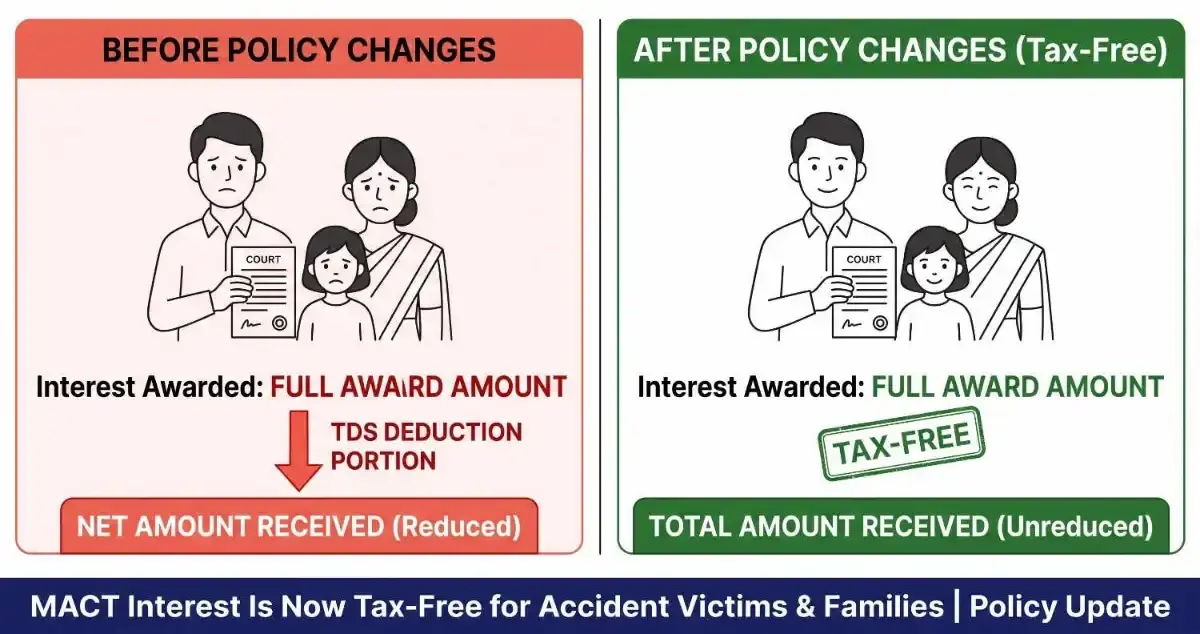
MACT interest income TDS exemption 2026 explained: who qualifies, old vs new Act rules, the FD interest trap, refund steps, and how to report it in your ITR.
Jul 24, 2026