

Section 194T TDS explained: 10% rate, ₹20,000 threshold, 40(a)(ia) disallowance dispute, Section 393 mapping, non-resident partner gap, and journal entries.
If your firm pays a partner salary, commission, bonus, or interest above ₹20,000 a year, you owe 10% TDS under Section 194T. This is non-negotiable, even if part of that payment later gets disallowed under Section 40(b). The rule started 1 April 2025 and catches firms that never deducted TDS on anything before.
Section 194T of the Income-tax Act, 1961 makes a partnership firm or LLP deduct tax before paying a partner anything classified as salary, remuneration, commission, bonus, or interest. Until 31 March 2025, none of this attracted withholding. Partners paid tax themselves at filing time. The Finance (No. 2) Act, 2024 closed that gap.
This topic spans two laws. Payments credited or paid up to 31 March 2026 (FY 2025-26, AY 2026-27) fall under Section 194T of the 1961 Act. From 1 April 2026 (Tax Year 2026-27), the same rule sits under Section 393(3), Table Sl. No. 7 of the Income-tax Act, 2025, confirmed via the Income Tax Department's official 1961-vs-2025 mapping resource and cross-checked through CBDT-aligned compliance guidance, since the rate and threshold carry over unchanged.
Applies to | Does NOT apply to |
|---|---|
Traditional partnership firms (Indian Partnership Act, 1932) | A partner's share of profit (exempt under Section 10(2A)) |
LLPs registered under the LLP Act, 2008 | Capital withdrawals or drawings |
Both small and large firms (no turnover or audit threshold) | Genuine reimbursement of business expenses with bills |
Resident working and non-working partners, and minors admitted to benefits | Payments below ₹20,000 aggregate per partner per year |
A note on partial cases: a minor admitted to the benefits of a partnership is still covered by 194T if payments cross the threshold, even though Section 40(b) deduction limits apply only once that minor becomes a full working partner. Almost no consumer guide states this; don't assume minors are automatically exempt.
Rate: 10% on the gross covered amount. 20% if the partner has no PAN (Section 206AA).
Threshold: ₹20,000 aggregate per partner per financial year, combining salary, commission, bonus, and interest. Cross it, and TDS applies to the entire amount, not just the excess.
Trigger point: earlier of credit (including to the capital account) or actual payment. A March book entry triggers TDS even with zero cash movement.
Deposit deadline: 7th of the following month; for March deductions, 30 April 2026.
Returns: Form 26Q for resident partners, Form 27Q for non-resident partners, filed quarterly.
No Form 15G/15H, no Section 197 certificate is available for 194T in FY 2025-26, since the section isn't on the eligible list, a real cash-flow problem for partners in the nil-tax bracket this year.
Section 40(b) limits run separately on a tiered structure: for book profit up to ₹6,00,000, the deductible cap is the higher of ₹3,00,000 or 90% of book profit; above ₹6,00,000, it's ₹5,40,000 (90% of the first slab) plus 60% of the remaining book profit. This cap decides what the firm can deduct. It has no bearing on how much TDS the firm must withhold under 194T. Use the Section 40(b) Partner Remuneration Calculator to get your exact allowable figure before you finalise payouts.
The disallowance dispute nobody's settled yet: most guides flatly say a 194T default triggers a 30% expense disallowance under Section 40(a)(ia). But that section disallows expenditure under Sections 30-38, and partner remuneration falls under Section 40(b), a different chapter. Some practitioners argue 40(a)(ia) may not technically reach 194T defaults, leaving Section 271C (penalty equal to undeducted TDS) and 201(1A) interest as the real exposure. CBDT hasn't clarified this publicly. Treat both consequences as live risk.
Example 1, common case. Suresh is a working partner at an LLP in Pune. Over FY 2025-26 the firm credits him ₹10,000 monthly salary (₹1,20,000), a ₹15,000 year-end bonus, and ₹10,000 commission. Total = ₹1,45,000. That's above ₹20,000, so TDS applies on the full sum, not the excess over the threshold.
TDS = ₹1,45,000 × 10% = ₹14,500. Suresh receives ₹1,30,500 net, and ₹14,500 shows up in his Form 26AS as a credit he claims while filing ITR-3.
Example 2, edge case (the one competitors skip). Farida is a non-resident partner in an Indian LLP, settled in Dubai, receiving ₹6,00,000 annual remuneration. Plain-text reading of 194T doesn't exclude non-residents, so the firm could withhold 10% under 194T = ₹60,000. But Section 195 is the dedicated non-resident TDS section, and only Section 195 unlocks DTAA relief and a Section 197 lower-deduction certificate. Neither of these is available under 194T.
This isn't theoretical: CBDT amended Form 27Q on 27 March 2025 specifically to add a 194T line ahead of the existing Section 195 entry for non-resident partner payments, a sign the department currently expects 194T (not 195) to apply. Until a circular settles the qua-income versus qua-residential-status conflict, firms with NRI partners should get this confirmed in writing by their CA before deducting, since the wrong call costs the partner their treaty benefit.
Add every covered payment to that partner for the year: salary + commission + bonus + interest on capital.
Check the running total against ₹20,000. Below it, stop. No TDS applies.
Above ₹20,000, apply 10% (or 20% without PAN) to the whole amount.
Deduct at the earlier of credit or payment.
Deposit by the 7th of the next month (30 April for March).
Want this done instantly across all five payment heads instead of by hand? Use the Section 194T TDS Threshold Calculator. Enter the four payment types and PAN status, and it returns the exact TDS figure and net payout.
When the firm credits remuneration and deducts TDS in the same entry:
Partner Remuneration A/c   Dr.  1,45,000
        To Partner's Capital/Current A/c     1,30,500
        To TDS Payable (194T) A/c               14,500
On deposit:
TDS Payable (194T) A/c     Dr.  14,500
        To Bank A/c                              14,500
If remuneration is later disallowed under Section 40(b), only the firm's deduction claim changes. The journal entry and TDS already deposited stay as recorded. Reconciling the gap is a year-end step, not a reversal.
1. TDS deducted on the full amount, but only part allowed under 40(b). Say the firm deducted TDS on ₹8,00,000 paid, but book-profit computation allows only ₹5,00,000 under Section 40(b). File a revised Form 26Q for that quarter; the excess TDS can be adjusted against a future liability or claimed back through the correction process. Don't leave Form 26AS showing ₹8,00,000 against a partner offering only ₹5,00,000 to tax. That mismatch invites a notice.
2. Missed the 30 April deadline for March TDS. Interest runs at 1% per month from when TDS was deductible till deduction, and 1.5% per month from deduction till deposit, under Section 201(1A). Deposit immediately via Challan ITNS 281, then file the correction statement. Delay compounds the interest month by month.
3. Wrong section quoted on a transaction straddling 31 March / 1 April 2026. Credit or payment on or before 31 March 2026 → quote 194T. On or after 1 April 2026 → quote Section 393(3) Sl. No. 7. Using the old number post-transition can trigger a validation error on the TDS portal, forcing a correction filing. Check the credit date in your books, not the filing date.
Partnership deed specifying remuneration, commission, and interest terms (digital copy accepted)
Firm's TAN (apply via NSDL/Protean if missing)
Partner PAN (without it, the rate jumps to 20%)
Book profit working papers for the Section 40(b) cross-check
Quarterly challans and Form 26Q/27Q acknowledgments for the audit trail
Default | Consequence | Section |
|---|---|---|
Failure to deduct TDS | Interest @1% per month until deducted | 201(1A) |
Deducted but not deposited | Interest @1.5% per month until deposited | 201(1A) |
Non-deduction (full default) | Penalty equal to the TDS amount not deducted | 271C |
Late TDS return filing | ₹200 per day until filed, capped at TDS amount | 234E |
Possible expense disallowance | 30% of the unpaid-TDS expense (disputed scope, see above) | 40(a)(ia) |
Wilful non-deposit | Prosecution up to 7 years | 276B |
Section 271C penalty can be waived if the firm proves "reasonable cause" under Section 273B, a genuine, documented belief that TDS didn't apply, not a casual oversight.
No. Profit share is exempt under Section 10(2A) and was never inside the TDS net. 194T only catches salary, remuneration, commission, bonus, or interest the deed authorises separately from profit distribution.
By 194T, not 194A. Section 194A excludes payments to partners by their own firm. The CBDT notification text for 194T explicitly lists interest "on any account," including capital account, as covered.
Yes, that's the most common mistake. Once the aggregate crosses ₹20,000, TDS applies to the whole sum, not the excess. A firm paying ₹25,000 owes TDS of ₹2,500 (10% of ₹25,000), not ₹500.
Interest under Section 201(1A) starts accruing immediately at 1.5% per month on the deducted-but-undeposited amount, and a late Form 26Q filing adds ₹200/day under Section 234E. Deposit first via Challan ITNS 281, then file the correction return. Don't wait to "fix everything" before paying.
Yes. The definition of "firm" under 194T includes LLPs registered under the LLP Act, 2008. The 10% rate, ₹20,000 threshold, and the credit-or-payment trigger apply identically. Section 40(b) deduction limits, however, are computed slightly differently for LLPs than for traditional firms.
This is genuinely unresolved. The plain text of 194T doesn't exclude non-residents, but Section 195 is the dedicated non-resident provision and the only route to DTAA relief. CBDT's March 2025 Form 27Q amendment suggests 194T currently applies too. Confirm with your CA in writing before paying, since the wrong call costs the partner their treaty benefit.
It can. If the retirement deed doesn't clearly separate capital repayment, accumulated profit, and goodwill, authorities can recharacterise part of the payout as remuneration, triggering retrospective TDS exposure. Get the deed itemised before the final settlement is paid.
Yes. Section 194T triggers at the earlier of credit or payment. A year-end journal entry crediting remuneration to the capital account creates the TDS obligation, regardless of when, or whether, cash actually moves.
No. Genuine reimbursements with bills are exempt, but disguising remuneration as reimbursement invites recharacterisation on audit, plus interest and penalty for the TDS that should have been deducted.
194T applies from 1 April 2025 through 31 March 2026. From 1 April 2026, the same rule moves to Section 393(3), Table Sl. No. 7 of the Income-tax Act, 2025, with rate and threshold unchanged. Only the section number and return reference change.
Yes. Section 194T doesn't define these terms, and Section 15's definitions are explicitly excluded by Explanation 2 to Section 15. That gap lets authorities argue broadly for items like club memberships or car-parking reimbursements. Document the nature of every payment to avoid disputes.
Pull last year's partner payment ledger and run it through the Section 194T TDS Threshold Calculator for every partner, then cross-check against the Section 40(b) Partner Remuneration Calculator. If a deadline has slipped, check exposure on the Section 234A, 234B & 234C interest guide. For non-resident partners, confirm with the Income Tax Department portal before deducting.
Income Tax Department, Section 194T of the Income-tax Act, 1961: incometaxindia.gov.in
CBDT, Income-tax (Seventh Amendment) Rules, 2025 (Form 26Q and Form 27Q amendment for partner payments, notified 27 March 2025): incometaxindia.gov.in/notifications
Income Tax Department, utility to check provisions of the Income-tax Act, 1961 vis-à-vis the Income-tax Act, 2025: incometaxindia.gov.in
Income Tax Department, e-filing portal help section on TDS provisions under the Income-tax Act, 2025: incometax.gov.in
For educational purposes only. Verify all figures at official sources before acting. Toolisky is not affiliated with any government body. Consult a qualified CA or legal professional before making compliance decisions. See toolisky.com/accuracy-and-limitations.
No TAN for NRI property purchase applies only from 1 October 2026, and only to resident individual and HUF buyers. Get the rates, forms, and dates you need.
Jul 25, 2026

Did you lose the SGB premature redemption tax exemption? Here's exactly who's affected, how much tax applies now, and how to check your own bonds.
Jul 24, 2026
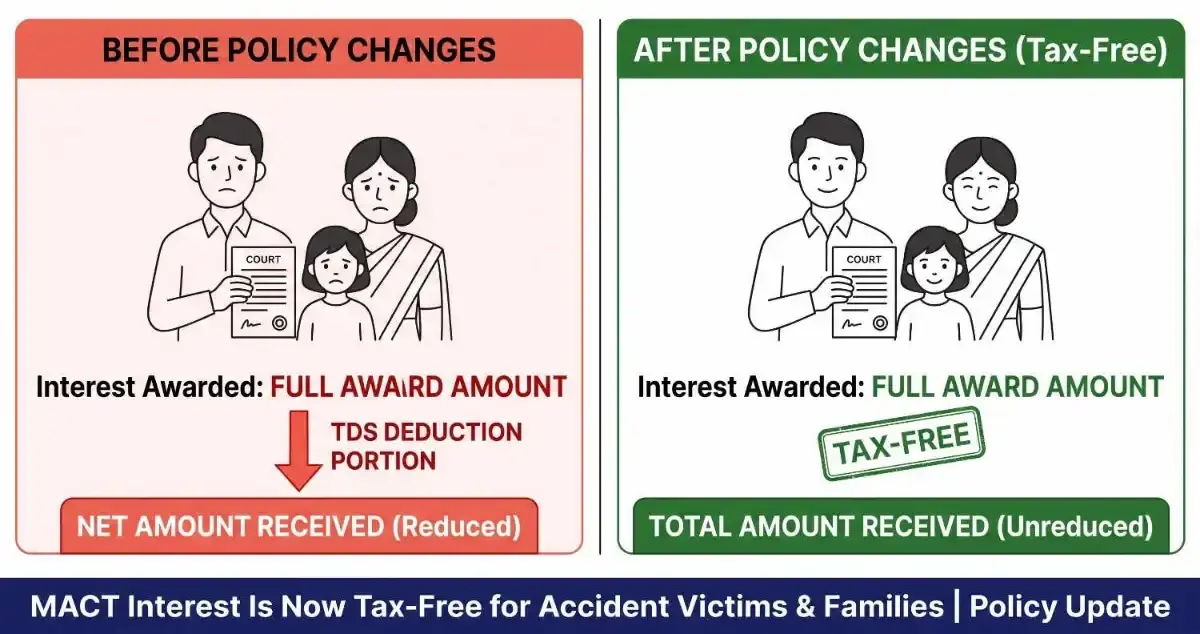
MACT interest income TDS exemption 2026 explained: who qualifies, old vs new Act rules, the FD interest trap, refund steps, and how to report it in your ITR.
Jul 24, 2026