
Tax on FD interest in India: how Section 194A TDS works, 80TTA vs 80TTB limits, Form 15G/15H rules, and how to avoid an AIS mismatch notice
Yes, FD interest is taxable in India. Fully, every year, at slab rate, whether or not the bank deducts TDS. For FY 2025-26, banks deduct TDS under Section 194A only once your interest from that bank crosses ₹50,000 (₹1,00,000 for senior citizens). Below that, you still owe the tax. The bank just doesn't collect it upfront.
What Is Tax on FD Interest?
Who Does This Apply To?
TDS, 80TTA & 80TTB Rules for FY 2025-26
Examples: Real Numbers
How to Save Tax on FD Interest
What If Something Goes Wrong?
Penalties
FAQ
FD interest falls under "Income from Other Sources" under the Income-tax Act, 1961, which governs your income for FY 2025-26 (assessed as AY 2026-27). It gets added to your total income and taxed at your slab rate. There's no special FD rate, and no exemption just because the money sits in a bank deposit.
What trips people up most often: FD interest is taxed on accrual basis, not when you actually receive the money. We'll come back to why that matters in the mismatch section below.
A quick note on timing, since this confuses even careful filers. From 1 April 2026, the Income-tax Act, 1961 gets replaced by the Income-tax Act, 2025, and "Assessment Year" gets replaced by "Tax Year." But your FY 2025-26 income, which is what this article covers, is still governed entirely by the 1961 Act and filed as AY 2026-27. Section 194A, Section 80TTA, and Section 80TTB referenced throughout this guide are all 1961 Act numbers, current and correct for this year's filing.
Applies to | Does NOT apply to |
|---|---|
Anyone with an FD in a bank, NBFC, post office, or cooperative society | NRE account holders (interest exempt under Section 10(4)) |
Resident individuals, HUFs, senior citizens | FD interest already below the basic exemption limit with zero tax payable |
NRIs with NRO fixed deposits | Tax-free notified infrastructure bonds |
People with FDs spread across multiple banks |
Even with zero TDS deducted anywhere, you still must report every rupee of FD interest in your ITR. TDS threshold and "is it taxable" are two separate questions, and mixing them up is exactly how people end up under-reporting income.
Budget 2025 raised the Section 194A thresholds, effective 1 April 2025:
Payee category | Payer | Threshold (FY 2024-25) | Threshold (FY 2025-26) |
|---|---|---|---|
General (below 60) | Bank / post office / co-op bank | ₹40,000 | ₹50,000 |
Senior citizen (60+) | Bank / post office / co-op bank | ₹50,000 | ₹1,00,000 |
Anyone | Other payers (NBFCs, companies) | ₹5,000 | ₹10,000 |
TDS rate is 10% with a valid PAN on file, 20% without one. No surcharge or cess gets added at this stage; that comes later at final tax computation.
Here's a detail competitors gloss over: the threshold applies per bank, not across all your banks combined. Earn ₹45,000 at SBI and ₹45,000 at HDFC, and neither bank deducts TDS. But you've still earned ₹90,000 in interest, all of it taxable, with both entries showing up separately in your AIS.
A deduction of up to ₹10,000 a year, but only on savings account interest, not FD interest. It doesn't touch your fixed deposit income at all. Old regime only.
A much bigger deduction: up to ₹50,000 a year, covering savings account, FD, RD, and post office deposit interest, all combined. This is the one that actually shelters FD income. Old regime only, same as 80TTA.
You can't claim both. If you're 60 or older, always go with 80TTB. It's five times bigger and covers more ground.
Section 80TTA | Section 80TTB | |
|---|---|---|
Who | Individuals & HUFs under 60 | Resident senior citizens 60+ |
Limit | ₹10,000/year | ₹50,000/year |
Covers FD interest? | No | Yes |
Available in new regime? | No | No |
Here's the part that catches people out. Under the new tax regime, the default since FY 2023-24, neither 80TTA nor 80TTB exists. Every rupee of FD and savings interest gets taxed at slab rate with no shelter at all.
That said, the new regime isn't necessarily worse for FD holders. For FY 2025-26, the Section 87A rebate covers tax fully on taxable income up to ₹12,00,000 (₹12,75,000 for salaried individuals once the ₹75,000 standard deduction is applied), with a maximum rebate of ₹60,000. So if your total income, FD interest included, stays under that line, your tax under the new regime is nil regardless of how much of it came from interest. The 80TTA/80TTB deductions only start mattering once your total income runs past this rebate threshold and the old regime's deductions become worth more than the new regime's lower rates.
If your total income for the year will land below the taxable threshold, you can submit a self-declaration asking your bank to skip TDS entirely.
Form 15G: residents and HUFs below 60, estimated tax liability nil.
Form 15H: senior citizens (60+), estimated tax liability after deductions (including 80TTB) nil.
Submit it fresh every April, before the first interest credit, separately at every bank where you hold an FD. Miss the window, and the only way to get the TDS back is by filing your ITR and claiming a refund.
One thing worth flagging for next year: from 1 April 2026, Forms 15G and 15H merge into a single new form, Form No. 121, under the Income-tax Act, 2025. This change doesn't apply to your current FY 2025-26 filing. You still use the existing 15G or 15H this year.
Suresh is 34, salaried, with FDs at two banks under the old regime.
FD at SBI: ₹4,80,000 at 7% → interest = ₹33,600
FD at HDFC: ₹6,00,000 at 7.2% → interest = ₹43,200
Total FD interest: ₹33,600 + ₹43,200 = ₹76,800
Neither bank crosses ₹50,000 individually, so no TDS gets deducted anywhere. But Suresh still owes tax on the full ₹76,800. Section 80TTA doesn't help here, since it only covers savings accounts, not FDs. His ₹76,800 gets added to total income and taxed at his slab rate. In the 20% bracket, that's ₹15,360 in tax plus 4% cess, payable through advance tax or self-assessment tax since no bank withheld anything along the way.
Farida is a senior citizen with no business income, living on pension and FD interest.
FD interest from Bank of Baroda: ₹85,000
Savings account interest: ₹9,000
Total interest income: ₹85,000 + ₹9,000 = ₹94,000
Under the old regime, she claims Section 80TTB: deduction capped at ₹50,000, covering both her FD and savings interest together.
Taxable interest after 80TTB: ₹94,000 − ₹50,000 = ₹44,000
Her FD interest is below the ₹1,00,000 senior-citizen threshold, so the bank deducts no TDS. Since she has no income from business or profession, Section 207 exempts her from advance tax entirely. She can pay whatever's due as self-assessment tax in July, with no Section 234B or 234C interest charged for paying late in the year.
Add up interest from every bank, not just the ones that deducted TDS.
Check your AIS before assuming any number. It often shows more than you remember, especially for cumulative FDs.
Pick your regime deliberately. Senior citizens with meaningful FD income often do better under the old regime's 80TTB deduction plus the ₹3,00,000 basic exemption. Younger taxpayers with modest interest income may come out ahead under the new regime's ₹12 lakh rebate. Run the actual numbers; don't assume.
Submit Form 15G/15H at the start of the year, to every bank separately, only if you genuinely expect zero tax liability.
Spread large deposits across banks if you're close to the per-bank threshold. This won't cut your actual tax, but it avoids unnecessary TDS friction while you wait for a refund.
Report everything in your ITR, even interest with no TDS deducted at all.
This is one of the most common fear-driven searches in this space, and for good reason. Two real causes usually sit behind it.
Accrual vs receipt mismatch. A 3-year cumulative FD has interest reported to AIS as it accrues each year, even though you don't receive a rupee until maturity. If you only declared interest in the year you got paid, your ITR shows less than AIS, and that's a guaranteed mismatch flag.
Fix: declare FD interest every year as it accrues, not just at maturity. You generally can't amend old returns once the deadline has passed, but you can file correctly going forward, and use the updated return provisions (ITR-U) if you're still within the time limit for an earlier year.
Multiple banks, partial TDS. Three of your five FDs deducted TDS, two didn't. AIS shows all five with their respective status, but it's easy to miss the TDS-free ones when self-reporting from memory.
Fix: download your AIS before filing, cross-check every entry against your own bank statements, and report the AIS total, not just what you remember earning.
You'll get an automated notice under Section 143(1)(a). Don't panic; this isn't a penalty notice yet, just a request for clarification. You typically get a window to respond on the e-filing portal, either accepting the discrepancy and paying the additional tax with interest, or submitting your own interest certificates if you believe the AIS figure is wrong. Ignore it, and it escalates toward a formal assessment, which costs more in the end.
The only path back is filing your ITR and claiming it as a refund. There's no way to recover it directly from the bank once it's already gone to the government as your TDS credit.
Interest certificates / Form 16A from every bank with an FD
Your AIS and Form 26AS, downloaded fresh from the e-filing portal
PAN linked correctly with every bank account, to avoid the 20% no-PAN rate
Copies of any Form 15G/15H submitted, for your own records
Under-reporting interest income: penalty under Section 271(1)(c), ranging from 100% to 300% of the tax evaded.
Missed advance tax instalments: interest under Section 234B and 234C at 1% per month on the shortfall.
Incorrect Form 15G/15H submission when you weren't actually eligible: interest and penalty can apply on the unpaid TDS.
Late ITR filing: fee under Section 234F of ₹1,000 if total income is up to ₹5,00,000, ₹5,000 otherwise.
Yes, fully, under "Income from Other Sources," at your slab rate, in both the old and new regime, for FY 2025-26. No exemption applies regardless of bank or tenure.
₹50,000 per bank per ear for individuals below 60, and ₹1,00,000 for senior citizens, after Budget 2025 raised both limits effective 1 April 2025.
No, and this is the most common misconception around this topic. Section 80TTA only covers savings account interest, never FD interest. Only Section 80TTB (senior citizens, 60+) covers FD interest, up to ₹50,000.
Because FD interest is taxed on an accrual basis. The bank reports interest as it accrues each year, not when it's actually paid out at maturity. A 3-year cumulative FD will show interest in your AIS every single year, not just in year three.
Yes, all of them combined, even if each bank individually stayed below the TDS threshold and deducted nothing. The threshold only decides whether a bank withholds tax upfront; it has no bearing on whether the interest is taxable or needs reporting.
File your ITR and claim the deducted TDS as a refund. That's the only route available once the amount has been deposited with the government.
No. Form 121 only applies from FY 2026-27 onward, once the Income-tax Act, 2025 takes effect. For FY 2025-26, the year this article covers, you still use the existing Form 15G or Form 15H.
Yes, in three ways: a higher TDS threshold (₹1,00,000 versus ₹50,000), a bigger deduction under Section 80TTB that 80TTA doesn't offer, and exemption from advance tax under Section 207 if there's no business income involved.
If your total tax liability after TDS exceeds ₹10,000 for the year, yes, in quarterly instalments. The major exception: senior citizens with no business or professional income are exempt under Section 207 entirely, and can pay everything as self-assessment tax in July with no 234B or 234C interest.
Correct TDS deduction doesn't mean your full tax liability is settled. It's only an advance credit against total tax; if your slab rate sits above 10%, you owe the difference. A Section 143(1)(a) notice is usually about reported income not matching AIS, which is a separate issue from whether TDS was deducted properly.
Pull up your AIS today and tally every FD interest entry against your own bank statements before you file. It takes ten minutes and saves you a notice later. The nterest income tax calculator can run the actual tax for you once you have the numbers in front of you. For a fuller picture of which regime saves you more once FD income enters the mix, check the old vs new regime comparison. For official forms and your AIS download, head to the Income Tax e-filing portal directly.
For educational purposes only. Verify all figures at official sources before acting. Toolisky is not affiliated with any government body. Consult a qualified CA or legal professional before making compliance decisions. See toolisky.com/accuracy-and-limitations.
Income Tax Department of India, e-Filing Portal: https://www.incometax.gov.in/iec/foportal/
Income Tax Department, FAQs on Interplay and Transition from the Income Tax Act, 1961 to the Income Tax Act, 2025 (Form 15G/15H to Form 121, Section 197A to 393(6)): https://www.incometaxindia.gov.in/documents/81799/11848482/Updated-FQAs-on-Interplay%26Transitions.pdf
Income Tax Department, official TDS Rates reference (Section 194A and others): https://www.incometaxindia.gov.in/w/tds-rates-1
Income Tax Department, "What is rebate under Section 87A for FY 2025-26 and who can claim it": https://www.incometaxindia.gov.in/w/what-is-rebate-under-section-87a-for-f.y-2025-26-and-who-can-claim-it-
Income Tax Department, tutorial on exemption from payment of advance tax for resident senior citizens (Section 207): https://incometaxindia.gov.in/tutorials/32-%20exemption%20from%20pymt%20of%20adv.%20tax.pdf
Income Tax Department, FAQs for Senior Citizens (Section 194A threshold, Section 207, Section 194P): https://www.incometaxindia.gov.in/frequently-asked-questions?categoryId=40193
Press Information Bureau, Government of India, Budget 2025-26 announcement on Section 87A rebate and new tax regime: https://www.pib.gov.in/PressReleaseIframePage.aspx?PRID=2098406
Income-tax Act, 1961, full text (Sections 80TTA, 80TTB, 194A, 207, 234B, 234C, 234F, 271(1)(c)): https://www.incometaxindia.gov.in/income-tax-act
Income-tax Act, 2025, full text: https://www.incometaxindia.gov.in/income-tax-act-20251
Utility to check provisions of Income-tax Act, 1961 vis-à-vis Income-tax Act, 2025: https://www.incometaxindia.gov.in/utility-to-check-provisions-of-income-tax-act-1961-vis-a-vis-income-tax-act-2025
No TAN for NRI property purchase applies only from 1 October 2026, and only to resident individual and HUF buyers. Get the rates, forms, and dates you need.
Jul 25, 2026

Did you lose the SGB premature redemption tax exemption? Here's exactly who's affected, how much tax applies now, and how to check your own bonds.
Jul 24, 2026
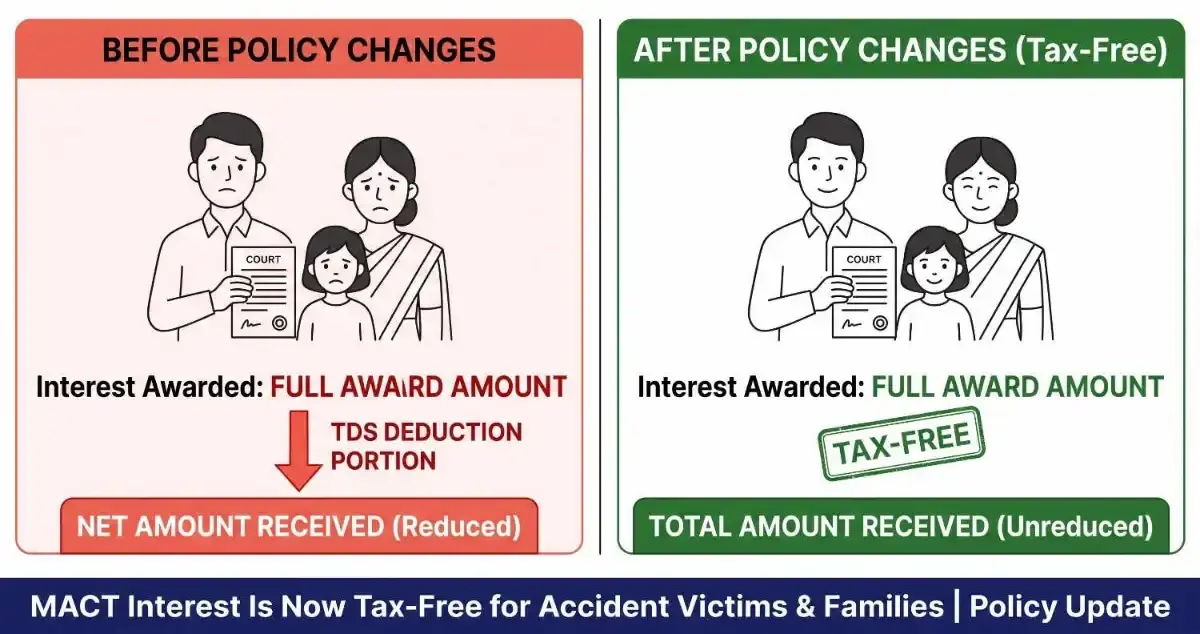
MACT interest income TDS exemption 2026 explained: who qualifies, old vs new Act rules, the FD interest trap, refund steps, and how to report it in your ITR.
Jul 24, 2026