

TDS on FD in 2026: Section 393 rates (10%), ₹50,000/₹1 lakh thresholds, Form 121 guide, post-office FD myth busted, NRI rules, refund walkthrough.
Banks deduct 10% TDS on your FD interest once it crosses ₹50,000 a year — ₹1,00,000 if you're a senior citizen. Both thresholds changed on 1 April 2025. The governing section changed again on 1 April 2026: it's now Section 393 of the Income Tax Act, 2025, not Section 194A. If you're reading about Form 15G or ₹40,000, that's already outdated.
TDS (Tax Deducted at Source) on FD is the amount your bank cuts from your interest before crediting it to your account. It's not a separate tax — it's an advance payment against your final income tax liability for the year.
For Tax Year 2026-27 (income from 1 April 2026 onwards), TDS on FD interest is governed by Section 393 of the Income Tax Act, 2025, which replaced Section 194A of the old 1961 Act. The mechanism is identical; only the section number changed. For FY 2025-26 (income up to 31 March 2026), Section 194A of the 1961 Act still governs.
Your bank doesn't care about your tax slab. It checks whether your total FD interest crossed the annual threshold. If yes, it deducts 10% (or 20% without PAN). If not, it pays in full — but that interest is still taxable and must appear in your ITR.
[Source: incometaxindia.gov.in/w/section-393-5]
Applies to | Does NOT apply to |
|---|---|
Residents earning FD interest over ₹50,000/year per bank (non-seniors) | NRE account holders — interest fully tax-exempt |
Senior citizens (60+) with FD interest over ₹1,00,000/year per bank | PPF and Sukanya Samriddhi Yojana account holders |
Post office time deposit holders (see note below) | Post office savings account interest (savings ≠ time deposit) |
Company FD / NBFC holders earning over ₹10,000/year | Government-notified tax-free bond holders |
NRO account holders — flat 30% + surcharge/cess, no threshold | FCNR(B) account holders — fully exempt |
Post office FD correction: Many top-ranked sites — including Bankbazaar, Paisabazaar, and others — claim post office FDs are TDS-free. This is wrong. Section 393(1) Table Sl. No. 5(ii) of the Income Tax Act, 2025 explicitly covers "a post office for a deposit made under a scheme notified by the Central Government." The same ₹50,000/₹1,00,000 thresholds apply. The TDS-free claim belongs to post office savings accounts, not post office time deposits — two different products. Verify at incometaxindia.gov.in/w/section-393-5.
These numbers apply for Tax Year 2026-27 under Section 393 of the Income Tax Act, 2025.
Category | Deducted by | Annual threshold (per bank) | Rate with PAN | Rate without PAN |
|---|---|---|---|---|
Non-senior residents (below 60) | Banks, cooperative banks, post offices | ₹50,000 | 10% | 20% |
Senior citizens (60+) | Banks, cooperative banks, post offices | ₹1,00,000 | 10% | 20% |
All residents | Company FDs, NBFCs, other specified persons | ₹10,000 | 10% | 20% |
NRO account holders (NRI) | Banks | No threshold | 30% + surcharge + 4% cess | 30% + surcharge + 4% cess |
[Source: Section 393(1) Table Sl. No. 5(ii) and 5(iii), incometaxindia.gov.in/w/section-393-5]
Four rules that trip people up:
Threshold applies per bank, not in total. Earn ₹48,000 from SBI and ₹48,000 from HDFC — neither deducts TDS. But your total ₹96,000 interest is fully taxable and must go into your ITR.
TDS is on the full amount, not just the excess. Interest of ₹60,000 with a ₹50,000 threshold means TDS on all ₹60,000 — not just ₹10,000. Section 393(1)(a) is explicit on this.
CBS vs non-CBS banks. Core Banking Solution (CBS) banks aggregate your interest across all branches under your PAN. Non-CBS banks calculate per branch — which used to allow TDS avoidance by spreading FDs across branches, but CBS has closed that gap at most banks.
Cumulative FDs: TDS hits annually, not at maturity. Per Section 393(1)(c), TDS is deducted "at the time of credit of such income to the account of the payee or at the time of its payment, whichever is earlier." Most banks credit FD interest in their books annually. You'll see yearly TDS entries — not a single deduction at maturity.
Suresh holds ₹10,00,000 in a 1-year FD at 7% interest.
Annual interest = ₹10,00,000 × 7% = ₹70,000
Threshold for non-senior = ₹50,000; ₹70,000 > ₹50,000 → TDS applies on the full ₹70,000
TDS deducted = ₹70,000 × 10% = ₹7,000
Amount credited = ₹70,000 − ₹7,000 = ₹63,000
When Suresh files his ITR, ₹70,000 is added to salary income. If his marginal rate on this portion is 10%, tax = ₹7,000. TDS already covers that — net additional liability is zero.
Had Suresh not given PAN: TDS = ₹70,000 × 20% = ₹14,000. He'd get a ₹7,000 refund on filing.
Use Toolisky's interest income tax calculator to see your exact liability across FDs, 80TTB deductions, and slab rates in one step.
Farida holds three FDs at a CBS bank — the bank aggregates interest under her PAN across branches:
FD at Branch A: ₹5,00,000 × 7.5% = ₹37,500
FD at Branch B: ₹4,00,000 × 7.5% = ₹30,000
FD at Branch C: ₹3,00,000 × 7.5% = ₹22,500
Total = ₹90,000
Senior citizen threshold = ₹1,00,000. ₹90,000 < ₹1,00,000 → No TDS deducted. But ₹90,000 is still taxable. Under old regime she claims Section 80TTB: ₹90,000 − ₹50,000 = ₹40,000 taxable interest.
Now suppose total interest were ₹1,10,000:
₹1,10,000 > ₹1,00,000 → TDS on the entire ₹1,10,000
TDS = ₹1,10,000 × 10% = ₹11,000
The "entire amount" rule — not just the ₹10,000 excess — catches many retirees off guard.
From 1 April 2026, Form 121 replaces both Form 15G and Form 15H under Section 393(6) of the Income Tax Act, 2025 and Rule 211 of the Income Tax Rules, 2026. One form, no age distinction.
Eligibility: Any resident individual, HUF, trust, AOP, or BOI (not companies or firms) whose total estimated tax for Tax Year 2026-27 is nil. For under-60s: total income must also not exceed the basic exemption limit. For seniors (60+): only the nil-tax condition applies.
[Source: incometaxindia.gov.in/documents/d/guest/form-no-121-1 and Section 393(6)]
Steps to file online:
Go to incometax.gov.in → Login with PAN and password
Navigate to e-File → Income Tax Forms → File Income Tax Forms
Select Form 121 → choose Tax Year 2026-27
Part A: name, PAN, address, estimated total income for the Tax Year
Part B: income type (bank interest), institution name, account details, estimated interest amount
Check declaration box → Submit → download acknowledgment
Submit a separate Form 121 to each bank — one submission doesn't cover multiple institutions
Bank must assign a unique ID to your Form 121 and include it in its quarterly TDS return
Submit before the first interest credit. TDS already deducted cannot be reversed at source — you reclaim it through your ITR.
Scenario 1 — TDS deducted despite submitting Form 121. Ask the branch for the unique identification number they should have logged against your form. If they can't provide it, the form likely wasn't recorded in their system. Submit a written complaint to the branch manager. Still stuck? Raise a grievance at incometax.gov.in under "Grievance & Support." You can't reverse already-deposited TDS, but you claim it as a credit in your ITR and get a refund.
Scenario 2 — Bank deducting 20% even though you gave your PAN. The usual cause is PAN not linked to the FD account, or a name mismatch. Visit the branch with your original PAN card and Aadhaar. Submit a written PAN correction request; banks typically process this within 7–10 working days. Claim the already-deducted excess as a refund in your ITR — it cannot be reversed at source.
Scenario 3 — AIS shows TDS that doesn't match your Form 16A. Download both the Annual Information Statement (AIS) and Form 16A. Compare line by line. If any entry is wrong, go to incometax.gov.in → Annual Information Statement → Feedback → click the disputed entry → select "Information is incorrect." The bank verifies and corrects it in its next TDS return cycle. Don't file your ITR until the mismatch is resolved.
Missed Form 121 and TDS was deducted? Your full refund path:
Verify TDS via Form 168 (formerly Form 26AS) and AIS. Log in at incometax.gov.in → e-File → Income Tax Returns → View Form 26AS. Form 26AS is now called Form 168 under the Income Tax Act, 2025 — see the Toolisky guide on Form 26AS and Form 168 for what changed.
Report total FD interest under "Income from Other Sources" in your ITR (ITR-1 for most salaried). Include all banks, even where no TDS was deducted.
Claim TDS credit. The deducted amount is pre-filled in your ITR from Form 168. If it doesn't match Form 16A, correct it manually.
File by 31 July 2026 (for FY 2025-26). Late filing means interest under Section 234A on remaining tax.
Refund timeline: 30–45 days for e-filed returns verified via Aadhaar OTP. Track at incometax.gov.in/iec/foportal/refunds.
NRO FDs (Non-Resident Ordinary): TDS at flat 30% plus applicable surcharge plus 4% health and education cess, with no minimum threshold. Even ₹1 of interest attracts TDS. [VERIFY: Confirm section number under Income Tax Act, 2025 governing NRI TDS on NRO FD interest — was Section 195 under the 1961 Act; check at incometaxindia.gov.in/w/tds-rates-1]
NRE FDs and FCNR(B): Interest is fully tax-free in India. No TDS, no threshold.
DTAA relief: If India has a tax treaty with your country of residence, the NRO TDS rate may be lower than 30%. Submit a Tax Residency Certificate (TRC) and Form 10F to your bank before the interest credit date — annually. Without these, the bank defaults to 30%.
Failure | Consequence |
|---|---|
Late or non-deduction of TDS | 1% interest per month from due date to deduction date [VERIFY: section equivalent to 201(1A) under IT Act 2025] |
TDS deducted but not deposited | 1.5% interest per month from deduction to deposit date [VERIFY: same section] |
Repeated non-deposit | Rigorous imprisonment 3 months to 7 years + fine [VERIFY: section equivalent to 276B under IT Act 2025] |
For you as the FD holder: The AIS pulls interest data from banks automatically. If you don't declare FD interest in your ITR, the system flags it under Section 143(1)(a). Concealment of income can attract a penalty of 50%–200% of the tax evaded under the Income Tax Act, 2025. [VERIFY: exact penalty section in IT Act 2025, was Section 271(1)(c) in the 1961 Act]
On the entire interest. If your FD interest is ₹60,000 and the threshold is ₹50,000, TDS applies to all ₹60,000 (= ₹6,000 at 10%), not just the ₹10,000 excess. Section 393(1)(a) of the Income Tax Act, 2025 is explicit: deduction is on "the entire amount of such income" where it exceeds the threshold.
Yes. Section 393(1) Sl. No. 5(ii) explicitly includes "a post office for a deposit made under a scheme notified by the Central Government" as a TDS deductor. Thresholds are identical to bank FDs: ₹50,000 for non-seniors, ₹1,00,000 for senior citizens. The TDS-free claim you see online applies to regular post office savings accounts — not post office time deposits.
Per bank. Earn ₹48,000 from SBI and ₹48,000 from HDFC — neither deducts TDS (each below ₹50,000). But your total ₹96,000 is taxable and must be declared in your ITR. The AIS aggregates all bank-reported interest; under-reporting gets flagged automatically.
Yes. From 1 April 2026, Form 121 under Section 393(6) of the Income Tax Act, 2025 replaces both. It's one form for all eligible ages. The eligibility logic is unchanged: estimated total tax for the Tax Year must be nil. For non-seniors, total income must also not exceed the basic exemption limit. Submit separately to each bank.
Visit the branch with your PAN card and Aadhaar. The likely cause is PAN not linked to that specific FD account, or a name mismatch. Submit a written update request; banks process PAN corrections in 7–10 working days. The excess deducted at 20% vs 10% cannot be reversed at source — claim it as a refund in your ITR.
Yes. TDS is deducted when interest is "credited to the account of the payee," not at payout — per Section 393(1)(c). Most banks credit interest annually in their ledger even on cumulative FDs. You'll see yearly TDS deductions on your FD statement, not one sum at maturity. Many depositors don't check until maturity and are surprised.
Yes, but only through your ITR. Report total FD interest under "Income from Other Sources," claim the TDS as a credit, and if your final tax liability is lower than what was deducted, the difference is refunded. The bank cannot reverse TDS once it's deposited with the government — the ITR route is the only option.
The primary (first) account holder's PAN only. The interest is treated entirely as the first holder's income for TDS purposes, regardless of who contributed the funds. The second or third holder's PAN plays no role in TDS deduction.
Yes, at a lower threshold of ₹10,000 per year per company under Section 393(1) Sl. No. 5(iii) — raised from ₹5,000 effective 1 April 2025. TDS at 10% applies on the full interest amount once it crosses ₹10,000. Form 121 can be submitted to the company too if your estimated total tax is nil.
Form 26AS has been renamed Form 168 under the new Act. The data it contains — TDS credits, advance tax paid, interest reported by banks — is the same. For FY 2025-26 ITR filings you may see both names used interchangeably. See the Form 26AS / Form 168 guide on Toolisky for the full transition picture.
Absolutely. TDS thresholds determine whether your bank deducts at source — they don't determine taxability. If your FD interest is ₹45,000 (below the ₹50,000 threshold), no TDS is deducted, but ₹45,000 is still taxable income you must declare in your ITR. The AIS shows all bank-reported interest; non-declaration triggers a mismatch notice.
Check your FD interest total for Tax Year 2026-27 right now — if it's heading above ₹50,000 (or ₹1,00,000 for senior citizens) at any one bank and your total tax is nil, submit Form 121 before the next interest credit date. Use the interest income tax calculator on Toolisky to find your exact tax liability before acting. For official forms and the latest rules, verify everything at incometax.gov.in.
For educational purposes only. Verify all figures at official sources before acting. Toolisky is not affiliated with any government body. Consult a qualified CA or legal professional before making compliance decisions. See toolisky.com/accuracy-and-limitations.
No TAN for NRI property purchase applies only from 1 October 2026, and only to resident individual and HUF buyers. Get the rates, forms, and dates you need.
Jul 25, 2026

Did you lose the SGB premature redemption tax exemption? Here's exactly who's affected, how much tax applies now, and how to check your own bonds.
Jul 24, 2026
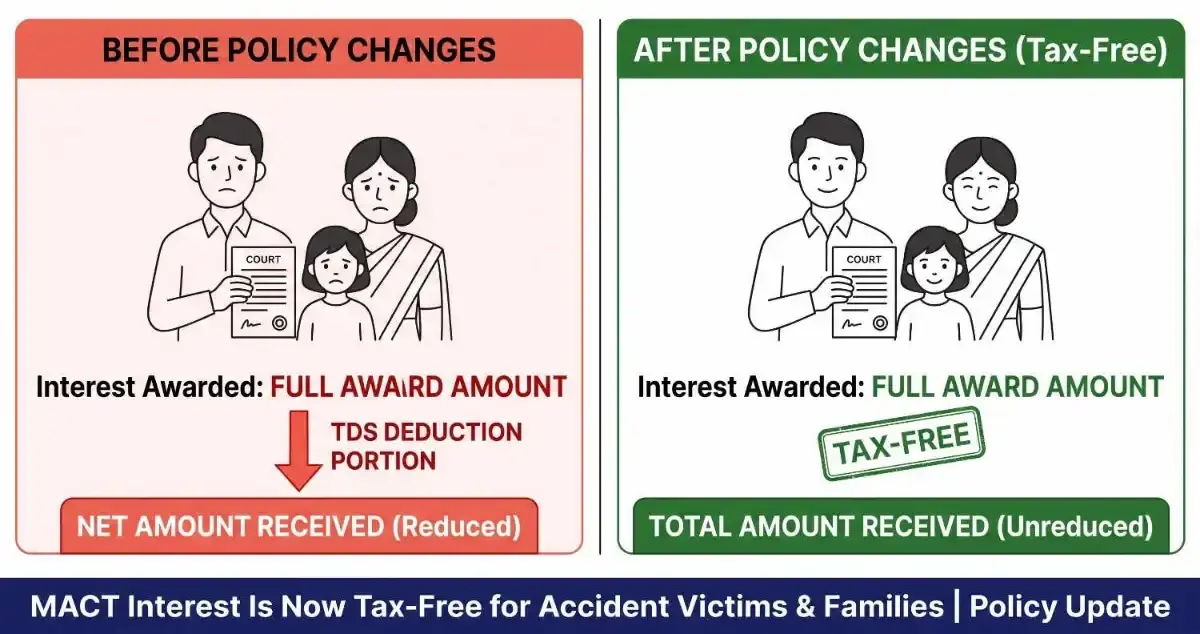
MACT interest income TDS exemption 2026 explained: who qualifies, old vs new Act rules, the FD interest trap, refund steps, and how to report it in your ITR.
Jul 24, 2026