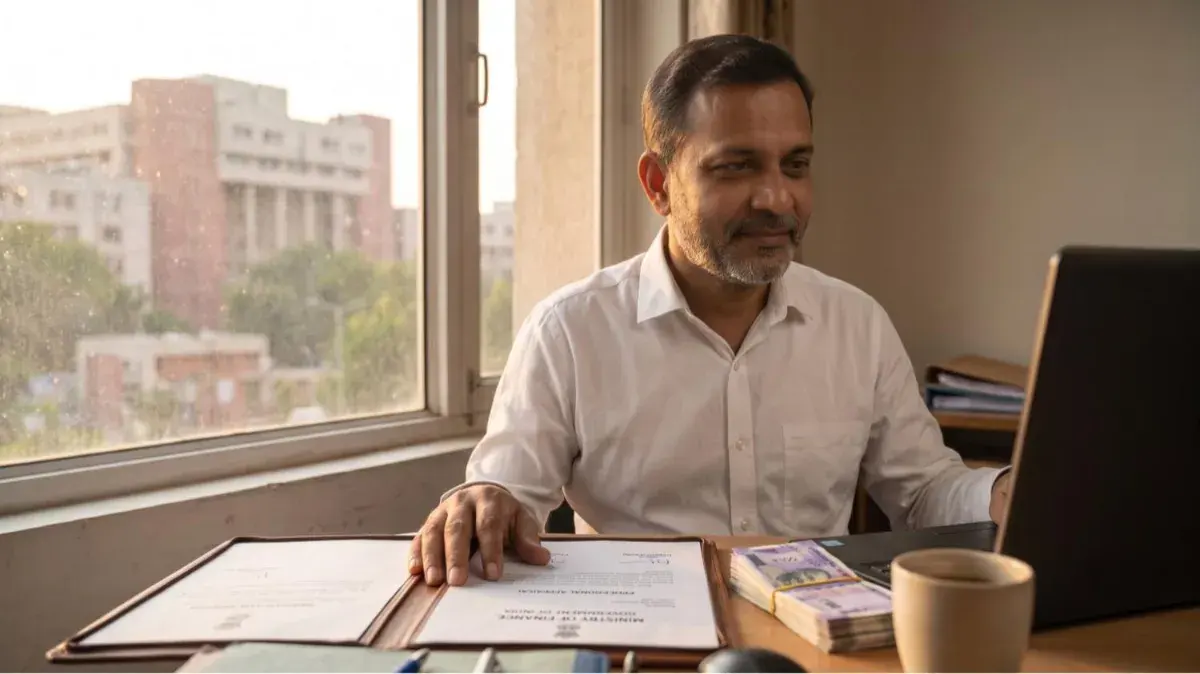

Is the 8th Pay Commission decided yet? Get the real fitment factor status, eligibility rules, and timeline for 2026 — verified against official sources.
As of July 2026, the 8th Pay Commission still hasn't decided on a fitment factor, a pay matrix, or a pension formula. It's in the middle of consultations and data collection. The commission was set up on 3 November 2025 and has 18 months to hand in its report — which puts the real deadline around 3 May 2027.
Think of the 8th Pay Commission (8th CPC) as the government's once-a-decade reset button for how much central government staff get paid. India has done this roughly every ten years since independence, and this is the eighth round. It's not a tax law — you won't find it anywhere in the Income-tax Act — it runs on a Ministry of Finance, Department of Expenditure Gazette resolution dated 3 November 2025.
The commission is a three-person team: Justice Ranjana Prakash Desai (a retired Supreme Court judge) as Chairperson, Prof. Pulak Ghosh of IIM Bengaluru as the part-time Member, and Pankaj Jain, an IAS officer, as Member-Secretary. They work out of the Chanderlok Building on Janpath in New Delhi.
Like every Pay Commission before it, this one's temporary. Once it submits its report and the government accepts it, the 8th CPC shuts down — exactly how the 7th CPC wound up after 2016.
If you've spent twenty years at a nationalised bank and are waiting for an 8th CPC hike, you're going to be disappointed. This is genuinely the most-searched confusion around this whole topic, so let's clear it up early.
Applies to | Does not apply to |
|---|---|
Central government employees, industrial and non-industrial | Bank employees at PSU or private banks |
All India Services officers (IAS, IPS, IFoS) | Reserve Bank of India staff |
Defence Forces personnel | State government employees |
Union Territory administration staff | Private sector employees |
Supreme Court and High Court staff (UT-funded) | Central PSU or PSE staff on company scales |
Judicial officers of subordinate courts in UTs | Gramin Dak Sevaks (separate committee) |
Pensioners and family pensioners who retired on or before 31 December 2025 |
Two exclusions catch people out every single time. Bank employees get their pay revised under the Bipartite Settlement between the Indian Banks' Association and the unions — a completely different system. The current, 12th Bipartite Settlement runs from 1 November 2022 to 31 October 2027, so bank staff are mid-cycle right now no matter what the 8th CPC eventually decides. The RBI is also specifically carved out of the "regulatory bodies" the commission covers.
The partial case: state government employees. Nothing here is automatic for them. Each state cabinet decides on its own whether — and when — to adopt the Centre's recommendations, often with its own fitment factor, and states have historically taken anywhere from one to three years to follow suit. Assam, for instance, has already started setting up its own state pay commission instead of waiting around.
Rather than making you piece this together from ten different headlines, here's the sequence as it's actually happened, confirmed against the commission's own site:
Date | Development |
|---|---|
16 Jan 2025 | Cabinet gives in-principle approval to form the 8th CPC |
3 Nov 2025 | Gazette notification: commission formally constituted, Terms of Reference and chairperson named |
Nov 2025–Mar 2026 | MyGov 18-point public questionnaire open for feedback |
14 Apr 2026 | NC-JCM Staff Side formally submits its common memorandum — ₹69,000 minimum pay, 3.833 fitment factor |
28–30 Apr 2026 | Regional consultation, New Delhi |
18–19 May 2026 | Regional consultation, Hyderabad |
1–4 Jun 2026 | Regional consultation, Srinagar and Jammu & Kashmir |
8 Jun 2026 | Regional consultation, Ladakh |
22–23 Jun 2026 | Regional consultation, Lucknow |
30 Jun 2026 | Deadline for ministries and departments to upload salary and allowance data |
6–7 Jul 2026 | Regional consultation, Bhubaneswar (scheduled) |
9–10 Jul 2026 | Regional consultation, Kolkata (scheduled) |
~3 May 2027 | 18-month deadline for the commission's report |
Right now, the commission has just closed its ministry data-collection window and is working through that data alongside its ongoing regional consultations.
The deadline for unions and associations to submit their memorandums has been pushed back more than once — most recently to 15 June 2026, per the commission's own homepage. Given how often that date has moved, don't take any deadline as final until you've checked 8cpc.gov.in yourself.
Every site seems to quote a different fitment factor, and here's the honest reason why: none of them are official, because the commission hasn't picked one.
Once a number does exist, the formula is simple:
Revised Basic Pay = Current Basic Pay × Fitment Factor
Here's the part almost nobody explains properly. A chunk of whatever fitment factor eventually gets announced just absorbs your existing Dearness Allowance into your new basic pay — it isn't extra money in your pocket. DA sits at 60% right now (the Cabinet approved a 2% DA hike effective 1 January 2026, taking it from 58% to 60%), so the "merge-only" multiplier alone works out to 1.60. Anything the commission adds on top of that is your real, actual raise.
Figure | Value | Status |
|---|---|---|
7th CPC fitment factor (2016) | 2.57 | Official, already implemented |
Merge-only multiplier (today's 60% DA absorbed) | 1.60 | Arithmetic floor, not a raise |
NC-JCM Staff Side's formally submitted demand, 14 Apr 2026 | 3.833 (minimum pay ₹69,000) | Union demand, officially submitted to the commission |
Earlier NC-JCM drafting-committee discussion, Feb 2026 | 3.00–3.25, varying by level | Superseded by the April submission below |
Independent analyst and aggregator estimates | roughly 1.83 to 2.86 | Unofficial, varies widely by source |
8th CPC Commission's own recommendation | Not yet decided | Awaiting report, due around May 2027 |
Worth flagging: the 3.25 figure that circulated in February 2026 was an early drafting-committee discussion point. By the time the NC-JCM Staff Side actually filed its 51-page memorandum on 14 April 2026, the number it went with was 3.833, built off a proposed minimum basic pay of ₹69,000 (up from ₹18,000). That's a union demand, not something the commission has accepted — but it's the current, up-to-date ask, so treat any site still quoting 3.25 as behind.
The government has also told Parliament that merging DA into basic pay outside a full Pay Commission revision isn't on the table right now, so don't expect an early, partial merger before the report lands.
Example 1: the common case. Suresh is a Level 6 central government employee on a current 7th CPC basic pay of ₹35,400. His DA at 60% adds ₹21,240, taking basic-plus-DA to ₹56,640 before HRA and TA. Nobody — including the commission itself — can tell Suresh his future number yet. What he can do is take his own basic pay and run it against each scenario in the tracker table above, so he's looking at a realistic range instead of trusting one viral number.
Example 2: the edge case most articles skip. Priya keeps seeing "157% pay hike" headlines about the 7th CPC and expects something similar this time. Here's what actually happened in 2016, with the real, settled numbers. Pre-revision basic pay was ₹7,000. DA had reached 125% by 1 January 2016, adding ₹8,750, for a pre-revision total of ₹15,750. The revised basic pay came to ₹18,000. That's a genuine increase of ₹2,250 — 14.3%, not 157%. The 2.57 fitment factor looked huge on paper mostly because it was absorbing 125% of accumulated DA first. Keep that arithmetic in mind before you get too excited about any 8th CPC headline number.
Want to see what a similar jump would mean for your own take-home pay after tax, once a real figure exists? The salary increment calculator runs old-versus-new pay through both tax regimes and shows the net gain, not just the headline percentage.
Point | 7th CPC | 8th CPC |
|---|---|---|
Implemented | 1 January 2016 | Reference date 1 January 2026; actual rollout not yet fixed |
Fitment factor | 2.57 (final) | Not decided |
Minimum basic pay | ₹18,000 | Not decided (union demand: ₹69,000) |
Minimum pension | ₹9,000 | Not decided |
Structure | Pay Matrix, 18 levels (replaced Grade Pay) | Expected to keep the Pay Matrix, revise the numbers inside it |
DA at reference date | 125% | 60% |
The biggest structural difference isn't the multiplier — it's the starting DA. A smaller headline fitment factor this time could still mean a genuinely fair increase, precisely because there's less accumulated DA left to absorb than there was in 2016.
You don't need to do anything to eventually get your pay revised — it kicks in automatically once notified. But if you want to submit your own suggestions, as an individual, an association, or a department, here's the actual process, not a vague "visit the portal" line.
Go to the official 8th CPC portal or the MyGov memorandum submission page.
Pick your category: Individual Employee/Pensioner, Association or Union, or Ministry/Department.
Verify with an OTP sent to your registered mobile number or email.
Fill in the memorandum form under the right heading — salary revision, fitment factor, allowances, pension restructuring, or pay matrix changes.
Double-check every field, then submit online.
Save the Unique Memo ID the portal gives you — you'll need it later to track your submission or request an appointment.
You'll need a working mobile number or email for the OTP, plus basic service details (your employee ID, or PPO number if you're a pensioner). No physical documents, emails, or PDFs are accepted — the commission has said offline submissions won't be considered.
You get a WhatsApp message offering an "8th CPC salary calculator" APK. That's a scam. The Indian Cybercrime Coordination Centre, under the Ministry of Home Affairs, has warned that fraudsters send fake calculator APK files to hijack phones and drain bank accounts once installed. No government body sends salary tools over WhatsApp. Delete the message and stick to 8cpc.gov.in.
Your OTP fails, or the portal doesn't generate a Memo ID. Don't keep resubmitting — that just creates duplicate entries. Clear your browser cache, retry on a stable connection, and make sure the mobile number matches what's registered. Still stuck? Note the time and the exact error, and reach out through the commission's official contact channel listed on 8cpc.gov.in.
You submitted under the wrong category by mistake. There's no public "edit" option once a memorandum's in. Submit a fresh, correctly categorised entry, reference your earlier Unique Memo ID in the text, and flag the error clearly so reviewers don't count it twice.
There's no penalty tied to the Pay Commission process itself. The real money question is what happens once your arrears actually arrive — a lump sum can push you into a higher tax slab for that year.
Arrears of salary or pension are taxed in the year you actually receive them, not the year they relate to. You can claim relief under Section 89(1) of the Income-tax Act, 1961, by filing Form 10E online before you file your return. Skip that step and the Income Tax Department can — and does — deny the relief outright, even if you'd otherwise have qualified.
One genuine update here: the Income-tax Act, 2025 took effect on 1 April 2026 and renumbers large parts of the old 1961 Act, forms included. The Income Tax Department's own forms page confirms that Section 89(1) relief now sits under Section 157 of the 2025 Act, and Form 10E has been replaced by Form No. 39 — but only for Tax Year 2026–27 onward. If your arrears belong to FY 2025-26 (AY 2026-27), you're still filing the familiar Form 10E under the old numbering; Form 39 only applies once you're filing for Tax Year 2026-27 itself, due by 31 July 2027. Toolisky's own Form 26AS to Form 168 guide walks through a similar renumbering change if you want more context, and our Income Tax Act 2025 vs 1961 guide covers what shifted more broadly.
Separately, if arrears push you into filing late, Section 234F kicks in: a ₹1,000 penalty if your total income is up to ₹5 lakh, and ₹5,000 above that. The due date for ITR-1 and ITR-2 for FY 2025-26 (AY 2026-27) is 31 July 2026, unless the CBDT extends it (taxpayers filing ITR-3 or ITR-4 without an audit requirement get until 31 August 2026). Run your numbers through the salary tax calculator once you know your arrears amount, instead of guessing your slab.
No confirmed date exists yet. The commission has to submit its report within 18 months of its 3 November 2025 constitution — so around May 2027. Past commissions took 18 to 30 months between their Terms of Reference and salaries actually being credited, so a realistic window is late 2027 into 2028, with arrears backdated to 1 January 2026.
Not automatically. It directly covers only central government staff. States usually adopt similar revisions afterward through their own cabinet approval, often with a different fitment factor and a one-to-three-year lag. A few states, Assam included, have started setting up their own pay commissions rather than waiting.
No. Public and private sector bank employees are covered by the Bipartite Settlement between the Indian Banks' Association and their unions — a totally separate system. The current 12th Bipartite Settlement runs until 31 October 2027, so the next bank wage revision will come from the 13th Settlement, not the 8th CPC.
There isn't one yet — this is genuinely the most-repeated inaccuracy online. The commission hasn't finalised the fitment factor, pay matrix, HRA structure, or pension formula. The 7th CPC's 2.57 remains the last confirmed figure. The 3.833 you're seeing quoted now is the NC-JCM union's formally submitted demand, not a government decision.
The government has told Parliament there's no proposal to merge Dearness Allowance with basic pay outside the full Pay Commission process, despite repeated union demands. DA will keep getting revised twice a year, in January and July, under the existing 7th CPC formula, until the 8th CPC's own recommendations are notified.
No. The Terms of Reference specifically cover pensioners and family pensioners who retired on or before 31 December 2025. Retiring after that date puts you outside this particular revision window — though your pension will still follow whatever the 8th CPC eventually recommends for future retirees under the rules applicable at that time.
Beyond the multiplier, the starting point is very different. DA stood at 125% when the 7th CPC took effect in January 2016; it's 60% now. That means there's less accumulated DA to absorb into the new basic pay this time — so even a lower headline fitment factor could still mean a fair real increase.
Justice Ranjana Prakash Desai, a retired judge of the Supreme Court of India, chairs the commission. Prof. Pulak Ghosh of IIM Bengaluru serves as the part-time Member, and Pankaj Jain, an IAS officer, is Member-Secretary.
Not yet — treat any calculator claiming exact 8th CPC pension figures with real caution, since the formula isn't finalised. The Ministry of Home Affairs has specifically warned about fake "salary calculator" apps circulating on WhatsApp. Stick to 8cpc.gov.in for genuine updates until an official method is notified.
Nobody can say precisely yet, but you can estimate a range. Multiply your current basic pay by each scenario in the fitment factor tracker table above, then subtract your current basic-plus-DA to see the real gain — not just the headline jump. Remember that part of any multiplier only absorbs your existing 60% DA.
There's no direct edit function on the portal once you've submitted. File a new memorandum with the correct details, referencing your original Unique Memo ID in the text so the commission's secretariat can identify it as a correction rather than a duplicate.
Nothing about your actual salary changes today — the 8th CPC is still gathering data and running consultations, with its report due around May 2027. Bookmark 8cpc.gov.in for the moment an official fitment factor drops, and until then, run your own numbers through the salary increment calculator instead of trusting a random WhatsApp forward.
Written by Viraj Mathpati, Legal Advisor & Senior Content Writer | Last Updated: July 2026 Reviewed by Toolisky Editorial Team
For educational purposes only. Verify all figures at official sources before acting. Toolisky is not affiliated with any government body. Consult a qualified CA or legal professional before making compliance decisions. See toolisky.com/accuracy-and-limitations.
No TAN for NRI property purchase applies only from 1 October 2026, and only to resident individual and HUF buyers. Get the rates, forms, and dates you need.
Jul 25, 2026

Did you lose the SGB premature redemption tax exemption? Here's exactly who's affected, how much tax applies now, and how to check your own bonds.
Jul 24, 2026
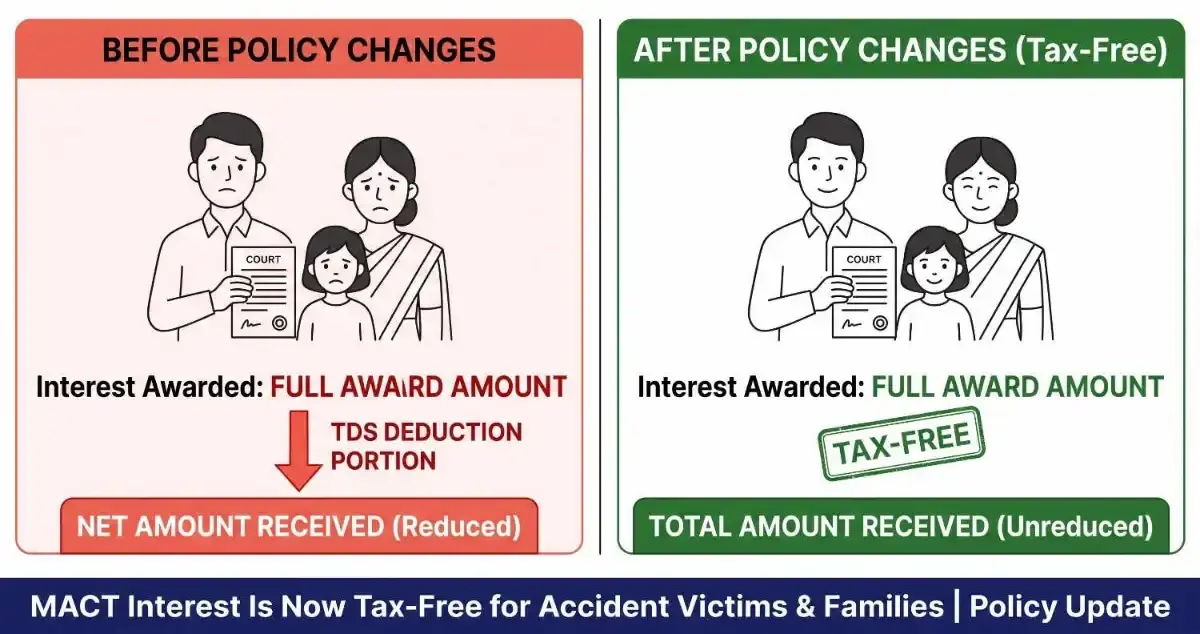
MACT interest income TDS exemption 2026 explained: who qualifies, old vs new Act rules, the FD interest trap, refund steps, and how to report it in your ITR.
Jul 24, 2026