

Calculate NRI foreign interest tax India 2025-26. NRO FD tax, DTAA rates by country, Form 67 deadline, Schedule FSI steps & worked ₹ examples with full arithmetic.
If you earn interest from an NRO account, a US bank, a UK savings account, or any foreign deposit — India taxes it differently depending on whether you're an NRI or a resident. The rate, the conversion rule, the DTAA you can use, and what you file after the calculation all depend on your status. This article covers the full picture for FY 2025-26 with real ₹ examples, verified DTAA rates from incometaxindia.gov.in, and the exact Form 67 steps — so you know exactly what to do, not just what the law says.
Your tax liability on interest income depends on two things: where the interest comes from and what your residency status is.
Under Section 5(2) of the Income-tax Act, 1961, a non-resident is taxed in India only on income that accrues or arises in India, or is received in India. So NRO account interest — credited by an Indian bank — is fully taxable. Interest from a US or UK bank sitting outside India? Completely exempt from Indian tax for NRIs.
For Indian residents (ROR — Resident and Ordinarily Resident), the rule is the opposite. Every rupee of global income is taxable, including interest from foreign banks. They convert it to INR under Rule 115 of the Income Tax Rules, 1962, then report it under Schedule FSI in ITR-2.
Governing law: Income earned in FY 2025-26, assessed in AY 2026-27, falls under the Income-tax Act, 1961 — not the Income-tax Act, 2025, which takes effect only from Tax Year 2026-27 onwards. All section numbers in this article are 1961 Act references.
Key terms:
NRO account — Non-Resident Ordinary; holds India-source income; interest is fully taxable
NRE account — Non-Resident External; interest completely exempt under Section 10(4)(ii)
FCNR account — Foreign Currency Non-Resident; interest exempt under Section 10(15)(iv)(fa)
DTAA — Double Taxation Avoidance Agreement; reduces withholding tax rate on Indian-source interest for NRIs
Form 67 — Mandatory for Indian residents to claim credit of tax paid abroad (Rule 128, Income Tax Rules, 1962); NRIs with NRO income don't file this
Schedule FSI — Schedule in ITR-2 where residents declare foreign-source income
TTBR — Telegraphic Transfer Buying Rate; SBI's rate used to convert foreign income to INR for tax purposes [Rule 115, Income Tax Rules, 1962]
Applies to | Does NOT apply to |
|---|---|
NRIs with NRO account FD or savings interest | NRIs with NRE or FCNR account interest |
NRIs with interest on Indian bonds in foreign currency (Section 115AC) | NRIs earning interest from foreign banks outside India |
Indian residents (ROR) with interest from US/UK/SG/AU bank accounts | HUFs and companies — different rules apply |
Residents with US T-Bills, UK Gilts, foreign bond interest | Persons of Indian Origin with no India-source income |
RNOR — partial rules apply; foreign income may be exempt | NRIs below the basic exemption limit who choose not to file |
RNOR note: If you returned to India recently and are classified Resident but Not Ordinarily Resident under Section 6(6), your foreign income may be exempt for up to 2–3 financial years. Confirm your RNOR status before computing tax — the calculation is very different.
NRO interest is taxed at slab rates, not a flat rate. TDS is deducted by the bank at 30% flat under Section 195 before DTAA. If you submit a valid Tax Residency Certificate (TRC) plus Form 10F to your bank before the interest is credited, TDS gets deducted at the lower DTAA rate instead.
New Regime Slabs — FY 2025-26 (applicable to NRIs):
Total Income (₹) | Tax Rate |
|---|---|
Up to ₹4,00,000 | Nil |
₹4,00,001 – ₹8,00,000 | 5% |
₹8,00,001 – ₹12,00,000 | 10% |
₹12,00,001 – ₹16,00,000 | 15% |
₹16,00,001 – ₹20,00,000 | 20% |
₹20,00,001 – ₹24,00,000 | 25% |
Above ₹24,00,000 | 30% |
Add 4% Health & Education Cess on total tax.
Surcharge on NRI interest income:
Total Indian Income (₹) | Surcharge Rate |
|---|---|
Up to ₹50 lakh | Nil |
₹50 lakh – ₹1 crore | 10% of tax |
₹1 crore – ₹2 crore | 15% of tax |
Above ₹2 crore | 25% of tax |
Surcharge cap for Section 115A income: The enhanced 25% surcharge does NOT apply to income taxable under Section 115A (e.g., interest on foreign currency bonds, specified securities). For such income, surcharge is capped at 15%. For regular NRO savings/FD interest taxed at normal slab rates, the higher surcharge tiers apply if total income crosses ₹2 crore.
Section 115A of the 1961 Act provides special concessional rates on specific categories of interest — not regular NRO FD interest. The 20% gross rate under Section 115A applies to:
Interest on monies borrowed or debt incurred by Government or Indian concern in foreign currency
Interest from notified Infrastructure Debt Funds: 5%
Interest on long-term infrastructure bonds / rupee-denominated bonds under Section 194LC: 5% or 4% (depending on bond type and issuance date)
Regular NRO savings account and FD interest is taxed at normal slab rates — NOT at 20% under Section 115A. This is a commonly misunderstood distinction.
Both are fully exempt. No TDS, no tax return required purely on account of these. Still report them in Schedule EI (Exempt Income) of ITR-2 if you file.
These rates come directly from the official incometaxindia.gov.in treaty comparison table. They represent the maximum withholding tax rate under the DTAA on interest paid to an NRI from Indian sources. To access this rate, you need TRC + Form 10F submitted to your Indian bank before interest is credited.
Country | DTAA Interest Rate | Default Indian Rate |
|---|---|---|
USA | 15% | 30% + surcharge + cess |
UK | 15% | 30% + surcharge + cess |
Australia | 15% | 30% + surcharge + cess |
Canada | 15% | 30% + surcharge + cess |
Singapore | 15% | 30% + surcharge + cess |
Germany | 10% | 30% + surcharge + cess |
Japan | 10% | 30% + surcharge + cess |
France | 10% | 30% + surcharge + cess |
Netherlands | 10% | 30% + surcharge + cess |
Bangladesh | 10% | 30% + surcharge + cess |
China | 10% | 30% + surcharge + cess |
Mauritius | 7.5% | 30% + surcharge + cess |
UAE | [VERIFY: official treaty text — commonly cited as 10% or 12.5%] | 30% + surcharge + cess |
Practical note — UAE: UAE historically had no personal income tax, so the DTAA was less actively used. Since UAE introduced corporate tax in June 2023, the treaty has become more relevant. Confirm the current NRO interest withholding rate with your CA for UAE specifically before relying on any published rate.
How the DTAA benefit actually works: Even at 30% TDS, you're not necessarily paying 30% tax. If your total Indian income is below ₹24 lakh, your actual tax rate is well below 30%. Filing ITR-2 and claiming a refund of excess TDS is the real mechanism. The DTAA rate matters most when you can't or won't file a return, or when you want the bank to deduct less upfront.
Step 1: Get gross NRO interest for FY 2025-26 from bank statement or Form 26AS on incometax.gov.in.
Step 2: Check if your country has a DTAA with India. If yes, and you submitted TRC + Form 10F before interest was credited, TDS should have been deducted at the treaty rate. If not, TDS was at 30%.
Step 3: Add NRO interest to total Indian income. Apply new regime slabs (or old regime if you filed Form 10-IEA).
Step 4: Add surcharge if total income exceeds ₹50 lakh. Apply 4% cess on (tax + surcharge).
Step 5: Deduct TDS already withheld (from Form 26AS). Pay any balance as self-assessment tax, or claim refund if TDS exceeds liability.
Step 6: File ITR-2 by 31 July 2026 for AY 2026-27.
Use Toolisky's Foreign Interest Tax Calculator — it applies the correct slab rates, surcharge tiers, and cess for FY 2025-26 in seconds.
This is the scenario everyone misses. If you're an ROR resident with a US savings account, UK current account, or Singapore FD — that interest is taxable in India.
Step 1: Find your foreign interest income. Note the date it was received or became due (whichever is earlier).
Step 2 — TTBR conversion: Under Rule 115 of the Income Tax Rules, 1962, foreign bank interest (classified as Income from Other Sources — general) uses the SBI TTBR on the last day of the previous year, i.e., 31 March 2026 for FY 2025-26. This is not the last day of the preceding month — that applies to salaries and "interest on securities." Bank account interest is general "Income from Other Sources," so the rate is fixed at 31 March 2026.
However — there's an important exception: if your foreign interest income was actually received or brought into India before 31 March 2026, the conversion happens at the actual receipt date rate, not 31 March. [Rule 115(2)]
Step 3: Add the INR amount to your Indian income. Tax it at your slab rate.
Step 4: Compute Foreign Tax Credit (FTC). It's the lower of: (a) Indian tax computed on that foreign income, or (b) actual foreign tax paid on it.
Step 5: File Form 67 online before filing ITR-2. Then fill Schedule FSI and Schedule TR in ITR-2.
Step 6: File ITR-2 by 31 July 2026.
Situation: Priya lives in London. She has an NRO FD of ₹20,00,000 at 6.8% p.a. No other Indian income. UK-India DTAA interest rate: 15%.
Step 1: NRO FD interest = ₹20,00,000 × 6.8% = ₹1,36,000
Step 2 — TDS:
Priya submitted TRC from HMRC + Form 10F before FD matured
Bank deducted TDS at 15% (treaty rate) = ₹1,36,000 × 15% = ₹20,400
Step 3 — Actual tax computation:
Total Indian income = ₹1,36,000
New regime: income up to ₹4,00,000 → tax = ₹0
No surcharge, no cess
Step 4 — Net position:
Tax liability: ₹0
TDS already deducted: ₹20,400
Refund: ₹20,400 — Priya files ITR-2 and gets the entire TDS back
Without TRC + Form 10F: Bank would have deducted 30% = ₹40,800. Refund would still be ₹40,800 — but that's ₹40,800 sitting with the government for months until Priya files ITR-2. The TRC route means less upfront deduction.
Situation: Ramesh lives in Chicago. His India income: ₹55,00,000 in rental income + ₹6,00,000 NRO FD interest. USA-India DTAA rate: 15%.
Step 1: Total Indian income = ₹55,00,000 + ₹6,00,000 = ₹61,00,000
Step 2 — Tax on ₹61,00,000 (new regime):
Slab (₹) | Amount in slab (₹) | Rate | Tax (₹) |
|---|---|---|---|
0 – 4,00,000 | 4,00,000 | 0% | 0 |
4,00,001 – 8,00,000 | 4,00,000 | 5% | 20,000 |
8,00,001 – 12,00,000 | 4,00,000 | 10% | 40,000 |
12,00,001 – 16,00,000 | 4,00,000 | 15% | 60,000 |
16,00,001 – 20,00,000 | 4,00,000 | 20% | 80,000 |
20,00,001 – 24,00,000 | 4,00,000 | 25% | 1,00,000 |
24,00,001 – 61,00,000 | 37,00,000 | 30% | 11,10,000 |
Base tax = ₹13,10,000
Step 3 — Surcharge: Total income ₹61 lakh > ₹50 lakh → 10% surcharge = ₹13,10,000 × 10% = ₹1,31,000
Step 4 — 4% Health & Education Cess: = (₹13,10,000 + ₹1,31,000) × 4% = ₹14,41,000 × 4% = ₹57,640
Total tax = ₹13,10,000 + ₹1,31,000 + ₹57,640 = ₹14,98,640
Step 5 — TDS already deducted:
Rental TDS at 30% (Section 195) = ₹55,00,000 × 30% = ₹16,50,000
NRO FD TDS at DTAA 15% = ₹6,00,000 × 15% = ₹90,000
Total TDS = ₹17,40,000
Net position: TDS (₹17,40,000) > Tax liability (₹14,98,640) → Refund of ₹2,41,360
Ramesh must file ITR-2 to claim this refund. Without ITR-2, ₹2.41 lakh stays with the government permanently.
Situation: Farida lives in Mumbai. She has a US savings account (held for old work savings). In FY 2025-26 it earned USD 800 interest. US withheld 10% at source. She has Indian salary income of ₹18,00,000.
Step 1 — TTBR conversion: Under Rule 115, clause (c) — Income from Other Sources (general) → use SBI TTBR on the last day of the previous year = 31 March 2026. Say TTBR on 31 March 2026: 1 USD = ₹86.50 [VERIFY: check actual SBI TTBR rate for 31 March 2026 before publishing] USD 800 × ₹86.50 = ₹69,200
Step 2 — Add to total income: ₹18,00,000 (salary) + ₹69,200 (US interest) = ₹18,69,200
Step 3 — Tax on ₹18,69,200 (new regime):
Slab (₹) | Amount in slab (₹) | Rate | Tax (₹) |
|---|---|---|---|
0 – 4,00,000 | 4,00,000 | 0% | 0 |
4,00,001 – 8,00,000 | 4,00,000 | 5% | 20,000 |
8,00,001 – 12,00,000 | 4,00,000 | 10% | 40,000 |
12,00,001 – 16,00,000 | 4,00,000 | 15% | 60,000 |
16,00,001 – 18,69,200 | 2,69,200 | 20% | 53,840 |
Base tax = ₹1,73,840
Add 4% cess = ₹1,73,840 × 4% = ₹6,953 → Total Indian tax = ₹1,80,793
Step 4 — Marginal Indian tax on foreign interest only: Tax at ₹18,69,200 = ₹1,80,793 Tax at ₹18,00,000 = ₹1,80,793 − (₹69,200 × 20% × 1.04) = Let's compute directly: Tax on ₹18,00,000: ₹20,000 + ₹40,000 + ₹60,000 + (₹2,00,000 × 20%) = ₹1,60,000 + cess ₹6,400 = ₹1,66,400 Indian tax attributable to foreign interest = ₹1,80,793 − ₹1,66,400 = ₹14,393
Step 5 — FTC calculation: US tax paid on USD 800 at 10% = USD 80 → at TTBR 31 March 2026: USD 80 × ₹86.50 = ₹6,920
FTC = lower of Indian tax on foreign income (₹14,393) OR foreign tax paid (₹6,920) = ₹6,920
Net Indian tax after FTC = ₹1,80,793 − ₹6,920 = ₹1,73,873
Farida files Form 67 first, then ITR-2 with Schedule FSI showing ₹69,200, Schedule TR claiming ₹6,920 credit, and Schedule FA disclosing the US bank account.
Who files Form 67? Indian residents (ROR) who earned foreign bank interest, paid tax abroad, and want FTC against Indian tax. NRIs with NRO interest do NOT file Form 67 — they claim excess TDS refund through ITR-2 directly.
What Form 67 contains: Name, PAN, AY, country, nature of income (interest), gross INR amount, DTAA article number, foreign tax paid in INR (converted using SBI TTBR on the date of foreign tax payment), FTC claimed.
Deadline: The base rule under Rule 128 requires Form 67 to be filed on or before the ITR due date. For AY 2026-27 for non-audit individuals, that's 31 July 2026. [VERIFY: Confirm whether CBDT Notification 100/2022 extending Form 67 filing to end of AY remains in effect for AY 2026-27 under the 2025 Act framework — check incometax.gov.in/notifications before publishing. Do not rely on the extension without confirming.]
Step-by-step Form 67 filing on incometax.gov.in:
Log in at incometax.gov.in with PAN and password
Click e-File → Income Tax Forms → File Income Tax Forms
Select "Persons not dependent on any source of income" tab
Find "Double Taxation Relief (Form 67)" → click File Now
Select Assessment Year: 2026-27 → click Continue
Click Let's Get Started on the instruction screen
Fill Part A: country of income source, nature of income (interest), gross amount in INR (at TTBR), DTAA article number, foreign tax paid in INR, FTC claimed amount
Upload supporting documents: foreign bank tax certificate (e.g., US 1099-INT, UK R40/P60), foreign tax payment proof, self-certified translation if not in English
Click Preview → Proceed to e-Verify
e-Verify via Aadhaar OTP, EVC through net banking, or DSC
Download the acknowledgement — note the reference number
Then in ITR-2:
Schedule FSI — enter each foreign income source; the INR amount here must match Form 67 exactly
Schedule TR — reference Form 67 here; enter FTC claimed
Schedule FA — disclose every foreign financial account, even if balance was zero at year-end
Toolisky's Foreign Interest Tax Calculator computes the INR figure, Indian tax, and FTC credit for you. Have all three numbers ready before opening Form 67 — the portal doesn't compute them for you.
Assume ₹50 lakh deposit, 6.5% annual interest rate for comparison:
Account | Gross Interest (₹) | Tax Treatment | TDS at Source | Net if No ITR Filed (₹) | Net After Filing ITR (₹ approx, income only ₹3.25L) |
|---|---|---|---|---|---|
NRE FD | 3,25,000 | Exempt — Section 10(4)(ii) | 0% | 3,25,000 | 3,25,000 |
FCNR FD | 3,25,000* | Exempt — Section 10(15)(iv)(fa) | 0% | 3,25,000 | 3,25,000 |
NRO FD | 3,25,000 | Taxable at slab rate | 30% = ₹97,500 | 2,27,500 | 3,25,000 (full refund if no other income and below ₹4L) |
*FCNR is in foreign currency; INR equivalent changes with exchange rates.
The bottom line: If your only Indian income is NRO interest below ₹4,00,000, the new regime gives you zero tax liability. The 30% TDS is fully refundable via ITR-2. But you have to file — many NRIs skip this and lose lakhs sitting with the government as excess TDS.
For NROs with high other Indian income (rent + interest crossing ₹24L+), the effective tax on the marginal NRO interest can reach 30% + surcharge. In that case, NRE routing of future foreign earnings makes more financial sense.
Happens when Form 10F wasn't on the portal or TRC wasn't submitted before interest was credited. The bank defaults to 30%.
Fix: You can't change past TDS. File ITR-2 and claim a full refund of the excess TDS. Verify the TDS credit appears in Form 26AS — if it doesn't, raise a grievance at incometax.gov.in: Pending Actions → Grievances → Submit Grievance → "TDS Credit Not Reflecting". If there's a genuine error in TDS deduction details, the AO can correct under Section 154 of the 1961 Act.
Your FTC claim in Schedule TR won't be backed by a filed Form 67. CPC will likely disallow the credit and process your return without it, resulting in higher tax demand.
Fix: If the return isn't verified yet — file Form 67 immediately, then complete e-verification. If already processed, file a revised return (deadline: 31 December 2026 for AY 2026-27) and file Form 67 before submitting the revised ITR. If the assessment year has ended and Form 67 was never filed, consult a CA — a Section 154 rectification or an appeal may be the only route, and success isn't guaranteed.
Many people use today's Google rate or the bank's transfer rate. Both are wrong. Others use the last day of the preceding month (that's the salary rule, not the general Other Sources rule).
Fix: For foreign bank interest (general Income from Other Sources), the correct TTBR date is 31 March 2026 — the last day of the previous year. Get SBI's historical TTBR for that date from their website or treasury. File a revised return with the corrected INR figure. If you under-reported income as a result, pay self-assessment tax (Challan 280, Code 300) before filing the revision.
Default | Amount / Rate | Section (1961 Act) |
|---|---|---|
Late ITR filing, income > ₹5 lakh | ₹5,000 late fee | Section 234F |
Late ITR filing, income ≤ ₹5 lakh | ₹1,000 late fee | Section 234F |
Advance tax shortfall | 1% simple interest per month | Section 234B |
TDS not deducted (payer liability) | 1% per month from due date to deduction date; 1.5% from deduction to deposit | Section 201 |
Schedule FA non-disclosure — foreign account not reported | ₹10,00,000 flat penalty | Black Money Act, 2015 |
Form 67 not filed — FTC disallowed | Loss of credit; no separate ₹ penalty but full Indian tax payable | Rule 128 |
Wrong form filed (ITR-1 instead of ITR-2) | Defective return notice — fix within 15 days | Section 139(9) |
Advance tax rule: If estimated Indian tax liability for FY 2025-26 exceeds ₹10,000 after TDS credit, you must pay advance tax in four instalments. Missed instalments attract interest under Section 234C. Check Toolisky's Section 234A 234B 234C Interest Calculator to compute this before July 2026.
Yes, fully. NRO account interest is Indian-source income — it accrues in India regardless of where you live. It's taxed at your applicable slab rate after being added to your total Indian income. TDS is deducted at 30% flat under Section 195 plus surcharge and cess. If your total Indian income stays below ₹4,00,000 under the new regime, actual tax is ₹0 and the full TDS is refundable via ITR-2.
Not as long as your NRI status is maintained. NRE account interest is exempt under Section 10(4)(ii) of the 1961 Act — fully, unconditionally. This exemption stops the moment you become a resident. So if you returned to India during FY 2025-26 and became resident, NRE interest earned after your status change becomes taxable. The cut-off is your date of change in residential status, not the financial year start.
The DTAA sets a cap on India's withholding rate on interest paid to a resident of the treaty country. Under Section 90 of the 1961 Act, whichever rate is lower — domestic 30% or the treaty rate — applies. For most countries, that's 10%–15%. Submit TRC and Form 10F to your Indian bank before interest is credited. The bank then deducts at the treaty rate. After April 2026, Form 10F has been renumbered as Form 41 under the Income-tax Act, 2025, but for FY 2025-26 filings (AY 2026-27), Form 10F under the 1961 Act still applies.
No. Form 67 is specifically for Indian residents claiming credit of tax paid in a foreign country. As an NRI, your NRO interest is taxed only in India — there's no foreign tax to credit. The mechanism for NRIs is simpler: claim refund of excess TDS through ITR-2. Indian residents earning foreign bank interest do need Form 67.
This is a critical fact most articles get wrong. Under Rule 115(1) of the Income Tax Rules, 1962, the "specified date" for Income from Other Sources (general category — which includes bank interest) is the last day of the previous year — 31 March 2026 for FY 2025-26. The "last day of the preceding month" rule applies to salaries and "interest on securities" only.
Yes. As an ROR resident, your global income is taxable in India. Convert US interest to INR at SBI TTBR as of 31 March 2026, add it to Indian income, pay tax at your slab rate. Then claim FTC for any US withholding tax — file Form 67 before your ITR-2. Disclose the US account in Schedule FA (non-disclosure attracts ₹10 lakh penalty). Report the income in Schedule FSI.
Yes. Interest from US T-Bills, UK Gilts, Singapore SGS bonds, or any foreign government/corporate bond is treated as general Income from Other Sources for Indian residents. No special exemption exists for foreign government bonds. Same treatment as bank interest — convert at TTBR (31 March 2026), add to income, claim FTC via Form 67 for any foreign tax deducted, report in Schedule FSI.
No. Section 80TTA allows deduction of up to ₹10,000 on savings account interest, but it applies only to residents under the old regime. NRIs can't claim it. Under the new regime (default for everyone from FY 2024-25), no Chapter VI-A deductions apply anyway, so this question is moot for new regime filers.
Schedule FA (Foreign Assets) in ITR-2 requires disclosure of every foreign financial account held at any point during the calendar year — January to December 2025 for FY 2025-26. This includes bank accounts, investments, insurance, pension funds, or any financial interest outside India. It's mandatory for all residents (ROR) regardless of income level. A ₹10 lakh penalty applies under the Black Money (Undisclosed Foreign Income and Assets) Act, 2015 for non-disclosure.
ITR-1 is not available to NRIs — at all. The minimum applicable form for an NRI with any Indian income is ITR-2. If you have business or professional income from India, use ITR-3. Filing ITR-1 as an NRI results in a defective return notice under Section 139(9), requiring correction within 15 days. File ITR-2 immediately on receiving the notice.
Under Rule 128, Form 67 must be filed by the ITR due date. The base position is clear: missing it risks losing the FTC claim entirely. CBDT Notification 100/2022 extended the Form 67 deadline to the end of the assessment year in certain cases — for AY 2026-27 that would be 31 March 2027 — but confirm this extension is still in force and applies to your situation before counting on it. Your underlying ITR must have been filed on time for the extension to apply. [VERIFY: Check incometax.gov.in/notifications for any superseding CBDT circular before publishing]
Technically no — if total income is below the basic exemption (₹4,00,000 under new regime) and TDS has been deducted at correct rate, return filing isn't mandatory. But in practice, yes — always file. The bank has already deducted 30% TDS (or even DTAA rate). To get it back, you must file ITR-2. Many NRIs lose thousands of rupees in refunds they never claim simply because they assumed they didn't need to file.
[Source: incometax.gov.in — Non-Resident Individual AY 2026-27]
[Source: incometaxindia.gov.in — Taxation of Non-Residents, March 2026]
[Source: incometaxindia.gov.in/charts-tables/tax-rates-as-per-it-act-vis-a-vis-tax-treaties — fetch the live page before publishing to confirm current rates, as treaties can be amended]
[Source: Rule 115(1) Explanation clause (c), Income Tax Rules, 1962]
[Source: incometaxindia.gov.in — Taxation of Non-Residents, 2026]
[Source: Rule 115, Explanation, clause (c), Income Tax Rules, 1962]
[Source: incometaxindia.gov.in — FAQs on Interplay and Transition]
Your next step today: log into incometax.gov.in and download your Form 26AS for FY 2025-26. Check exactly how much TDS your bank deducted on NRO interest. Then use Toolisky's Foreign Interest Tax Calculator to compute your actual tax versus what was deducted — the gap is usually your refund. File ITR-2 by 31 July 2026. All official NRI tax rules are at incometaxindia.gov.in.
For educational purposes only. Verify all figures at official sources before acting. Toolisky is not affiliated with any government body. Consult a qualified CA or legal professional before making compliance decisions. See toolisky.com/accuracy-and-limitations
No TAN for NRI property purchase applies only from 1 October 2026, and only to resident individual and HUF buyers. Get the rates, forms, and dates you need.
Jul 25, 2026

Did you lose the SGB premature redemption tax exemption? Here's exactly who's affected, how much tax applies now, and how to check your own bonds.
Jul 24, 2026
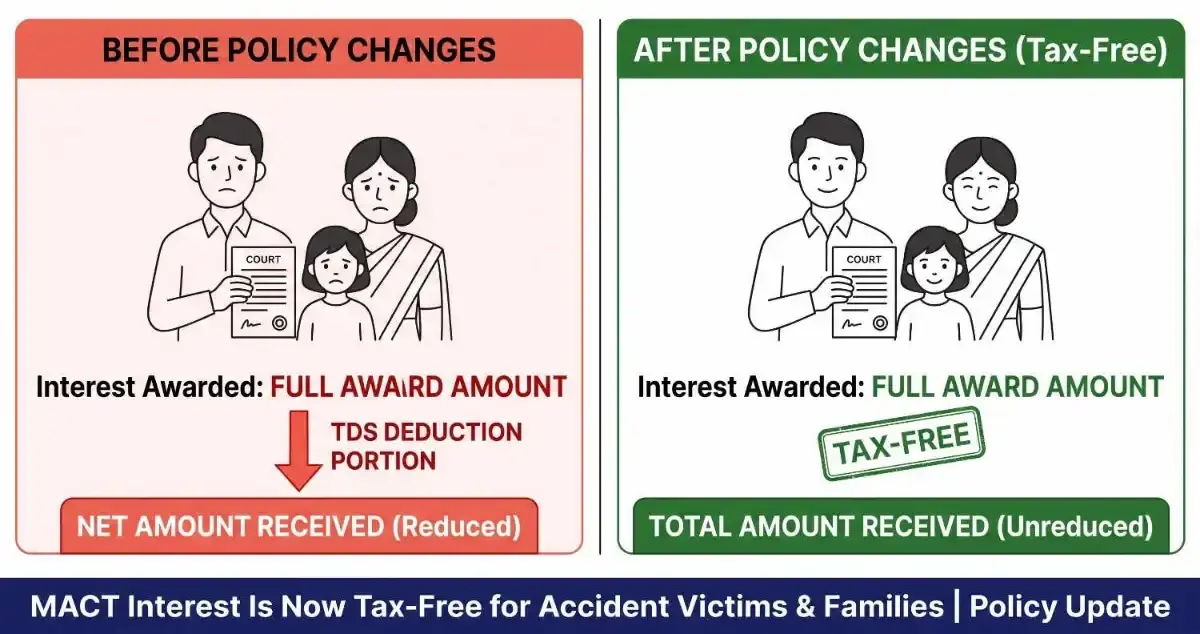
MACT interest income TDS exemption 2026 explained: who qualifies, old vs new Act rules, the FD interest trap, refund steps, and how to report it in your ITR.
Jul 24, 2026