

Section 24(b) of Income Tax Act lets you claim up to ₹2 lakh on home loan interest for FY 2025-26. Eligibility, limits, examples, and ITR steps inside.
Section 24(b) of the Income Tax Act lets you claim up to ₹2 lakh a year on home loan interest for a self-occupied house, and the full interest with no cap if the house is let out. It applies only under the old tax regime, and it's still governed by the 1961 Act for FY 2025-26 returns. Here's exactly how much you can claim, who qualifies, and how the math actually works.
Section 24 of the Income Tax Act, 1961 covers deductions from "Income from House Property." It has two parts. Section 24(a) gives a flat 30% standard deduction on rental income. Section 24(b) is the one everyone cares about: deducting interest paid on a home loan.
So no, "Section 24B" isn't a separate law. It's a sub-clause sitting inside Section 24. A lot of blogs get this sloppy.
For FY 2025-26 (AY 2026-27), your return is governed by the Income-tax Act, 1961, since that's the law in force for income earned up to 31 March 2026. The Income-tax Act, 2025 replaced it from 1 April 2026 onward, but that only affects Tax Year 2026-27 and after. Filing for FY 2025-26 right now? Section 24(b) numbering is what applies to you.
Not every borrower qualifies. Not every property does either.
Applies To | Does NOT Apply To |
|---|---|
Individuals/HUFs with a loan from a bank, NBFC, or housing finance company | Loans from friends or family (deduction rules differ) |
Owners of self-occupied, let-out, or deemed-let-out property | Tenants, since you must own the house |
Loans for purchase, construction, repair, or reconstruction | Loans to pay brokerage or agent commission |
NRIs owning property in India | Loans against commercial property |
Joint owners who are also co-borrowers | Co-borrowers who aren't co-owners |
One partial case: if you work in another city and rent accommodation there, your own home elsewhere can still count as self-occupied. You don't have to physically live in it.
Here are the real numbers, not vague descriptions of them.
Self-occupied property: Capped at ₹2,00,000 per year, old regime only. Budget 2026 left this untouched despite expectations of a hike to ₹3 lakh. It's stayed unchanged since 2014. [Source: incometaxindia.gov.in]
Let-out property: The entire interest is deductible, no upper limit. But loss set-off against other income is capped at ₹2,00,000 a year, carried forward 8 assessment years. See the Rent Income Tax Calculator for the net effect on your rental income.
Two self-occupied houses: Allowed with nil annual value, but the ₹2 lakh cap applies combined across both, not per house.
A third house, unrented: Treated as deemed let-out, taxed on notional rent regardless of actual earnings.
Renovation or repair loans: Capped at ₹30,000 a year.
Construction deadline: Miss the 5-year window (from the end of the FY the loan was taken) and your cap drops from ₹2,00,000 to ₹30,000.
Pre-construction interest: Claimed in 5 equal instalments starting the year construction finishes, still inside the ₹2 lakh cap.
New tax regime: Blocked entirely for self-occupied property. Let-out interest is still allowed against rental income, with no loss set-off elsewhere.
Filing for Tax Year 2026-27 onward? The numbering changes. Here's the verified mapping (see our Income Tax Act 2025 vs 1961 guide for the full picture).
Feature | Income-tax Act, 1961 | Income-tax Act, 2025 |
|---|---|---|
Governing period | Up to FY 2025-26 (AY 2026-27) | Tax Year 2026-27 onward (from 1 April 2026) |
Interest deduction section | Section 24(b) | Section 22(2) |
Self-occupied cap | ₹2,00,000 | ₹2,00,000 (unchanged) |
Let-out property | Full interest, loss capped at ₹2,00,000 for set-off | Same structure carried forward |
Standard deduction on rent | Section 24(a) | Section 22(1) |
The deduction itself hasn't changed. Only the address has. Don't be surprised if your CA says "Section 22(2)" for your FY 2026-27 return. It's not a new benefit, just a renumbered one; check the Income-tax Act, 2025 text yourself if you'd like.
These four get confused constantly. Here's the difference in one place.
Section | What It Covers | Max Deduction | Loan Window |
|---|---|---|---|
24(b) | Home loan interest | ₹2,00,000 (self-occupied) | Any time, old regime |
80C | Principal + stamp duty | ₹1,50,000 (combined) | Any time, old regime |
80EE | Extra, first-time buyers | ₹50,000, over 24(b) | 1 Apr 2016 – 31 Mar 2017 |
80EEA | Extra, affordable housing | ₹1,50,000, over 24(b) | 1 Apr 2019 – 31 Mar 2022 |
Both 80EE and 80EEA are closed to fresh loans. The sanction windows shut years ago. You can only use them if you're still repaying a loan sanctioned inside those dates. For how 80C and 80EEA stack with 24(b) in full, see our home loan tax benefits guide.
Example 1: the common case, Rajesh's self-occupied property
Rajesh works in an IT firm in Pune. He took a ₹30 lakh home loan in FY 2022-23, and in FY 2025-26 he pays ₹2,45,000 in interest.
Actual interest paid: ₹2,45,000
Section 24(b) cap for self-occupied: ₹2,00,000
Deduction allowed: ₹2,00,000 (the extra ₹45,000 is simply lost, not carried forward)
Rajesh falls in the 20% slab. Tax saved = ₹2,00,000 × 20% × 1.04 (cess) = ₹41,600
That's real money back, but only because he stayed on the old regime. Under the new regime, this deduction wouldn't exist for him.
Example 2: the edge case competitors skip, Farida's delayed construction
Farida took a ₹40 lakh loan in FY 2018-19 to build a house. The 5-year deadline fell on 31 March 2024. Construction finished only in FY 2025-26, after the deadline.
Interest paid in FY 2025-26: ₹1,80,000
Normal self-occupied cap: ₹2,00,000
Cap actually applicable, since construction breached the 5-year window: ₹30,000
Deduction allowed: ₹30,000, not ₹1,80,000
Tax saved at 20% slab + cess: ₹30,000 × 20.8% = ₹6,240, instead of the ₹41,600 she'd have gotten if she'd finished on time
That single missed deadline cost Farida over ₹35,000 in tax savings. Worth checking your own completion certificate date right now, isn't it?
Get your annual interest certificate from your bank or housing finance company.
Check whether the house is self-occupied, let-out, or under construction, since the cap differs for each.
Apply the right limit: ₹2,00,000 self-occupied (₹30,000 if the 5-year deadline was missed, or for repairs), or full interest for let-out.
If construction just finished, add 1/5th of your accumulated pre-construction interest.
Log in to incometax.gov.in and open "Schedule House Property" in your ITR.
Choose ITR-1 for one or two house properties (a new AY 2026-27 rule; earlier it allowed just one), or ITR-2 for more complex cases.
Fill the "Section 24(b): Interest on borrowed capital" schedule: lender name, loan account number, sanction date, total loan amount, outstanding balance, and interest paid.
Cross-check auto-filled figures against your AIS before submitting, since mismatches trigger notices.
1. Your claim gets disallowed after filing. Usually the property isn't yet registered in your name, or the completion certificate date doesn't match the municipal record. Re-check the exact date and correct the "House Property" schedule.
2. Your bank's interest certificate doesn't match what you claimed. Request a fresh certificate. Most lenders reissue these by May or June. File a revised return with the corrected figure before the window closes.
3. You missed the deduction entirely. File a revised return any time before 31 March of the assessment year. Revising after 31 December draws a fee under Section 234I: ₹1,000 up to ₹5 lakh income, ₹5,000 above. If the window's shut, an updated return (ITR-U) is still possible, at extra tax cost. Pull your loan documents first to confirm the numbers.
Interest certificate, provisional and final (digital copy accepted)
Loan sanction letter, for 80EE/80EEA eligibility checks
Completion or occupancy certificate from builder or municipal authority
Property registration document or sale deed, for ownership proof
Bank statement showing EMI debits, if the certificate is disputed
No completion certificate yet? Request it from your builder or the local municipal office. Banks won't issue a final interest certificate without it.
No dedicated penalty exists for a wrong Section 24(b) claim, but a few rules will still catch you.
Excess or incorrect claim: If scrutiny disallows your deduction, you owe the shortfall tax plus interest under Section 234B/234C for underpaid advance tax.
Missed ITR deadline: Due date for FY 2025-26 (AY 2026-27) is 31 July 2026 for non-audit taxpayers. [Source: incometax.gov.in] Miss it and Section 234A charges 1% monthly interest on unpaid tax, plus a late fee under Section 234F: up to ₹5,000, or ₹1,000 if income is under ₹5 lakh. Belated returns are allowed until 31 December 2026.
Late revised return: Revising after 31 December (but before 31 March of the assessment year) now draws a fee under Section 234I, the same ₹1,000/₹5,000 structure.
It's the clause under Section 24 that lets you deduct interest paid on a home loan from your taxable income, up to ₹2 lakh a year for self-occupied property, or the full amount for let-out property, under the old tax regime only.
Only for a let-out property, and only against its rental income. Self-occupied property gets zero deduction under the new regime. This is the single biggest misconception borrowers carry into ITR season.
₹2,00,000 a year for self-occupied property, unchanged since 2014 and unchanged again in Budget 2026. Let-out property has no cap on the interest itself, only on the loss you can set off elsewhere.
Yes, but the ₹2 lakh cap applies combined across both self-occupied properties, not per property. A third unrented house is taxed on deemed rental value instead.
Same benefit, two different laws. Section 24(b) governs FY 2025-26 filings; Section 22(2) of the 2025 Act takes over from Tax Year 2026-27, with the ₹2 lakh cap unchanged.
Not directly. Interest paid during construction becomes "pre-construction interest," claimed in 5 equal instalments starting the year construction completes, as long as that happens within 5 years of the loan's disbursal year.
Yes. File a revised return if your original deadline hasn't passed, or use ITR-U within its window if it has. You'll need your interest certificate and completion documents ready before refiling.
Yes, but only if both are co-owners on the title AND co-borrowers on the loan. Each can then claim up to ₹2,00,000 independently, based on ownership share.
80EE gives ₹50,000 extra for loans sanctioned April 2016-March 2017, capped at ₹35 lakh loan and ₹50 lakh property value. 80EEA gives ₹1,50,000 extra for loans sanctioned April 2019-March 2022, with a ₹45 lakh stamp duty cap. Neither window is open today.
Yes. NRIs get the same interest deduction as resident taxpayers on Indian property loans, subject to correct TDS treatment on any rental income and applicable DTAA provisions.
Pull your interest certificate today and check which cap applies to you: self-occupied, let-out, or the reduced ₹30,000 limit. Run the numbers on the Old vs New Tax Regime Calculator to see which regime genuinely saves more. For the official text, check the Income Tax Act, 1961 or the ITR-1 filing FAQs on the department's own portal.
For educational purposes only. Verify all figures at official sources before acting. Toolisky is not affiliated with any government body. Consult a qualified CA or legal professional before making compliance decisions. See toolisky.com/accuracy-and-limitations.
No TAN for NRI property purchase applies only from 1 October 2026, and only to resident individual and HUF buyers. Get the rates, forms, and dates you need.
Jul 25, 2026

Did you lose the SGB premature redemption tax exemption? Here's exactly who's affected, how much tax applies now, and how to check your own bonds.
Jul 24, 2026
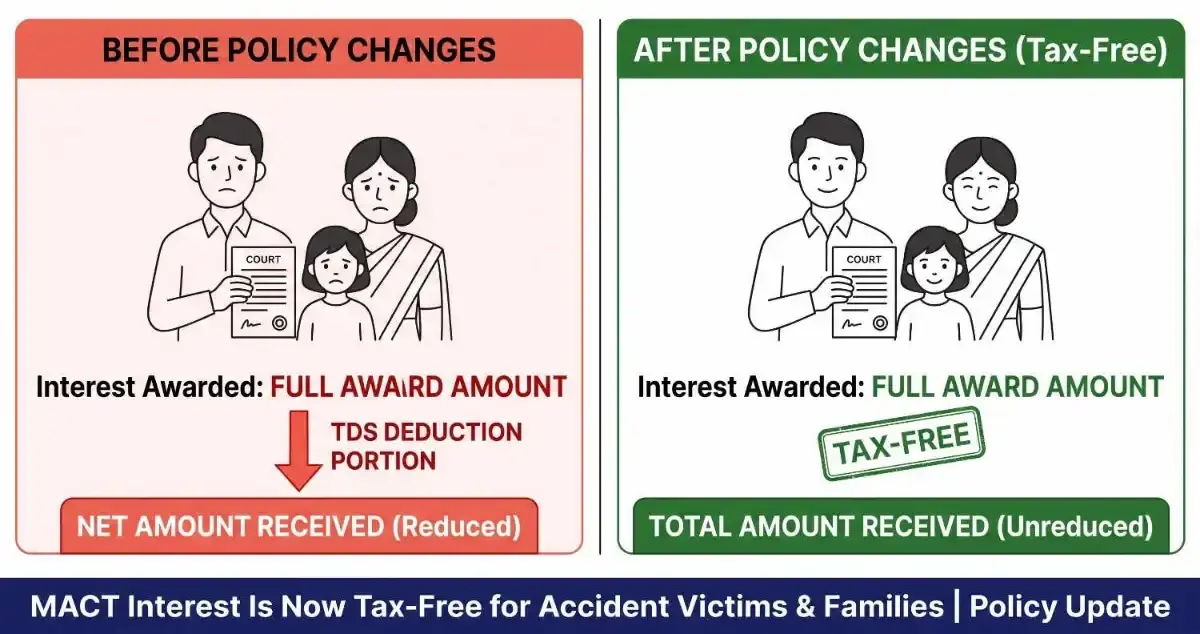
MACT interest income TDS exemption 2026 explained: who qualifies, old vs new Act rules, the FD interest trap, refund steps, and how to report it in your ITR.
Jul 24, 2026