
Standard deduction in income tax is ₹75,000 (new regime) or ₹50,000 (old regime). FY 2025-26 calculation, section numbers, examples with math, and ITR steps.
The standard deduction in income tax is ₹75,000 under the new regime and ₹50,000 under the old — a flat amount deducted from your gross salary before tax is computed. No bills, no proof, and no investment required. Every salaried employee and pensioner in India gets this automatically, but most don't know when it stops applying.
Standard deduction is a fixed flat amount deducted from gross salary before income tax is computed. You do not submit receipts, declare expenses, or make investments to get it. Budget 2018 reintroduced it to replace transport allowance (₹19,200 per year) and medical reimbursement (₹15,000 per year) in a single, simpler line item.
For income earned up to 31 March 2026 (FY 2025-26 / AY 2026-27), the standard deduction is governed by Section 16(ia) of the Income-tax Act, 1961. For income earned from 1 April 2026 onwards (Tax Year 2026-27), it falls under Section 22 of the Income-tax Act, 2025. The deduction amounts are unchanged between the two Acts.
If you want to understand how the 1961 and 2025 Acts differ more broadly, read the Income Tax Act 2025 vs 1961 guide on Toolisky.
Applies to | Does NOT apply to |
|---|---|
Salaried employees — private, public, and government sector | Freelancers and consultants earning professional fees |
Pensioners receiving employer or government pension taxed under "Salaries" | Self-employed individuals and business owners |
Employees who changed jobs within the same financial year | People earning only rental income, interest, or capital gains |
Directors on a company payroll drawing salary | Family pensioners receiving family pension after the employee's death* |
Note on family pensioners. Family pension — the amount a spouse or dependent receives after the salaried employee dies — is taxed under "Income from Other Sources," not "Salaries." Standard deduction does not apply. A separate deduction under Section 57(iia) of the Income-tax Act, 1961 applies instead: the lower of ₹25,000 or one-third of the annual family pension. Budget 2025 increased this from ₹15,000 to ₹25,000.
Budget 2026 made no changes to standard deduction amounts. These limits apply for both the current AY 2026-27 filing and Tax Year 2026-27 returns.
Tax Regime | Standard Deduction | Section (FY 2025-26) | Section (Tax Year 2026-27) |
|---|---|---|---|
New tax regime (default) | ₹75,000 per year | Section 16(ia) — 1961 Act | Section 22 — 2025 Act [VERIFY] |
Old tax regime | ₹50,000 per year | Section 16(ia) — 1961 Act | Section 22 — 2025 Act [VERIFY] |
Family pension deduction | ₹25,000 or 1/3 of pension, lower of the two | Section 57(iia) — 1961 Act | [VERIFY: 2025 Act equivalent] |
One deduction per year, not per employer. If you worked for two companies in FY 2025-26, your total standard deduction is still ₹75,000 (new regime) — not ₹1,50,000.
The ₹75,000 new regime limit was confirmed for AY 2026-27 and beyond by the Taxation Laws (Amendment) Bill, 2025. This resolved a drafting lapse in Finance (No.2) Act, 2024 that had linked the enhanced deduction only to one clause of Section 115BAC(1A) rather than covering the full regime. [VERIFY: Taxation Laws (Amendment) Bill, 2025 was enacted and text is available at incometaxindia.gov.in or cbdt.gov.in]
Use the Standard Deduction Tax Impact Calculator to enter your gross salary and see your exact tax saving in under 30 seconds.
Formula: Taxable salary = Gross salary − Standard deduction
Your actual ₹ saving depends on which slab your taxable income falls into. New regime slab rates for FY 2025-26 and Tax Year 2026-27 (confirmed unchanged by Budget 2026):
Taxable Income Slab | New Regime Rate |
|---|---|
Up to ₹4,00,000 | Nil |
₹4,00,001 – ₹8,00,000 | 5% |
₹8,00,001 – ₹12,00,000 | 10% |
₹12,00,001 – ₹16,00,000 | 15% |
₹16,00,001 – ₹20,00,000 | 20% |
₹20,00,001 – ₹24,00,000 | 25% |
Above ₹24,00,000 | 30% |
Add 4% Health and Education Cess on the tax amount. Section 87A rebate eliminates tax entirely if taxable income is ₹12,00,000 or below — maximum rebate ₹60,000.
At a gross salary of ₹12,75,000, the ₹75,000 standard deduction pulls your taxable income to exactly ₹12,00,000. Section 87A then wipes out the entire ₹60,000 tax, leaving ₹0 payable. Earn ₹13,00,000 gross instead, and you lose this benefit — that ₹25,000 difference in gross salary costs you ₹70,980 in tax (see Example 2 below).
Gross salary: ₹12,75,000. He opts for the new tax regime.
Gross salary = ₹12,75,000
Standard deduction (Section 16(ia), new regime) = ₹75,000
Taxable income = ₹12,75,000 − ₹75,000 = ₹12,00,000
Tax on ₹12,00,000:
Nil on ₹4,00,000 = ₹0
5% on ₹4,00,000 = ₹20,000
10% on ₹4,00,000 = ₹40,000
Tax before rebate = ₹60,000
Section 87A rebate (income ≤ ₹12,00,000) = ₹60,000
Tax after rebate = ₹60,000 − ₹60,000 = ₹0
Cess (4% on ₹0) = ₹0
Net tax payable: ₹0
Suresh pays zero income tax on a ₹12.75 lakh salary. The ₹75,000 standard deduction is the only reason his taxable income lands exactly at the ₹12 lakh Section 87A threshold.
Farida earned ₹4,80,000 from her first employer (April–September 2025) and ₹8,50,000 from her second (October 2025–March 2026). New regime. Total gross = ₹13,30,000.
Common mistake: Each employer calculated TDS applying ₹75,000 standard deduction independently. Farida cannot claim ₹1,50,000 total. She gets ₹75,000 once.
Total gross salary = ₹4,80,000 + ₹8,50,000 = ₹13,30,000
Standard deduction = ₹75,000 (annual cap, not per employer)
Taxable income = ₹13,30,000 − ₹75,000 = ₹12,55,000
Tax on ₹12,55,000:
Nil on ₹4,00,000 = ₹0
5% on ₹4,00,000 = ₹20,000
10% on ₹4,00,000 = ₹40,000
15% on ₹55,000 = ₹8,250
Tax before cess = ₹68,250
Section 87A rebate: not applicable (income > ₹12,00,000)
Cess (4% on ₹68,250) = ₹2,730
Net tax payable: ₹70,980
Because each employer applied ₹75,000 separately, total TDS deducted is less than ₹70,980. Farida must pay the shortfall as self-assessment tax using Challan 280 at incometax.gov.in before 31 July 2026. She should have submitted Form 12B to her second employer disclosing the salary from the first so the second could calculate correct TDS.
For FY 2025-26 (AY 2026-27) returns — filing window open until 31 July 2026 [VERIFY: no CBDT deadline extension as of date of publishing; check cbdt.gov.in]:
Log in at incometax.gov.in → e-File → Income Tax Returns → File Income Tax Return.
Select Assessment Year 2026-27. Choose Tab 1 (uses old Act 1961 section numbers; matches your Form 16).
Select your ITR form — ITR-1 for salary and interest income only; ITR-2 if you have capital gains or multiple properties.
Go to Schedule S (Salary). Enter your gross salary from Part B of your Form 16.
Locate the Standard Deduction field. Verify it shows ₹75,000 if you are under the new regime, or ₹50,000 under the old regime. Edit it if the portal shows the wrong figure.
If you have two Form 16s (from two employers), add both salaries in Schedule S. The combined standard deduction must not exceed ₹75,000 total.
Complete the e-verification step and submit.
Check your effective tax rate under each regime before committing — the Old vs New Tax Regime guide shows exactly when each saves more. Full slab rates for FY 2026-27 are also available in the Income Tax Slab guide.
Scenario 1 — Employer applied ₹50,000 instead of ₹75,000 in new regime. Your employer overcalculated TDS by deducting based on ₹50,000 instead of ₹75,000. File your ITR claiming ₹75,000 standard deduction. The ₹25,000 extra deduction reduces taxable income and the excess TDS becomes a refund. CBDT typically processes refunds within 30-45 days of ITR processing. Track it at incometax.gov.in → Services → Refund Status.
Scenario 2 — Both employers each applied ₹75,000 standard deduction. Both employers deducted TDS using ₹75,000 as standard deduction — but only ₹75,000 is legal for the full year. Your combined TDS falls short of actual liability. Calculate the actual tax (as shown in Example 2 above), pay the shortfall using Challan 280 (Self-Assessment Tax) at incometax.gov.in, and disclose ₹75,000 in the ITR. Pay before 31 July 2026 to avoid interest under Section 234B.
Scenario 3 — You already filed your ITR and missed the standard deduction. File a revised return under Section 139(5) of the Income-tax Act, 1961 / Section 263(5) of the Income-tax Act, 2025. Go to incometax.gov.in → e-File → Income Tax Returns → File Income Tax Return → select Revised → AY 2026-27. The revised ITR window for AY 2026-27 closes on 31 December 2026. Your refund will be recalculated automatically on processing.
Standard deduction itself has no penalty — a missed claim just means you pay more tax than you need to. Penalties arise from late filing or unpaid tax.
Situation | Section (1961 Act) | Section (2025 Act) | Amount |
|---|---|---|---|
ITR filed after 31 July 2026, income ≤ ₹5,00,000 | Section 234F | Section 451 [VERIFY] | ₹1,000 |
ITR filed after 31 July 2026, income > ₹5,00,000 | Section 234F | Section 451 [VERIFY] | ₹5,000 |
TDS shortfall not paid by 31 July 2026 (self-assessment) | Section 234B | Section 447 [VERIFY] | 1% per month on unpaid tax |
Yes. The new tax regime (default from AY 2024-25) allows ₹75,000 as standard deduction from FY 2024-25 onwards — ₹25,000 more than the ₹50,000 available under the old regime. This was formally confirmed by the Taxation Laws (Amendment) Bill, 2025, which resolved a drafting ambiguity in Finance (No.2) Act, 2024 that had restricted the enhanced amount to a specific transitional clause of Section 115BAC(1A). [VERIFY: Bill enacted into law]
Yes — once per financial year, not once per employer. Add both salaries together and deduct ₹75,000 total (new regime) or ₹50,000 (old). Submit Form 12B to the second employer disclosing salary from the first so TDS is calculated correctly on the combined income. If both employers each applied ₹75,000 separately, calculate the shortfall and pay it via Challan 280 before 31 July 2026.
Yes, if your pension is from a former employer and is taxed under "Salaries." Both the ₹75,000 new regime and ₹50,000 old regime limits apply equally to pensioners. One constraint: the deduction cannot exceed the actual pension amount. A pensioner receiving ₹40,000 annual pension can only deduct ₹40,000 — not the full ₹75,000. No documentation is required; the deduction appears in Form 16 automatically.
No — this is the most common misconception. Standard deduction under Section 16(ia) applies only to income taxable under "Salaries." Freelancers and self-employed individuals earn under "Profits and Gains from Business or Profession." They can claim actual business expenses under Section 37 of the Income-tax Act, 1961, but standard deduction is unavailable to them. If you work on a retainer basis under a formal employment contract, that salary qualifies.
Yes. Standard deduction is a flat deduction from total gross salary income, which includes basic pay, dearness allowance, HRA (before exemption), bonus, incentives, and all taxable allowances. You deduct ₹75,000 (new regime) from the full gross figure — there is no rule restricting it to basic pay. Leave Travel Allowance (LTA) has a separate exemption process and is handled independently.
Your employer over-deducted TDS by basing it on ₹50,000 instead of ₹75,000. When you file your ITR, enter ₹75,000 in the standard deduction field. The portal recalculates your tax on the lower taxable income, and the extra TDS becomes a refund. CBDT typically credits refunds within 30-45 days of ITR processing. Track the refund at incometax.gov.in → Services → Refund Status.
Family pension — paid to the spouse or a dependent after the employee's death — is taxed under "Income from Other Sources," not Salaries. Standard deduction does not apply. The applicable deduction is Section 57(iia) of the Income-tax Act, 1961 [VERIFY: 2025 Act equivalent]: the lower of ₹25,000 or one-third of the annual family pension received. Budget 2025 increased this ceiling from ₹15,000 to ₹25,000.
No — they operate at different stages of the tax calculation. Standard deduction (Section 16(ia)) is a salary-head deduction that reduces gross salary before reaching "Gross Total Income." Section 80C (Section 123 under the 2025 Act) is a Chapter VI-A deduction from Gross Total Income and requires actual investments in PPF, ELSS, NSC, or LIC. Under the new regime, standard deduction is available but Section 80C is not — they are entirely separate.
Yes. File a revised return under Section 139(5) of the Income-tax Act, 1961 / Section 263(5) of the Income-tax Act, 2025. Log in at incometax.gov.in → e-File → Income Tax Returns → select "Revised Return" → AY 2026-27. Enter ₹75,000 (new regime) or ₹50,000 (old regime) in the standard deduction field. The revised return for AY 2026-27 can be filed until 31 December 2026; your refund will recalculate on processing.
No. Standard deduction is a flat annual amount — ₹75,000 or ₹50,000 — regardless of months worked. Even if you earned salary for just two months in FY 2025-26 and received ₹90,000 total, you deduct ₹75,000 (new regime), leaving only ₹15,000 as taxable salary. The only real constraint is that the deduction cannot exceed your total actual salary or pension amount for the year.
Your current standard deduction is ₹75,000 (new regime) — file your ITR before 31 July 2026 at incometax.gov.in and verify the Standard Deduction field in Schedule S shows the correct amount. If you have two Form 16s or missed the deduction in a previously filed return, revise it by 31 December 2026.
Use the Standard Deduction Tax Impact Calculator to check your exact tax saving in seconds.
Official source: incometaxindia.gov.in
No TAN for NRI property purchase applies only from 1 October 2026, and only to resident individual and HUF buyers. Get the rates, forms, and dates you need.
Jul 25, 2026

Did you lose the SGB premature redemption tax exemption? Here's exactly who's affected, how much tax applies now, and how to check your own bonds.
Jul 24, 2026
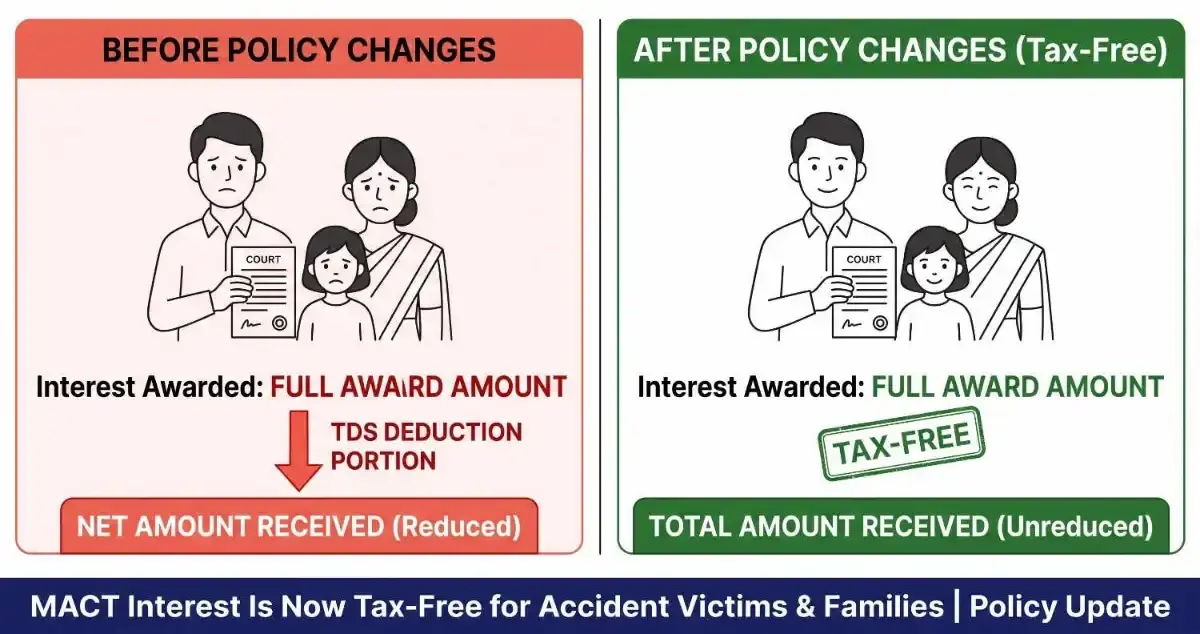
MACT interest income TDS exemption 2026 explained: who qualifies, old vs new Act rules, the FD interest trap, refund steps, and how to report it in your ITR.
Jul 24, 2026