

India's June 5, 2026 ordinance scraps 12.5% capital gains tax on government bonds for foreign investors. Here's what actually changed, what stayed the same, and why it does not affect retail investors, equity, or property gains.
India's June 5, 2026 ordinance removes capital gains tax on government securities (G-Secs), but only for Foreign Institutional Investors (FIIs) and the Bank for International Settlements (BIS). If you're a resident Indian investor or an individual NRI, your capital gains tax on G-Secs has not changed at all. Here's the full breakdown.
On June 5, 2026, the President promulgated the Income-tax (Amendment) Ordinance, 2026 under Article 123 of the Constitution, since Parliament wasn't in session. It amends Schedule IV of the Income-tax Act, 2025 by inserting two new entries: Serial No. 13D and Serial No. 13E.
Quick definition: Government Securities (G-Secs) are bonds issued by the Central Government to fund infrastructure, railways, defence, and welfare spending, and are considered virtually risk-free since the government backs them directly.
Entry 13D exempts Foreign Institutional Investors (FIIs), defined under Section 210(6)(a) of the Income-tax Act, 2025 and including FPIs notified as FIIs, from income tax on any interest earned on G-Secs and on any capital gains from their sale, exchange, or transfer.
Entry 13E gives an identical exemption to the Bank for International Settlements (BIS), the Basel-based institution that manages reserves for central banks worldwide. BIS currently holds zero Indian G-Secs, so this opens a brand-new door for it.
The ordinance is deemed to have come into force from April 1, 2026, the start of FY 2026-27, so the relief covers the entire current financial year, not just income earned after June 5.
Before this, FIIs paid a 20% withholding tax on G-Sec interest and 12.5% long-term capital gains tax on holdings over 12 months. That tax friction is now gone for this category of investor, provided they meet the compliance condition discussed below.
This is where most quick-take headlines blur the picture, so let's be precise.
Exempt under the ordinance:
Foreign Institutional Investors (FIIs), as specifically defined in Section 210(6)(a) of the Income-tax Act, 2025. This covers entities registered as FPIs and notified as FIIs: foreign pension funds, sovereign wealth funds, and foreign insurance companies investing through the institutional route.
The Bank for International Settlements (BIS).
Not exempt. Capital gains tax on G-Secs continues exactly as before for:
Resident Indian individuals, HUFs, and businesses holding G-Secs directly or through a demat/RBI Retail Direct account.
Individual NRIs and OCIs investing in G-Secs in their personal capacity, through NRI/NRO accounts, FCNR routes, or the RBI Retail Direct Gilt Account Scheme, rather than as a registered FII.
Domestic mutual funds and AIFs investing in G-Secs on behalf of resident investors.
The confusion is understandable: an NRI is technically a person residing outside India, and headlines often say "tax exemption for foreign investors." But "Foreign Institutional Investor" is a defined legal category for institutional money, not a synonym for "any Indian living abroad." An individual NRI buying G-Secs through their own NRI account is not an FII, so the exemption doesn't reach them.
Since the ordinance leaves resident and individual NRI taxation untouched, here's what actually applies for FY 2025-26 (AY 2026-27): the rules carried forward from the Finance Act 2024 changes.
Holding period: G-Secs are listed securities, so the long-term threshold is more than 12 months. Sell on or before the 12-month mark and it's short-term.
Long-term capital gains (LTCG): Taxed at a flat 12.5%, with no indexation benefit.
Short-term capital gains (STCG): Added to your total income and taxed at your applicable slab rate.
Cess: A 4% Health and Education Cess applies on top of the tax computed, in both cases.
No special exemption threshold applies the way the ₹1.25 lakh exemption applies to listed equity LTCG. Every rupee of G-Sec LTCG is taxable at 12.5% once it's classified as long-term.
[VERIFY: confirm the exact corresponding section number for capital gains on listed government securities under the Income-tax Act, 2025, since FY 2026-27 onward is governed by the new Act rather than the 1961 Act. The rate and holding-period logic above are expected to carry forward, but the section reference should be checked against the final notified Act text.]
Example 1: Resident salaried investor, no change from the ordinance
Rohan, a salaried professional earning ₹12,00,000 a year, bought ₹5,00,000 worth of a 10-year G-Sec through RBI Retail Direct in March 2024. He sold it in May 2025 for ₹5,60,000, after a holding period of over 12 months, so it's long-term.
LTCG = ₹5,60,000 − ₹5,00,000 = ₹60,000
Tax @ 12.5% = ₹7,500
Plus 4% cess = ₹300
Total tax payable = ₹7,800
Nothing about the June 5 ordinance changes this. Rohan pays the same ₹7,800 he would have paid before the ordinance existed.
Example 2: The NRI misconception, corrected
Priya is an NRI based in Dubai. She invested ₹10,00,000 in G-Secs through her NRO account in January 2025 and sold them in June 2026 for ₹11,20,000, after a 17-month holding period, so long-term. She read a headline about "foreign investor tax exemption on G-Secs" and assumed it applied to her.
It doesn't. Priya invested as an individual through a personal NRO account, not as a registered FII.
LTCG = ₹11,20,000 − ₹10,00,000 = ₹1,20,000
Tax @ 12.5% = ₹15,000
Plus 4% cess = ₹600
Total tax payable = ₹15,600
If Priya's investment had instead been routed through a registered FII or FPI structure (a different, institutional arrangement most individual NRIs don't use), that entity's gains could potentially qualify for the Entry 13D exemption, subject to compliance. Her direct personal holding does not.
Investor Category | Tax on G-Sec Capital Gains Before June 5, 2026 | Tax on G-Sec Capital Gains After the Ordinance |
|---|---|---|
FIIs / FPIs (registered, as defined under Sec 210(6)(a)) | 12.5% LTCG (>12 months); higher rates on STCG | Fully exempt, from April 1, 2026, subject to reporting compliance |
Bank for International Settlements (BIS) | Not previously investing in G-Secs | Fully exempt, from April 1, 2026 |
Resident individuals / HUFs | 12.5% LTCG (>12 months); slab-rate STCG (≤12 months) | No change (same 12.5% LTCG / slab-rate STCG) |
Domestic companies / businesses | 12.5% LTCG; slab/corporate-rate STCG | No change |
Individual NRIs/OCIs (personal accounts, not FII) | 12.5% LTCG (>12 months); applicable STCG rate | No change |
If you're a resident or individual NRI investor, here's how to work out what you owe:
Find your holding period. Subtract the purchase date from the sale/redemption date. More than 12 months counts as long-term.
Calculate the gain. Sale value minus purchase cost minus any transfer-related expenses.
Apply the right rate. 12.5% flat for LTCG (no indexation); your income-tax slab rate for STCG.
Add 4% cess on the tax amount from Step 3.
Check for surcharge if your total income crosses the applicable threshold for your slab; this layers on top of the basic tax, not the gain itself.
Report it correctly in your ITR under "Capital Gains," even if tax was already deducted at source on the interest component.
"Get your exact figure in seconds — use our Capital Gains Tax Calculator on Toolisky" instead of doing this by hand.
The FII exemption isn't automatic. It's conditional on the FII furnishing information in a prescribed form and manner. Until that's notified and complied with, an FII has to report, not just assume zero tax.
It applies only within the current financial year: gains from April 1, 2026 onward, not anything booked in FY 2025-26 or earlier.
Equities are untouched. This ordinance is specific to Government Securities; equity shares, equity funds, and corporate bonds follow their own unchanged rules for every investor category.
Sovereign Gold Bonds (SGBs) have their own indexation and maturity-linked exemption rules and are not affected by this ordinance.
A parallel, distinct reform, the RBI/DEA's Foreign Exchange Management (Non-Debt Instruments) (Third Amendment) Rules, 2026, eases how individual foreign nationals (PROIs) access Indian equities via NRI/OCI-style onboarding. That's about market access, not tax, and shouldn't be confused with this ordinance.
Almost every report led with "foreign investors get tax-free G-Secs," but few flagged that the relief hinges on a reporting condition that isn't fully operationalised yet. Until the prescribed format is notified and complied with, the exemption is conditional, not automatic, which matters for an FII's own tax provisioning even though it has no bearing on resident or NRI taxpayers.
This ordinance changes nothing about your filing if you're a resident or NRI investor, but it's a good prompt to check your own numbers. Today, pull up your G-Sec purchase date and current value and see whether you're still short of the 12-month threshold. If you're close, say within 2-3 weeks, timing your sale after that date instead of before could mean the difference between slab-rate STCG and flat 12.5% LTCG on the same gain.
Foreign Interest Income Tax Calculator: for NRI readers
Further reading: Income Tax Act 2025 vs 1961: What Every Indian Taxpayer Must Know for FY 2025-26 and LTCG Tax Rate India 2026.
"Get your exact figure in seconds — use our Long-Term Capital Gains Tax Calculator on Toolisky" before you file.
No. The ordinance exempts only Foreign Institutional Investors (FIIs) and the Bank for International Settlements (BIS). Resident individuals, HUFs, and businesses continue paying 12.5% LTCG on holdings over 12 months, or slab-rate STCG, exactly as before.
Only if routed through a registered FII/FPI structure, which most individual NRIs don't use. An NRI investing personally via NRO, NRE, FCNR, or RBI Retail Direct is not an FII and still pays the standard 12.5% LTCG or slab-rate STCG.
It's a specific category defined under Section 210(6)(a) of the Income-tax Act, 2025: institutional entities registered as Foreign Portfolio Investors and notified as FIIs, such as foreign pension funds and sovereign wealth funds. It is not a general label for any non-resident person.
The ordinance is deemed to have come into force from April 1, 2026, the start of FY 2026-27. It covers FII and BIS income from that date onward, not gains booked in earlier financial years.
It's conditional. The FII must furnish information in a form and manner to be prescribed by the government. Until that's met, the exemption isn't simply self-executing.
12.5% on long-term gains held over 12 months, with no indexation, plus 4% cess. Short-term gains held 12 months or less are taxed at your regular income slab rate.
The rate structure of 12.5% LTCG and slab-rate STCG is expected to carry forward, since the ordinance itself works within the Income-tax Act, 2025 framework. [VERIFY: confirm the exact section reference for resident G-Sec capital gains under the finalised Income-tax Act, 2025 text.]
In principle, gains earned by a properly registered, compliant FII entity could fall under the exemption. But that's a different investment structure from holding G-Secs in your own name, with its own costs and eligibility rules. It's not a simple workaround for an individual NRI account.
Press Information Bureau, Government of India: Press release on the Income-tax (Amendment) Ordinance, 2026 and related G-Sec reforms
Income Tax Department, Government of India: Capital Gains: rates, holding periods, and computation rules
[VERIFY: link to the full notified text of the Income-tax Act, 2025, and Schedule IV once published on incometaxindia.gov.in, for the precise statutory wording of Entries 13D and 13E.]
Reviewed by Anita Patil (CA) and Viraj Mathpati (Law Student, Symbiosis Law School) | Last Updated: June 2026
This article is for educational purposes only. Consult a qualified CA or legal professional before making tax decisions. See /accuracy-and-limitations.
No TAN for NRI property purchase applies only from 1 October 2026, and only to resident individual and HUF buyers. Get the rates, forms, and dates you need.
Jul 25, 2026

Did you lose the SGB premature redemption tax exemption? Here's exactly who's affected, how much tax applies now, and how to check your own bonds.
Jul 24, 2026
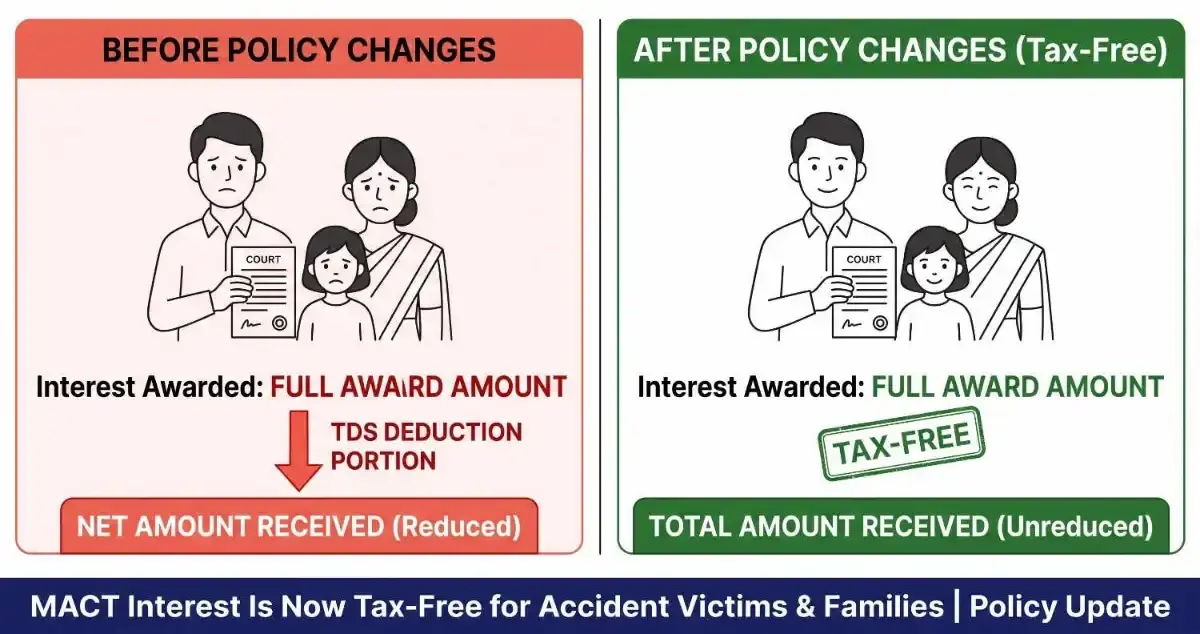
MACT interest income TDS exemption 2026 explained: who qualifies, old vs new Act rules, the FD interest trap, refund steps, and how to report it in your ITR.
Jul 24, 2026