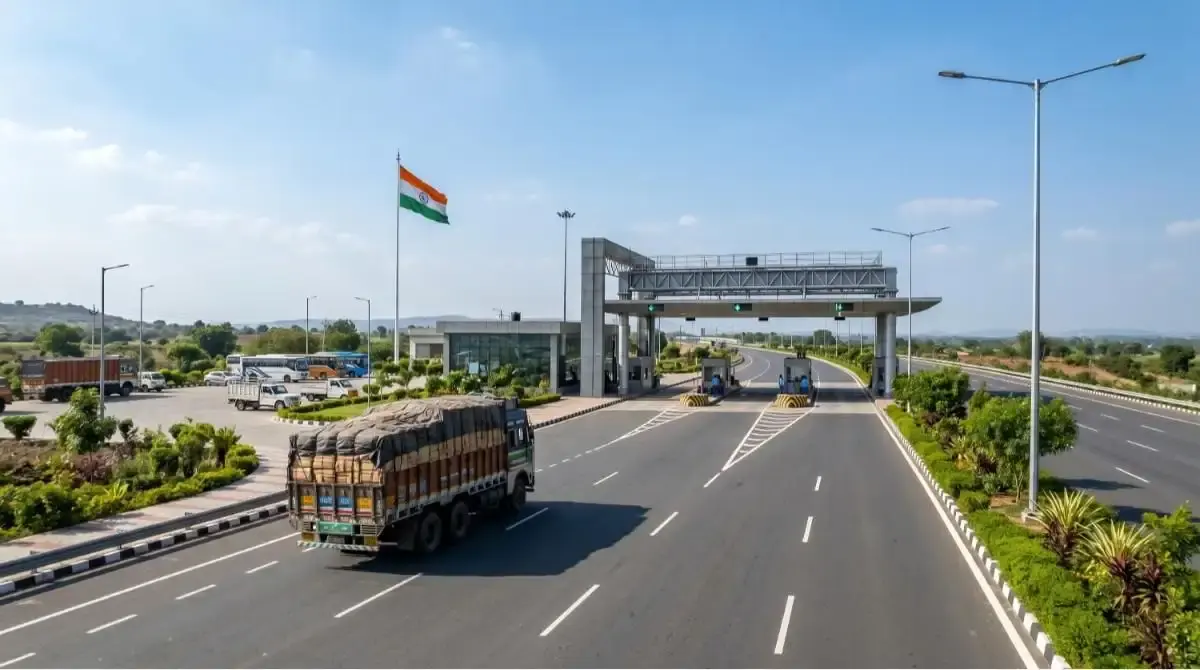

Border check post tax 2026 guide: state-wise rates for UP, Rajasthan, Maharashtra, Gujarat, MP & Haryana, Parivahan Checkpost V4 steps, and penalty rules.
Border check post tax 2026: state-wise rate table (UP, Rajasthan, Maharashtra, Gujarat, MP, Haryana), exact Parivahan Checkpost V4 steps, failed transaction fix, SMS receipt verify, and penalty rules.
Every time a commercial vehicle crosses a state border in India, that destination state is legally entitled to charge border check post tax — a road-use levy under its own Motor Vehicles Taxation Act. Physical border booths are largely gone, replaced by mobile squads and FASTag tracking, but the payment obligation is very much alive in 2026. What changed is that you now pay online at services.parivahan.gov.in/checkpostv4 before you move — not at a roadside booth after you're stopped.
This guide covers everything truck drivers, transporters, fleet operators, and packers & movers need: state-wise rate slabs, the exact Parivahan Checkpost V4 steps, how to fix a failed transaction, how to verify your receipt by SMS, and what the penalties look like if you skip payment.
Border check post tax — also called "other-state vehicle tax" or "checkpost tax" on government portals — is the fee a destination state charges when a vehicle registered elsewhere enters and operates commercially on its roads. It sits alongside road tax (paid in your home state at registration) and toll (paid per plaza). Paying one does not cover the others.
What actually changed leading into 2026:
Physical barriers dismantled in most states. Rajasthan, UP, Maharashtra, Gujarat, and Haryana have shifted enforcement to mobile squads and ANPR cameras linked to FASTag data. The tax didn't go away — the collection point moved online.
Tamil Nadu joined the online checkpost system in May 2026. Vehicles entering Tamil Nadu must now pre-pay via the Parivahan portal, not at the Walajah or Krishnagiri toll checkpost offices.
Checkpost V4 portal replaced the older checkpost.parivahan.gov.in URL. The current portal is services.parivahan.gov.in/checkpostv4.
Before you open the payment portal, confirm your registration number format with the free Vehicle Number Format Checker on Toolisky. A mismatched format is the single most common reason the "Get Details" step fails.
Vehicle Type | Must Pay? | Notes |
|---|---|---|
Goods carrier / truck on temporary permit | Yes | Road tax + Special Road Tax (SRT) both apply |
Tourist bus / contract carriage on countersigned permit | Yes | Charges by seating capacity |
Interstate stage carriage (fixed cross-state route) | Yes | Separate rate schedule per state |
Taxi / cab on interstate trip | Yes | Temporary permit required |
Bare chassis being transported to fabrication unit | Yes | Flat per-chassis fee — see state tables |
Vehicle on temporary registration from dealer | Yes | Flat per-vehicle fee |
National permit holder | Partial | Annual authorisation fee per state, not per trip — but not a blanket exemption |
Private car on personal holiday | No | Only if used commercially does liability arise |
Ambulance, fire brigade, defence vehicle | No | Exempt under Central Motor Vehicles Rules |
There is no single national rate. Each state notifies its own schedule. The table below is the most complete public comparison available. Verify rates against each state's transport portal before dispatch — states revise schedules periodically.
GVW / Load Capacity | Road Tax | Special Road Tax (SRT) | Period |
|---|---|---|---|
Up to 7,000 kg | ₹110 per 1,000 kg | Up to 5,000 kg: ₹90 per 1,000 kg | 30 days |
Above 7,000 kg | +₹50 per 1,000 kg for excess | Above 5,000 kg: +₹70 per 1,000 kg for excess | 30 days |
Motor car / omnibus (up to 10 seats) on temp reg | ₹200 flat | — | Per entry |
Bare chassis | ₹1,000 flat | — | Per entry |
Annual permit multiplier: 10× the 30-day rate for a 12-month authorisation.
Official source: transport.rajasthan.gov.in
Vehicle Category | Rate | Period |
|---|---|---|
Goods vehicle up to 7,500 kg GVW | ₹130 per 1,000 kg | 30 days |
Goods vehicle 7,501–12,000 kg | ₹150 per 1,000 kg | 30 days |
Goods vehicle above 12,000 kg | ₹170 per 1,000 kg | 30 days |
Tourist/contract carriage (per seat) | ₹25 per seat | 7 days |
Stage carriage (per seat) | ₹30 per seat | 7 days |
Official source: uptransport.upsdc.gov.in
GVW | Temporary Permit Tax | Period |
|---|---|---|
Up to 3,000 kg | ₹90 per 1,000 kg | 7 days |
3,001–7,500 kg | ₹120 per 1,000 kg | 7 days |
7,501–12,000 kg | ₹160 per 1,000 kg | 7 days |
Above 12,000 kg | ₹200 per 1,000 kg | 7 days |
Maharashtra also levies a Green Tax surcharge of 15% on vehicles older than 8 years entering on a temporary permit.
Official source: transport.maharashtra.gov.in
GVW | Rate | Period |
|---|---|---|
Up to 7,500 kg | ₹100 per 1,000 kg | 30 days |
7,501–12,000 kg | ₹140 per 1,000 kg | 30 days |
Above 12,000 kg | ₹180 per 1,000 kg | 30 days |
Official source: rtogujarat.gov.in
Vehicle Type | Rate | Period |
|---|---|---|
Goods vehicle (per 1,000 kg GVW) | ₹115 | 30 days |
Tourist bus (per seat) | ₹20 | 7 days |
Contract carriage (per seat) | ₹18 | 7 days |
Official source: transport.mp.gov.in
GVW | Rate | Period |
|---|---|---|
Up to 7,500 kg | ₹105 per 1,000 kg | 30 days |
7,501–12,000 kg | ₹145 per 1,000 kg | 30 days |
Above 12,000 kg | ₹185 per 1,000 kg | 30 days |
Official source: hartrans.gov.in
Example 1 — Suresh's 6-tonne truck entering Rajasthan (the common case)
Suresh runs a parcel delivery business out of Indore. His truck has a GVW of 6,000 kg and a load-carrying capacity of 4,000 kg. Both fall inside Rajasthan's "up to 7,000 kg" band.
Road Tax: 6,000 ÷ 1,000 × ₹110 = ₹660
Special Road Tax: 4,000 ÷ 1,000 × ₹90 = ₹360
Total for 30 days: ₹1,020
Example 2 — Farida's 8.5-tonne truck entering Rajasthan (the edge case)
Farida's truck has a GVW of 8,500 kg, load capacity 6,000 kg. Both figures cross Rajasthan's thresholds, so the second slab kicks in.
Road Tax: (₹110 × 7) + (₹50 × 2, as the excess 1,500 kg rounds up to 2 full units) = ₹770 + ₹100 = ₹870
Special Road Tax: (₹90 × 5) + (₹70 × 1) = ₹450 + ₹70 = ₹520
Total for 30 days: ₹1,390
Example 3 — Same 8.5-tonne truck entering Uttar Pradesh
Using UP's slab (above 7,500 kg at ₹150 per 1,000 kg):
Tax: 8,500 ÷ 1,000 × ₹150 = ₹1,275 for 30 days
The ₹115 per-trip difference shows exactly why you need state-specific rates, not a generic estimate.
The current payment portal is services.parivahan.gov.in/checkpostv4, not the older checkpost.parivahan.gov.in address. Both URLs redirect correctly as of June 2026, but use the V4 link to avoid cached redirect issues on mobile browsers.
Step 1: Open services.parivahan.gov.in/checkpostv4 and click Tax Payment under the Payment menu.
Step 2: Choose the state you are entering from the "Select State" dropdown. Do not select your home/registration state.
Step 3: Pick the correct Service Name for your vehicle type (e.g., "Goods Vehicle — Temporary Permit" or "Tourist Vehicle — Countersigned Permit") and click Go.
Step 4: Enter your vehicle registration number exactly as it appears on your RC. Click Get Details. Most fields — owner name, vehicle category, GVW — auto-fill from the VAHAN database.
If "Get Details" fails: check your registration number format first at Toolisky's Vehicle Number Format Checker. Common error: old-format numbers (e.g., RJ 14 CA 1234) entered with extra spaces or without the state code prefix.
Step 5: Fill in any field that did not auto-populate, such as permit period (7, 30, or 365 days).
Step 6: Click Calculate Tax. The system applies the destination state's own notified slabs and shows Road Tax and Special Road Tax separately.
Step 7: Review the breakdown. If it looks correct, click Pay Tax and choose your payment method — UPI, net banking, or debit/credit card.
Step 8: On successful payment, a digital receipt generates immediately. Download and save it. This is the document checked at mobile squads and roadside inspections — not your bank SMS.
Sending three trucks on the same route? You do not need three separate payment sessions.
On the Checkpost V4 portal homepage, click Sign Up / Register to create a User ID with your business email and mobile.
Log in, go to Tax Payment, and follow Steps 2–6 above for your first vehicle.
Instead of clicking "Pay Tax," click Add to Cart.
Repeat Steps 2–6 for each additional vehicle. Each one gets added to the same cart.
Once all vehicles are added, open the cart and click Pay All. A single payment covers all vehicles.
Receipts for each vehicle generate individually after payment clears.
This also helps if you manage the same route monthly — you can pre-save vehicle details in your account to speed up future payment sessions.
Downloading the receipt: Immediately after payment, the portal shows a "Payment Successful" page with a Download Receipt button. If you missed it, log in to your account, go to Payment History, and download from there. Guest payments without login cannot be retrieved after the session ends — another reason to create an account for regular routes.
Saving on mobile: Save the PDF receipt to your phone's Documents folder or WhatsApp yourself the file. Transport inspectors scan the QR code on the receipt or enter your vehicle number in their enforcement app — both resolve against the VAHAN checkpost database in real time.
SMS receipt verification: You can verify any checkpost payment receipt without internet. Send an SMS in this format to 7738299899:
VAHAN [STATE CODE] CP [VEHICLE NUMBER]
Example: VAHAN RJ CP RJ14CA1234
The reply comes within 60 seconds and confirms payment status, amount paid, and permit validity period. This is the same check a traffic inspector runs on the road.
State codes used in the SMS: RJ (Rajasthan), UP (Uttar Pradesh), MH (Maharashtra), GJ (Gujarat), MP (Madhya Pradesh), HR (Haryana), TN (Tamil Nadu).
This is the most common practical problem with online checkpost payment — and almost no guide explains it properly.
What happened: Your bank processed the payment (money left your account), but the portal timed out or lost the response before generating the receipt. Your vehicle technically has no valid checkpost payment record yet, even though you paid.
Do not pay again immediately. A double payment gets refunded eventually, but the process takes weeks and adds paperwork. Instead:
Step 1: Wait 15–20 minutes. Some payment gateways reconcile within this window and the receipt appears automatically.
Step 2: Go to services.parivahan.gov.in/checkpostv4 → Payment menu → Check Pending Transaction.
Step 3: Enter your vehicle registration number and the approximate transaction date/time. The system searches for unreconciled payments matching your vehicle.
Step 4: If a pending transaction is found, click Reverify Failed Transaction. This forces the portal to recheck with the payment gateway. If the gateway confirms the payment went through, the receipt generates on the spot.
Step 5: If Reverify shows "No Transaction Found" after 24 hours, raise a ticket at the payment gateway's helpline (shown on your bank statement) and email the Parivahan helpdesk at helpdesk-parivahan@gov.in with your vehicle number, transaction reference from your bank statement, and the exact amount. Include a screenshot of your bank debit.
Step 6: Keep your bank statement showing the debit as a temporary proof of attempted payment while the dispute resolves. Most mobile enforcement squads accept this temporarily, though it is not a substitute for the actual receipt.
Border check post tax non-payment is enforced under the Motor Vehicles Act, 1988 and each state's Motor Vehicles Taxation Act. Penalties across states generally follow this structure:
Violation | Typical Penalty |
|---|---|
Operating without checkpost tax payment | Up to 4× the applicable tax amount |
Operating without valid permit | Detention of vehicle + fine up to ₹10,000 |
Repeat offence within 12 months | Permit cancellation risk + enhanced fine |
Carrying goods without valid permit + tax | Compounding fee per detention |
Rajasthan and Haryana enforcement squads have stepped up roadside checks since Q1 2026. A ₹1,390 unpaid checkpost tax for a 9-tonne truck can become a ₹5,560 fine plus vehicle detention time — far more costly than the original payment.
Is border check post tax still applicable in 2026? Yes. The tax itself hasn't changed. Only the collection method shifted — online at Checkpost V4 instead of roadside booths. Enforcement is active via mobile squads in most states.
What is the difference between border check post tax and road tax? Road tax is paid in your home state at registration — usually a one-time or annual levy. Border check post tax is charged by each destination state every time (or for each permit period) you bring an out-of-state commercial vehicle onto its roads. They are collected by different authorities under different laws.
What is AIP (Annual Inter-State Permit) and how does it relate to checkpost tax? An AIP / national permit gives a vehicle authorisation to operate across four or more contiguous states for a full year. Instead of per-trip checkpost tax, national permit holders pay an annual authorisation fee to each state they enter. This fee is lower than repeated 30-day payments for heavy-use routes but is still a payment obligation — not an exemption.
My private car crosses state borders every month for personal travel. Do I owe this tax? No, for personal travel. Border check post tax targets commercial vehicles on permit. The moment a private car is used commercially — carrying paid goods or passengers — the exemption can fall away.
I selected the wrong service type on the portal. Can I get a refund? No, and this is a critical warning. The Parivahan checkpost portal explicitly states that no refunds are issued for incorrect service selection. Double-check your vehicle type and permit category before clicking Pay Tax. If in doubt, use Calculate Tax first (without paying) across different service options to see which one gives the expected figure.
How long is a 30-day permit valid? A 30-day temporary permit runs from the date of payment, not the date of entry. If you pay on 25 June, the permit is valid until 24 July. You can pay up to 7 days before your planned entry date.
Tamil Nadu just added checkpost tax in May 2026 — what do I need to know? Tamil Nadu now requires pre-payment via the Parivahan Checkpost V4 portal before entry. Select "Tamil Nadu" from the state dropdown. Physical payment at Walajah Road or Krishnagiri checkpost offices is no longer the standard process. Keep the digital receipt — Tamil Nadu enforcement squads verify via the VAHAN mobile app.
Can I use the mParivahan app to pay checkpost tax? Not directly. mParivahan handles RC, driving licence, and challan services. Checkpost tax is a separate web-based module at services.parivahan.gov.in/checkpostv4. You need a browser, not the app. The app may show you your RC and permit details, but payment happens on the portal only.
Is border check post tax the same as GST or the e-way bill? No. The e-way bill is a GST compliance document tracking movement of goods for tax purposes — issued by the GST Network under GST law. Border check post tax is a Motor Vehicles Act levy on the vehicle's use of another state's roads, collected by that state's transport department. A valid e-way bill does not exempt a vehicle from checkpost tax. Both obligations apply simultaneously.
What documents do I need to pay online? Vehicle registration number, chassis number (for verification if prompted), and your intended permit period. Owner name, vehicle category, and GVW auto-fill from the VAHAN database after you enter the registration number correctly.
How do I handle checkpost tax if I run a transport MSME across multiple states? Use the fleet multi-vehicle payment flow (sign up for a portal account, add vehicles to cart, pay together). For understanding your MSME classification and access to government schemes like CGTMSE or Mudra loans for fleet financing, use Toolisky's MSME Classification Calculator and CGTMSE Calculator.
Confirm your registration number format at Vehicle Number Format Checker — one wrong character blocks the entire transaction.
Open services.parivahan.gov.in/checkpostv4, select your destination state, and run Calculate Tax first — even if you pay later. Get the exact figure, build it into your freight cost.
Pay and download the receipt. Keep it as a PDF on your phone and share with your driver.
SMS-verify at 7738299899 (VAHAN [STATE CODE] CP [VEHICLE NO]) to confirm the payment registered in the system before the truck departs.
Vehicle Number Format Checker — validate your registration number format before the portal rejects it
MSME Classification Calculator — check Micro/Small/Medium classification if you operate a transport or logistics business
CGTMSE Calculator — estimate guarantee coverage and fees for financing trucks or fleet expansion
Mudra Loan Eligibility Checker — check PMMY eligibility if you're growing a small transport or courier operation
PAN Card Validator — useful when your transport business PAN needs to match other registration documents
services.parivahan.gov.in/checkpostv4 — official Checkpost V4 payment portal, Ministry of Road Transport and Highways / NIC
parivahan.gov.in — Parivahan Sewa, main vehicle and transport services portal
transport.rajasthan.gov.in — Rajasthan rate notification
morth.gov.in — Ministry of Road Transport and Highways
services.india.gov.in — National Portal of India, service listing
This article is for educational purposes only. Rates and rules change — verify against official state transport portals before dispatch. See /accuracy-and-limitations.
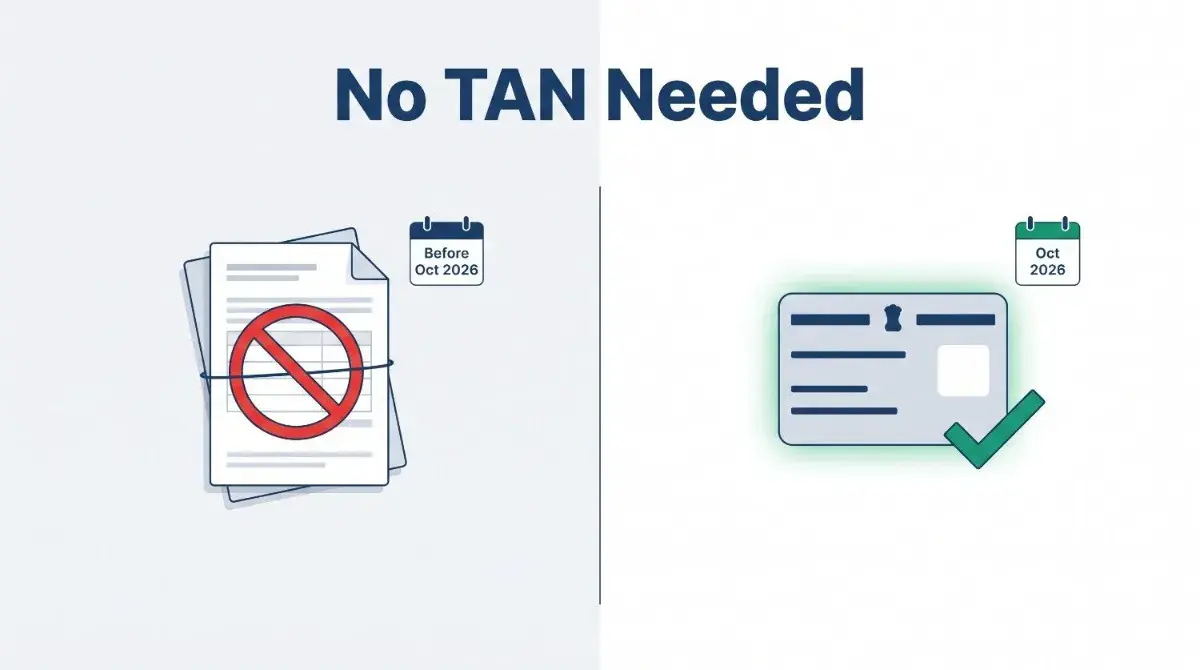
No TAN for NRI property purchase applies only from 1 October 2026, and only to resident individual and HUF buyers. Get the rates, forms, and dates you need.
Jul 25, 2026

Did you lose the SGB premature redemption tax exemption? Here's exactly who's affected, how much tax applies now, and how to check your own bonds.
Jul 24, 2026
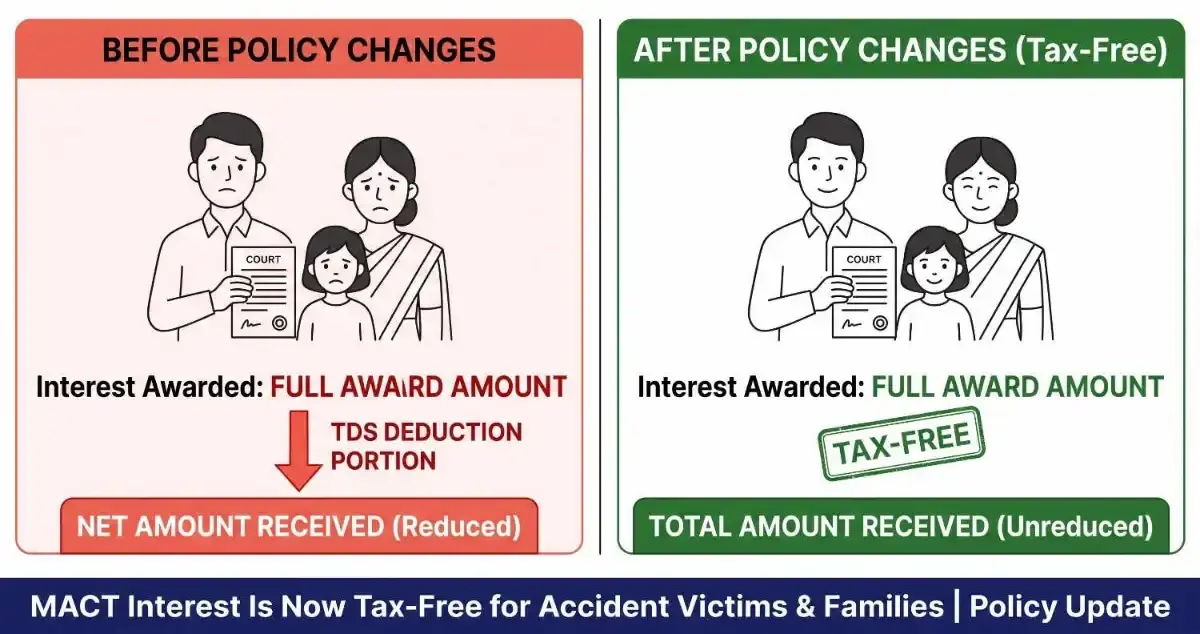
MACT interest income TDS exemption 2026 explained: who qualifies, old vs new Act rules, the FD interest trap, refund steps, and how to report it in your ITR.
Jul 24, 2026