

New ITR forms AY 2026-27 explained: all 8 forms including ITR-B, CBDT notification dates, due dates, and why Act 1961 still applies.
CBDT has notified 8 ITR forms for AY 2026-27, not 7. Most guides only count ITR-1 to ITR-7 and stop there. They miss the new block-assessment form, ITR-B. And here's the part that trips up even seasoned filers: every one of these forms runs on the old Income-tax Act, 1961, even though the Income-tax Act, 2025 is already in force. Confusing? Let's untangle it, form by form.
Here's the short answer, no hedging: AY 2026-27 runs entirely on the Income-tax Act, 1961.
Why, if the new Act already took effect on 1 April 2026? Simple. AY 2026-27 taxes the income you earned in FY 2025-26 — that's April 2025 to March 2026, a period that closed before the new law even started. The Income-tax Act, 2025 governs Tax Year 2026-27 onward, and those returns won't be filed until 2027. So for this filing season, forget the new section numbers. They don't apply yet.
CBDT notified all seven annual forms — ITR-1 through ITR-7 — along with the verification form ITR-V and the updated-return form ITR-U on 30 March 2026. A corrigendum followed on 10 April 2026, fixing drafting errors in Schedule CG, Schedule OS, and Schedule UD. ITR-2 was revised through Notification No. 46/2026, and ITR-3 through Notification No. 47/2026 — both dated 30 March 2026, under the Income-tax (Third and Fourth Amendment) Rules, 2026. You can check the notifications yourself on the Income Tax Department's official notifications page.
An ITR form is simply the return you file under Section 139 of the Income-tax Act, 1961, reporting your income, deductions, and tax paid for FY 2025-26. Every competitor article we checked stops at seven forms. That's an oversight, and it's an easy one to fix once you know where to look.
CBDT quietly turned this into an 8-form season. Alongside ITR-1 through ITR-7 sits Form ITR-B — the block-assessment return for search and seizure cases. It falls under Chapter XIV-B and was notified separately through CBDT Notification No. 30/2025, dated 7 April 2025, under Rule 12AE. It applies to a narrow group only: anyone who received a notice under Section 158BC after an income-tax search under Section 132, or a requisition under Section 132A, initiated on or after 1 September 2024. Not in that group? Skip it entirely. If you are, though, it isn't optional.
Applies to | Does NOT apply to |
|---|---|
Every resident individual, HUF, firm, LLP, company, or trust with income in FY 2025-26 | Returns for Tax Year 2026-27 — that's next season's filing, under the new Act |
Salaried employees, freelancers, and business owners filing ITR-1 to ITR-6 | Anyone without an active search or requisition notice — don't file ITR-B speculatively |
Anyone who received a Section 158BC block-assessment notice → files ITR-B | — |
One partial case worth flagging: if your firm was searched during FY 2025-26, you may need both your regular ITR-3 or ITR-5 for that year and a separate ITR-B once the notice arrives. One doesn't replace the other.
This is where most competitor pages fall short — they describe one or two forms and leave you to hunt for the rest. Here's every form, its actual change, and its actual deadline, in one place.
Two real relaxations landed this year. First, you can now report income from up to two house properties instead of just one, so a salaried person with a self-occupied flat and a second rented flat no longer has to move to ITR-2. Second, long-term capital gains under Section 112A up to ₹1.25 lakh — with no carried-forward losses — can now sit inside ITR-1 too.
A new field called "amount of rent which cannot be realised" has also been added under Section 25A, giving unrealised rent its own line instead of burying it inside your net annual value. Where TDS was deducted under Section 194-IB, you now also have to quote the tenant's PAN or Aadhaar.
Eligibility cap: total income up to ₹50 lakh, no business income, no short-term capital gains at all, no foreign assets, and you can't be a company director. Due date: 31 July 2026.
The same two-house-property and unrealised-rent changes apply here too. One more addition worth knowing about: you now have to disclose the combined closing balance across all your active bank accounts as of 31 March 2026, inside Schedule BP. It wasn't asked before, and it's mandatory, not optional, so don't skip it.
Covers Section 44AD (business, turnover up to ₹2 crore, or ₹3 crore where 95%+ receipts are digital), Section 44ADA (specified professionals — doctors, CAs, architects — up to ₹50 lakh, or ₹75 lakh with the digital condition), and Section 44AE (goods-carriage owners, up to 10 vehicles). Due date: 31 August 2026 for non-audit cases — a permanent shift from 31 July under the Finance Act 2026, not a one-off extension.
The old capital-gains fields for pre-Budget-2024 rates (15% STCG, 10% LTCG) are gone. They no longer apply to anything in FY 2025-26. The separate reporting split for gains before and after 23 July 2024 has also disappeared, since the entire year now sits under one uniform rate. A new field for late-filing fees on revised returns has been added as well.
Use ITR-2 once you're past the ITR-1 ceiling — multiple properties with carried-forward losses, any short-term capital gains, foreign assets, or company directorship. Due date: 31 July 2026.
Revised through Notification 47/2026. Carries the same unrealised-rent field and capital-gains cleanup as ITR-2, plus GSTIN-wise turnover reporting for GST-registered filers, cross-checked against GSTR-1 and GSTR-3B.
Due date: 31 August 2026 for non-audit cases — the same permanent Finance Act 2026 shift as ITR-4. 31 October 2026 if Section 44AB tax audit applies (the audit report itself is due 30 September 2026). 30 November 2026 for transfer-pricing cases requiring Form 3CEB under Section 92E. Not sure whether audit even applies to you? Toolisky's Section 44AB Tax Audit Applicability Checker walks through the ₹1 crore, ₹10 crore, and ₹50 lakh thresholds in a couple of minutes.
ITR-5 covers LLPs, partnership firms, AOPs, BOIs, and co-operative societies. Due date: 31 July 2026 for non-audit cases — the same date as ITR-1 and ITR-2, which surprises a lot of firm owners who assume they automatically get the August 31 date. ITR-6 is for companies not claiming exemption under Section 11, and since companies are statutorily audited, ITR-6 always follows the audit track: 31 October 2026. ITR-7 covers entities filing under Sections 139(4A) to 139(4D) — trusts, political parties, research associations. All three forms carry the same capital-gains schedule cleanup already described for ITR-2 and ITR-3, and any of them can shift to 30 November 2026 if transfer-pricing reporting applies.
Filed under Section 158BC, or 158BC read with 158BD if you're a third party whose assets turned up during someone else's search. The block period covers the six assessment years before the search, plus the part-year running up to the search date. Undisclosed income for that block is taxed flat at 60% under Section 113, plus surcharge and 4% cess — pushing the effective rate close to 78%. Due date: 60 days from the date of the Section 158BC notice. There's no fixed calendar date here, since the clock starts on the notice, not the assessment year. And unlike a regular ITR, ITR-B cannot be revised once it's filed — errors after that point need an appeal or a rectification application instead.
Ramesh, a software engineer in Pune, earns ₹14 lakh in salary. He owns two flats — one self-occupied, one rented out at ₹18,000 a month (₹2.16 lakh a year). In December 2025 he redeemed some equity mutual funds and booked LTCG of ₹90,000. His FD interest for the year comes to ₹60,000.
Gross salary: ₹14,00,000
Rental income after the 30% standard deduction: ₹1,51,200
FD interest: ₹60,000
LTCG under Section 112A (under the ₹1.25 lakh cap): ₹90,000
Total income: ₹16,01,200
His total income sits comfortably under ₹50 lakh, both house properties are now allowed, and the LTCG falls under the cap with no carried-forward losses to worry about. Verdict: he files ITR-1, by 31 July 2026.
Farida runs a jewellery business in Nagpur. Officers conducted a search under Section 132 at her premises on 5 January 2026. She'd already filed her regular ITR-3 for the previous assessment year on time. During the search, they found ₹40 lakh in unrecorded cash sales spread across six earlier years.
The Assessing Officer issues a Section 158BC notice on 10 February 2026. Farida's block period covers six preceding assessment years plus the broken period from 1 April 2025 to 5 January 2026. She has 60 days from the notice date — so until 11 April 2026 — to file ITR-B.
Total undisclosed income across the block: ₹40,00,000
Tax under Section 113 at 60%: ₹24,00,000
Surcharge (illustrative, at an assumed applicable rate of 15%): ₹3,60,000
Subtotal: ₹27,60,000
Health and Education Cess at 4%: ₹1,10,400
Total tax on undisclosed income: ₹28,70,400
This whole process runs separately from, and in addition to, her regular annual returns for those years — those stay as filed, except where the block assessment specifically abates them under Section 158BA(3).
Just salary, pension, one or two houses, and simple interest income? → ITR-1, if total income stays under ₹50 lakh.
Capital gains beyond the ITR-1 limit, foreign assets, or company directorship? → ITR-2.
Business or professional income mixed with salary or capital gains? → ITR-3.
Small business or professional opting for presumptive taxation? → ITR-4, under ₹50 lakh (or ₹75 lakh if you're heavily digital).
LLP, firm, company, or trust? → ITR-5, ITR-6, or ITR-7.
Received a Section 158BC notice after a search? → ITR-B, regardless of which annual form you also file.
Still unsure between ITR-1 and ITR-4? Toolisky's ITR-1 vs ITR-4 guide works through three more borderline cases in detail. And before you commit to a regime, it's worth running your numbers through the Old vs New Tax Regime Calculator or the Salary Tax Calculator — five minutes now can save you a revised return later.
You filed the wrong ITR form entirely. The Department issues a defective-return notice under Section 139(9), giving you a set window to refile in the right form. Miss that window, and the return counts as never filed — which brings back Section 234F and 234A exposure from the original due date, not the notice date.
You missed your deadline. File a belated return under Section 139(4) any time up to 31 December 2026. You'll owe the Section 234F fee — ₹1,000 if total income is under ₹5 lakh, ₹5,000 otherwise — plus 1% monthly interest under Section 234A on any tax still unpaid. One thing people often miss: a belated filer also loses the option to switch into the old tax regime for that year.
You filed correctly but spotted a mistake afterward. File a revised return under Section 139(5). Finance Act 2026 pushed this window from 31 December out to 31 March 2027 — a genuinely useful extra quarter. Just remember, revision only fixes an already-filed return. If you filed the wrong form altogether, or missed the deadline entirely, you need a belated or updated return instead, not a revision.
Document | Digital copy okay? | Where to get it |
|---|---|---|
Form 16 (salary TDS certificate) | Yes | Your employer, by 15 June 2026 |
Form 26AS, AIS, and TIS | Yes | incometax.gov.in e-filing portal |
Bank statements and closing balances (for ITR-4's Schedule BP) | Yes | Your bank's net-banking portal |
Section 158BC notice and seized-material inventory (ITR-B only) | Yes | The Assessing Officer's communication |
Capital gains statements | Yes | Your broker or mutual fund RTA portal |
Rent agreement, tenant PAN or Aadhaar (if claiming unrealised rent) | Yes | Your own records, or the tenant |
Quick reassurance if you've heard about form-name changes: Form 16 is still what you'll get for FY 2025-26. Its replacement, Form 130 under the new Act, only kicks in from Tax Year 2026-27 salary, issued starting June 2027. Don't go looking for it this season — it isn't coming yet.
Late filing fee, Section 234F: ₹1,000 if income is ₹5 lakh or below, ₹5,000 above that.
Interest on unpaid tax, Section 234A: 1% per month, or part of a month, from the due date onward.
Filed the wrong form and never corrected it: treated as non-filing, so both 234A and 234F apply fresh.
ITR-B specifically: a flat 60% tax under Section 113, plus surcharge and 4% cess — no slab benefit, no standard deduction, and no revision once it's submitted.
Missed the 60-day ITR-B window: the Assessing Officer can move to a best-judgment block assessment, usually on far less favourable terms than a return you file yourself.
No. AY 2026-27 covers income earned in FY 2025-26 — April 2025 to March 2026 — and that falls entirely under the Income-tax Act, 1961. The 2025 Act only applies from Tax Year 2026-27 onward, filed starting 2027.
Eight, not seven. ITR-1 through ITR-7 handle annual returns. Form ITR-B, notified separately under Notification 30/2025, covers block assessment for search and seizure cases. Most guides mention only the first seven.
ITR-3, or ITR-4 if your freelance income qualifies for presumptive taxation under Section 44ADA and your combined total income stays under ₹50 lakh. You can't split one year's income across two separate forms.
You'll likely get a defective-return notice under Section 139(9). Refile in the correct form within the given window. If that window has already passed and you haven't fixed it, the return counts as never filed — so file a fresh belated return under Section 139(4) before 31 December 2026 instead.
No. The two-property relaxation only applies when you have no carried-forward house-property losses. If you do, you'll still need ITR-2 or ITR-3, no matter how low your income is.
31 July 2026 for ITR-1, ITR-2, and ITR-5 (non-audit). 31 August 2026 for ITR-3 and ITR-4 without audit. 31 October 2026 for audit cases across ITR-3, ITR-5, and ITR-6. 30 November 2026 for transfer-pricing cases.
No, and this is a common misconception. Only ITR-3 and ITR-4 non-audit filers got a permanent shift to 31 August under Finance Act 2026. ITR-1, ITR-2, and non-audit ITR-5 filers still file by 31 July 2026, exactly as before.
ITR-B is a one-time block-assessment return for anyone who received a Section 158BC notice following a search or requisition under Section 132 or 132A, initiated on or after 1 September 2024. If you haven't received such a notice, you don't file it. It isn't part of anyone's regular annual filing.
No. Unlike a regular ITR, ITR-B has no statutory revision mechanism. Errors found after filing can only be fixed through appellate proceedings or a rectification application under Section 154 — both slower routes than a simple revised return.
No. Form 130 only replaces Form 16 from Tax Year 2026-27 salary onward, issued starting June 2027. For FY 2025-26 — the year AY 2026-27 covers — you'll still get the familiar Form 16 by 15 June 2026.
They'll apply to Tax Year 2026-27, filed from 2027 onward. Expect renumbered sections throughout: Section 44AB becomes Section 63, Section 54 becomes Section 82, and so on. Consolidated forms are also expected, like Form 26 replacing the current 3CA, 3CB, and 3CD trio. The basic idea of "which form fits which income type" should stay familiar. The numbers behind it won't.
Check your total income, your house-property count, and whether you have any capital gains, then match yourself against the table above before you open the e-filing portal. Run your numbers through the Old vs New Tax Regime Calculator first, so you know your liability before you commit to a form. For the official notification text and live filing utilities, head to incometax.gov.in.
For educational purposes only. Verify all figures at official sources before acting. Toolisky is not affiliated with any government body. Consult a qualified CA or legal professional before making compliance decisions. See toolisky.com/accuracy-and-limitations.
No TAN for NRI property purchase applies only from 1 October 2026, and only to resident individual and HUF buyers. Get the rates, forms, and dates you need.
Jul 25, 2026

Did you lose the SGB premature redemption tax exemption? Here's exactly who's affected, how much tax applies now, and how to check your own bonds.
Jul 24, 2026
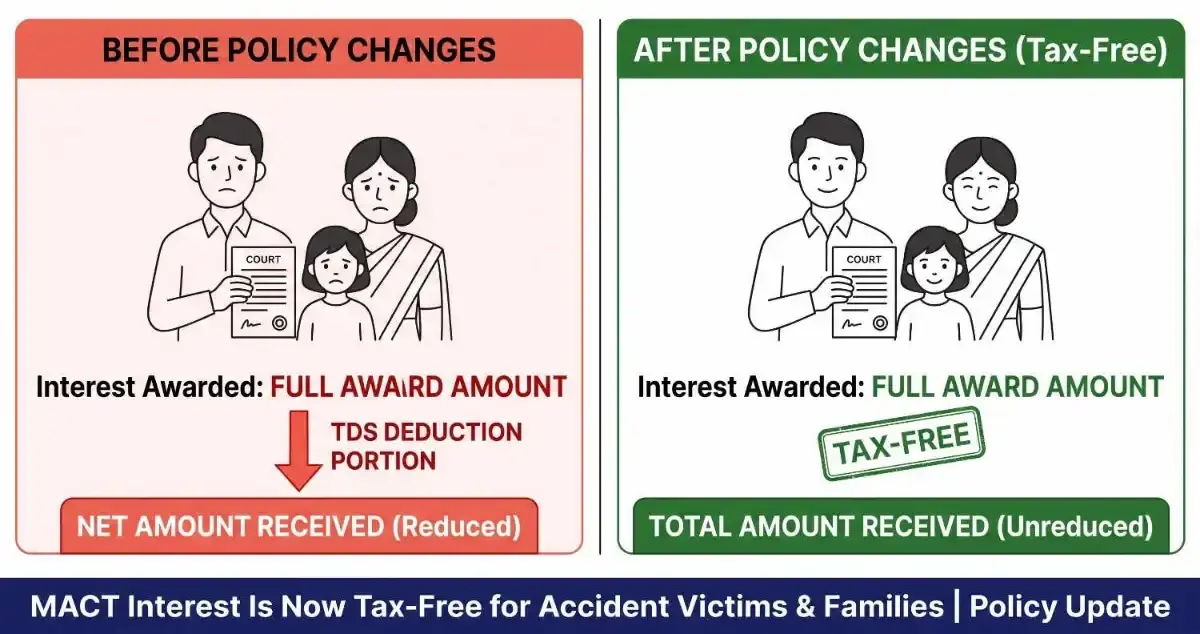
MACT interest income TDS exemption 2026 explained: who qualifies, old vs new Act rules, the FD interest trap, refund steps, and how to report it in your ITR.
Jul 24, 2026