

TDS on sale of property by NRI from UK: exact 2026 rates, Form 128, DTAA Article 14, HMRC filing steps, and repatriation timelines for FY 2025-26 and 2026-27.
If you live in the UK and you're selling a house or flat in India, the buyer has to hold back a chunk of your money before it ever reaches you. That's TDS, and for NRI sellers it can eat into a much bigger slice of the sale price than most people expect. On top of that, HMRC wants to know about the gain too, unless you happen to fall inside a fresh exemption window.
This guide walks through the exact TDS on sale of property by NRI from UK sellers, how the India-UK tax treaty stops you paying twice, and what to file on both sides once the sale is done.
A quick note on which law applies: India moved from the old Income-tax Act, 1961 to the new Income-tax Act, 2025 on 1 April 2026. If your sale closed before that date, the 1961 Act numbers apply. If it closes on or after 1 April 2026, use the 2025 Act numbers given below. Both are confirmed against the Income Tax Department's own explainer on the new Act.
TDS simply means your buyer takes tax out of the payment before it lands in your account. For an NRI seller, the buyer does this under Section 195 of the Income-tax Act, 1961 (for sales closing before 1 April 2026), or under Section 393(2) of the Income-tax Act, 2025, once that law takes over.
This is very different from a resident-to-resident sale, where TDS is a flat 1% under Section 194-IA (or Section 393(1) under the new Act), and it only kicks in once the price crosses ₹50 lakh. There's no such floor for an NRI seller. Even a ₹10 lakh sale attracts TDS.
A few terms worth knowing before we go further: DTAA stands for Double Taxation Avoidance Agreement, the treaty between India and the UK that decides who taxes what. HMRC is the UK's tax authority. FTCR, or Foreign Tax Credit Relief, is what stops you from paying full tax twice on the same gain, once in India and again in the UK.
Applies to | Doesn't apply to |
|---|---|
NRIs, OCIs, and PIOs who are UK tax residents selling Indian residential, commercial, or non-agricultural land | Resident Indians selling to other resident Indians (that falls under Section 194-IA, 1%, only above ₹50 lakh) |
Property sold directly or through a Power of Attorney | Agricultural land sold to a non-relative resident, which most NRIs can't legally hold anyway |
Property you bought yourself or inherited | Gifts between relatives, since there's no sale and no TDS trigger |
One case worth flagging: if you moved to the UK after 6 April 2025, and you'd spent the previous 10 years outside the UK, you may fall inside the new 4-year FIG window on the UK side. Your Indian gain could end up exempt from UK tax even though Indian TDS still applies in full. More on that below.
Holding period | Base rate | Effective rate with surcharge and cess |
|---|---|---|
Long-term gain (held over 24 months) | 12.5%, no indexation | 13.00% on gains up to ₹50 lakh, 14.30% between ₹50 lakh and ₹1 crore, and 14.95% above ₹1 crore |
Short-term gain (24 months or less) | Slab rate, buyers usually default to 30% | Can run close to 35.88% at the top surcharge band |
No PAN on file | Flat 20% | Applies no matter what kind of gain it is, under Section 206AA (1961 Act) or Section 397(2) (2025 Act) |
By default, TDS is calculated on your entire sale price, not your profit. And unlike resident sellers of property bought before 23 July 2024, NRIs can't opt for the older 20%-with-indexation rule. That choice was never extended to non-residents, so you're on the flat 12.5% rate regardless of when you originally bought the property.
How the section numbers map from the old Act to the new one, checked against multiple CA-verified trackers:
1961 Act | 2025 Act | Form that changes |
|---|---|---|
Section 195 (TDS on non-resident payments) | Section 393(2) | Form 27Q continues to be used for now under the new numbering |
Section 197 (Lower Deduction Certificate) | Section 395(1) | Form 13 becomes Form 128 |
Section 206AA (no-PAN rate) | Section 397(2) | No form change |
Section 201 (default and interest) | Section 398 | No form change |
Form 16A (TDS certificate) | Section 395(4) | Confirm the exact replacement form number with your CA before relying on it |
Sections 54, 54EC, and 54F (reinvestment exemptions) | Renumbered under the 2025 Act, but the exact new section numbers are still being finalised across CA trackers as of mid-2026 | Not yet settled |
One change worth knowing if your sale closes after 1 October 2026: individual and HUF buyers will no longer need a TAN to deduct TDS on a purchase from an NRI. They'll use their PAN with a challan-cum-statement instead. This is purely a paperwork change for the buyer. It doesn't touch your TDS rate, and buyers who are companies or firms will still need a TAN.
Here's something most guides get wrong: Article 14 of the India-UK DTAA does not cap the tax rate on capital gains at all. It simply confirms that each country can tax capital gains under its own domestic law. So India keeps its full right to apply that 12.5%-plus rate, treaty or no treaty. What the DTAA actually does, through Article 24, is stop you from paying full tax twice on the same gain.
In practice, you pay Indian tax first, through TDS, and true it up when you file your Indian return. Then, on the UK side, you claim Foreign Tax Credit Relief for the Indian tax you already paid, against your UK Capital Gains Tax bill. You end up paying whichever amount is higher between the two countries, not both in full.
On the UK side, the rules changed sharply from 6 April 2025. The old non-dom remittance basis is gone. Every UK resident is now taxed on gains as they arise worldwide, at 18% or 24%, after a £3,000 annual exempt amount, unless you qualify as a "new resident" claiming the 4-year FIG exemption. That needs 10 years of prior non-UK residence, and you claim it year by year on your Self Assessment.
You'd report the gain on the SA108 form and claim the credit through SA106, as part of your normal Self Assessment. That's separate from the UK's 60-day residential property return, which only covers UK-based property, not Indian property. You'll also want a UK Tax Residency Certificate and Form 41 (which will replace the older Form 10F from 1 April 2026), so your Indian buyer can apply the treaty rate at source, under Section 159(8) of the 2025 Act.
Suresh has lived in Manchester for eight years. He's selling a flat in Pune that he inherited from his father in 2010. A registered valuer certifies the Fair Market Value as on 1 April 2001 at ₹8,00,000. He sells the flat in 2026 for ₹1,20,00,000, without applying for a Lower Deduction Certificate.
Capital gain: ₹1,20,00,000 − ₹8,00,000 = ₹1,12,00,000
TDS is worked out on the full sale price, ₹1,20,00,000, since there's no certificate in place
Base tax plus 15% surcharge (gain above ₹1 crore) plus 4% cess: ₹15,00,000 + ₹2,25,000 + ₹69,000 = ₹17,94,000, or 14.95% of the sale price
Amount that lands in his NRO account: ₹1,02,06,000
His actual Indian tax liability, worked out on the gain alone, comes to ₹16,74,400. That means he's owed a ₹1,19,600 refund once he files his return.
On the UK side, he's been resident too long to claim FIG. Converting ₹1,12,00,000 at roughly ₹107 to the pound gives about £104,673. After the £3,000 exempt amount, £101,673 is taxable at 24%, which is around £24,401. His Indian tax (about £15,648) gets credited under FTCR, leaving him with roughly £8,753 still owed to HMRC.
Priya moved from Singapore to London in 2024, after 12 years outside the UK. That puts her inside her second year of FIG eligibility. She sells ancestral land in Kerala, inherited from her grandfather, with a certified FMV as on 1 April 2001 of ₹6,00,000, for ₹80,00,000. This time, she applies for and gets Form 128 (the renamed Form 13) before the sale closes.
Capital gain: ₹80,00,000 − ₹6,00,000 = ₹74,00,000
Because she has the certificate, TDS is worked out on the gain only, ₹74,00,000
Base tax plus 10% surcharge (gain between ₹50 lakh and ₹1 crore) plus 4% cess: ₹9,25,000 + ₹92,500 + ₹40,700 = ₹10,58,200, or 14.30% of the gain
Amount that lands with her: ₹69,41,800
Because she claims FIG on her Self Assessment, this Indian gain is completely exempt from UK Capital Gains Tax, with nothing to report on SA108 at all, though she does give up her £3,000 annual exempt amount for that year as a trade-off.
Get the property's Fair Market Value certified by a government-registered valuer. If you're using the 1 April 2001 value because the property was bought or inherited earlier, make sure the valuer states this clearly.
Apply for Form 128 (the Lower or Nil Deduction Certificate, under Section 395(1)) through the TRACES portal, ideally 30 to 45 days before the sale closes.
Once approved, hand the certificate to your buyer so TDS is calculated on your gain, not the full sale price.
Get your UK Tax Residency Certificate from HMRC, and file Form 41 (or Form 10F, if your sale closes before 1 April 2026) so your buyer can apply the treaty rate.
File your Indian ITR-2 to reconcile the TDS deducted against your actual tax liability, and claim any refund you're owed.
In the UK, complete SA108 and SA106 (or SA109 if you're claiming FIG) by 31 January following the end of the tax year.
Portal screens and form layouts on both the TRACES website and HMRC's Self Assessment pages do get updated from time to time, so it's worth a quick check before you file.
The buyer deducted TDS on the full sale price and you had no certificate. That's just the default outcome, not a mistake on anyone's part. File your ITR, show your actual capital gain calculation, and claim the excess back as a refund. This usually takes three to nine months to come through.
Your Form 128 application gets rejected or is still pending when your sale date arrives. The buyer has to deduct at the standard rate in the meantime. You can either reapply with a corrected computation, or simply recover the excess later through your ITR refund rather than delay the sale.
HMRC flags your return because your Indian TDS certificate arrived late. File on time using an estimated figure, mark the return as provisional, and amend it once your final certificate comes through. HMRC generally allows amendments within twelve months of the filing deadline.
Document | Digital copy okay? | Where to get it |
|---|---|---|
PAN card | Yes | NSDL or Protean, if you don't already have one |
FMV valuation certificate (for property bought before 2001) | Yes | A government-registered valuer in India |
Form 128, the Lower Deduction Certificate | Yes | TRACES portal, usually through your Indian CA |
UK Tax Residency Certificate | Yes | HMRC |
Power of Attorney, apostilled by the FCDO | No, the original needs to be couriered | A UK solicitor or notary, followed by FCDO apostille |
Form 15CB and Form 15CA | Yes | Your Indian CA, needed to repatriate the funds |
If a buyer fails to deduct TDS correctly, they become an "assessee in default," and end up owing the shortfall plus 1% interest per month under Section 201 (1961 Act) or Section 398 (2025 Act). Filing the TDS return late attracts a ₹200-per-day fee under Section 234E, capped at the TDS amount itself. On the UK side, missing the Self Assessment deadline brings an automatic £100 penalty the next day, rising to £10 a day after three months (capped at £900), with further penalties at six and twelve months.
Sort out your FMV valuation and get your capital gain properly computed by a CA before you sign anything. That one step decides whether you wait months for a refund or keep most of your money at the time of sale. You can run your own numbers through Toolisky's Section 195 TDS Calculator for NRI Sellers, and double-check anything time-sensitive against the Income Tax Department's official portal.
12.5% on long-term gains, held over 24 months, rising to an effective 13% to 14.95% once surcharge and cess are added, depending on the size of the gain. Short-term gains are taxed at slab rates, and buyers usually default to 30% plus cess if they don't know your exact slab.
Yes, if you're UK tax resident and you're not claiming the FIG exemption for that particular year. You'd report it on SA108 and claim Foreign Tax Credit Relief through SA106 for the Indian tax you've already paid.
Article 14 doesn't lower India's tax rate, but Article 24 guarantees you a UK tax credit for whatever you paid in India. You're never taxed twice on the full amount, just once, at whichever rate is higher.
Apply through the TRACES portal with your computed capital gain and supporting documents, ideally 30 to 45 days before the sale, usually with your Indian CA handling the filing.
That the rate is still 20%. It dropped to a flat 12.5% (no indexation) for NRIs from 23 July 2024 onward. A surprising number of calculators, and even some bank websites, still quote the old figure.
Once your CA issues Form 15CB and you file Form 15CA, the bank usually processes the SWIFT transfer in about 3 to 7 working days, subject to the USD 1 million per year NRO repatriation limit under FEMA.
Yes, through a Power of Attorney notarised by a UK solicitor and apostilled by the FCDO (not an Indian consulate), then couriered to India and registered at the local Sub-Registrar's office.
Buyers should file a correction statement and pay the shortfall with interest as soon as possible. Sellers can recover any TDS deducted above their actual liability by claiming a refund when they file their ITR.
Yes, if you moved to the UK before 6 April 2025 and were using the remittance basis, you're now taxed on worldwide gains as they arise. If you're a newer arrival, within your first four years of UK residence, you may be able to claim the FIG exemption instead.
Yes. You can reinvest in another Indian house under Section 54, or put up to ₹50 lakh into REC, PFC, or IRFC bonds within six months under Section 54EC, to reduce your taxable gain. TDS is still deducted upfront regardless, and you recover the difference later through your refund.
For educational purposes only. Please verify all figures against official sources before acting on them. Toolisky is not affiliated with any government body. Consult a qualified CA or legal professional before making compliance decisions.
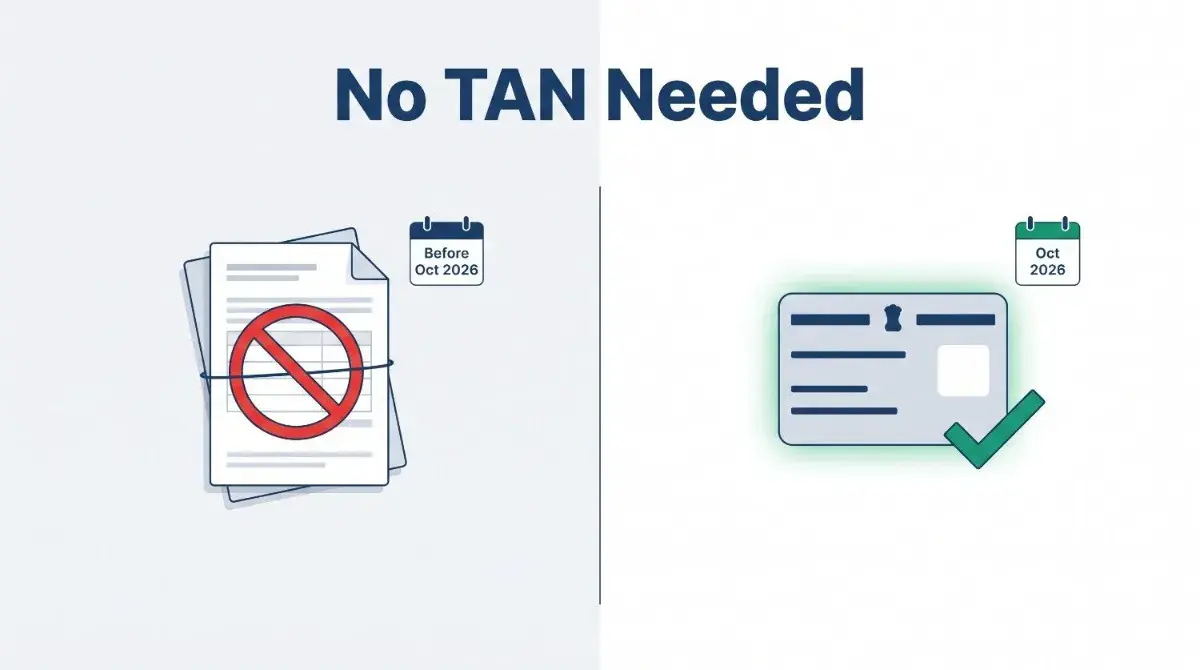
No TAN for NRI property purchase applies only from 1 October 2026, and only to resident individual and HUF buyers. Get the rates, forms, and dates you need.
Jul 25, 2026

Did you lose the SGB premature redemption tax exemption? Here's exactly who's affected, how much tax applies now, and how to check your own bonds.
Jul 24, 2026
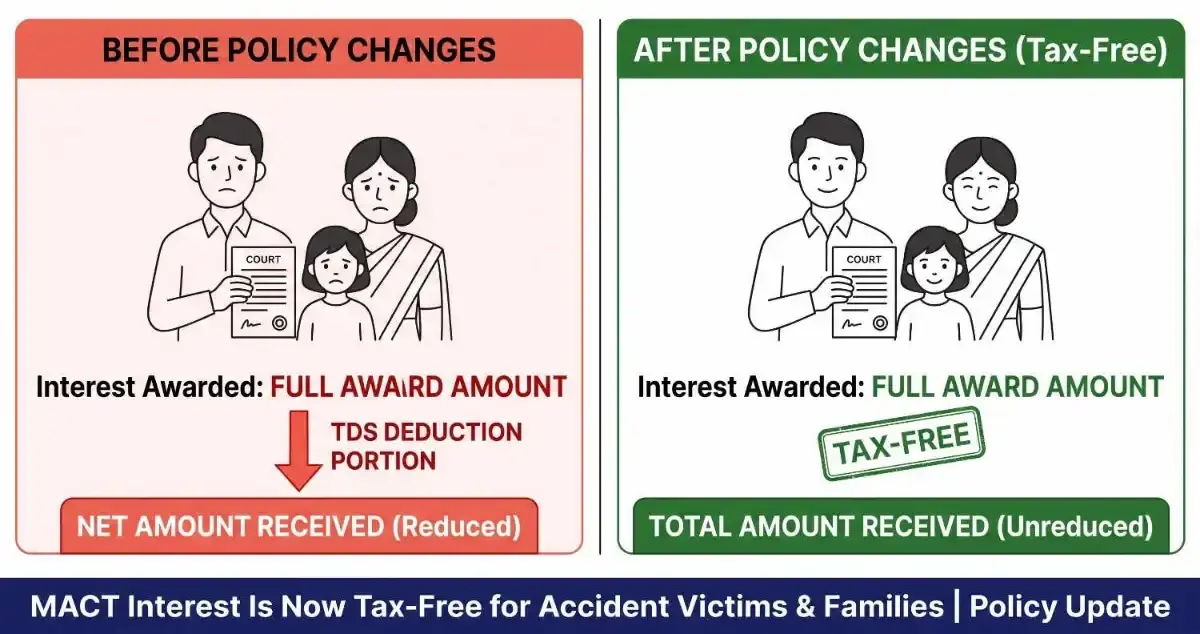
MACT interest income TDS exemption 2026 explained: who qualifies, old vs new Act rules, the FD interest trap, refund steps, and how to report it in your ITR.
Jul 24, 2026