

ESIC eligibility 2026 explained: ₹21,000/₹25,000 wage limit, the 10-vs-20 employee rule by state, family rules, and who's excluded, with real examples.
You qualify for ESIC if you earn ₹21,000 or less a month in gross wages (₹25,000 if you have a disability) and work at an establishment with 10 or more employees, 20 in a few states. Miss either condition and you're out. Here's exactly how ESIC eligibility works, with the details most guides skip.
ESIC stands for the Employees' State Insurance Corporation. It runs a self-financed health insurance and social security scheme under the ESI Act, 1948, administered under the Ministry of Labour and Employment. You and your employer both pay a small share of your wages every month, and in exchange you and your family get free medical care, sickness pay, maternity benefit, and a few other cash benefits.
One quick note before we go further. A lot of people search "ESIC eligibility" while actually hunting for ESIC's own recruitment exams, UDC, MTS, nursing posts, and so on. That's a completely different thing. This guide is about who qualifies for ESI coverage, not who can sit for an ESIC job exam.
Applies to | Does NOT apply to |
|---|---|
Employees earning ≤ ₹21,000/month gross (₹25,000 for PwD) at a covered establishment | Employees earning above the wage ceiling |
Contract, temporary, and casual staff within the wage limit | Apprentices engaged under the Apprentices Act, 1961 |
Trainees hired under a company's certified Standing Orders | Freelancers and self-employed people with no employer |
Factories, shops, hotels, restaurants, cinemas, and other notified establishments with 10+ (or 20+) staff | Agricultural workers and domestic workers in private homes |
Directors who draw a salary and work under company control | Establishments below the state's employee threshold |
Here's a partial case worth flagging. A trainee hired under your company's own Standing Orders counts as a regular employee for ESIC. A trainee under the Apprentices Act, 1961 does not. That single distinction has confused payroll teams for years, and forum threads on it go back to 2008.
Want a quick answer instead of reading the whole rulebook? Toolisky's ESIC Eligibility Checker runs your wage and headcount details against the current rules in seconds.
This is where most of the confusion actually lives, so let's go rule by rule.
Wage ceiling: ₹21,000 a month in gross wages for a general employee. ₹25,000 a month if you're a Person with Disability. This figure hasn't moved since January 2017, even with repeated industry pressure to raise it to ₹25,000 or ₹30,000.
Establishment threshold: 10 or more employees in most states and union territories. Maharashtra is still commonly listed as a 20-employee state, but that's outdated information. A Maharashtra government notification (ESIC 2015/C.R.150/RAKAVI-2, effective 1 October 2020) brought shops, hotels, restaurants, cinemas, and similar establishments there down to 10 employees. Chandigarh, Odisha, Tamil Nadu, and Telangana still show up as either 10 or 20 depending on which guide you read.
Contribution rate: 4% total, split as 0.75% from the employee and 3.25% from the employer. Unchanged since 1 July 2019.
Daily wage exemption: if your average daily wage works out to ₹176 or less, you pay nothing yourself. Your employer still pays their 3.25% share.
The 50% wage rule: under Section 2(88) of the Code on Social Security, 2020, which came into force on 21 November 2025, your Basic pay plus Dearness Allowance must together add up to at least half your gross wage. If allowances push above that, the extra gets added back as "wages" for ESIC purposes. For years, some employers kept basic pay artificially low to dodge the wage ceiling. That loophole is now closed.
Family and dependants: your spouse, minor children, and children still in education up to age 21 are automatically covered. Dependent parents qualify only if their monthly income doesn't cross a prescribed limit, currently ₹9,000 plus dearness relief under Rule 61A of the ESI (Central) Rules, 1952. Since the Code on Social Security took effect in November 2025, a widower and, in specific cases, grandparents can also qualify as dependants, a genuine expansion from the old ESI Act definition.
For a deeper look at how the new wage rule actually changes real payslips, read Toolisky's ESIC New Rules 2026 article.
Example 1: the common case
Suresh runs payroll for a 12-person electronics shop in Pune. One of his staff, earning ₹18,000 gross a month, asks if she's covered. Two things need checking: her wage and the shop's headcount.
Her wage: ₹18,000, which is under ₹21,000. The shop's headcount: 12, above the 10-employee threshold. She's covered.
Her contribution: ₹18,000 × 0.75% = ₹135, deducted from her pay. Her employer pays ₹18,000 × 3.25% = ₹585. Combined monthly contribution: ₹720.
Example 2: the edge case
Farida's CTC is structured as ₹8,000 basic plus ₹13,500 in HRA and special allowance, totalling ₹21,500 gross. On the face of it, that's above the ₹21,000 ceiling, so no ESIC.
But run the 50% check. Half of ₹21,500 is ₹10,750. Her Basic plus DA is only ₹8,000, short by ₹2,750. That shortfall gets added back as wages under the new Labour Code rule, which pulls her effective wage down toward the ceiling. Depending on how her regional ESIC office finalises the add-back calculation, she may land back inside coverage.
The lesson here isn't just for Farida. Anyone with a low basic-to-CTC ratio should ask their employer to recheck the numbers now, not after the next salary revision. Toolisky's ESIC Salary Calculator walks through this same arithmetic for your own payslip.
Confirm your establishment's headcount. Ask HR whether the company has crossed 10 employees, or 20 in a state still applying that older threshold.
Add up your gross monthly wage. Include Basic, DA, HRA, and any other allowance paid every month. Leave out overtime, annual bonus, and reimbursements.
Compare against the ceiling. ₹21,000 for a general employee, ₹25,000 if you're a Person with Disability.
Apply the 50% rule. If your Basic plus DA is under half your gross pay, some of your allowance may count back in.
Check your IP number and Pehchan status. Log in to the ESIC insured-person portal at esic.gov.in with your Aadhaar-linked details to see your coverage status directly.
Your salary crossed ₹21,000 partway through the period. No need to worry immediately. Coverage runs until the end of the current six-month contribution period, April to September or October to March. You're reassessed only when the next period begins.
Your employer isn't deducting ESIC even though you clearly qualify. That's a violation of the ESI Act. Keep your payslips and offer letter handy, and file a complaint at your nearest ESIC Regional Office. Coverage can be restored, and the employer can be made to pay back contributions.
You end up with two establishment codes, or your Pehchan card details don't match. Write to your Regional Office with both establishment codes or your IP number and ask for consolidation. Don't open a third registration hoping the problem sorts itself out; it won't.
Document | Digital copy accepted? | Where to get it |
|---|---|---|
Aadhaar card | Yes | UIDAI, or your employer's HR team |
Bank account details | Yes | Your bank |
Passport-size photo | Yes | Any photo studio |
Employer's ESIC establishment code | Not applicable | Employer HR or payroll |
Family and dependant details, for card additions | Yes | Self-declaration, verified by employer |
An employer who fails to pay contributions faces up to 3 years' imprisonment and a fine up to ₹10,000 under Section 85 of the ESI Act. If the employer deducted your 0.75% share but never deposited it with ESIC, the minimum penalty rises to 1 year plus a mandatory ₹10,000 fine. Interest on delayed payment runs at 12% a year under Section 39(5)(a), and damages under Section 85-B can climb as high as 25% of the arrears once a delay passes six months. These penalties fall on the employer, not you, but knowing them gives you real leverage if your contribution isn't reaching ESIC on time.
For the full step-by-step registration process, including forms, fees, and deadlines, see Toolisky's ESIC Registration Process 2025-26 guide.
No. Once your gross wage crosses ₹21,000, or ₹25,000 for a Person with Disability, ESIC stops applying going forward. If you were already enrolled, your coverage continues only until the end of the current contribution period, not from the day your salary changes.
That's correct, and it does surprise most people. Despite years of industry requests to raise it to ₹25,000 or ₹30,000, no official notification had revised the ₹21,000 ceiling as of mid-2026. It's worth keeping an eye on, since a change can happen without needing a vote in Parliament.
Only apprentices engaged under the Apprentices Act, 1961 are excluded from ESIC. Trainees hired under a company's own certified Standing Orders count as regular employees and are covered, a mix-up that has confused HR desks for well over a decade.
Your spouse, minor children, unmarried daughters, and children still in education up to age 21 qualify automatically. Dependent parents qualify only if their income stays under the prescribed limit. Since November 2025, a widower and certain grandparents can also qualify as dependants.
ESIC simply doesn't apply at that workplace, no matter what you earn. The moment the company's headcount crosses the state's threshold, the employer gets 15 days to register, and coverage becomes mandatory for every employee within the wage limit.
No. Once both conditions, the wage limit and the headcount, are met, ESIC coverage is a legal requirement, not a personal choice for you or your employer.
Not yet, in most situations. Pure gig work without a direct employer-employee relationship still sits outside ESIC today. The Code on Social Security, 2020 opens a legal path toward future coverage, but the rollout for gig workers is still being worked out.
There's no expiry on your employer's obligation here. Once the gap is discovered, ESIC can demand contributions going back to when you first became eligible, plus 12% annual interest. Raise it with HR or your Regional Office as soon as you notice it.
It's 10, for shops, hotels, restaurants, cinemas, and similar establishments, following a state notification effective 1 October 2020. A lot of guides still quote the older 20-employee figure, so it's worth confirming with your Regional Office if you're unsure which applies to you.
They're separate schemes entirely. ESIC applies once an establishment has 10 (or 20) employees, with a ₹21,000 wage ceiling and a 4% combined contribution. EPF applies at 20 employees nationwide, with a ₹15,000 basic-wage ceiling and 12%+12% contribution. You can be covered under both schemes at the same time.
Add up your gross wage against the ₹21,000 or ₹25,000 ceiling and check your employer's headcount today, not after your next appraisal. The ESIC Eligibility Checker gives you an instant answer using the current rules. For anything still unclear, esic.gov.in/coverage remains the official source to confirm your state's exact threshold.
For educational purposes only. Verify all figures at official sources before acting. Toolisky is not affiliated with any government body. Consult a qualified CA or legal professional before making compliance decisions. See toolisky.com/accuracy-and-limitations.
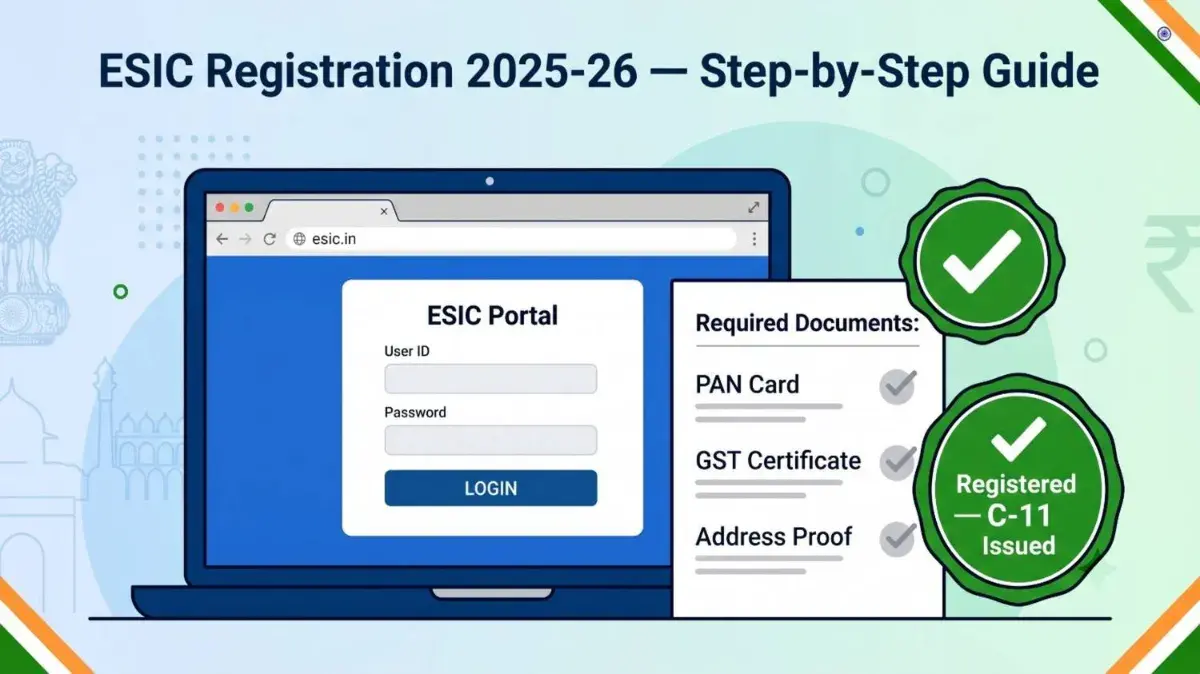
ESIC registration process 2025-26: the complete step-by-step online guide covering documents, fees, portal steps, deadlines, and employer penalties in India.
Jul 15, 2026
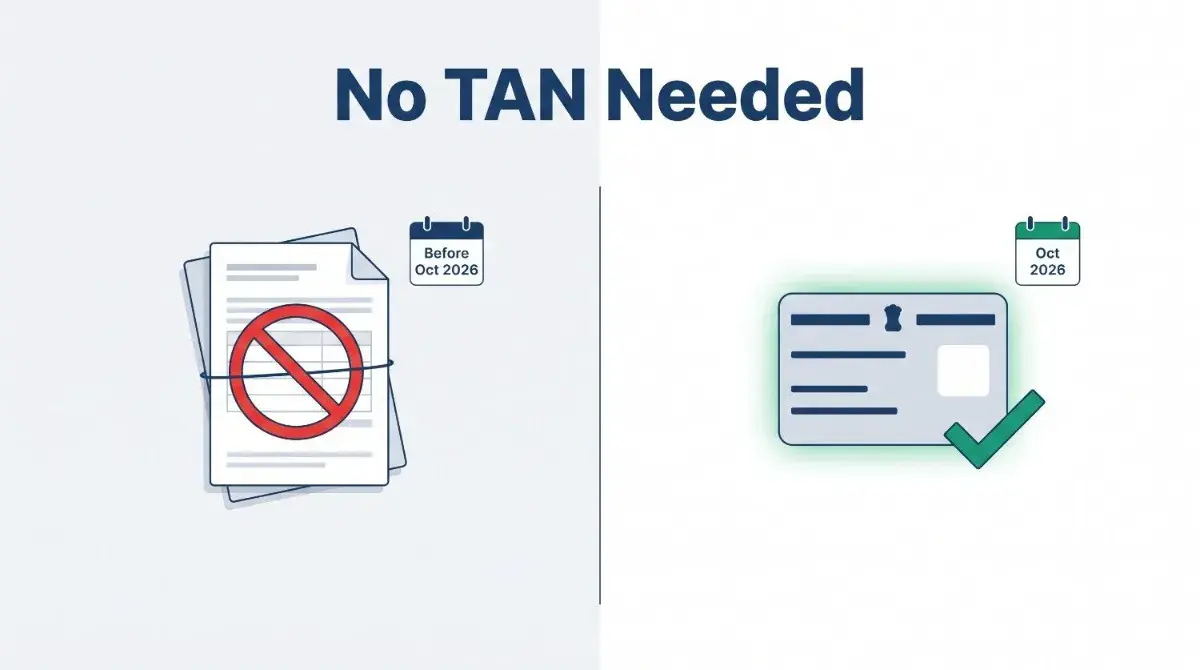
No TAN for NRI property purchase applies only from 1 October 2026, and only to resident individual and HUF buyers. Get the rates, forms, and dates you need.
Jul 25, 2026

Did you lose the SGB premature redemption tax exemption? Here's exactly who's affected, how much tax applies now, and how to check your own bonds.
Jul 24, 2026