

ESIC vs EPF compared for 2026: wage ceilings, contribution rates, who's mandatorily covered by both, Labour Code changes, and a full worked ₹ example.
ESIC and EPF are two separate, mandatory payroll deductions in India. ESIC pays for your medical and health cover, EPF builds your retirement savings, and most salaried employees are legally required to be in both at once rather than pick one. This guide walks through exact eligibility, rates, and what actually changed under the 2026 Labour Codes.
ESIC stands for Employees' State Insurance Corporation, the body that runs the ESI Scheme under the ESI Act, 1948. It pays for medical treatment, sickness leave, maternity benefit, and compensation if you're injured at work.
EPF stands for Employees' Provident Fund, a retirement savings scheme under the Employees' Provident Funds and Miscellaneous Provisions Act, 1952, run by the Employees' Provident Fund Organisation (EPFO). Both laws now sit inside the wider Code on Social Security, 2020, in force since 21 November 2025. Fresh EPF Scheme 2026, EPS Scheme 2026, and EDLI Scheme 2026 rules were notified on 1 July 2026, replacing the old 1997 contribution notification, and this article uses those current numbers, checked against esic.gov.in and epfindia.gov.in.
This is the one table almost every guide skips, and it's exactly what HR teams search for when they're checking a new hire's payslip.
ESIC | EPF | |
|---|---|---|
Applies to | Employees earning ₹21,000/month gross or less (₹25,000 for PwD), at establishments with 10 or more employees (a few states use 20) | Employees earning ₹15,000/month basic + DA or less, at establishments with 20 or more employees |
Does not apply to | Agricultural workers, domestic workers in private homes, and anyone earning above the wage ceiling | Establishments with under 20 staff, unless they choose to register voluntarily |
Partial or conditional cases | Coverage runs for the rest of the six-month contribution period even if pay crosses ₹21,000 mid-cycle | An employee already on EPF at a previous job must stay on EPF even if the new basic pay is above ₹15,000 |
Notice that the two ceilings don't line up: ₹21,000 for ESIC, ₹15,000 for EPF. That gap is why one employee can end up in neither scheme, one of them, or both, depending purely on how their salary is structured. This matters just as much for a small startup checking ESIC and EPF applicability for the first time as it does for a large factory HR desk.
Employee: 0.75% of gross wages
Employer: 3.25% of gross wages
Total: 4% of gross wages, unchanged since 1 July 2019 [Source: esic.gov.in]
Daily wage earners averaging ₹176/day or less: employee share is waived, employer still pays 3.25%
Wage ceiling: ₹21,000/month (₹25,000 for persons with disabilities)
Contribution periods: 1 April–30 September and 1 October–31 March
Payment deadline: 15th of the following month, under Regulation 31 of the ESI (General) Regulations, 1950
Employee: 12% of basic pay plus DA
Employer: 12%, split as 3.67% into your EPF account and 8.33% into your pension account (EPS)
The EPS portion is capped at ₹15,000 in wages, so the most that ever goes into your pension fund each month is ₹1,250
Employer also pays 0.5% toward EDLI (life insurance), and you don't pay anything for this yourself
Wage ceiling: ₹15,000/month basic + DA, notified on 29 May 2026 under Section 2(89) of the Code on Social Security, 2020
Establishments with fewer than 20 employees, plus a handful of notified industries such as beedi, jute, brick, coir, and guar gum, pay a reduced 10% rate on both sides
EPF interest rate for FY 2025-26: 8.25%, the third year running at this level [Source: epfindia.gov.in]
Sickness Benefit: 70% of wages for up to 91 days a year, extendable to two years at 80% for 34 notified long-term illnesses
Maternity Benefit: 100% of wages for 26 weeks, or 12 weeks in case of miscarriage
Disablement Benefit: 90% of wages, paid for life if the disability is permanent
Dependants' Benefit: roughly 90% of wages paid to the family if death results from an employment injury
Unemployment relief (Atal Beemit Vyakti Kalyan Yojana): 50% of average wages for up to 90 days, a scheme now extended till 30 June 2027
EDLI life cover: 35 times your average monthly wages over the last year, capped at ₹7 lakh, with a ₹2.5 lakh minimum guaranteed
EPS pension: starts once you've completed 10 years of service, from age 58 onward
Most articles describe these as "medical and retirement benefits" and leave it there. Wouldn't you rather know the actual percentages before you need them?
Ramesh works at a garment unit in Pune. His entire salary of ₹15,000 is counted as basic pay, with no separate HRA line.
ESIC: ₹15,000 × 0.75% = ₹112.50 comes out of his pay. His employer adds ₹15,000 × 3.25% = ₹487.50. Total deposited with ESIC: ₹600.
EPF: ₹15,000 × 12% = ₹1,800 is deducted from Ramesh's salary. His employer matches this ₹1,800, split into ₹1,250 for EPS and ₹550 for EPF, plus a separate ₹75 for EDLI.
Ramesh's total statutory deduction on his salary slip: ₹112.50 + ₹1,800 = ₹1,912.50 out of a ₹15,000 gross salary.
Priya's CTC is built as ₹15,000 basic plus ₹5,000 HRA, adding up to ₹20,000. This is exactly the salary band almost no comparison article ever runs the numbers on.
ESIC check: Her gross wage is ₹20,000, under the ₹21,000 ceiling, so she's covered. Employee share: ₹150 (0.75%). Employer share: ₹650 (3.25%).
EPF check: Her basic pay is ₹15,000, right at the EPF ceiling, so mandatory coverage still applies. Employee share: ₹1,800 (12%). Employer share: ₹1,800, split as ₹1,250 to EPS and ₹550 to EPF, plus ₹75 to EDLI.
Priya ends up covered under both schemes at once, not because she chose one over the other, but because her salary happens to sit inside both ceilings simultaneously. Most "which is better" articles get this badly wrong. For the vast majority of salaried employees, ESIC and EPF simply aren't a pick-one situation.
Here's a correction almost every competitor blog still gets backwards: registering for ESIC and EPF isn't two separate applications anymore.
Go to the Unified Shram Suvidha Portal and sign up as an employer.
On the dashboard, under Registration, click "Registration for EPFO-ESIC," which is one combined form covering both Acts.
Fill in PAN, GST, bank details, and employee count, then upload your Certificate of Incorporation or Shops & Establishment licence.
Submit the form and receive your Labour Identification Number (LIN), which links to both your EPFO establishment code and your ESIC employer code.
One exception worth knowing about: Public Limited, Private Limited, and One Person Companies incorporated after 8 October 2020 no longer register on Shram Suvidha by hand. Their EPFO and ESIC codes get generated automatically through the MCA's SPICe+ incorporation flow instead. For the full step-by-step walkthrough, see our ESIC registration process guide.
Once you're registered, every eligible employee gets a UAN (Universal Account Number) for EPF, plus an Insurance Number and Pehchan card for ESIC. Both identifiers follow the employee across jobs, so keep them handy when switching employers.
You paid, but no confirmation letter arrived. Check "Payment History" in your employer login first. If your bank confirms the debit but the portal shows nothing after 3–4 working days, raise a grievance with your challan number and transaction ID. Don't pay again. A duplicate payment takes longer to reverse than the grievance takes to resolve.
Your application got rejected or stuck in verification. This is usually a PAN or GST mismatch, or an incomplete address proof. Check the "Application Status" tab for the exact rejection remark, fix that one field, and resubmit. There's no need to start over.
You ended up with two establishment codes for one company. This happens to companies incorporated after February 2020, where ESIC sometimes auto-registers through MCA data before the employer applies manually as well. Write to your Regional Office with both codes and ask for consolidation. An unused code doesn't sit quietly; it keeps racking up penalties.
Document | Digital copy accepted? | Where to get it |
|---|---|---|
PAN of the establishment | Yes | Income Tax e-filing portal |
Certificate of Incorporation, Partnership deed, or Shops & Establishment licence | Yes | MCA portal or local registrar |
GST registration certificate | Yes | GST portal |
Cancelled cheque or bank proof | Yes | Your bank |
Employee list with wage details | Yes | Internal payroll records |
Address proof of the establishment | Yes | Electricity bill or rent agreement |
No physical office visit is needed for either registration. Everything routes through a portal upload.
ESIC (Section 85, ESI Act): up to 3 years' imprisonment plus a fine up to ₹10,000. If an employer deducted the employee's 0.75% but never deposited it, the minimum jumps to 1 year in jail with a mandatory ₹10,000 fine. Damages under Section 85-B run up to 100% of arrears, graded from roughly 5% for a short delay to 25% past six months. Interest under Section 39(5)(a) runs at 12% a year.
EPF (Sections 7Q and 14B, EPF Act): interest is a flat 12% a year on the overdue amount. Damages used to follow a 5–25% sliding scale based on how late the payment was, but a June 2024 amendment simplified this to a flat 1% per month on the outstanding contribution, capped at 100% of arrears. It's a genuine, fairly recent change, and most guides online still haven't caught up with it.
Four Labour Codes came into force on 21 November 2025, folding the old ESI Act and EPF Act, among others, into the Code on Social Security, 2020. Three changes matter most going into the rest of 2026:
ESIC coverage is now nationwide. The old rule limiting ESIC to government-"notified" areas is gone. Every qualifying establishment across India is covered now, no matter which city or town it sits in.
Gig and platform workers get formal recognition for the very first time. Aggregators must contribute 1–2% of annual turnover, capped at 5% of what they pay their workers, into a dedicated Social Security Fund. India's roughly 7.7 million gig workers were entirely outside this system before this change.
The "50% wage rule" is now enforceable. Basic pay plus DA has to equal at least half of gross wages. If allowances push basic pay below that mark, the excess gets added back for ESI wage calculation. Read our deeper breakdown in ESIC New Rules 2026. One part is genuinely still unsettled: compliance advisories disagree on whether this rule also changes the EPF contribution base, or applies only to Payment of Wages-style comparisons.
If your payroll was built with a deliberately low basic salary to stay under the ESIC ceiling, this is the rule to recheck first.
ESIC is a health insurance scheme covering medical care, sickness, maternity, and disability, funded by a combined 4% contribution. EPF is a retirement savings scheme where 12% from both employee and employer builds a lump-sum corpus over your working life. They're run by different bodies, ESIC and EPFO, and neither is a substitute for the other.
Yes, and it happens all the time. ESIC applies up to ₹21,000 in gross wages, EPF applies up to ₹15,000 in basic pay plus DA. An employee earning ₹18,000–₹20,000 gross, with basic pay under ₹15,000, usually falls inside both ceilings and gets deducted for both.
No. "PF" is just short for EPF, the retirement fund. ESIC is a separate scheme covering health and disability. The two share nothing except that both are statutory payroll deductions run by different government bodies.
No, and this is one of the most common misconceptions out there. For most salaried employees, coverage depends on salary and establishment size, not personal preference. You can't opt for "just EPF" if your wages and employer's headcount meet ESIC's criteria too.
ESIC's ceiling is ₹21,000 a month in gross wages (₹25,000 for persons with disabilities). EPF's ceiling is ₹15,000 a month in basic pay plus DA. Both figures apply for FY 2025-26 and remain current, with no fresh gazette revision to either ceiling issued yet.
Coverage doesn't end immediately. ESIC runs in two six-month contribution periods: April to September, and October to March. If your gross wage crosses ₹21,000 partway through a period, you stay covered until it ends, and eligibility is reassessed only at the start of the next one.
One combined process, not two. Employers register under a single "Registration for EPFO-ESIC" option on the Unified Shram Suvidha Portal and receive one Labour Identification Number that links both statutory codes.
The Code on Social Security, 2020 took effect on 21 November 2025. ESIC coverage became nationwide instead of area-restricted, gig and platform workers gained formal coverage through aggregator contributions, and the 50% basic-to-gross wage rule became enforceable for ESI calculations.
Gig and platform workers get coverage through a separate, aggregator-funded route: platforms contribute 1–2% of annual turnover into a dedicated fund, rather than through standard ESIC or EPF employer-employee contributions, since they lack a traditional employment relationship.
This is treated as a serious offence, not a simple delay. Deducting an employee's share and failing to pass it on attracts a mandatory minimum penalty, which for ESIC means 1 year's imprisonment plus a ₹10,000 fine. File a complaint with your nearest ESIC Regional Office or EPFO office, with your payslips as proof.
No separate application is needed. EPS, the Employees' Pension Scheme, is funded from 8.33% of the employer's EPF share, capped at ₹15,000 wages, and pays a monthly pension after 10 years of service. EDLI is free life insurance up to ₹7 lakh, funded entirely by the employer, automatically active for every EPF member.
Yes, in one key way: the employee-count threshold. ESIC applies once an establishment crosses 10 employees (20 in a few states), while EPF becomes mandatory only at 20. A five-person startup may need ESIC registration well before EPF becomes compulsory, so check both thresholds separately.
Check your own payslip against the ₹21,000 and ₹15,000 ceilings today. You may already be covered under both schemes without realising it. Our ESIC Eligibility Checker confirms your status in seconds using your actual gross wage and state, and the Salary Tax Calculator India shows exactly how these deductions affect your take-home pay. For the official rulebook, bookmark the ESI Act, 1948, esic.gov.in, and epfindia.gov.in.
For educational purposes only. Verify all figures at official sources before acting. Toolisky is not affiliated with any government body. Consult a qualified CA or legal professional before making compliance decisions. See toolisky.com/accuracy-and-limitations.
No TAN for NRI property purchase applies only from 1 October 2026, and only to resident individual and HUF buyers. Get the rates, forms, and dates you need.
Jul 25, 2026

Did you lose the SGB premature redemption tax exemption? Here's exactly who's affected, how much tax applies now, and how to check your own bonds.
Jul 24, 2026
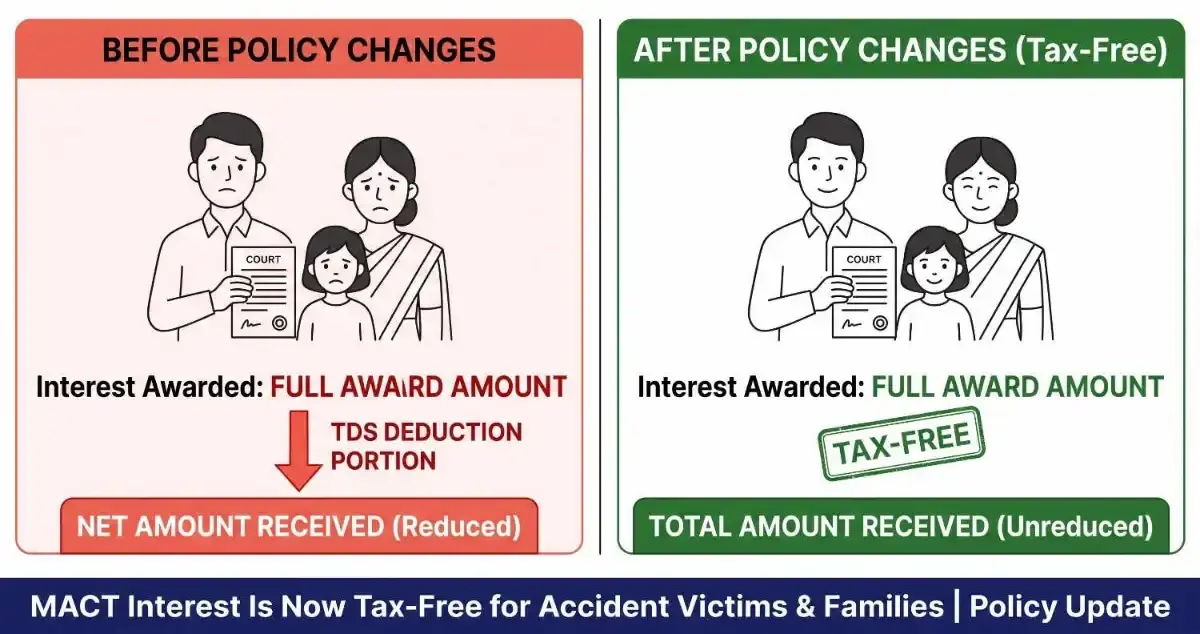
MACT interest income TDS exemption 2026 explained: who qualifies, old vs new Act rules, the FD interest trap, refund steps, and how to report it in your ITR.
Jul 24, 2026