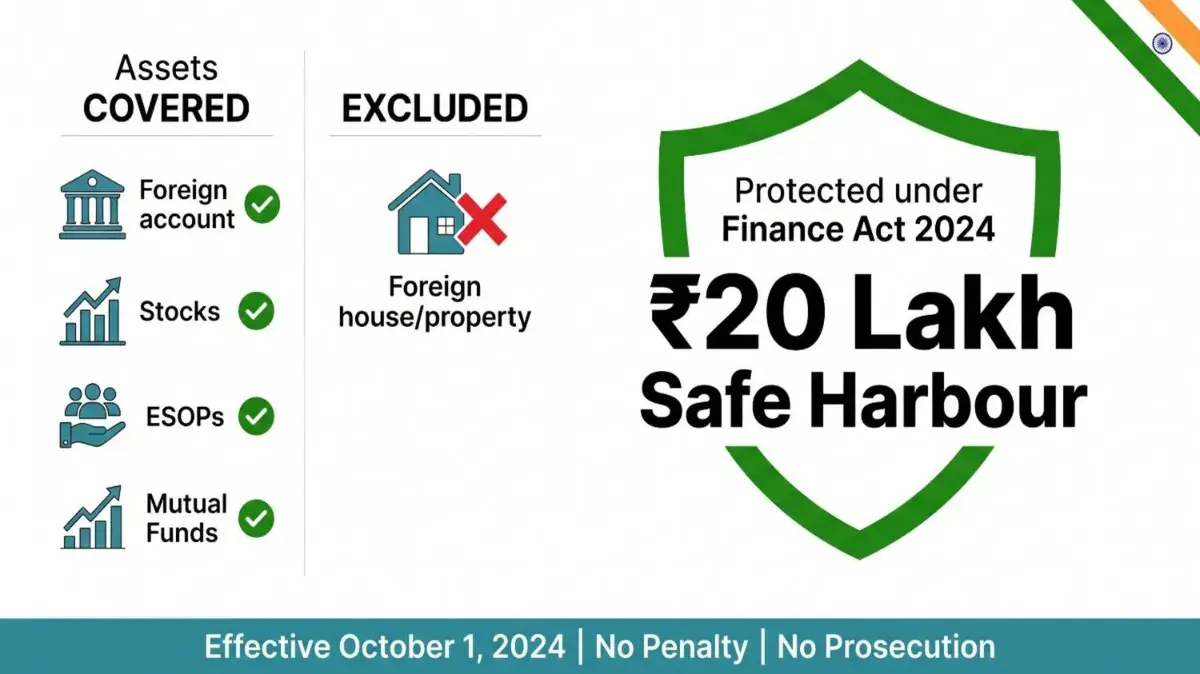

Foreign assets below ₹20 lakh: penalty under the Black Money Act is waived since Oct 2024, but Schedule FA disclosure stays mandatory. Full 2025 rules.
If your foreign assets, other than property, add up to ₹20 lakh or less in a year, the Black Money Act won't fine you or send a notice for missing them. But you still have to report them in Schedule FA. Skipping the disclosure and skipping the penalty are two very different things, and mixing them up is where most people go wrong.
It's a relief clause under Sections 42 and 43 of the Black Money (Undisclosed Foreign Income and Assets) and Imposition of Tax Act, 2015 (BMA). If your undisclosed foreign assets, excluding immovable property, add up to ₹20 lakh or less at any time in the year, the ₹10 lakh penalty doesn't apply. Since 18 August 2025, a CBDT instruction extends that same relief to prosecution under Sections 49 and 50.
In short: your duty to disclose never goes away — only the punishment for missing it does, and only up to that limit. The BMA sits outside the Income-tax Act, so it's untouched by India's move from the 1961 Act to the 2025 Act. Your duty to file Schedule FA comes from the seventh proviso to Section 139(1) of the Income-tax Act, 1961 — still the citation for AY 2026-27 returns. That proviso becomes Section 263 of the Income-tax Act, 2025 only from Tax Year 2026-27 onward.
Applies to | Does NOT apply to |
|---|---|
ROR individuals with foreign bank accounts, ESOPs/RSUs, brokerage holdings, or wallets like PayPal, Wise, or Payoneer | NRIs and RNORs — the BMA's own definition of "assessee" leaves them out, so no Schedule FA and no ₹20 lakh test at all |
Returning NRIs now ROR, holding small dormant foreign accounts | Anyone holding foreign immovable property, no matter how small its value |
IT professionals with vested ESOPs or RSUs from a foreign parent | Assets whose combined value crosses ₹20 lakh at any point in the year |
Students who studied abroad, still holding a small foreign balance | Non-residents earning only Indian-source income |
One partial case: if you were RNOR for part of the year and turned ROR partway through, the ₹20 lakh test only kicks in from the date you actually became ROR.
Here's how this Black Money Act ₹20 lakh threshold amendment actually played out, step by step:
Date | Threshold | What it covered | Source |
|---|---|---|---|
Up to 30 September 2024 | ₹5 lakh | Foreign bank accounts only | CBDT Instruction, 15 March 2022 |
From 1 October 2024 | ₹20 lakh | All foreign assets except immovable property | Finance (No. 2) Act, 2024, amending the proviso to Sections 42 and 43 of the BMA |
Prosecution relief, applied retrospectively from 1 October 2024 | ₹20 lakh | Same non-immovable assets | CBDT Instruction dated 18 August 2025, F. No. 285/46/2021-IT(Inv.V)/88 |
This CBDT foreign assets penalty waiver of 2024-25 is worth reading carefully, because three details trip people up every single time.
One, it's the total, not each asset on its own. Three dormant accounts worth ₹8 lakh each add up to ₹24 lakh together — over the limit — even though not one of them crosses ₹20 lakh alone.
Two, "at any time during the year" is the real test. The proviso doesn't just check your balance on 31 March or 31 December. A bonus RSU vesting that briefly pushes your total to ₹22 lakh in October, before it settles back to ₹15 lakh by year-end, may still count as a breach for that year [VERIFY: whether CBDT tests the peak value during the year or the value on one fixed date — the instruction text doesn't spell out a method].
Three, immovable property is never included. A foreign flat worth even ₹2 lakh still needs to go into Schedule FA, and skipping it still draws the full ₹10 lakh penalty. This is the exception people miss most often, and it's the one that catches out returning NRIs the hardest.
Asset type | Covered by the ₹20 lakh safe harbour? |
|---|---|
Foreign bank accounts (savings, current, FD) | Yes |
Vested ESOPs or RSUs in a foreign brokerage | Yes |
US stocks bought through Vested, Stockal, or similar apps | Yes |
PayPal, Wise, or Payoneer balances | Yes |
Foreign mutual fund units | Yes |
Foreign life insurance with cash value | Yes |
Signing authority on someone else's foreign account | [VERIFY: whether signing-authority-only interests count toward the aggregate, or are assessed separately — the BMA text doesn't say] |
Foreign immovable property (flat, house, land) | No — always excluded, always needs disclosure |
Falling under ₹20 lakh protects you from the BMA penalty and prosecution. It doesn't make your account invisible to the tax department. India gets account data every year from over 100 countries through the Common Reporting Standard and FATCA. A mismatch between that data and your ITR can still trigger a notice — you just won't face a penalty once you show the value stayed under ₹20 lakh. Filing correctly the first time avoids that notice altogether.
Once you've confirmed your accounts sit under this safe harbour, Toolisky's foreign interest income tax calculator works out exactly what tax is due on any interest they earned during the year.
Example 1 — the common case. Suresh, a software engineer in Bengaluru, spent eight months on a client project in Germany. He still holds a dormant German bank account with €1,200 in it, plus 100 vested RSUs from his employer's US parent company, currently worth $85 each.
German account: €1,200 × ₹90/EUR = ₹1,08,000
RSUs: 100 × $85 × ₹87/USD = ₹7,39,500
Aggregate non-immovable value: ₹8,47,500
That's comfortably under ₹20 lakh. Even if Suresh's CA missed Schedule FA last year, no ₹10 lakh penalty applies, and there's no prosecution either. He should still go back and correct the return, though, because the disclosure duty itself was never waived — only the punishment for missing it.
Example 2 — the edge case competitors skip. Priya moved back from the UK last year and is now ROR. She holds $600 in a dormant PayPal balance, £350 in a Wise account, and a small flat in Leeds she inherited from her grandmother, worth £45,000.
PayPal: $600 × ₹87/USD = ₹52,200
Wise: £350 × ₹110/GBP = ₹38,500
Non-immovable total: ₹90,700 — well under ₹20 lakh, protected
Leeds flat: £45,000 × ₹110/GBP = ₹49,50,000 — immovable property, excluded from the safe harbour no matter its value
Priya's PayPal and Wise balances are safe even if she forgets to disclose them. Her flat isn't. She has to report it in Schedule FA every year she owns it, or she's exposed to the full ₹10 lakh penalty and possibly prosecution. On the flat, the foreign assets below ₹20 lakh no-penalty rule offers zero protection, whatever its value.
List every non-immovable foreign asset you held during the year: bank accounts, vested ESOPs or RSUs, brokerage holdings, digital wallets, and foreign mutual fund units.
Convert each one to INR using the SBI TT buying rate. Schedule FA runs on the calendar year, so the usual reference date is 31 December of the year you're reporting, not 31 March.
Add up all the non-immovable assets together. Keep foreign property out of this total and track it on its own, since it always needs disclosure regardless of value.
Check if the total crossed ₹20 lakh at any point in the year, not only at year-end. A mid-year bonus vesting or a one-off transfer counts too.
If the aggregate stayed at or under ₹20 lakh all through the year, you're covered for both penalty and prosecution relief — but Schedule FA disclosure is still required.
If it crossed ₹20 lakh even once, the full BMA penalty and prosecution exposure applies for that year, on the entire value, not just the portion above ₹20 lakh.
You never filed Schedule FA for a past year, and your assets were under ₹20 lakh. File a revised return under Section 139(5) for AY 2025-26 before 31 December 2025, or check the correct ITR form to use — ITR-1 and ITR-4 don't carry Schedule FA, so any foreign asset at all means you need ITR-2 or ITR-3.
Your aggregate crossed ₹20 lakh briefly, and you're not sure if you're covered. Don't assume the relief applies just because your year-end number looks low. Get a CA to check the peak value against the BMA proviso, or look into FAST-DS 2026 once the government notifies its start date.
You hold both a small bank balance and a foreign property, and only disclosed the account. Foreign property is never covered by the ₹20 lakh rule, full stop. Amend your return to add it right away — this is one of the most common gaps CAs find on review, and it carries the full ₹10 lakh exposure for every year it's missed.
Document | Digital copy okay? | Where to get it |
|---|---|---|
Foreign bank account statements | Yes | Your foreign bank's net-banking portal |
ESOP or RSU vesting and brokerage statements | Yes | Your employer's stock plan portal, or your broker |
PayPal, Wise, or Payoneer transaction history | Yes | The respective app or website |
SBI TT buying rate records for each conversion date | Yes | |
Property deed or inheritance papers, if you hold foreign property | Yes | Your own records, or the property registrar in that country |
PAN and copies of prior years' ITRs | Yes |
Non-disclosure above ₹20 lakh (non-immovable), or of any foreign property at all: a flat ₹10 lakh penalty per year under Sections 42 and 43 of the BMA, whether or not any tax was actually due.
Undisclosed foreign income or asset value never brought to tax: 30% flat tax plus a 90% penalty — 120% total exposure, with no deductions of any kind.
Prosecution: 6 months to 7 years under Sections 49 and 50, unless the asset (excluding property) stayed under ₹20 lakh for the whole year, per the CBDT's 18 August 2025 instruction.
Wrong or incomplete entries in Schedule FA — the wrong table, missing fields — carry the same ₹10 lakh exposure as leaving it out entirely.
Yes, and this is the biggest misconception around this whole rule. Being under ₹20 lakh waives the penalty and the prosecution risk under the Black Money Act. It does not waive Schedule FA disclosure, which is a separate requirement under the Income-tax Act.
Foreign bank accounts, vested ESOPs and RSUs, brokerage holdings, foreign mutual funds, and wallets like PayPal or Wise. Foreign immovable property is excluded from this exemption and must always be disclosed.
In total. It's the combined value of every non-immovable foreign asset you hold, added together — not a separate ₹20 lakh allowance for each account or holding.
No. Foreign immovable property — a flat, a house, a plot of land — sits outside this relief entirely, no matter how small its value, and it always needs disclosure in Schedule FA.
ITR-1 doesn't support foreign asset disclosure at all. Holding any foreign asset means you needed ITR-2 or ITR-3 instead. File a revised return in the correct form, even though your penalty exposure is likely nil given the low value.
RNOR taxpayers don't even need this rule to protect them — the BMA's definition of "assessee" leaves RNOR individuals out entirely. The ₹20 lakh test and Schedule FA only start applying once you become full ROR.
Convert every non-immovable foreign asset to INR using the SBI TT buying rate, add them all up, and check if the total crossed ₹20 lakh at any point in the year — not only on 31 December.
The ₹20 lakh rule is automatic, ongoing relief that needs no application. FAST-DS 2026 is a one-time, six-month window meant to regularise past non-disclosure above that threshold, once it's formally notified.
Quite possibly. India receives account data from over 100 countries through CRS and FATCA every year. Staying under ₹20 lakh protects you from penalty if flagged, but it doesn't make the account invisible in the first place.
The proviso tests the value "at any time during the relevant year," so a brief spike above ₹20 lakh may still expose you for that year [VERIFY: exact peak-value methodology; get this confirmed with a CA for your specific numbers].
Yes. Once vested and sitting in a foreign brokerage account, they count as a non-immovable foreign asset and go straight into the aggregate calculation with your other holdings.
Each year gets assessed on its own. If every single year's aggregate stayed under ₹20 lakh, none of those years attract the ₹10 lakh penalty. File revised or belated returns for whichever years are still open, and keep an eye on FAST-DS 2026 if any year involved undisclosed foreign income above the limit.
List every foreign account, ESOP, and property you hold, convert each one to INR using the SBI rate, and add up everything except the property. Staying under ₹20 lakh means you're safe from penalty, but Schedule FA still has to be filed. Check the correct ITR form for your situation, and get your numbers confirmed by a CA before you submit — that's really the whole foreign assets below ₹20 lakh no-penalty rule in practice.
For educational purposes only. Verify all figures at official sources before acting. Toolisky is not affiliated with any government body. Consult a qualified CA or legal professional before making compliance decisions. See toolisky.com/accuracy-and-limitations.
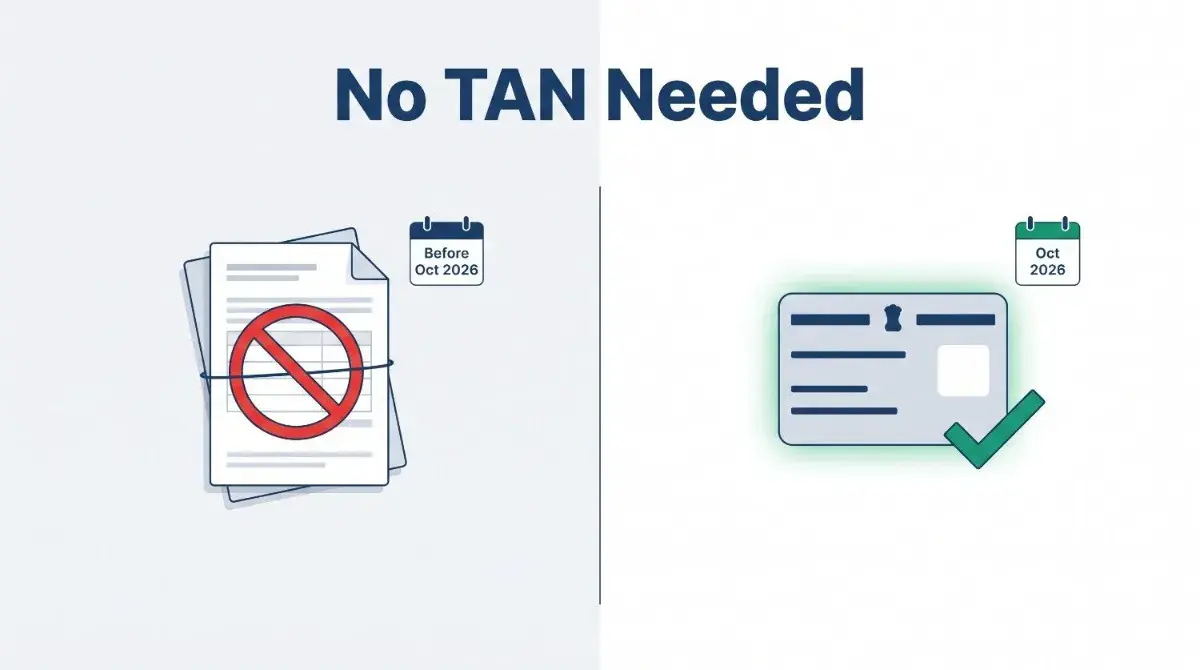
No TAN for NRI property purchase applies only from 1 October 2026, and only to resident individual and HUF buyers. Get the rates, forms, and dates you need.
Jul 25, 2026

Did you lose the SGB premature redemption tax exemption? Here's exactly who's affected, how much tax applies now, and how to check your own bonds.
Jul 24, 2026
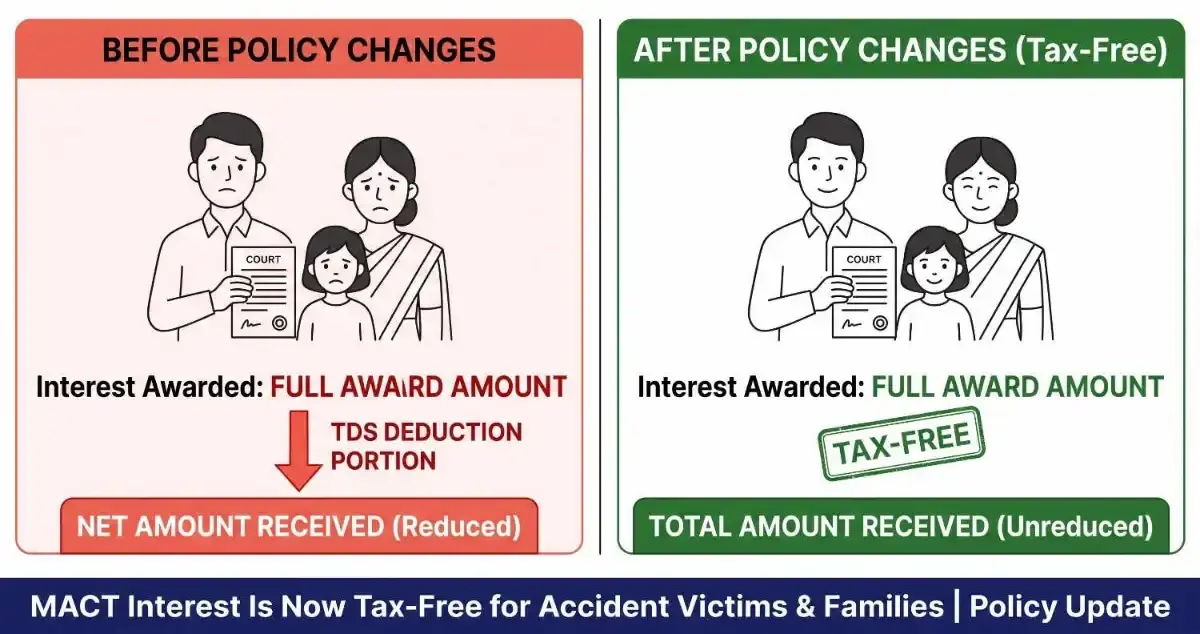
MACT interest income TDS exemption 2026 explained: who qualifies, old vs new Act rules, the FD interest trap, refund steps, and how to report it in your ITR.
Jul 24, 2026